
In 1823 Slang, A Dictionary of the Turf, the Ring, the Chase, the Pit and of Bon-Ton and the Varieties of Life… by ‘Jon Bee, Esq.’ appeared in print.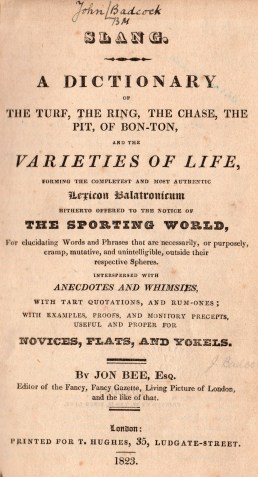
John Bee was actually the pseudonym of John Badcock, a sporting writer and contemporary of the much more famous Pierce Egan, for whom he appears to have felt intense antagonism.
This was an era of popular slang dictionaries, the most well-know of which was Grose’s The Vulgar Tongue, and in the same year as ‘Jon Bee’s’ effort Egan produced what he said was the third edition of Grose, although it was more of a straight lift with some additions.
Bee’s dictionary, as well as including a vitriolic attack on Egan in the preface, contains many quite discursive and highly prejudiced definitions and I was entertained by his descriptions of gentlemen of fashion.
At the pinnacle of well-dressed sporting gentlemen is the Corinthian:
A man highly togged was so termed, by reason of the supereminence of that order of architecture. In process of time (1761), the term was applied to superlative articles of dress… We would confine the word to nobility and gentry of education, who join heartily in the sports of the turf or the ring, the latterly particularly: but well-dressed prigs assume the envied name, or seedy sordid knaves, who have no soul for those things.
Corinthians must, by definition be Gentlemen:
None can be considered a true English gentleman by us, who has not stored his mind with English lore, spells every word rightly, and is capable of forming a sane off-hand judgment upon every subject that may come upon the carpet.
And they are undoubtedly Pinks:
One above the common run of mankind in his manful exertions is a pink.
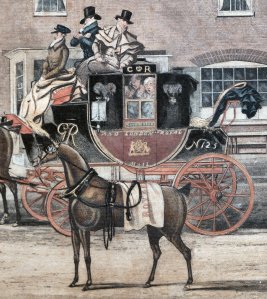
(left) A Corinthian in his many-caped greatcoat waits atop the mailcoach for an opportunity to take the ribbons and ‘wagon it’.
Rather less impressive than the Corinthian, but related, is the Swell:
A man highly dressed, in white upper tog* and lilly shallow**, (for example,) is a swell, however circumstanced in pocket; but to keep up the name he must lay out his blunt freely; bet, and swear ‘damme, Sir.’ If he does not fight, at least he ought to know how, and take lessons – or give them. No fighting man by profession can be a swell, he is a tulip, if he dresses thereafter, and looks swellish: – ‘tis esteemed the first grade towards Corinthianism, which he can never reach by any possibility whatever. No man who ever performed any duty or service for hire (except doctors, lawyers, parsons, and statesmen) can possibly be a real swell, certainly not a Gentleman, most indubitably not a Corinthian.
*Upper tog – a great coat ** Lilly shallow – a white, low-crowned driving hat
So who is this lesser-ranking Tulip?:
Fine habiliments of various colours and strong ones, compose the tulip… Tulips compared with Swells are what gilt gingerbread is to a gilded sign-board; the one fades soon, the other is at least intelligent to the last.
A variety of Tulip is a Gillyflower:
None can be a gillyflower, who does not wear a canary* or belcher** fogle*** round his twist****: if he put up many more colours, he becomes a tulip.
*Yellow ** yellow silk handkerchief with a little white & black. Named for Jem Belcher the pugilist *** a silk handkerchief **** neck
But what about Dandies?
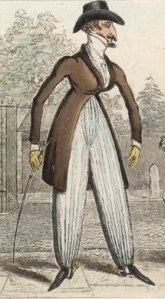 An invention of 1816, and applied to persons whose extravagant dress called forth the sneers of the vulgar; they were mostly young men who had this designation, and they were charged with wearing stays – a mistake easily fallen into, their wide web-belts having that appearance. Men of fashion became dandy soon after; having imported a good deal of French manner in their gait, lispings, wrinkled foreheads, killing king’s English, wearing immense pleated pantaloons, the coat cut away, small waistcoat, with cravat and chitterlings* immense: Hat small; hair frizzled and protruding. If one fell down he could not rise without assistance. Yet they assumed to be a little au militaire, and some wore mustachios. Lord Petersham was at the head of this sect of mannerists.
*Shirt frills
Above: Lord Petersham and his eponymous trousers
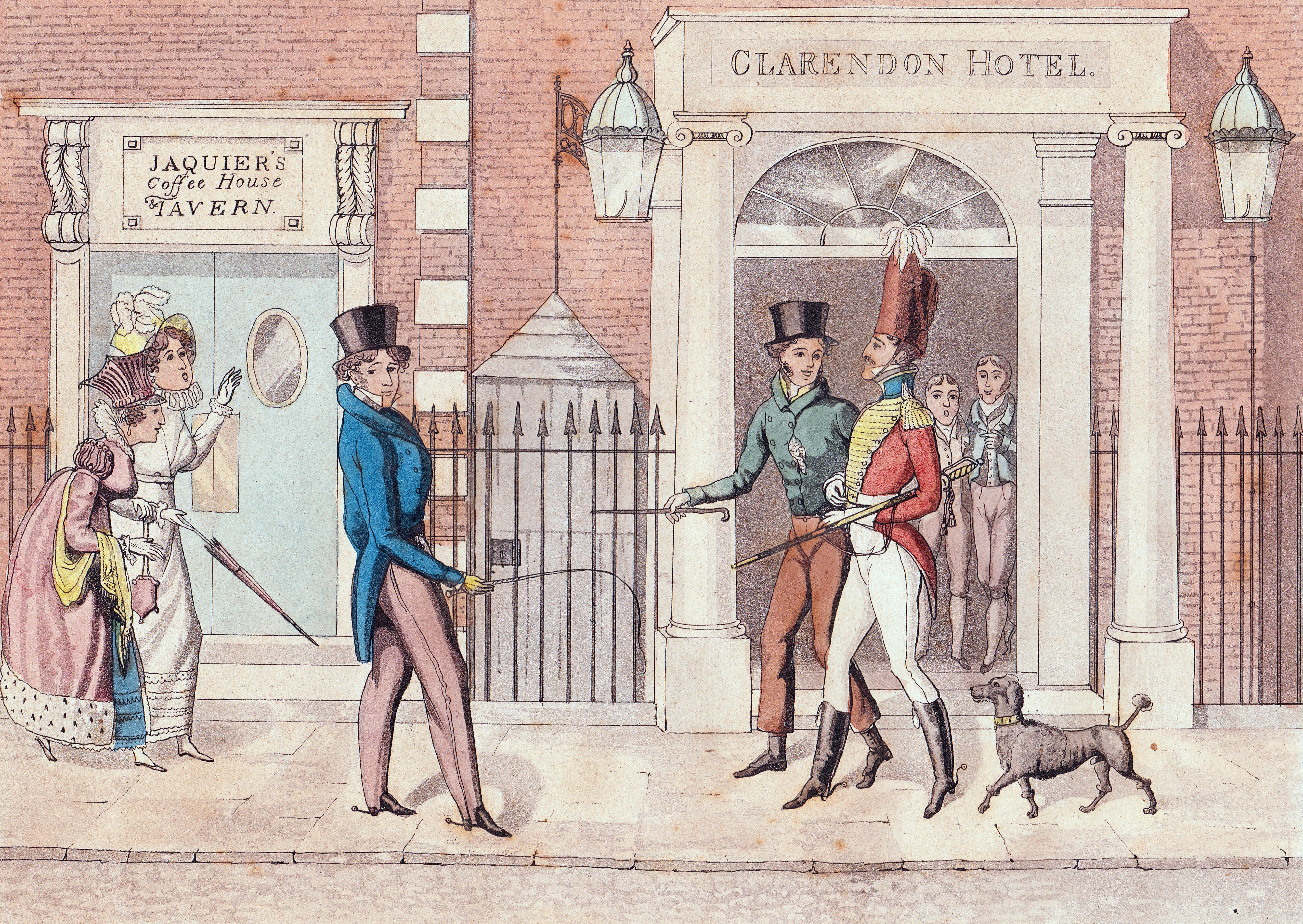
Our Dandy may very well be seen with his female counterpart – the Dandyzette – on his arm:
Her characteristics were, a large poked bonnet, short petticoats much flounced, and paint. When she walked she kept the step with her Dandy, as if they had been drilled together in Birdcage-walk.
And finally those ancestors of the modern Kidult – the Kiddy:
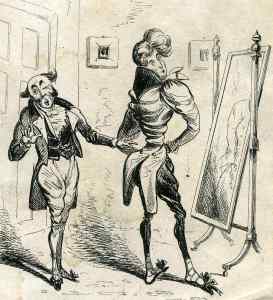 Kid, Kiddy and Kidling implies youth; but an old evergreen chap may be dressed kiddily, i.e. knowingly, with his hat on one side, shirt-collar up on high, coat cut away in the skirts, or outside breast-pockets, a yellow, bird’s-eye-blue , or Belcher fogle*, circling his squeeze**, and a chitterling shirt*** of great magnitude protruding on the sight, and wagging as its wearer walks. These compounded compose the kiddy; and if father and son come it in the same style, the latter is a kidling.
*Yellow or blue-spotted or black-spotted yellow silk handkerchief ** neck or throat *** large shirt-front frills
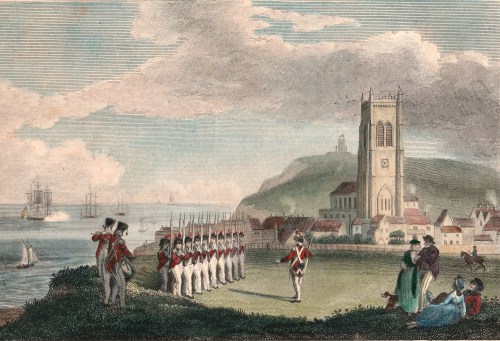
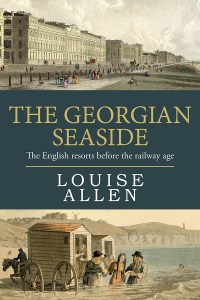 hand the sea-water cure sounds as though it would be helpful for what ails him. His wife keeps leaving prints of craggy cliffs and tossing waves about, so he supposes it would keep her happy and the rest of the family seemed keen enough. He would think on it.
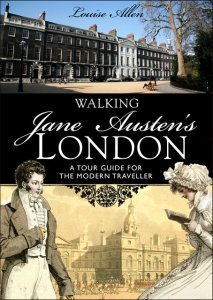 and admire Wordsworth’s view in Walk 6, of
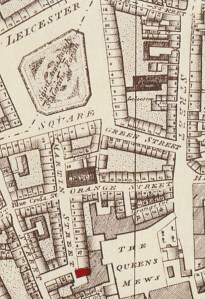

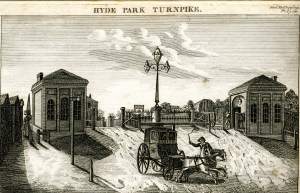 dent at the gates for giving her sister-in-law Eliza a chest cold. ‘The Horses actually gibbed on this side of Hyde Park Gate – a load of fresh gravel made it a formidable Hill to them, & they refused the collar; I believe there was a sore shoulder to irritate. Eliza was frightened, & we got out & were detained in the Eveng. air several minutes.’ You can follow Jane’s London travels in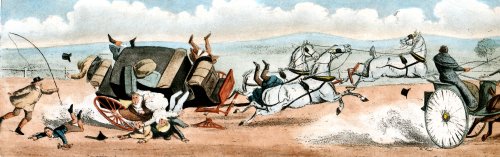
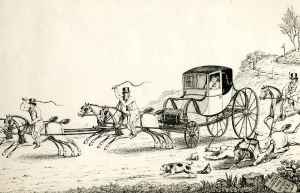
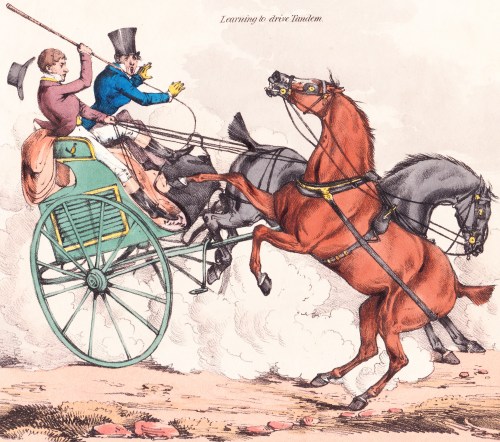 Alken shows a young gentleman who has got one of his pair turned around and one wheel off the road. The vehicle is a cocking cart used to transport fighting cocks and below the seat is a compartment ventilated by slats and a small image of a fighting cock on the armrest. In The Remains of a Stanhope (1827) the crash has already occurred, showing just how fragile these vehicles could be. A carpenter has been summoned and the owner is drawling somewhat optimistically, “I say my clever feller, have you an idea you can make this thing capable of progression?”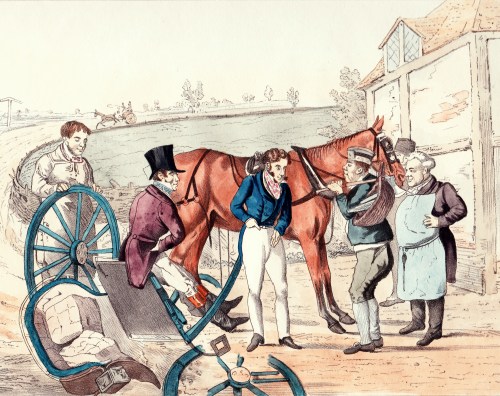
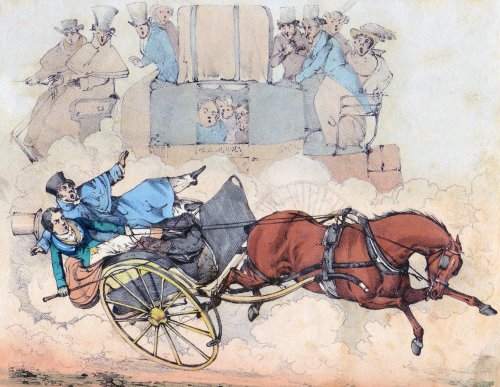
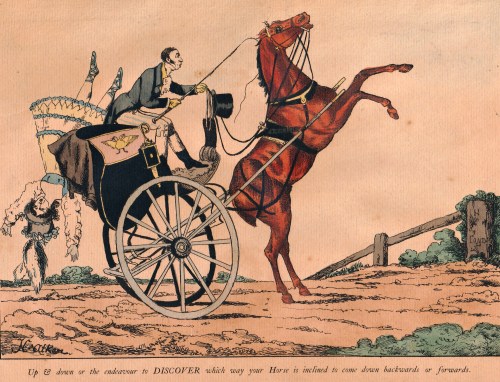
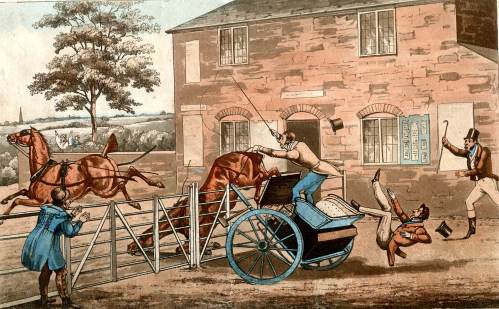 Young men crashing their vehicles was obviously commonplace, and then as now, showing off to the ladies was also part of the joy of owning a sporting vehicle. Alken was not above titillating his audience with a glimpse of petticoat or a shapely leg, even when the owner of the leg was about to get seriously hurt. In “Up and down or the endeavour to discover which way your Horse is inclined to come down backwards or forwards” (1817) the driver takes no notice at all of his fair passenger vanishing over the back of his fancy carriage. There are some nice details in this print – the two-headed goose on the side panel is presumably a reference to the driver not knowing which way he is going and the luxurious sheepskin foot rug is clearly visible.
  In the same series is an awful warning about the dangers of not choosing your horses with care. Captioned “Trying a new match you discover that they are not only alike in colour weight & action but in disposition.” One young man is heading out over the back of the carriage while his companion is poised to leap for safety amidst flying greatcoats, hats and seat cushions.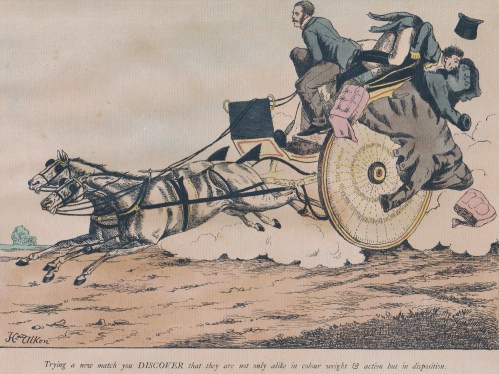







 Jane Austen's London