A Fishy Business – Billingsgate Market

The New Family Cookery or Town and Country Housekeepers’ Guide by Duncan MacDonald (1812) begins its General Directions for Marketing with fish and with Billingsgate Market:
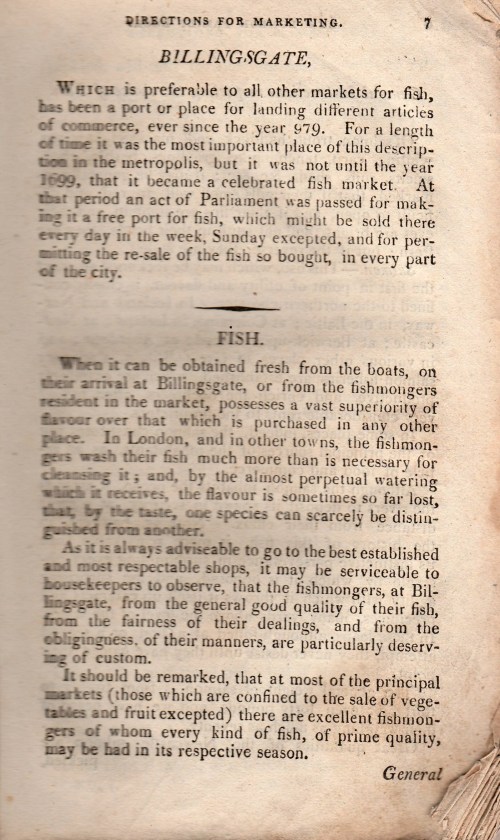
The comment in the penultimate paragraph is ironic, considering Billingsgate’s colourful reputation! When I was researching for my book Regency Slang Revealed I discovered that to talk Billingsgate meant to use particularly coarse and foul language.
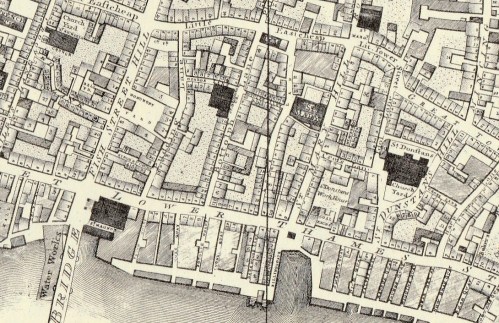
Billingsgate Market was sited at the foot of Lower Thames Street from at least the 10th century until it was moved to the new market site on the Isle of Dogs in 1982. The first set of toll regulations covering it dates from 1016 and by the time of Elizabeth I it was dealing in corn, malt, salt and vegetables, although fish was always the main reason for its existence at the highest point where fish could be unloaded straight from the boats before London Bridge. It can be seen in Horwood’s map of London (c1800) below with the deep indentation of the dock taking a bite out of the waterfront and London Bridge on the left. This dock vanished with the Victorian rebuilding of the market in 1850. That building proved inadequate and was replaced with the present handsome structure by Sir Horace Jones, opened in 1877. It was refurbished after the closure and is now used for various commercial purposes. During the 1988 work extensive remains of the late 12th century/early 13th century waterfront were revealed.
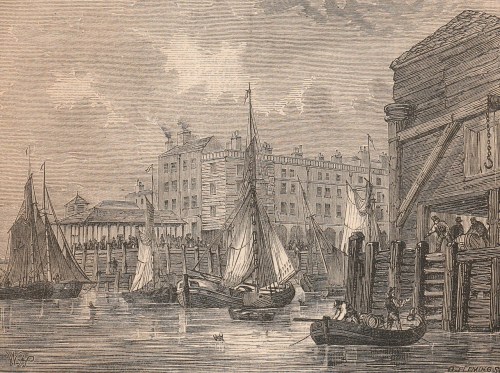
The engraving from a print of 1820 shows the view of the dock from the river. At this date there was no covered market building, simply stalls and tables set out around the dock. In the days before a ready supply of ice dealers would come into Billingsgate from places within about twenty five miles – an outer ring that included Windsor, St Albans and Romford – and fish was sold in lots by the Dutch auction method where the price falls until a buyer is found. Many of the fish were caught in the Thames and in 1828 a Parliamentary Committee took evidence that in 1798 there were 400 fishermen, each owning a boat and employing one boy, who made a good living between Deptford and London catching roach, plaice, smelts, flounders, shad, eels, dudgeon, dace and dabs. One witness stated that in 1810 3,000 Thames salmon were landed in the season. By the time of the Commission,eighteen years later, the fishery had been destroyed by the massive pollution of the river from water closets and  the waste from gas works and factories that went straight into the river.
It was the fishwives of Billingsgate who became its most notorious feature. They were tough women, as they needed to be to thrive in such a hard, competitive business, and they did not shrink from either physical violence or colourful language. In Bailey’s English Dictionary (1736) a “Billingsgate” is defined as “a scolding, impudent slut.” Addison referred to the “debate” that arose among “the ladies of the British fishery” and Ned Ward describes them scolding and chattering among their heaps of fish, “ready enough to knock down the auctioneer who did not knock down a lot to them.”

The women of Billingsgate were an inevitable attraction to young bucks and gentlemen slumming, as the two prints below show. The top one is a drawing by Henry Alken for the Tom and Jerry series – “Billingsgate: Tom and Bob taking a Survey after a Night’s Spree.”  Below that is “A Frolic: High Life or a Visit to Billingsgate” from The London Spy.
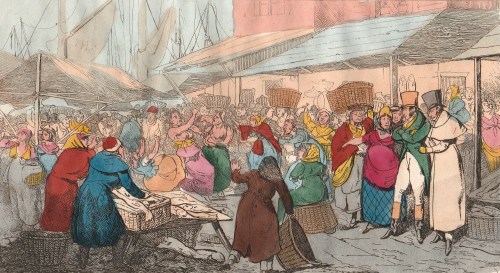
Here two sporting gentlemen stand out in the crowd of working people as they watch a fight that has broken out between two bare-breasted fishwives. Another has just been knocked to the ground. Amongst the details note the woman sitting on a basket smoking a clay pipe, another (far left) taking a swig from a bottle and the porter’s hat on the man in the centre foreground with its long ‘skirt’ to protect the neck.

This print below is not dated, but as there is the funnel of a steam boat in the background amongst the masts it is probably 1820s.
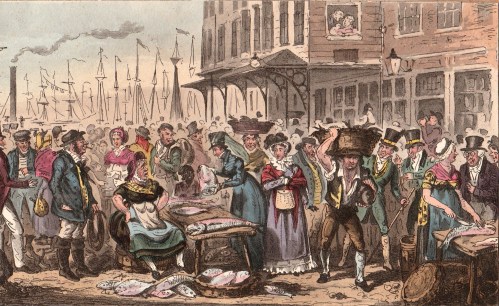
Here a determined-looking lady in a riding habit, her veil thrown back and her whip under her arm, is negotiating the sale of a large fish head. Behind her is a smartly-dressed woman, perhaps a merchant’s wife, and an elderly gentleman in spectacles is talking to another fish seller on the far right. There are two men in livery, perhaps accompanying the lady in the riding habit. The man standing behind the seated fishwife is a sailor, judging by his tarred pigtail, and the porter walking towards us is wearing one of the black hats whose ‘tail’ can just be glimpsed over his shoulders. It is all fairly orderly and respectable, despite the crowd (and the smell, no doubt) but a hint to the other activities in the area may be the couple in the window!


Save

Save

Save

Save

Save

Save

Save

Save

Save

1 Comment

Filed under Buildings, Food & drink, Rivers, Shopping, Street life, Women, working life

Keeping a Diary – and a lady who didn’t

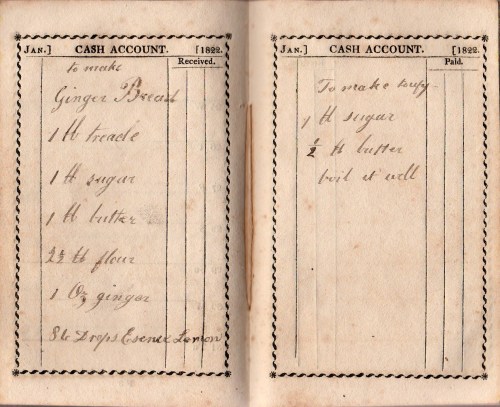
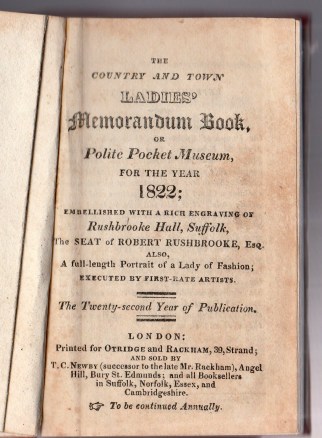
I recently deposited my late father’s 40+ years-worth of diaries with the Great Diary Project , an incredible undertaking to preserve diaries of all kinds.  It made me think about keeping a diary – and how many good resolutions there must be to do just that which are never fulfilled. Which reminded me that I own a ladies’ memorandum book for 1822 –  and the owner didn’t use it either.

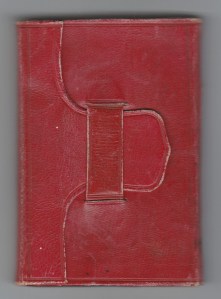
The book is beautifully bound in plain red Morocco leather with a tab to keep the covers closed and measures just over 4.5 x 3.25 inches.

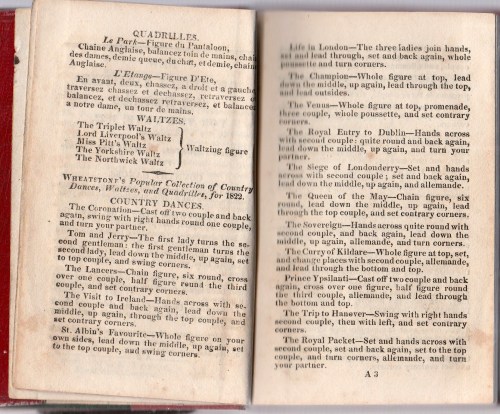
But even though it contains no fascinating insights into the daily life of a lady in 1822 it is a lovely item in its own right, and it does contain two handwritten recipes and a mass of other useful printed material including “New Songs and Melodies”, instructions for country dances and quadrilles, the price of stamps and “Enigmas, Charades and Rebuses.”

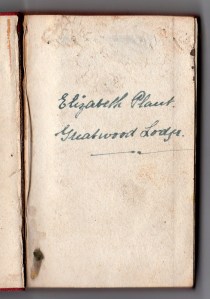
The diary belonged to “Elizabeth Plant. Greatwood Lodge.” I did not have much confidence that I could find her – but an on-line transcript of a deed appointing Thomas Plant “Farmer of Greatwood Lodge in the parish of Eccleshall in the county of Staffordshire” as a trustee in 1879 gave me the parish. Greatwood Lodge is still there, a red-brick farmhouse that was perhaps quite new in Elizabeth’s time, and still a farm.

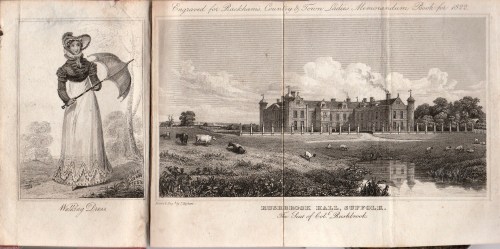
The frontispiece has a fashion plate and a view of a fine country house in Suffolk

As the frontispiece says the diaries were sold by a Bury St Edmund’s bookseller and throughout East Anglia the choice of a Suffolk house was probably for marketing purposes. Perhaps Elizabeth received it as a gift from a friend or relative.

I wonder if she took the picture of the walking dress to her local dressmaker, or even attempted it herself – and did she and her friends try out the country dances the book contained?

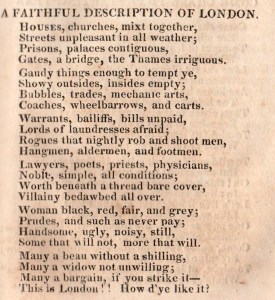
Amongst the poems I particularly like this cynical view off London – perhaps intended to convince the country-dwelling owners of the diary that they were in the right place:

The only things that Elizabeth wrote in her diary were two recipes, one for gingerbread and one for “toufy” or toffee, both on the accounts page for January. The  gingerbread sounds tasty!

Save

Save

Save

3 Comments

Filed under Domestic life, Entertainment, Fashions, Food & drink, Women

A Georgian Parlour Game

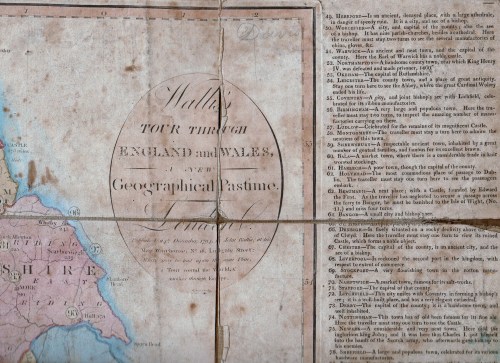
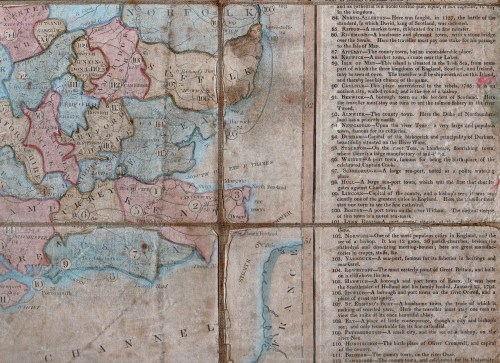
The Georgians were great believers in educational games and I own a battered and much-used copy of one of them – Wallis’s Tour Through England and Wales: A New Geographical Pastime, published in London in 1794.

The whole game measures approximately 500 x 630mm (20 x 26 inches) and is made up of 16 sections glued to a flexible backing. It folds up neatly into a slipcase approximately 175 x 140cm (7 x 4.5 inches). The slipcase has an imposing image of scrolls, flags and military drums on it, but it has had such a hard life that it is impossible to scan. There was another version of the game for Europe (on sale on the internet at over £1,000, I see) and one for the whole world. Unfortunately I doubt my battered copy of England and Wales is worth anything like that!

The same plate was also stuck onto wood and cut out so that each county formed a piece of a jigsaw – or dissected puzzle as they were known at the time. The children of George III played with these puzzles which survive at Kew Palace and can be seen here.

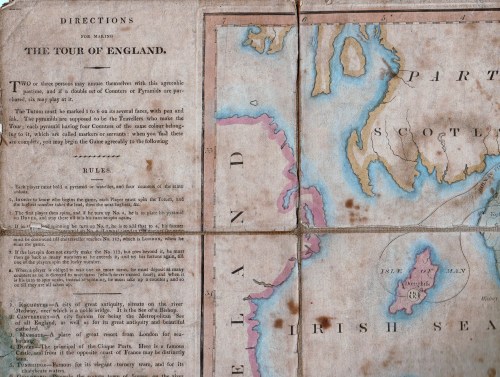
The instructions tell us that 2 to 6 “may amuse themselves with this agreeable pastime” for which they will need a “totum” and a pyramid (presumably some kind of marker) and four counters per player, each set in a different colour. A totum was a teetotum, a spinning top with a variable number of faces. I can recall making one as a child out of card cut as a polygon with a cocktail stuck through the centre. There are some lovely ones illustrated on this website.

Players spin the totum and the highest score starts. With their first score they place their pyramid on the corresponding town – 1, for example, would land them at Rochester. On their next turn they move on the number of towns they have scored – say 6 –  which would give them 7 and they can then move to Lewes, number 7 on the map. The winner is the first to reach London with exactly the right number. If a player exceeds the right number then he has to count backwards from London.

Each numbered town has a short description in the margins and some of these have a delay  involving missed turns. When a player lands on one of those they must deposit the stated number of counters and have to miss the next turn, or turns, until they have collected them back up again. (see 50. Worcester, in the top right hand corner of the first image). Presumably each player would be expected to read out the description of the towns they land on for the instruction of all the participants.

If you landed on 89, The Isle of Man, you would be shipwrecked and out of the game!

7 Comments

Filed under Domestic life, Education, Entertainment, Maps

Every Home Should Have One – An Ottomane Couch

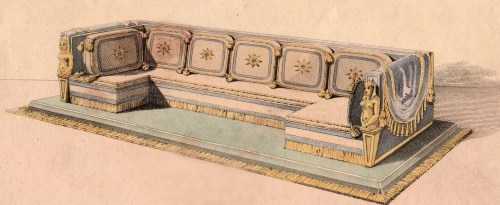
Rummaging in the treasure trove of prints I bought recently I found this from Ackermann’s Repository of Arts (July 1814). It is captioned “Design for an Ottomane [sic] Couch” although I doubt whether any citizen of the Ottoman Empire would recognise it!

otomane-couch

It is obviously designed for a very large house and it looks decidedly uncomfortable – but fashion overrides comfort, presumably. I’m at a loss to identify ‘Ottoman’ influences – the two half-figures of naked women look decidedly Egyptian in origin.

If it was mine I think I’d be worried about male guests dangling a hand over the end and groping the ornaments…


Save

Save

Save

Save

Leave a comment

Filed under Domestic life

The Cock and Pie Public House – “A Specimen of Ancient Architecture.”

cock-pie-drury-lane

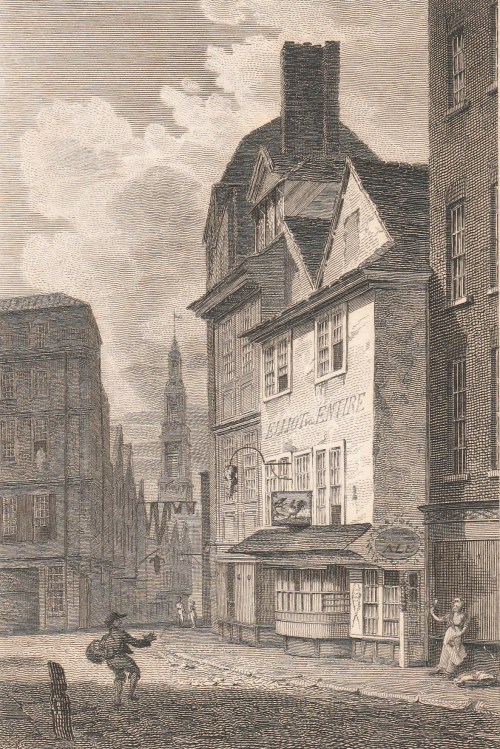
This print “View of the Cock & Pie Public House in Drury Lane” was published in 1807 as the frontispiece to volume 52 of The European Magazine. I was amused by the heading “Specimen of ancient architecture” making it sound as though the Druids, at least, were responsible for it! It isn’t easy to work out just how old it is – certainly 17th century, I imagine. It is said that it was where Nell Gwynne had her lodgings and where Samuel Pepys once saw her standing at the door.

I have been trying to place it along Drury Lane but with no success. It is certainly on the western side because one of the churches in the Strand to the south can be clearly seen at the end. The British Museum notes on their copy of the print that this is St Clement Dane, but I’m not convinced. Looking at maps of the time it seems more likely to be St Mary-le-Strand which stood opposite the end of Drury Lane.

The detail is fascinating. This was not a very respectable area, close to Covent Garden and the theatres (Nell Gwynne again!), and the gentleman walking away from us with a bundle on his shoulder is recoiling in surprise (disgust?) as the on the other side of the street woman toasts him with a wine glass. She is slumped drunkenly against a shop front, a basket of plucked chickens at her feet. Perhaps it was gin in that glass. The odd shape hanging in front of the inn is a bush, or bundle of greenery, the sign for home-brewed liquor being available that stretches back to Roman times. “ELLIOT & Co’s ENTIRE” is painted across the front and translating this took me into the history and mythology of ale, beer and porter making.

According to the Brewery History website which explains all this in exhaustive detail, “Entire, or “intire”, was an expression used by brewers to indicate a beer where the first, second and third mashes had been mixed and fermented together to make one grade of beer, rather than brewed separately to produce three different-strength beers…” This is another name for porter, as opposed to stout, a strong beer made from the first mash, which was the strongest. (If you want to be further confused with the different terms for beer and ale, have a look at my Regency Slang Revealed where I identified over thirty terms for ale and beers.)

The inn sign itself shows a cockerel on the ground and a magpie perched on a branch, a literal depiction of the name. Victorian writers maintain that this is a corruption of “Peacock in Pie” referring to the great banquet dish. Drury Lane was also a cock-fighting area and the cock may reflect that. (An area to the north-west of Drury Lane where St Martin’s Lane  met Long Acre and which became the notorious slum of Seven Dials, is shown on William Morgan’s map of 1682 as “Cock and Pye Fields” – it may have the same derivation.)

cock-pie-1840-2

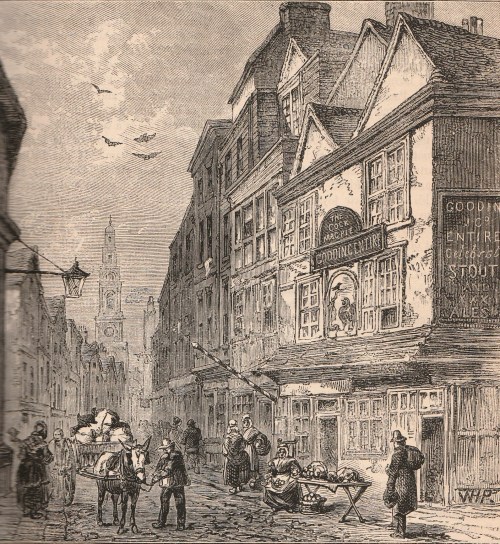
By the time  Old and New London (Edward Walford 1874) was published the building was still standing, although by then it had become “Stockley’s Cheap Bookshop”. The print of 1840 from that book, shows it when it was still a tavern, and indicates how buildings were constantly being adapted and changed. The middle upstairs window has been closed off and the sign is now on that bit of wall, the bush is no longer being displayed and the sheltering overhang over the ground floor front has been continued around the side. It is now “Gooding & Co’s Entire Celebrated Stout and XXX [ie strong] Ales” that are advertised for sale and the buildings on either side have also changed. A barber’s striped pole can be clearly seen and there is street lighting on the opposite building.

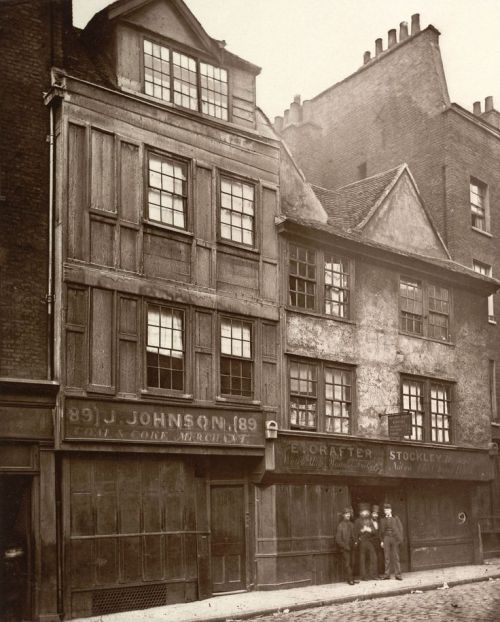
Finally here is a 19th century photograph of the poor Cock & Pie, now showing part of it as Stockley’s Bookshop. Does anyone know when Drury Lane was cleared and these old buildings swept away?

cock-pie-late-19thc


Save

Save

Save

6 Comments

Filed under Architecture, Buildings, Food & drink, Street life

In Like a Lion, Out Like a Lamb (or vice versa?)

march

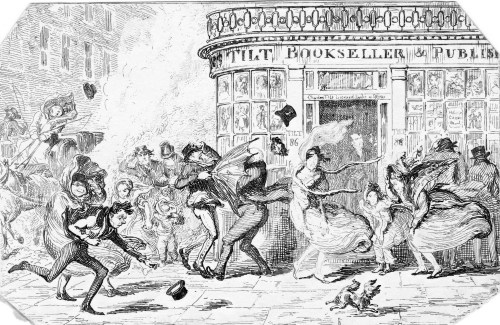
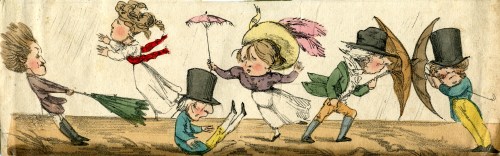
Cruikshank’s scene of chaos on the London streets in March is a reminder of just how variable March weather can be. Here’s another equally windy scene from my collection. The little watercolour sketch is undated and unsigned, but looks about 1820s to me.

windy-weather

So – keep tight hold of your umbrella – or remember that Beau Brummel considered that no gentleman would be seen with one and take a sedan chair instead.


Save

2 Comments

Filed under Street life, Weather

The Tower From the River

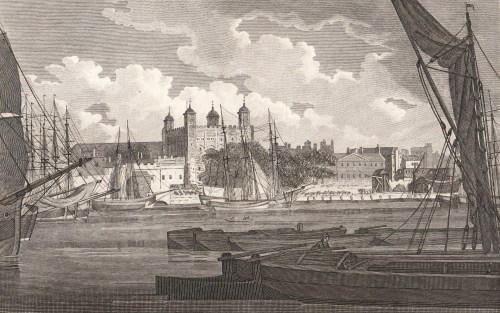
Just a short post today – but recently I went to see the exhibition about Emma Hamilton at the National Maritime Museum (stunning, by the way) and travelled by water bus between Greenwich and Westminster. We passed the Tower of London, of course, and it was interesting to compare the view today with this one of 1797.

tower

The biggest difference is the presence of the Embankment and the disappearance of the open space with the cannon to the right- presumably they belonged to the Board of Ordnance who were in the Tower. Now the approach road to London Bridge crosses close to this spot. The water gate, the entrance to Traitor’s Gate can be seen in the print as a crescent shape just to the left of the White Tower.

There are no crowds of tourists taking selfies in this image, but the amount of river traffic is surprisingly close – now it is tourist boats, river buses, the River Police and still quite a few barges and tugs. I wish I’d had this print with me!

Save

1 Comment

Filed under Architecture, Transport and travel, Travel, working life

A Ceremony Never Omitted Among the Vulgar

letter-on-balcony

“It is the ceremony…never omitted among the vulgar, to draw lots, which they term Valentines, on the eve before Valentine Day. The names of a select number of one sex are, by an equal number of the other, put into some vessel; and after that, everyone draws a name, for the present called their Valentine, and is look’d upon as a good omen of their being man and wife afterwards.” (Bourne Antiquitates Vulgares 1725)

lottery

By “the vulgar” Bourne means the common people, but Valentine’s Day customs appear to have appealed to all levels of society – and nations. In this French fan of the end of the 18th century young women have lots drawn by cherubs for the name of their lovers, each of which has a list of their virtues attached – one young man has none (hence the weeping female in the centre!), one has one virtue and so forth. The luckiest young lady – whose name is Clemence – scoops the jackpot and her lover will be handsome, brave, honourable, true… I found the fan at auction at the same time as I was writing The Piratical Miss Ravenhurst – the heroine of which is called Clemence. Naturally, the hero has to find the same fan in a shop and buy it for her.

John Brand in his Observations on Popular Antiquities (1813) quotes examples of names being drawn for Valentines and also of various ways of divining who your lover will be – for example taking five bay leaves, pining one to each corner of your pillow and one to the middle the night before the 14th and you would then dream of your beloved. The  sending of written Valentines or cards appears to have developed as the postal service improved at the end of the 18th century and the unimaginative male could turn to The Young Man’s Valentine Writer (1792) and copy out one of the sickly-sweet verses it contained.

small-kiss-biggerWhether you picked your bay leaves, sent a card or received a delightful verse – happy Valentine’s Day!
(The little detail of the kissing couple and the naughty young lady at the top of this post are from the French series of prints Modes et Manieres)

Save

7 Comments

Filed under courtship & marriage, Entertainment, Love and Marriage, Traditions

The Foundling Hospital

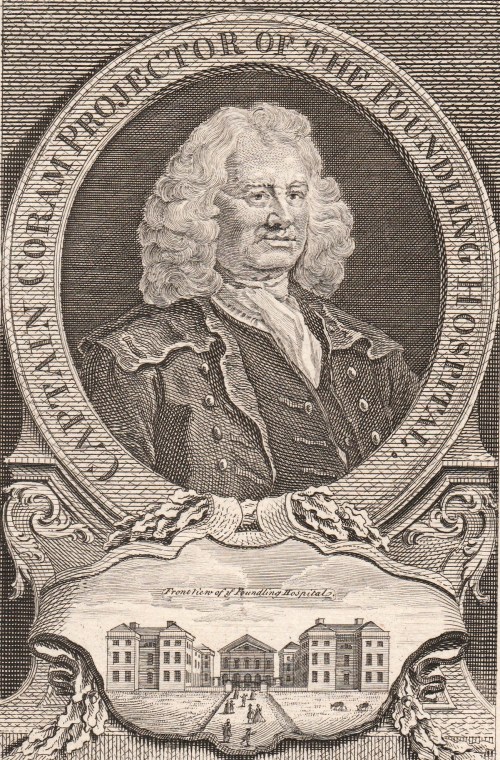
Although the prints in this post are much earlier, the Foundling Hospital would have been well known – and in fact a fashionable place to visit – right through the 19th century. It was founded in 1742 by the man in the portrait below, Captain Thomas Coram, master mariner and shipwright, who was appalled by the plight of the homeless children he saw on the streets of London when he came there to live.

thomas-coram

Coram worked hard for almost twenty years to alleviate the plight of orphaned children, or those abandoned by their parents “to die on a dunghill” before he secured sufficient support from ladies of “Nobility and Distinction” to provide a permanent home for them and a charter from George II in 1739.

After an unsatisfactory beginning in Hatton Garden a large plot – 56 acres – was bought in Lamb’s Conduit Fields, then open fields close to the road to Hampstead and Highgate villages. Work began on a grand hospital to the designs of Theodore Jacobsen and the first children – the boys – moved into the east wing in 1742. The west wing, for the girls, was ready by 1745.

foundling-hospital

The image above is a detail from “A View of the Foundling Hospital” published soon after the building was finished. Such magnificence might seem a waste of money that could have been better spent, but it was essential to attract the patronage of as many fashionable and wealthy people as possible and this fine and eminently respectable building became not only a place to visit but also one of worship in its chapel. Hogarth, and then other major artists, contributed paintings which were also an attraction to visitors who, once they were inside, could be solicited for donations.

Handel was another major benefactor. He donated an organ in 1750, gave concerts there, trained the choir and raised over £7,000 by performances of his Messiah.

The children were, at first, accepted as and when there was room on a first-come, first-taken basis but this proved unworkable because the numbers seeking admission were simply too great. Instead it became a lottery with mothers drawing a ball from a bag. White gave the child immediate admittance, providing they passed a medical exam, red put them on a waiting list and black was rejection. Amongst the most harrowing objects to see in all of London are in the collection of tokens mothers left with their child in the faint hope that one day they could come back to claim them. You can find out more about them at the Foundation’s website.

Once the children reached the age of fourteen they were apprenticed, joined the army or were found positions as domestic servants. Only  tiny handful were ever reunited with their mothers.

In 1926 the hospital moved to Redhill and then to Berkhamsted in Hertfordshire, where its buildings are now Ashlyns school. A smaller building was put up on part of the site and it retains one of the staircases and many of the furnishing and paintings from the original. Even part of the perimeter wall and gates can still be seen – have a look on StreetView at the junction of Guilford Street and Guilford Place, looking north, and you will recognize the centre front feature in the print above, although without its ironwork.


Save

Save

4 Comments

Filed under Architecture, Art, Buildings, Medicine & health, Women

From Palace to Prison – a Short History of Bridewell

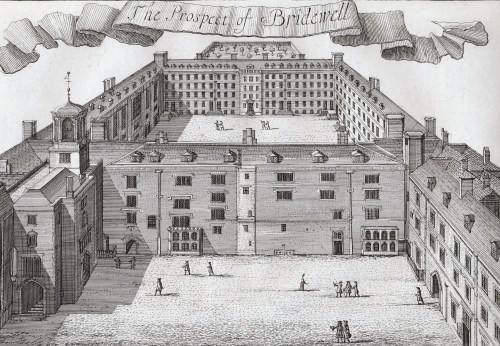
prospect-of-bridewell

How does somewhere turn, in the space of thirty years, from a royal palace where the Holy Roman Emperor Charles V was lavishly entertained to a place whose name became generic for prisons for the punishment of vagrants and fallen women?

Bridewell Palace was built for Henry VIII between 1515 and 1520. Its southern façade faced the Thames, its eastern face was on the banks of the River Fleet and it was named for the nearby holy well of St Bride and it was a typical rambling, brick-built Tudor palace around three courtyards. It was the location where Hans Holbein’s famous painting The Ambassadors was set, the venue for masques and celebrations when Charles V visited and the home of Henry’s illegitimate son Henry Blount, Duke of Richmond and Somerset.

Its days as a palace were short-lived after it served as the venue for conferences with the Papal Legate over the royal divorce and Henry’s last meeting with Catherine of Aragon in November 1529. By 1531 it was leased to the French Ambassador and it was there in 1533 that Holbein’s The Ambassadors was painted.

In 1553 Edward VI gave Bridewell away, granting it to the City of London as a home for destitute children and vagrants and as a prison for punishing disorderly and loose women and petty offenders with short periods of incarceration and regular whippings. Queen Mary confirmed Edward’s gift – perhaps not wanting to take back the place of such ill-memories of her mother.

The model of prison, hospital and workrooms proved successful enough for many others to be opened across the country, all called Bridewells. The whippings took place in  public twice a week, there was a ducking stool on the banks of the Thames in 1628 and there were also stocks. The regime appears to have been one of “short, sharp shock”, although it seems doubtful that it was very successful in reducing vagrancy, petty crime and immoral behaviour with no support for its inhabitants once they were released. More fortunate were orphans of City Freemen who were accommodated here for an education before being apprenticed to a trade.

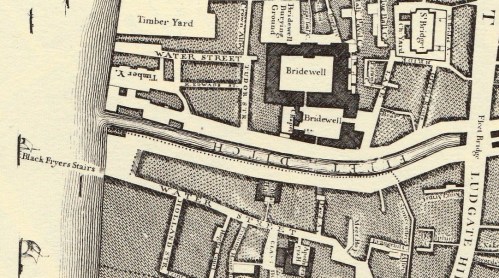
The Great Fire of 1666 destroyed much of the old palace and it was rebuilt in 1667. Judging by the print at the top of this post from a drawing by Jan Kip made in the early 18th century, some of the old Tudor palace survived. It can be seen surrounding the courtyard in the foreground with the 17th century and later additions behind. This version of Kip’s drawing was published in 1720 by John Strype and shows the view from the east – in other words, the artist is hovering above the Fleet River and looking west. The two courtyards of the rebuilt Bridewell can be clearly seen in this detail from John Rocque’s map of 1747 (below) turned to be in the same orientation.

bridewell-roque

Despite the floggings the Bridewell was more liberal than other prisons of the time – it had a doctor in 1700, seventy five years before they were appointed to prisons elsewhere, and in 1788 prisoners were not only given straw for their beds but actual beds to put it in – other gaols had neither beds nor straw. Women were not whipped after 1791. The air quality must have improved somewhat after the Fleet was covered in 1764 with the creation of New Bridge Street down to Blackfriars Bridge (1760-69).

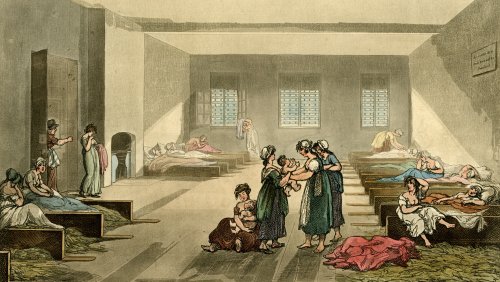
The beds filled with straw can be seen in this print of The Pass-Room at Bridewell, 1808 from Ackermann’s Microcosm of London. Here single women with babies were locked up as punishment for their ‘loose behaviour’. The notice on the wall warns that “Those who dirts Their Bed will be Punished.”

bridewell

Building work and improvements carried on until 1833 when all the Bridewells passed from local control to become part of the government’s prison system. In 1855 the prisoners were transferred to Holloway prison and the buildings were demolished in 1863/4. The only remaining fragment is the façade and gateway of 1802 which is now 14, New Bridge Street.

The outline of the site remains in the block bounded by New Bridge Street to the east, Tudor Street to the south, and Bridewell Place which wraps around the west and north sides. Tudor Street can be seen on the Rocque map and led towards one of the notorious and lawless Alsatias from which many of the inmates of Bridewell probably came.

As with Bedlam, the public could gain admittance to view the unfortunate inmates. Priscilla Wakefield, author of Perambulations in London (1814) wrote, ‘Many of the prisoners who we were permitted to see, were women, young, beautiful and depraved.’ Like much of Wakefield’s moralising writing this fills me with the desire to give her the life-chances those ‘depraved’ young women had and see how she got on!

The print below is from Ackermann’s Repository of May 1812 and shows the view looking south down New Bridge Street from what is now Ludgate Circus where Fleet Street dips down to the Fleet Valley and then rises eastwards up Ludgate Hill to St Paul’s Cathedral. Bridewell is concealed behind the furthest range of brown buildings on the right of the print.

new-bridge-street

This area is included in Walk 8 of my Walking Jane Austen’s London and Walk 9 of Walks Through Regency London.


Save

Save

Save

7 Comments

Filed under Architecture, Buildings, Crime, Rivers