Category Archives: Entertainment

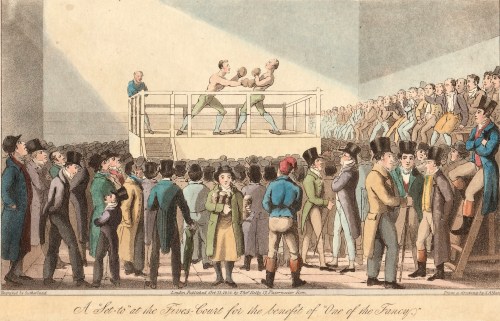
A Set-to at the Fives Court

Boxing

“FIVES-COURT. A place distinguished (in addition to the game of fives) for sparring matches between the pugilists. The combatants belonging to the prize-ring exhibit the art of self-defence at the Fives-Court with the gloves; and it is frequently at this Court where public challenges are given and accepted by the boxers. The most refined and fastidious person may attend these exhibitions of sparring with pleasure; as they are conducted with all the neatness, elegance and science of FENCING. Admission, 3s. each person. It is situated in St. Martin’s Street, Leicester-fields.”

(Grose’s Classical Dictionary of the Vulgar Tongue, revised and corrected…by Pierce Egan. 1823)

I was comparing the first, 1785, edition of Francis Grose’s Vulgar Tongue with the 1823 edition edited by that aficionado of ‘Boxiana’, pioneer sporting journalist and creator of Tom and Jerry, Pierce Egan, when I came across this reference to the Fives Court, obviously added by Egan.

The print at the top of this post is from my collection and I had wondered where the Fives Court was located – it was obviously a very large structure, judging from the light streaming in from a high window. It was built as a court for the game of fives, a sort of hand-ball, or hand-tennis, originally thought to have been played against church buttresses, but then adopted at the public schools of Rugby and Eton and refined. Like Real (Royal) tennis it is played on an indoor court with high walls and various slopes and ledges.

In 1802 a sparring exhibition was held between Mendoza and Bill Warr – two boxing superstars. It was held on the floor of the court, not on a removable platform ring as shown in my much later (1823) print, that was introduced at the suggestion of black pugilist Bill Richmond.

Initially the admission was two shillings or two and six pence up to three and six, but, as Grose states, it was soon standardised at three shillings. Vincent Dowling, another sports writer, noted that there was a small dressing room at one end that had a window looking down on the Court and this was set aside for “…some dozens of noblemen and persons of high rank, whose liberal contributions (many of them giving a guinea for a ticket) added greatly to the receipts of the beneficiary.”
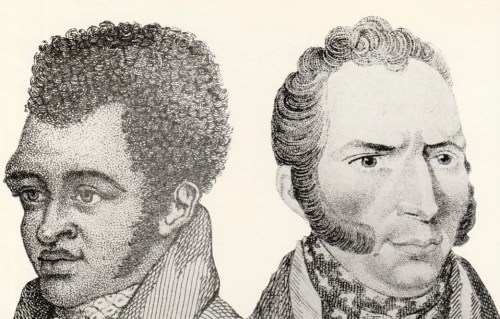
Bill Richmond (left) & Dutch Sam - two boxers whose physique drew artists to the Fives Court

The quote reminds us that most of these exhibition bouts were benefit performances for one of the pugilists who would stand at the door with a collecting box soliciting further donations in advance of the bout. Bill Richmond (shown above, left), like many retired pugilists, owned a pub. His was the Horse and Dolphin, located strategically next to the Fives Court, and tickets for bouts were sold there as well as in other sporting taverns.

The Court could accommodate an audience of up to 1,000 and, if full, admission might raise £200. The chief beneficiary would have to pay a fee for the court and to the referee and Master of Ceremonies. Lesser fighters, who would appear earlier on in the programme as warm-up acts, also got a payment from the takings. The great ‘Gentleman’ Jackson controlled who could have bouts at the Court and appears to have done so with few complaints, although in 1821 he refused the application of his bitter rival, Mendoza.

The bouts were for exhibition purposes, which is why gloves were worn, and Richmond was the first to strip to the waist, sparring without vest or shirt, so that his musculature could be admired by the fans. This display attracted artists including Benjamin Haydon, Joseph Farington (President of the Royal Academy) and John Rossi the sculptor who ‘much admired Dutch Sam’s [shown above, right] figure on account of the symmetry and the parts being expressed.

The 1823 print at the top of the post, ‘ “A Set-to” at the Fives-Court for the benefit of “One of the Fancy”’ is by Samuel Alken. The crowd is orderly and the gentlemen to either side in the foreground are very fashionably dressed. Respectably-dressed tradesmen can also be seen – one in an apron is in the audience sitting up on the right. The central figure facing us wears an apron and his arms are full of what look like giant cream horns. Close inspection shows that the contents are within conical containers stitched up the side – my guess is that these are some kind of bread roll, perhaps with a filling. I’d love to hear any other suggestions.
Fives red

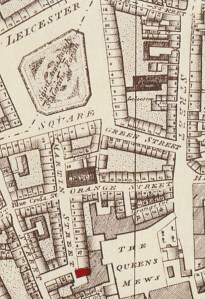
The Fives-Court operated as a boxing venue from 1802 until it closed in 1826 and was demolished as part of the redevelopment of the Royal Mews area into what became Trafalgar Square. The site is now under the northern edge of the Sainsbury Wing of the National Gallery and it is possible to pass this rather dreary location without the slightest inkling that it was once one of the sporting hot-spots of London. It is marked on the map in red.
2 Comments

Filed under Art, Buildings, Entertainment, Gentlemen, Sport

Londoners Take to Their Skates

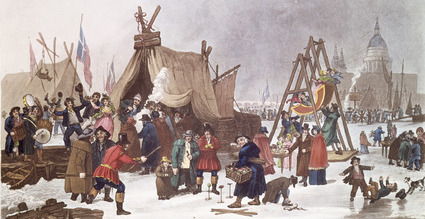
Everyone has heard of the Thames Frost Fairs where the river froze solid and Londoners could walk across, drive across – and on one notable occasion in 1814, lead an elephant across. The first recorded frost fair was in 1608, the last in 1814, after which warmer winters changes in the river’s flow because of  alterations to the bridges prevented it ever being possible again. Below is a detail from Luke Clennel’s picture of that last fair.

Frost Fair

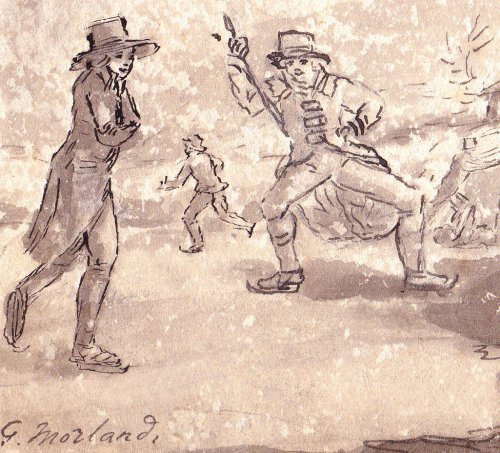
But the Thames did not freeze every year, even before 1814, and when it did the ice was covered in booths and stalls. More reliably Londoners could take to the frozen ponds and lakes in their parks and skate. Below is a detail from an original pen and ink sketch by George Morland in my own collection and you can see the simple skates laced onto the boots or shoes of the skaters.

Morland skaters crop

The Serpentine, the lake in Hyde Park formed from the Westbourne River, provided a particularly popular venue. The Picture of London for 1807, my favourite London guidebook describes it:

‘In severe winters, when the Serpentine River is frozen over, the ice is almost covered with people. One winter there were counted more than 6000 people at one time on the ice. A number of booths were pitched for the refreshment of the populace; and here and there was a group of six, eight or more, fashionable young men, skating, and describing very difficult figures, in the manner of a country dance, with particular neatness and facility of execution. In general, however, the English do not excel in this very exhilarating and wholesome exercise.
From the number of accidents which happen annually on this river when frozen over, his majesty gave the Humane Society a spot of ground on its banks on which they have erected a most convenient receiving-house for the recovery of the apparently drowned; it cost upwards of £500 and is worthy the inspection of the curious. The society, during the time of frost, keep men on the river to guard the unwary from danger, and to relieve those who may require their aid.’

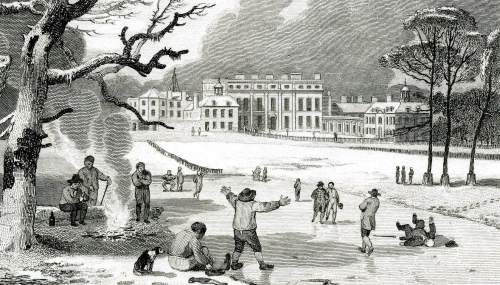
The lake in St James’s Park was also a good size for skaters as this detail from an undated print shows. Some skaters are obviously far better than others!

St James Park

The building on the far bank is the Queen’s House – Buckingham House – which eventually became Buckingham Palace.

Finally here is the image I am using for my Christmas card this year. The lady in her gorgeously warm-looking crimson pelisse seems very snug as she watches the skaters, especially the gentleman with his frozen fingers tucked into his armpits! Her rather bizarre hat is decorated with holly and there is a full description of her outfit at the end of this post.

Walking dress crop

A Very Merry Christmas and Happy 2016 to all my readers!

A Winter Walking Dress from La Belle Assemblée Feb 1812

A scarlet Merino cloth pelisse, lined with straw coloured sarsnet, trimmed with light coloured spotted fur, and attached with loops of black silk cordon and rich frog tassels; the broad fur in front, forming a tippet, pointed at the back. A narrow fur passes from the top of the sleeve,
is brought down the side seams, and relieved by fastenings of black silk cordon; four loops with frog ornament the shoulders and cuffs; plain standing up collar tied with cordon: a fine cashmire (sic) shawl, with brown ground, and richly variegated border, is generally thrown over the dress, in which is united both comfort and elegance. A Swedish hat of the same materials as the pelisse, lined with straw colour, and fastened up on one side; the crown trimmed with two rows of narrow spotted fur, and one still narrower at the edge of the hat; a bunch of the Christmas holly in front, and two tassels falling from the summit of the crown, of black, to answer the pelisse, which is worn over a white round dress, either plain or corded cambric. Beaver gloves, and demi-broquins of scarlet Morocco,
laced with black, and lined with fur, complete the dress.

7 Comments

Filed under Christmas, Entertainment, Fashions, London Parks, St James's Park

Pray Remember Guy Fawkes!


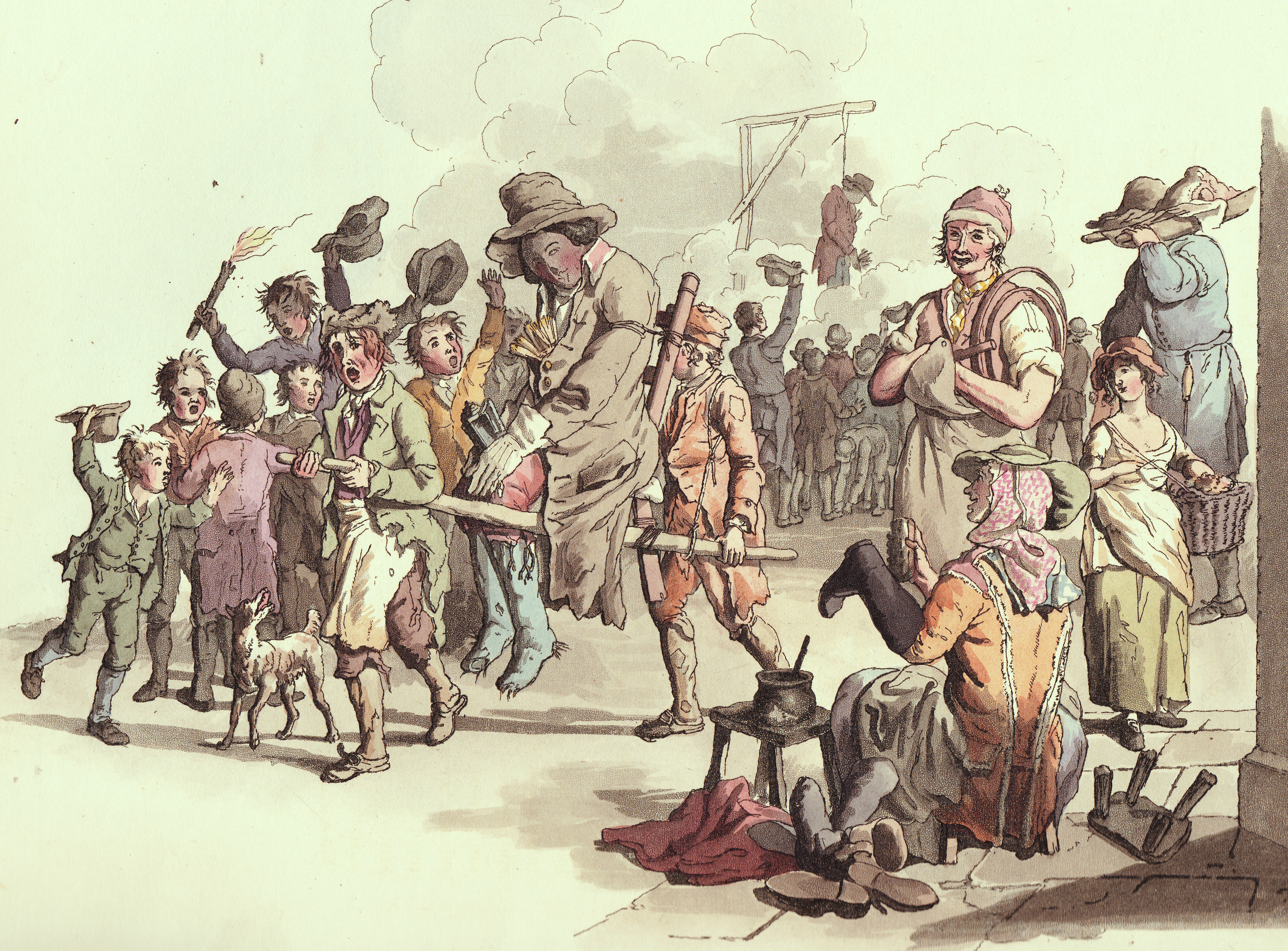
Pyne Guy Fawkes


The 5th November is the anniversary of the Gunpowder Plot in 1605 when a group attempted to blow up the House of Lords, along with King James I, during the State Opening of Parliament. The aim was to install James’s nine year old daughter Elizabeth as a Catholic head of state, but the conspirators were betrayed and Guy Fawkes, who had been guarding the thirty six barrels of gunpowder stacked in the cellars under the Lords’ Chamber, was captured.

Most of the conspirators managed to get out of London but were found and, after a fight, some were killed and the others captured. At their trial in January 1606 the eight survivors, including Guy Fawkes, were sentenced to be hanged, drawn and quartered. With the popular feeling so strong against Roman Catholics at the time, celebrations on the  anniversary of the discovery of the plot rapidly became a fixed part of the calendar and persisted nationally. Bishop Robert Sanderson (d.1663) preached, “God grant that we nor ours ever live to see November 5th forgotten, or the solemnity of it silenced.” By 1677 Poor Robin’s Almanac had the verse:

“Now boys with

Squibs and crackers play.

And bonfires blaze

Turns night to day.”

By the early 19th century the visible elements of the celebration – the bonfire, the effigy of the “guy” with small boys parading their own homemade versions and begging for “A penny for the guy” and the setting-off of fire crackers – were still as popular as ever. The idea of a bonfire, fireworks and the opportunity for a party was doubtless as appealing then as it is now and perhaps few people thought about what was being represented and the horrors of either the planned explosion or the hideous end of the conspirators.

I love the detail in the picture at the top of this post. It is from Pyne’s The Costumes of Great Britain, 1805 and shows urchins parading their guy. He is dressed in old clothes with a handful of firecrackers pushed into his coat front. in the background another guy has been hung over the bonfire with his hands full of firecrackers. In the right foreground are a group of tradespeople. A man carries a joint of meat in a wooden hod on his shoulder, too preoccupied to look up, but a girl selling something from her basket, a cooper with barrel hoops over his shoulder and his tools tucked into the front of his apron and a woman blacking boots look on in amusement. The shoe-black is wearing a soldier’s uniform jacket, two scarves over a white cap and a voluminous black skirt. Her pot of blacking is on the stool beside her and she is rubbing it into a boot with a small brush.

My copy of Observations on Popular Antiquities: chiefly illustrating the origin of our Vulgar Customs, Ceremonies and Superstitions by John Brand has the following for November 5th: “It is still customary in London and its vicinity for the boys to dress up an image of the infamous conspirator Guy Fawkes, holding in one hand a dark lanthorn, and in the other a bundle of matches, and to carry it about the streets begging money in these words, “Pray remember Guy Fawkes!” In the evening there are bon-fires , and these frightful figures are burnt in the midst of them.” The original edition was 1795, but the editor of the 1813 edition has added “Mr Brand was mistaken in supposing the celebration of the fifth of November to have been confined to London and its neighbourhood. The celebration of it was general.”

Cruickshank guy

Almost thirty years after the print by Pyne was published Cruickshank’s little image for November in London shows a very similar guy, although this one has a clay pipe in his mouth. Another guy is being carried in the distance on the right and he is wearing a tall white dunce’s cap which may be intended to represent the hats worn by heretics burnt at the stake by the Spanish Inquisition.

It is obviously November – fog is swirling in the street, the figure in the centre has his nose and mouth muffled and the advertisements pasted to the boarded-up window are for cloaks, greatcoats and furs. There is also an advert for fireworks.


4 Comments

Filed under Entertainment, Street life, Traditions, working life

A Flutter of Fans – A Very British Romance?

mid 18thcWatching the first episode of Lucy Worsley’s fascinating A Very British Romance last night I was inspired to look at my collection of 18th and early 19th century fans to see how they treat romantic love.

Fans were not only a practical necessity at hot and over-crowded balls and receptions, but they were also items of high fashion, conversation pieces and even sources of satire. And, of course, what better aid to romance for a strictly-chaperoned young lady who could deploy an entire range of flirtatious gestures with her fan – peeping over the top of it; hiding, then revealing her face; gesturing an invitation or snapping it shut sharply in rejection.

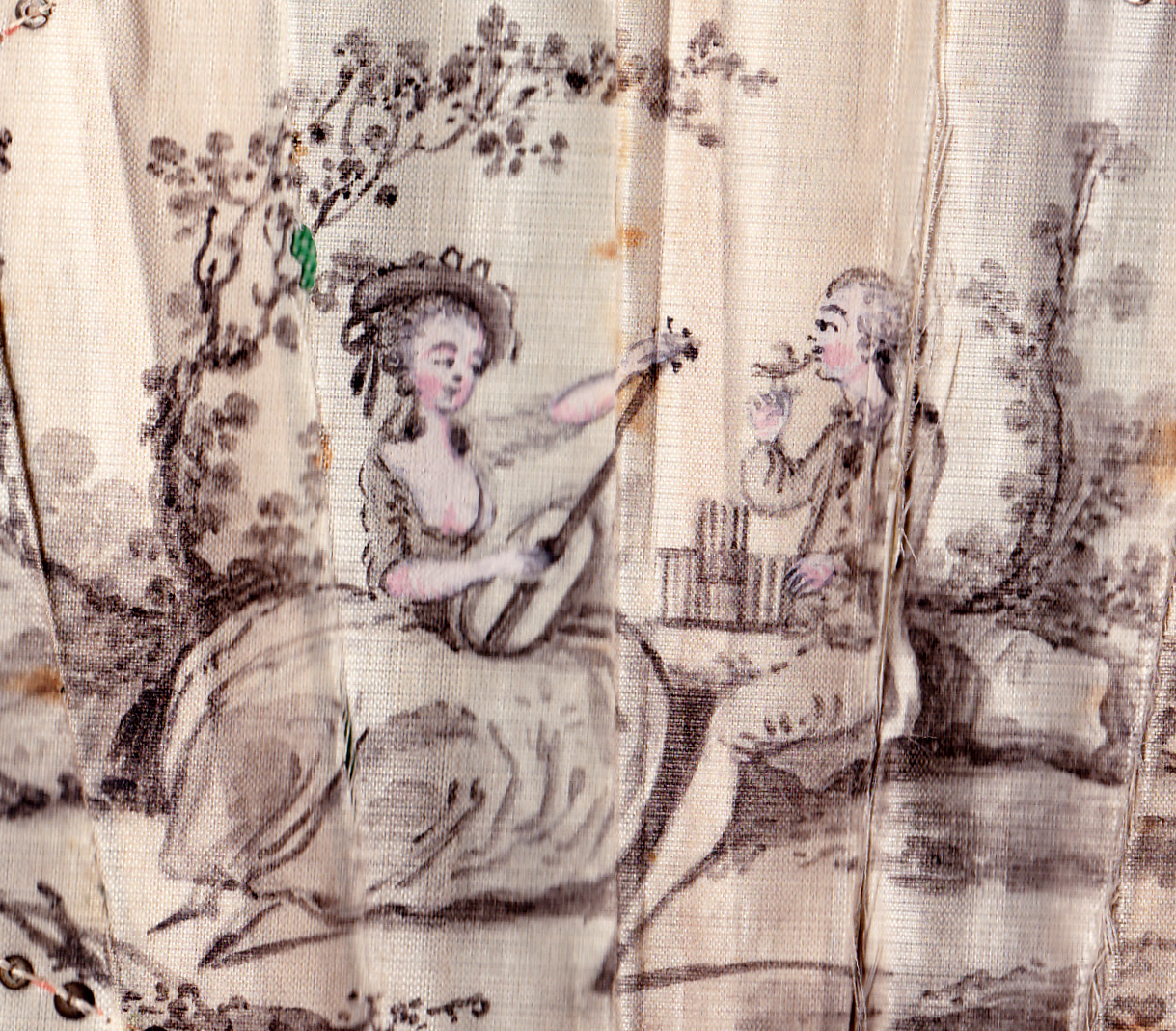
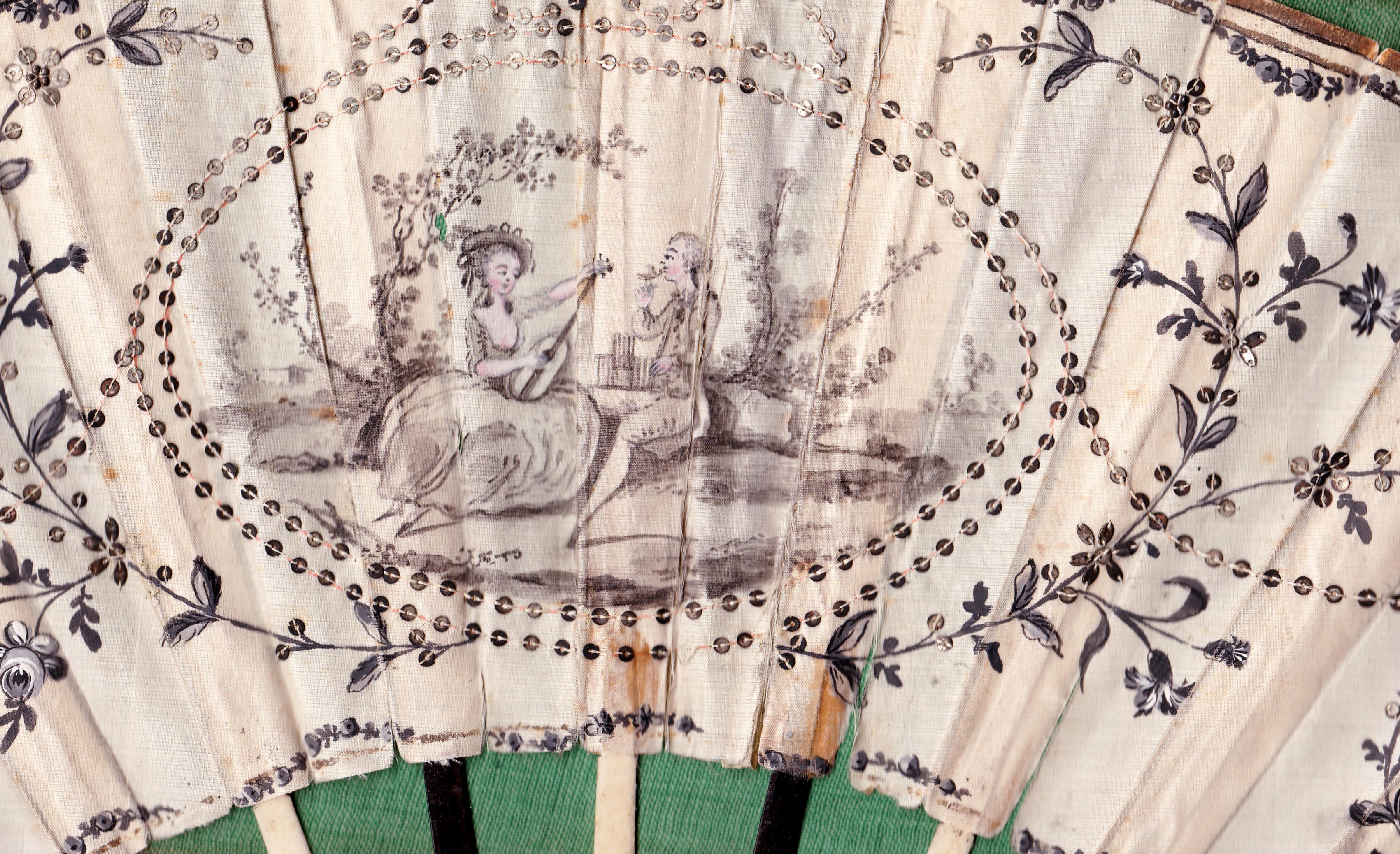
mid 18thcThe earliest – perhaps 1770s – is a simple fan with widely spaced black and white sticks. The leaf is painted on one side only in black, white and grey, with tiny silver sequins sewn through the pattern. The man and woman in the centre have delicate touches of pink on their cheeks, hands and on her bosom. This is a very informal outdoor scene. She is playing a guitar and perhaps singing a romantic song. He is sitting with his legs astride the bank, and raising a small bird to his lips, apparently to kiss its beak. A love bird? From their intense exchange of looks it is quite clear that hers are the lips they would both wish he was kissing.

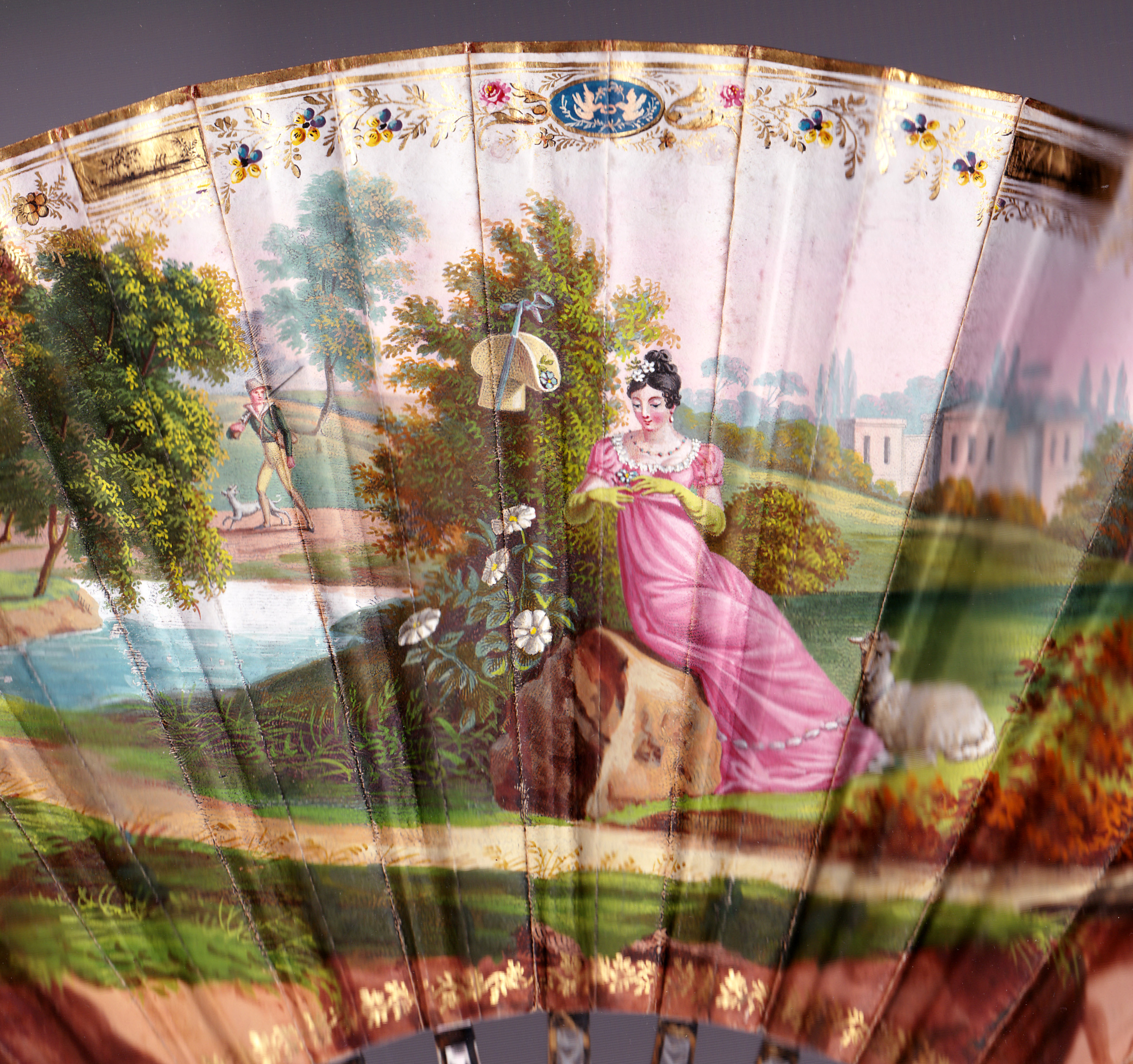
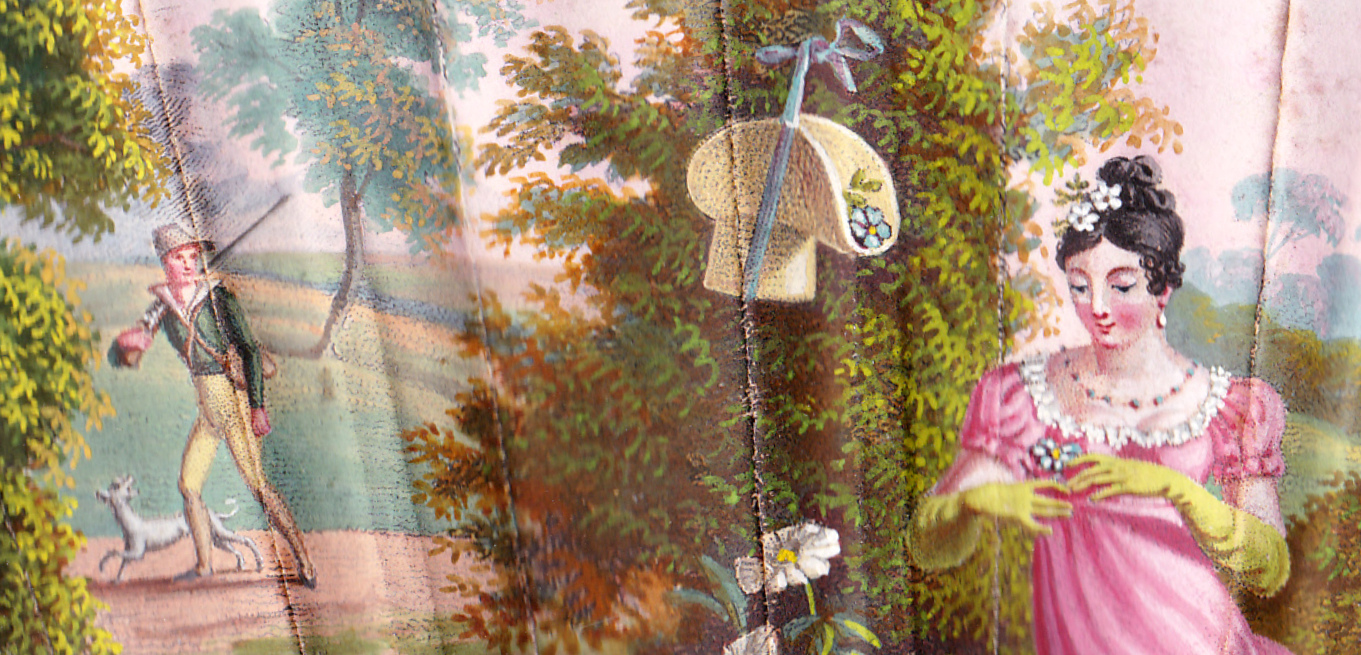
parkThe most modern (c1818?) is also outdoors. It is a detailed hand-painted and gilded scene set in the parkland surrounding a large country house. The young lady in the centre is gathering flowers which she is collecting in the bonnet which she has casually hung from a bush – perhaps an indication that she would like to shed a few more items of clothing if the right circumstances arose. parkOn the other hand, a lamb, a symbol of innocence, is sitting by her side. A young man, his gun over his shoulder and his ammunition pouch at his side, strides off on the other side of the lake with his dog at his heels. He is off hunting – but what or who? He is certainly very aware of the young lady and I would hazard a guess that she is just as aware of him. No doubt she set out early to compose herself into just this charming and innocent pose for his benefit.

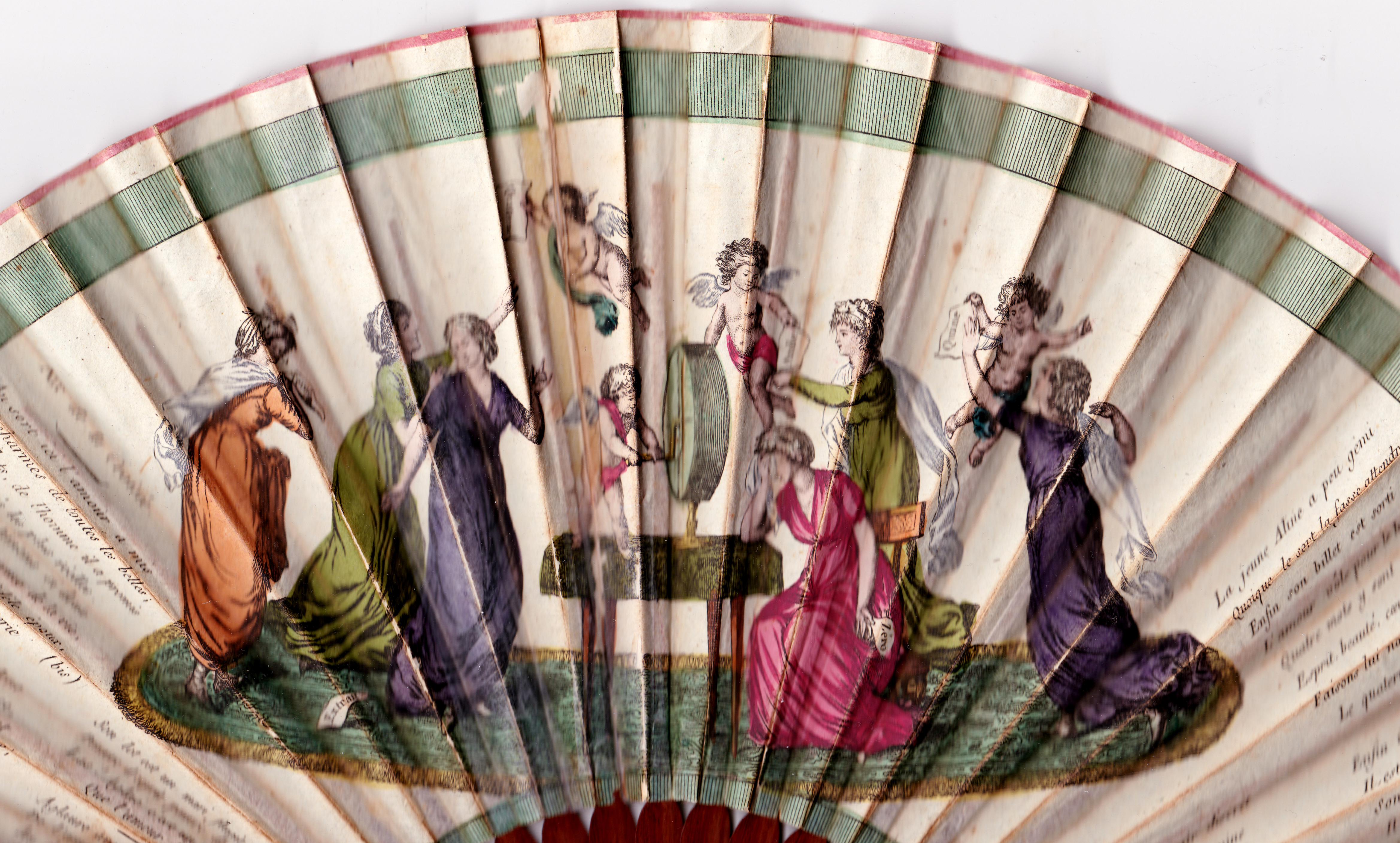
lotteryNow for a fan which I found in circumstances which I can only call romantic, if not downright spooky. I was writing The Piratical Miss Ravenhurst, the last of my Scandalous Ravenhurst series. My heroine was called Clemence – not the most common of English names. I was halfway through the book when I visited an antiques auction and spotted the handle of a fan poking out of a mixed lot of odds and ends. It had no loop on it – an almost infallible sign of an early fan – so I took a quick look and put it back before anyone else saw me taking an interest! In the event I got the whole lot for under £20 and when I had a good look at the fan I could tell it was not only late 18th century, but also French. The scene shows six young women in a lottery for love. The cupids draw a description of the virtues the lover of each will possess, described in very difficult old French in verses around the edge. (I have to thank fellow author Joanna Maitland for the translations!)  Poor Isis is in a hurry to receive her prediction – but her lover will have no virtues whatsoever. The next girl, “Aglaé, le coeur palpitant” – “her heart beating” – is destined for a lover who is articulate, but weak in spirit. Each girl in turn is told of a lover with two, then three, then four virtues. The final young woman is Clémence – my heroine’s name! And not only is her lover going to be handsome but he will surpass her hopes in every way.

Enfin il n’en reste plus qu’en
Il est pour la belle Clémence
Son sort est beau, mais peu commun
Il surpasse son espérence
Dons du Coeur, et dons l’esprit
Vertu, courage et bonne mine
Son amant les a réunit
Elle a gagné le quine.

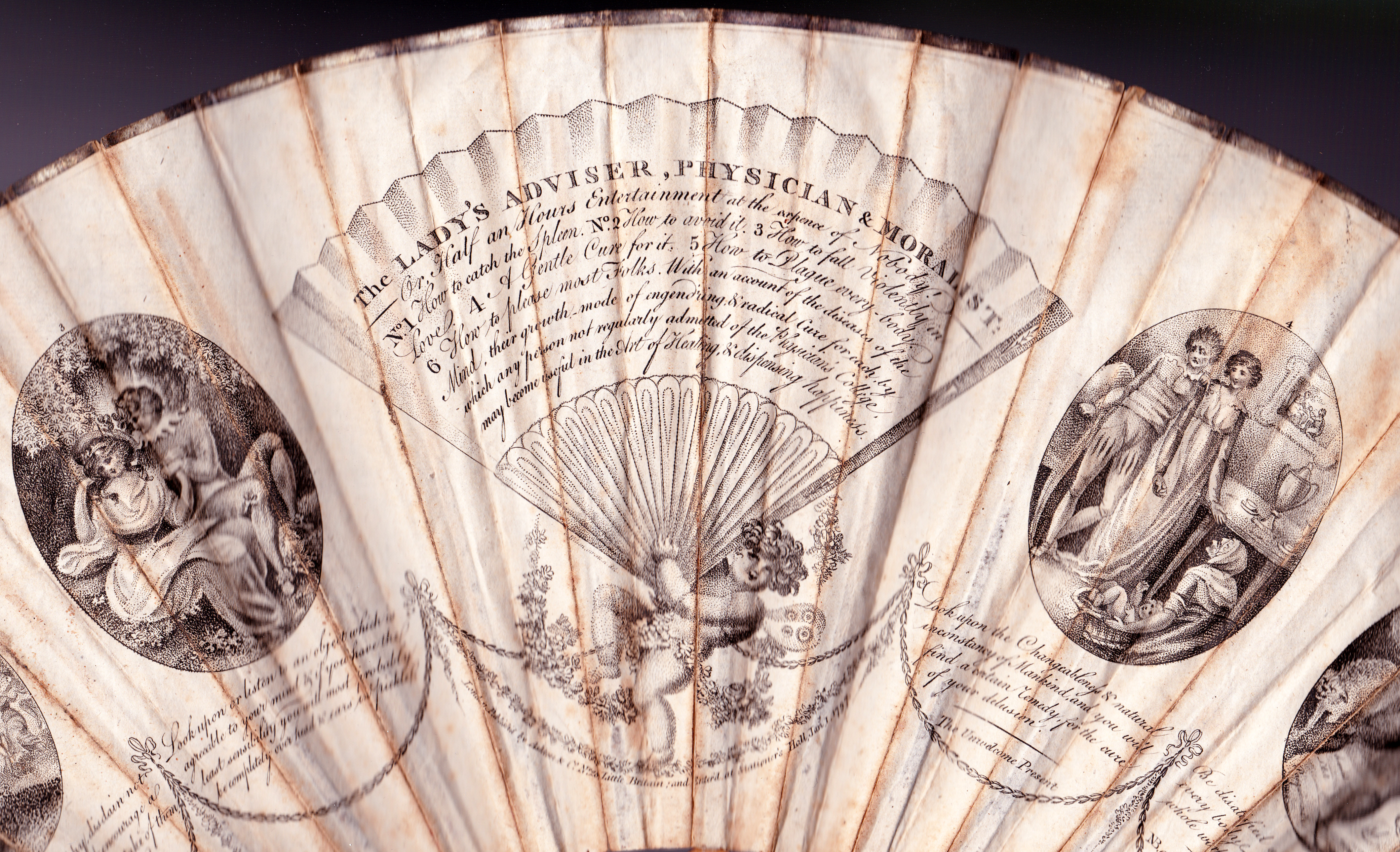
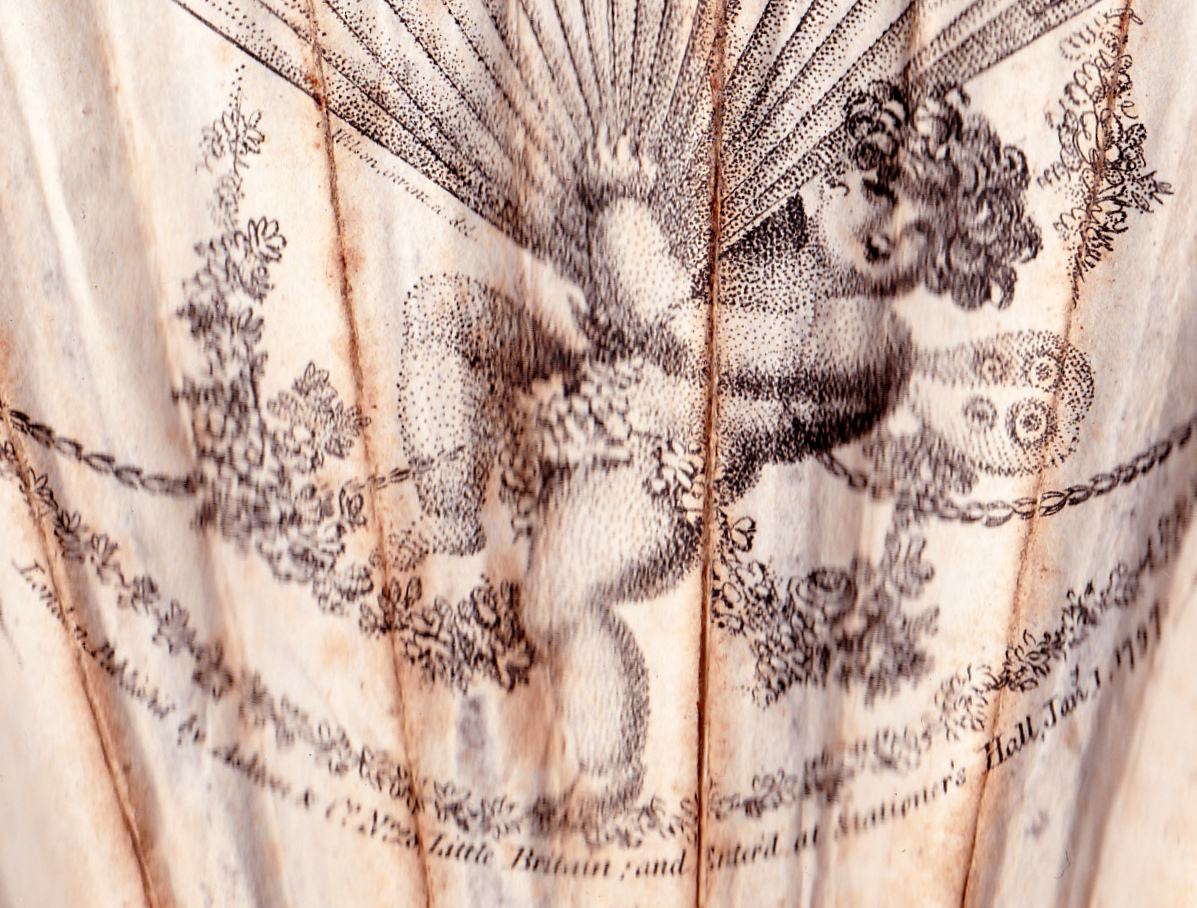
maximsTo counter all that intense romance I’ll end with a rather more cynical view of life and love with a fan produced in 1797. It was doubtless intended to be a conversation piece. The central text, shown on a fan held up by a fat little Cupid, explains that this is:

“The LADY’S ADVISER, PHYSICIAN & MORALIST: Or, Half an Hours Entertainment at the Expense of Nobody”

It has six scenes around the edge. The four not visible in this view show how to “Catch The Spleen” – devote yourself to cats rather than people and seek out unpleasantness; “How to Avoid It” – enjoy life with a virtuous disposition, honour and moderation; “How to Plague Every-Body” – be dissatisfied with everything, declare war against the whole world and finally “How to Please Most Folks” – “Be just to your Enemy, Sincere to Your Friend, Constant to Your Mistress.”

On the left above is “How To Fall Violently In Love”: “Look upon or listen to an object which is agreeable to your mind & if you have the least sensibility you will most probably be completely over head and ears in pickle.”

On the right is “A Gentle Cure For It”. The young couple are  married now and have been interrupted at the breakfast table by a woman with a child in a basket. The scene has the caption “The Unwelcome Present” and from the expression on the man’s face, and his body language, one assumes this child is a bye-blow of his. The text reads:

“Look upon the Changeableness & natural inconstancy of Mankind, and you will find a Certain remedy, for the cure of your delusion.” Really rather a scandalous scene for a lady’s fan!

maxims

6 Comments

Filed under courtship & marriage, Entertainment, Fashions, High Society, Historical Romance, Love, Love and Marriage

October In London

Return homeThe Cruickshank print for October shows the end of the summer for Londoners – the return home from their holidays, probably at the seaside. One party are disembarking from a mail coach on the left while on the other side a family are getting out of a hired post chaise. The new season is indicated by the man selling a pheasant in the centre and the poster for the start of the Theatre Royal’s winter programme.

These travellers are very much of the ‘middling sort’, respectable tradespeople or perhaps lawyers or merchants. A decade or so before and they would not have dreamed of taking a holiday – that was reserved for the upper classes and aristocracy, people with an income they did not have to work for, and ample time on their hands. But times were changing and improvements in transport, as well as changes in society, meant that the middle classes could manage to get away to perhaps Margate or Folkestone or one of the other growing resorts along the South and South East coasts.

The other print is from over twenty years earlier and shows the journey back to Town from the other end – The Departure is the final print in Political Sketches of Scarborough by J Green, illustrated by Thomas Rowlandson. The lady in her fashionable travelling outfit is sheltering from the rain while her luggage is loaded onto a hired chaise – Departureone of the “yellow bounders” famous for both colour and the wild swaying of their springs. She seems to be of a  higher rank than the unsophisticated travellers in the Crucikshank image and the verse indicated that she is following the lead of the most elevated visitor to Scarborough that season:

The chilling winds and rain combine,

That all should Scarbro’s sweets resign;

First one by one – then four by four,

And then they’re off by half a score;

Her GRACE is gone – with her a host

Of charms to captivate, are lost:

When she withdraws her genial ray,

The sun has set of Scarbro’s day.

3 Comments

Filed under Entertainment, High Society, Seaside resorts, Transport and travel

Bartholomew’s Fair

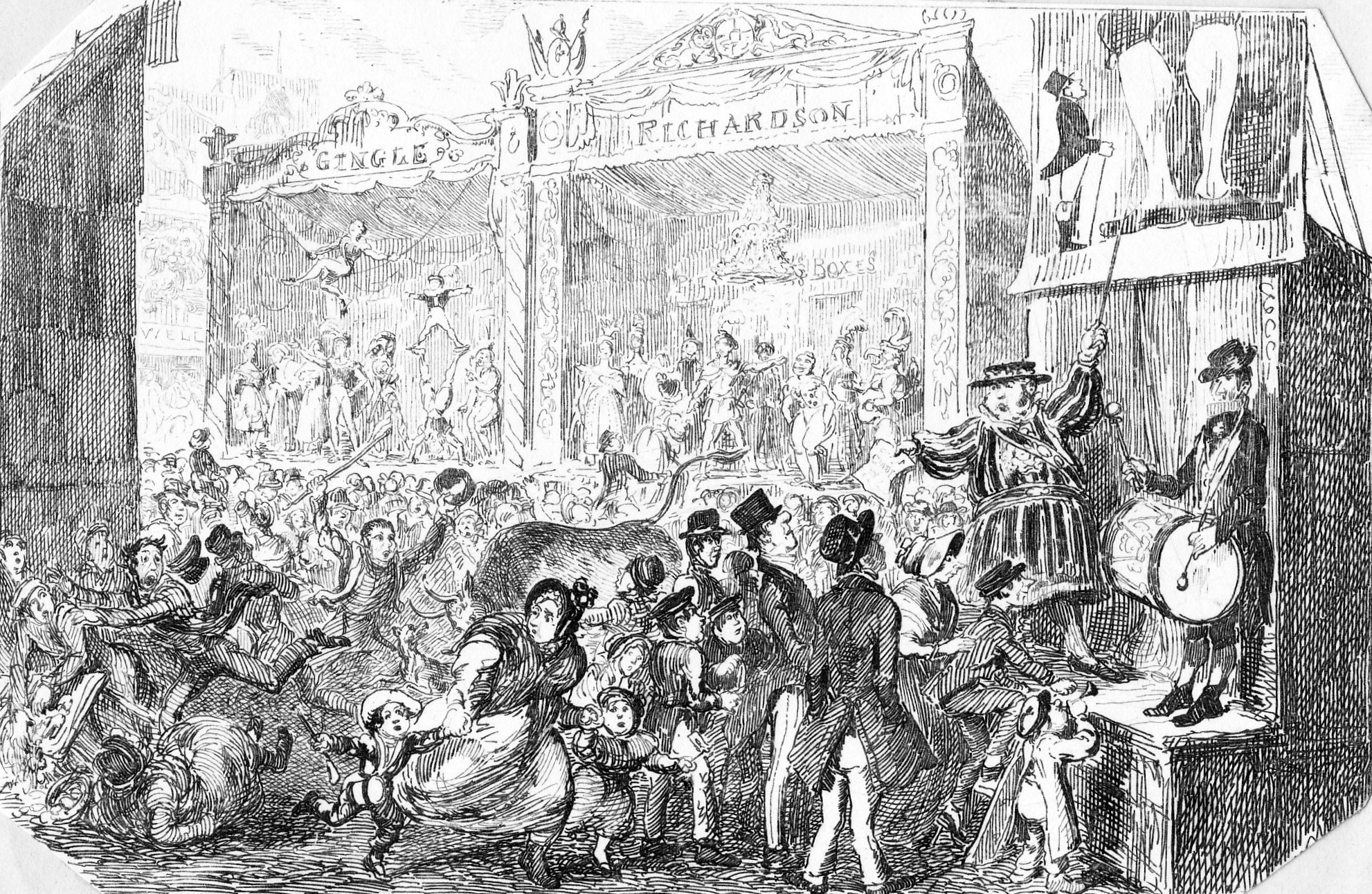
The George Cruickshank monthly print for September is a lively image of the Bartholomew fair, held at Smithfield from 1133 until Victorian moral outrage finally suppressed it in 1855.

Barth fair
Its origins were in the cloth fair which provided much of the income for the priory and hospice dedicated to St Bartholomew that eventually became today’s Bartholomew’s Hospital (“Barts”). The fair, one of the largest in the country, was held for three days from the eve of St Bartholomew’s Day (24th August). With the change of calendars in the 18th century the date slipped to 3rd September.
At the same time as the cloth fair the Corporation of London held a cattle fair at the same site and eventually, after many wrangles and the Dissolution of the monasteries, the Corporation took over the whole event.
By the 17th century the fair was more a vast funfair than a cloth or cattle sale and even the Puritans did not try and shut it down. By the time Charles II was on the throne it lasted for three weeks of carnival and downright disorder.
Everyone, rich or poor, went to the Fair, including Samuel Pepys who records numerous visits over the years. On September 2nd 1664 he watched the rope-dancing and bought combs for his wife and her maids.
Entertainments included theatrical performances, jugglers, magicians, stalls selling every kind of trinket, animal shows, food stalls, freaks and vast amounts of drink. The print for a fan dated 1721 shows a rather tidy and sedate fair, but does illustrate some of the activities – rope dancers, Faux the conjuror, rides in a dog cart, an early form of Ferris wheel, a peepshow of the Siege of Gibraltar and a stall selling “toys” – not children’s playthings but adult novelties and trinkets. Dolls known as Bartholomew Babies were one of the most popular souvenirs.

V0014666 Bartholomew Fair, site of St. Bartholomew's Hospital, London Credit: Wellcome Library, London. Wellcome Images images@wellcome.ac.uk http://wellcomeimages.org Bartholomew Fair, site of St. Bartholomew's Hospital, London, pictured in 1721. Aquatint with etching, c. 1800. Published: - Copyrighted work available under Creative Commons Attribution only licence CC BY 4.0 http://creativecommons.org/licenses/by/4.0/

V0014666 Bartholomew Fair, site of St. Bartholomew’s Hospital, London
Credit: Wellcome Library, London. Wellcome Images
images@wellcome.ac.uk
http://wellcomeimages.org
Bartholomew Fair, site of St. Bartholomew’s Hospital, London, pictured in 1721. Aquatint with etching, c. 1800.
Published: –
Copyrighted work available under Creative Commons Attribution only licence CC BY 4.0 http://creativecommons.org/licenses/by/4.0/

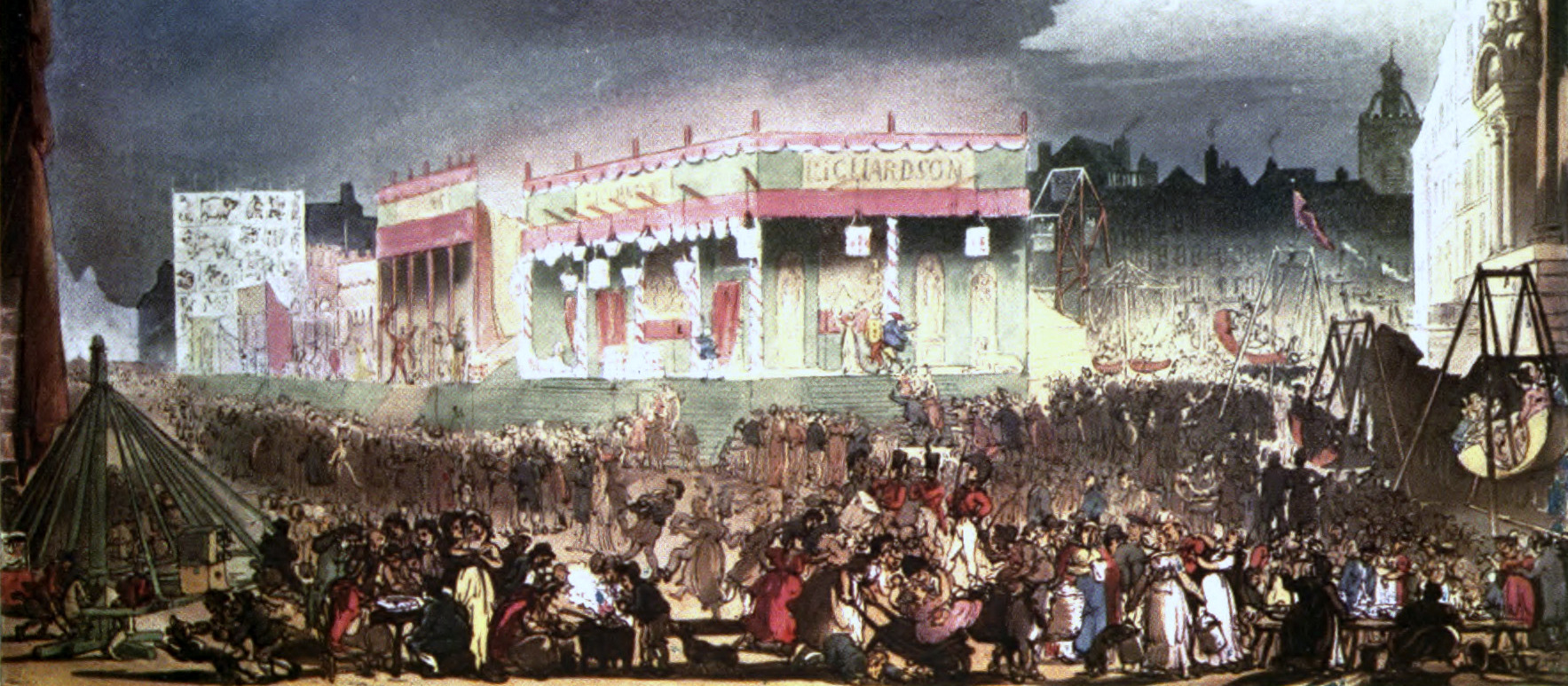
By the later 18th century Richardson’s booth was considered to have the best theatrical entertainments. He charged 6d admission (most others only charged a penny) and the tent was lined with green baize, illuminated by 2,000 lamps and the ushers were dressed as beefeaters. One can be seen to the right of Cruickshank’s print.
A visitor in 1825 records seeing “four lively little crocodiles hatched from eggs at Peckham by steam, Wombwell and his menageries [and] a glass blower in a glass wig blowing tea cups for 3d each.” An account of the money made by stallholders in 1828 gives an idea of the type of sideshows – the Pig-Faced Lady earned £150 (at 1d a time), the Panorama of the Battle of Navarino, £60 and the Chinese Juggler, £50. Wombwell’s Menagere made £1,500.
Cruickshank’s image shows a daytime scene with many children in the crowd – although even then the place is crowded and the bull-baiting appears to have got completely out of control. The coloured image by Pugin and Rowlandson for the Microcosm of London in 1801 shows a much darker, night-time scene, hinting at danger, debauchery and sin.

Microcosm Barth Fair
The Victorians certainly did not approve. In 1840 a committee regulated the booths and increased the rents and forbade “giants and dwarfs”. City notables ceased their support and by 1850 it was so reduced that it was no longer worth having an opening ceremony. In 1855 it ceased to exist, leaving only its name as a bye-word for uncontrolled fun for every class.

1 Comment

Filed under Entertainment, Street life, Traditions

It Is August In London – Eat Oysters on Oyster Day or Run Away to the Seaside?

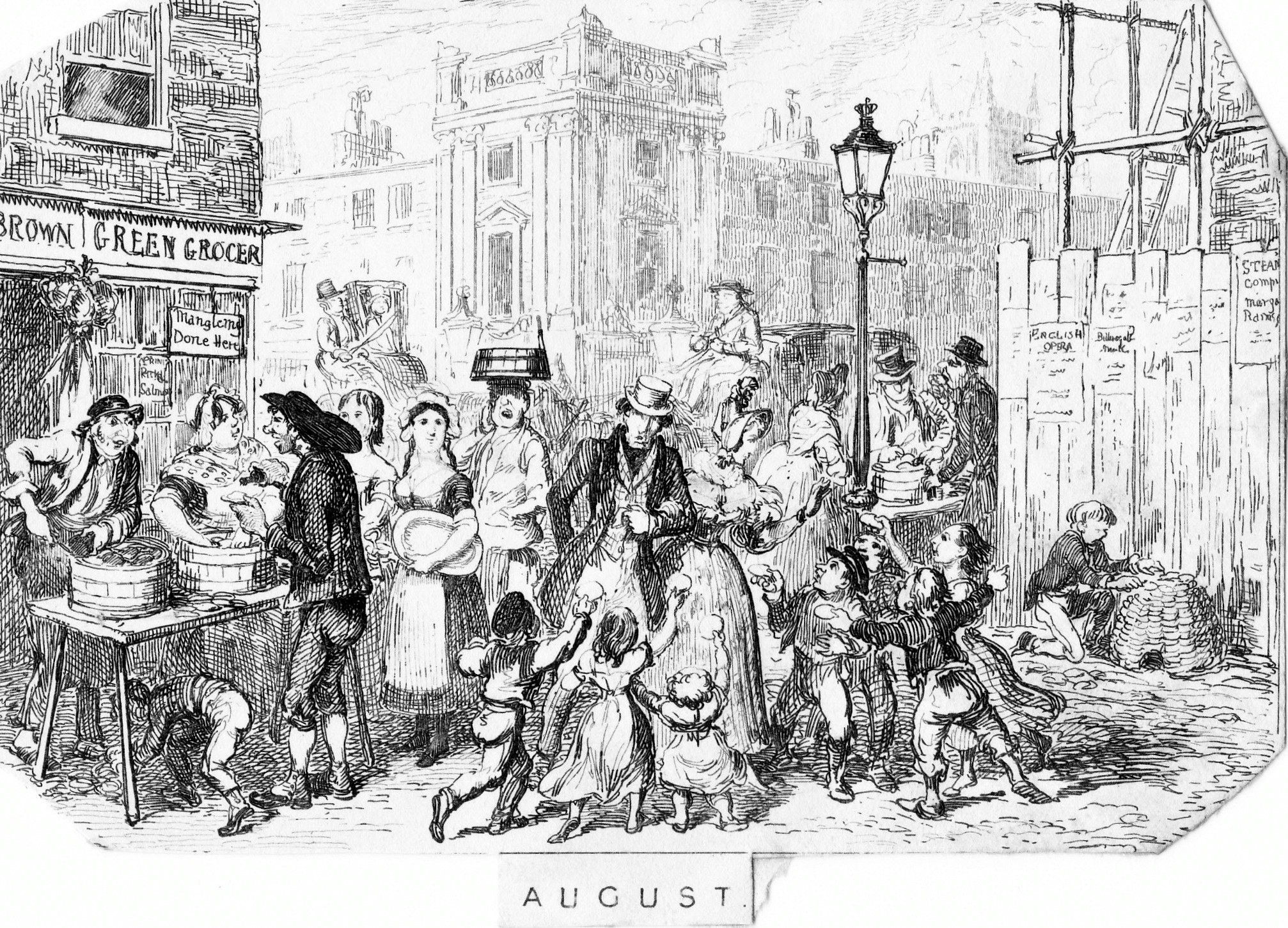
August in London was the time to celebrate “Oyster Day” – the arrival of the first oysters at Billingsgate fish market. The scene on the streets is shown in the first print from Crucikshank’s London Almanac. This was a significant day for the poor for whom oysters was a cheap staple. In London Labour and the Poor Mayhew wrote that “the number of oysters sold by the costermongers amounts to 124,000,000 a year. These, at four a penny, would realise the large sum of £129,650. We may, therefore, safely assume that £125,000 is spent yearly in oysters in the streets of London.”

London August

In the scene working people queue up at two trestle tables to buy oysters. The vendors are opening them and on the left we can see a coal heaver or dustman, distinguished by his hat with a protective neck flap, pouring some kind of relish or ketchup over his.

A small boy is rummaging under the trestle for empty shells and on the right one lad is building them into a construction while other children holding up shells mob a respectably-dressed couple begging for coppers. An article in the Illustrated London News of 1851 explains what must be happening.

“We will not pursue the calculation into how many grottoes might be built from the shells of a year’s supply of oysters…. The coming-in of oysters is observed as a sort of festival in the streets; and in such a nook of the metropolis as the present locality, the grotto is usually built of inverted oyster-shells piled up conically with an opening in the base, through which, as night approaches, a lighted candle is placed within the grotto, when the effect of the light through the chinks of the shelly cairn is very pretty. It is but fair that the young architects should be rewarded for their trouble accordingly, a little band, of what some churl may call urchins, sally forth to collect pence from the passers-by ; and the usual form of collecting the tax [is] by presenting a shell…”

Of course, you might choose to leave the heat and dust of London in August (to say nothing of the smell of discarded oyster shells) and go to the seaside. Brighton, Margate and Ramsgate were closest (if one leaves aside Gravesend, which even in the Georgian period was getting a reputation for being somewhat rough).

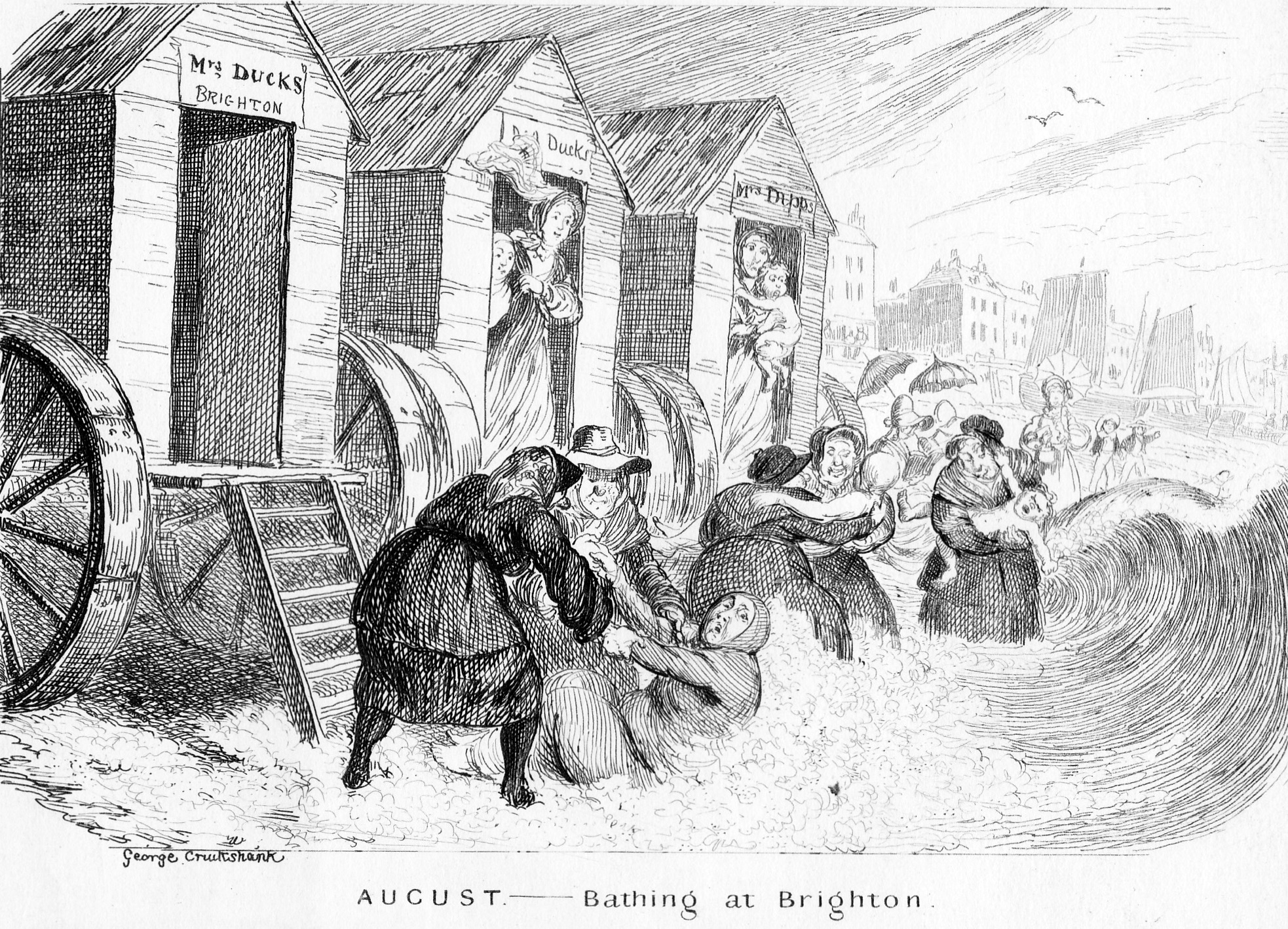
Brighton AugustCruikshank has chosen to show bathing machines at Brighton with four burly female “dippers” dunking their quailing customers in the sea. The machines have boards showing the names of the dippers – two for “Mrs Ducks” and one for “Mrs Dipps”. In the foreground a lady is entirely enveloped, head and all, in a flannel “case” while in the middle two dippers are about to plunge a slight figure – a teenage girl perhaps – in backwards. A furious baby is getting a relentless ducking at the far end.

The Margate design of bathing machine, invented by Quaker Benjamin Beale, had a hood which came down to shelter the bather’s modesty, and perhaps divert some of the force of the waves, but these were not used at Brighton.

Although the seaside holiday is often thought of as a Victorian invention they were very much a feature of the Georgian scene for those who had money and leisure. By 1800 every English county with a coastline had at least one seaside resort. Brighton is perhaps the most famous example, but it was by no means the first – Scarborough probably has best claim to the title, although Margate and Brighton were close behind and all three were flourishing in the 1730s, long before the Prince Regent made Brighton notorious.

Brighton did have the benefit of closeness to London that Scarborough did not. In 1821 Dr John Evans remarked on stagecoaches doing the journey in six hours and predicted that balloon travel would reduce it to four hours in the future and in 1823 Cobbett wrote of “stock-jobbers…[who] skip backwards and forward on the coaches, and actually carry on stock-jobbing, in ‘Change Alley, though they reside in Brighton.” In 1834 four hundred and eight passengers arrived by coach in Brighton in one day, and 50,000 were recorded for the year.

Just as beach-wear and cruise-wear figure in the fashion magazines today, outfits for seaside visits were carefully chosen. Here is one from La Belle Assemblée designed by Mrs Bell for “Sea Coast Promenade”. personally I think the wearer has located the gentlemen’s bathing beach and has no intention of promenading any further…

1809 telescope

6 Comments

Filed under Entertainment, Fashions, Food & drink, Seaside resorts

It’s June and the Pictures Are On the Wall

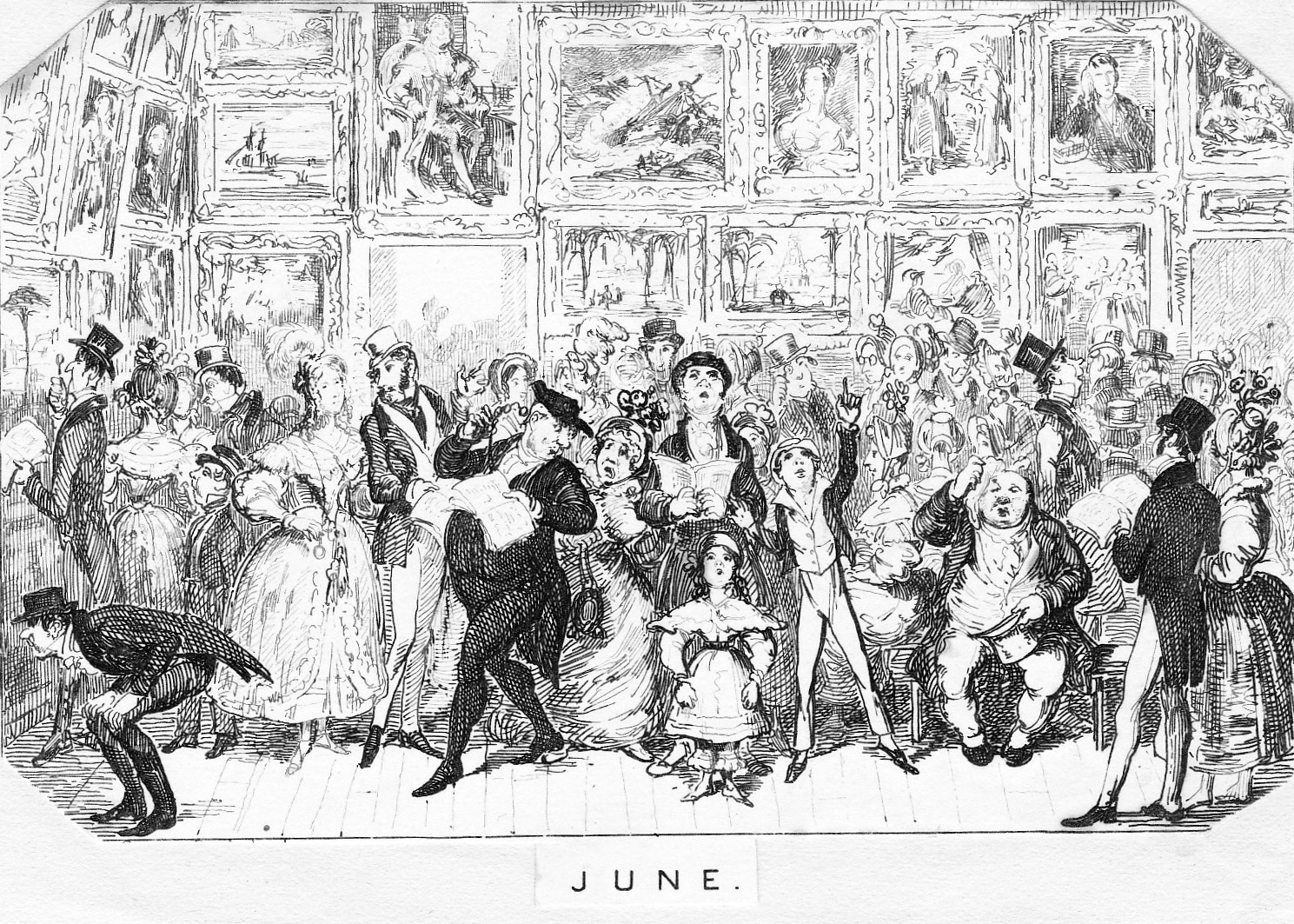
JuneFor the first of June here is another of Cruickshank’s delicious drawings of London life month by month. It shows the Royal Academy’s Summer Show with the gawping crowd of connoisseurs, fashionable types and sightseers, all jammed in to look at the pictures hung floor to ceiling in the fashion of the time. This was one of the major events in the London Season and has been held every year since 1769.

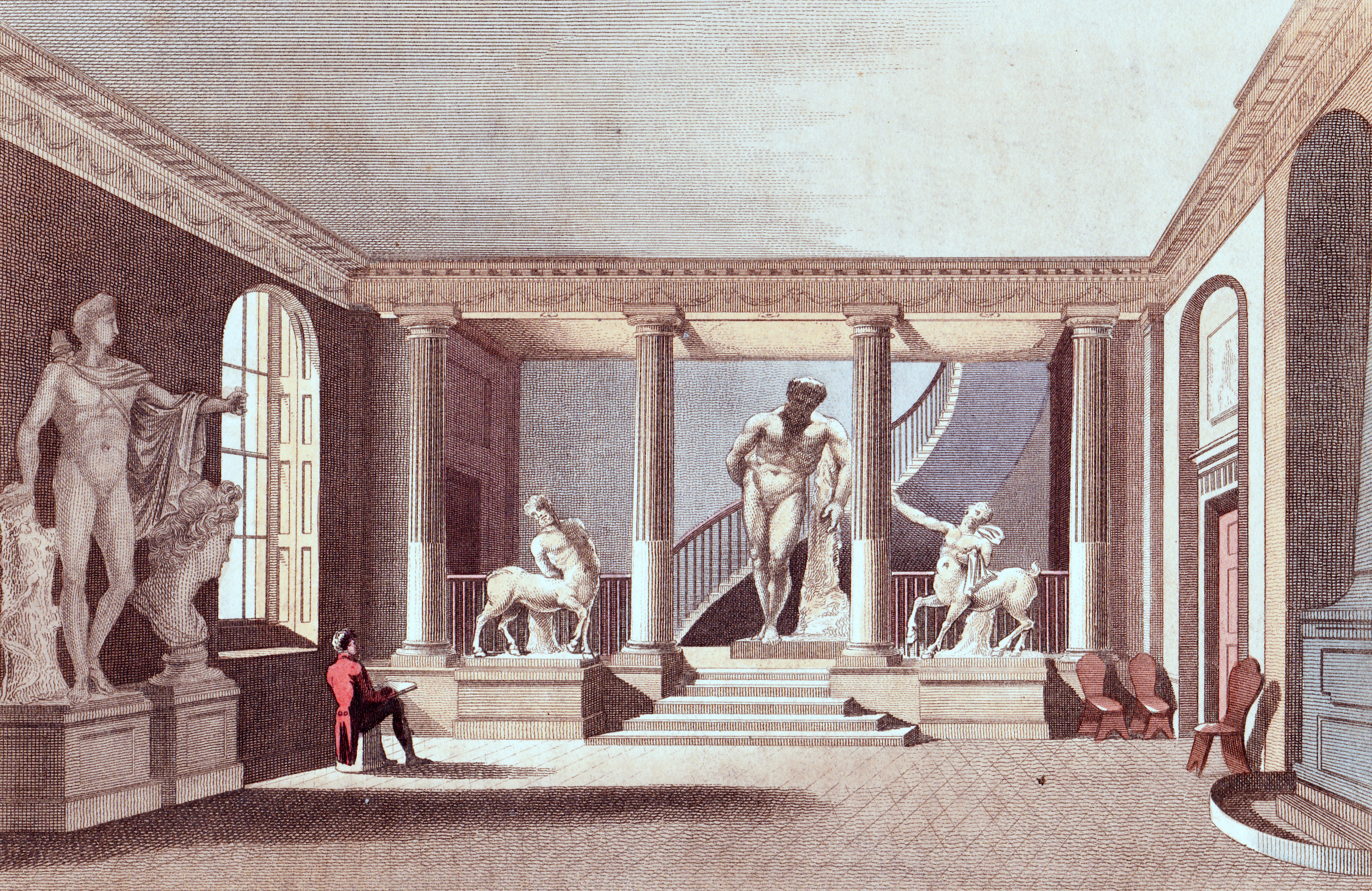
Here is Henry Alken’s view of the same event, drawn in  1821. Summer showThe Royal Academy was initially located in Pall Mall, then moved in 1771 to the first completed wing of New Somerset House, in the Strand. In 1837 it occupied the east wing of the recently completed National Gallery in Trafalgar Square and in 1868 it moved to its present location, Burlington House, Piccadilly. The plate below from Ackermann’s Repository for May 1810 shows the “Hall at the Royal Academy, Somerset House” with an artist sketching one of the plaster casts of Classical statues.

Royal Ac

Leave a comment

Filed under Art, Buildings, Entertainment, High Society

The Road to Waterloo Week 13: War Is Declared at Last, the Prince Regent Builds and the Mob Protests

France was still in the grip of a miserable, cold, foggy Spring but Napoleon would have been encouraged by Britain’s reluctance to declare war, giving him more time to wrestle with his constitutional and political problems and continue to expand his army.
An insecure British government was facing Radical opposition within the Commons and on the streets, the economy was shaky and everyone was depressed by the weather. The price of bread was rising, the farmers were having a tough time because of the rain and the King’s health kept him out of the public eye – “his disorder continues without any sensible alteration,” according to the bulletins.

Carlton House detail
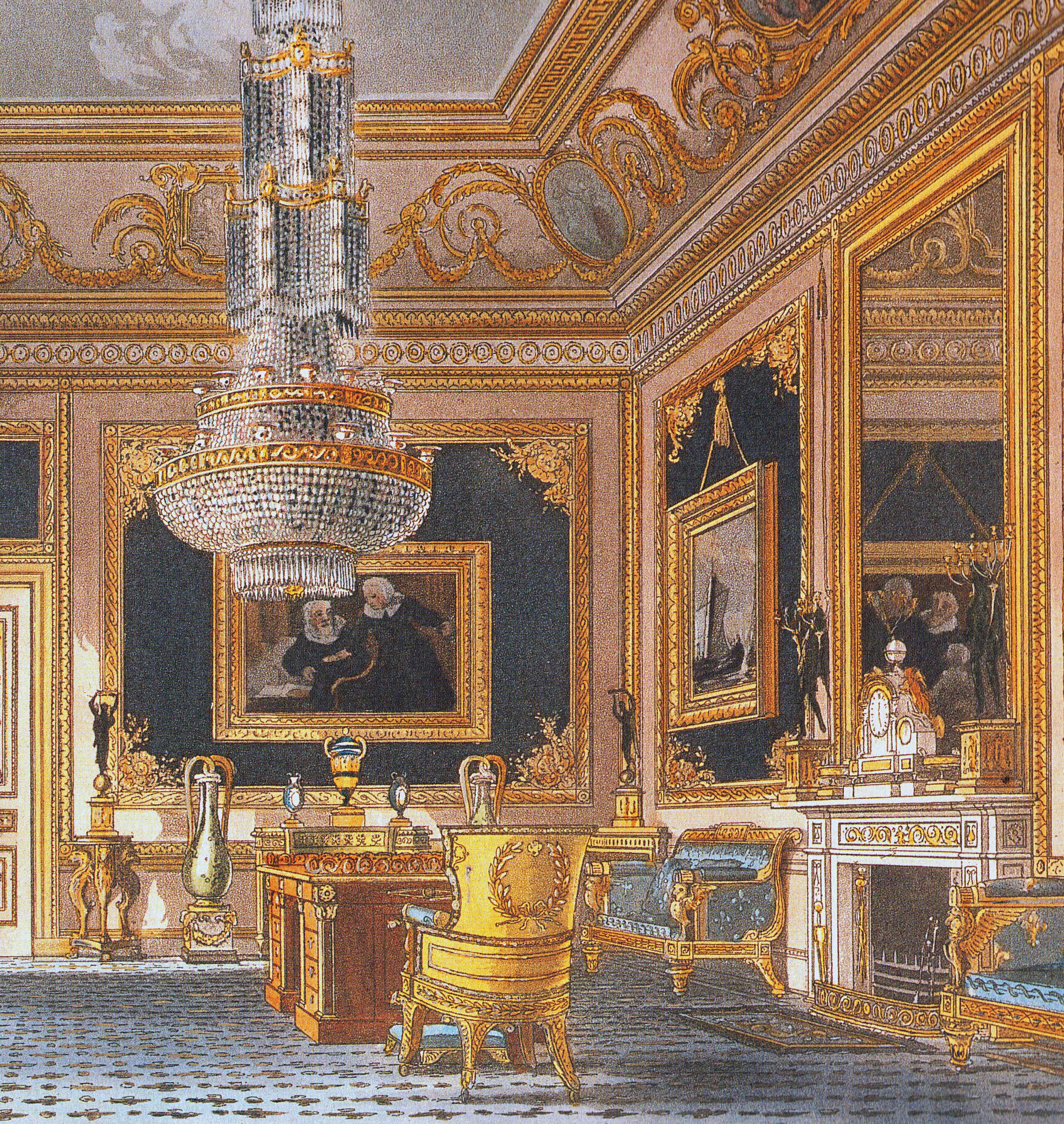
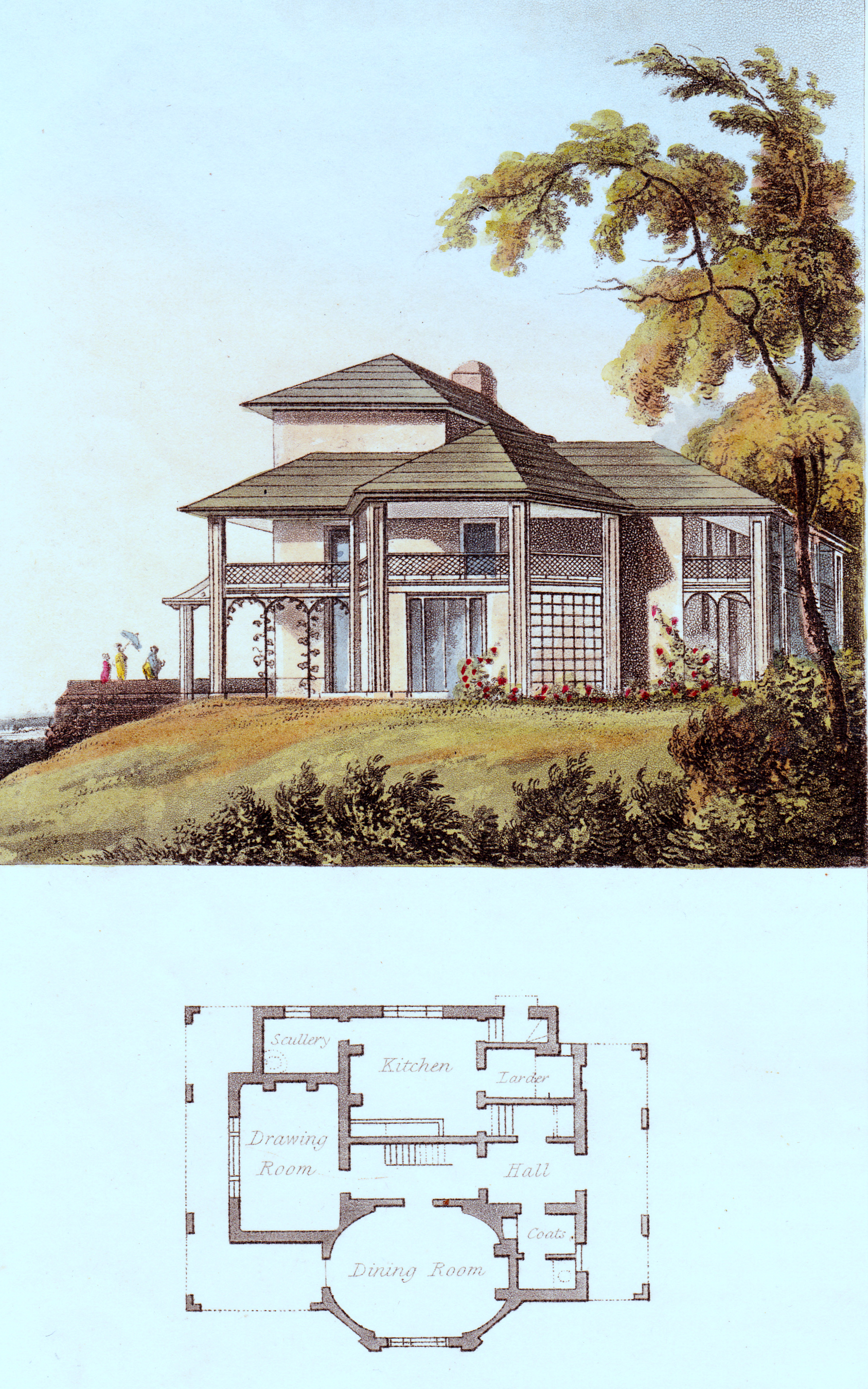
Only the Prince Regent seemed to be in a good mood – or perhaps he was keeping his spirits up with an orgy of lavish building works. A gothic-style dining room was added to Carlton House along with a library in the same style and a golden drawing room. Above is a detail of the Blue Velvet Room at Carlton House, a good example of the Regent’s lavish taste. At the same time John Nash was working on a “cottage” for the Regent in Windsor Great Park, a large and elaborate house the cottage orné style, with thatched roofs, verandas, and a conservatory. (It was demolished by William IV and the Royal Lodge now stands on the site). Nash was also working on further plans for the Pavilion at Brighton. Below is an example of the cottage orné style, although this is a much smaller example than Nash’s would have been. The drawing is from Ackermann’s Repository (November 1816)

cottage ornee
The Whigs were attacking the head of the diplomatic corps, Lord Castlereagh, and, through him the Congress of Vienna, dominated by Russia, Prussia and Austria who, they said, were a threat to independent nations. Vociferously led by Samuel Whitbread they argued that Napoleon had the support of the French people and it was wrong to go to war simply because Britain did not like him. Whitbread argued that the Emperor was now peace-loving, Castlereagh countered that once he had assembled 400,000 troops it would soon become apparent how peace-loving he was.
The harassed government was faced with mobs on the streets protesting about the Corn Law, the Income Tax, the slave trade and the Prince Regent’s extravagance, but they finally decided that Napoleon was secure on the French throne and that war was inevitable. The Allied Treaty, signed at Vienna on 25th March, was laid before the House at last – if Parliament ratified it, it became a declaration of war. It was approved in the Lords by 156 votes to 44 and in the Commons by 331 to 92 on 25th May. War was now inevitable, the only question was – when?
The firebrand Samuel Whitbread fell strangely silent after this, his place as the radical leader taken by Francis Burdett and Henry Hunt. Whitbread may have been in financial difficulty and earlier in the month he had resigned his management of Drury Lane Theatre, in which he had invested a great deal of money.
At Drury Lane on the 24th, there was a benefit performance by Edmund Kean, announced as a never-before performed tragedy by Shakespeare. The newspapers the next day were respectful of Kean, but sarcastic about the play.
“MR KEAN took his benefit last night. A tragedy by SHAKESPEARE – “never acted” had been announced as the performance of the evening; but “insurmountable difficulties” opposing the execution of this design, (no great wonder, bye the bye, for what play, undoubtedly SHAKESPEARE’S, can we at this time of day, take upon ourselves to assert, had never been acted?) the tragedy of the “Revenge”, was substituted, and MR KEAN appeared for the first time as the representative of Zanga.”

Leave a comment

Filed under Architecture, Entertainment, Napoleon, Prince Regent

Going to the Library In Georgian London

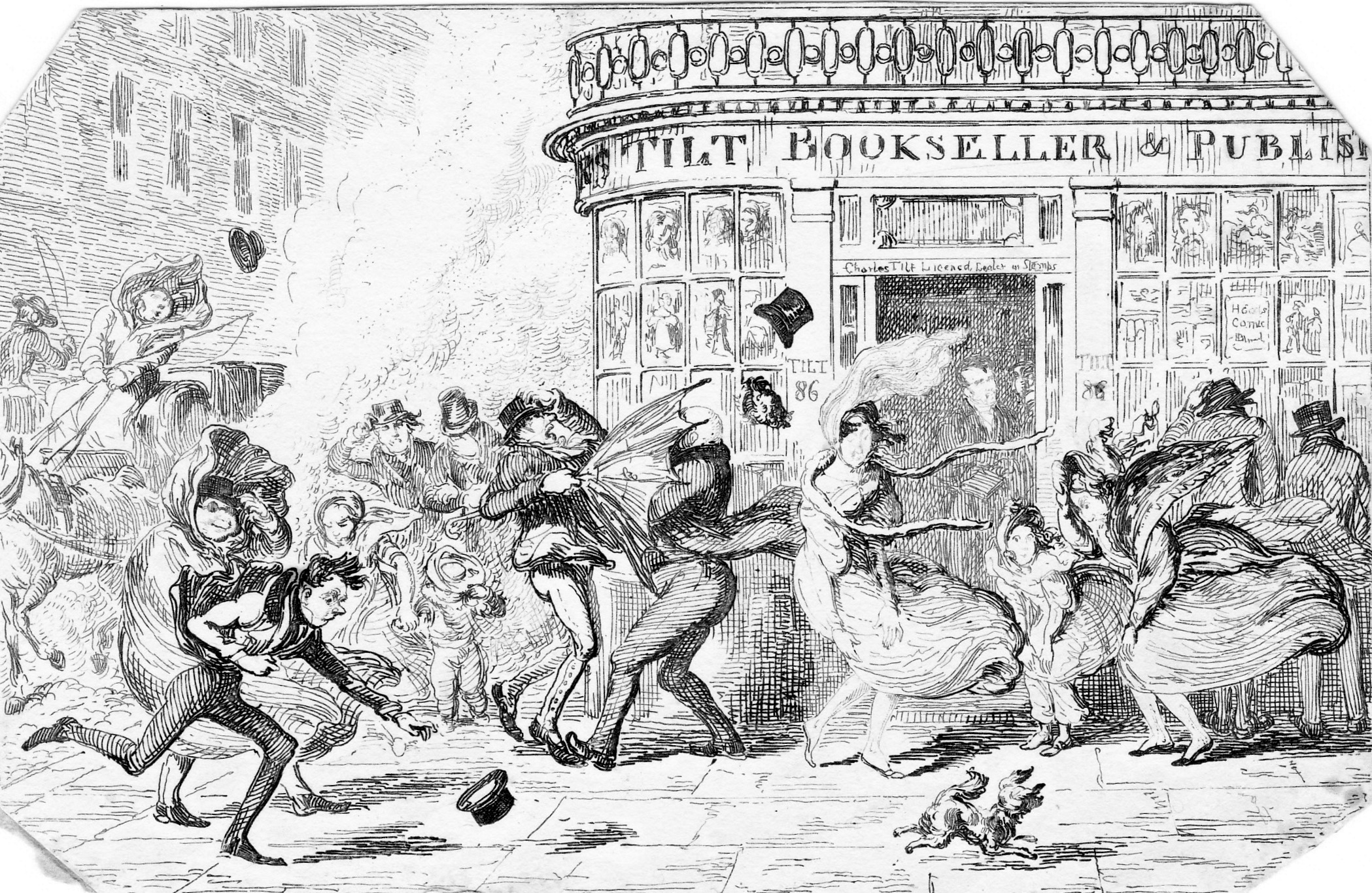
In a recent post I used two of Cruickshank’s delightful monthly views of London to illustrate the state of the streets. When I looked at March I found it showed the effects of March gales on pedestrians passing the doors of Tilt, Bookseller & Publisher, which made me dig further into my collection to see what I had on access to books.

March
For the middle and upper classes in Georgian London reading was a significant leisure pastime, whether the book was a collection of sermons, a political dissertation, a scientific work or a scandalous novel full of haunted castles, wicked barons and innocent young ladies in peril.
To have a library, however modest, was the mark of a gentleman, but not everyone could afford every book that they wanted, or wanted to own every book that they read.  The subscription circulating library came into existence to satisfy the reading habits of anyone who could afford a few pounds annual subscription and who required “Rational Entertainment In the Time of Rainy Weather, Long Evenings and Leisure Hours”, as the advertisement for James Creighton’s Circulating Library at no.14, Tavistock Street, Covent Garden put it in October 1808.

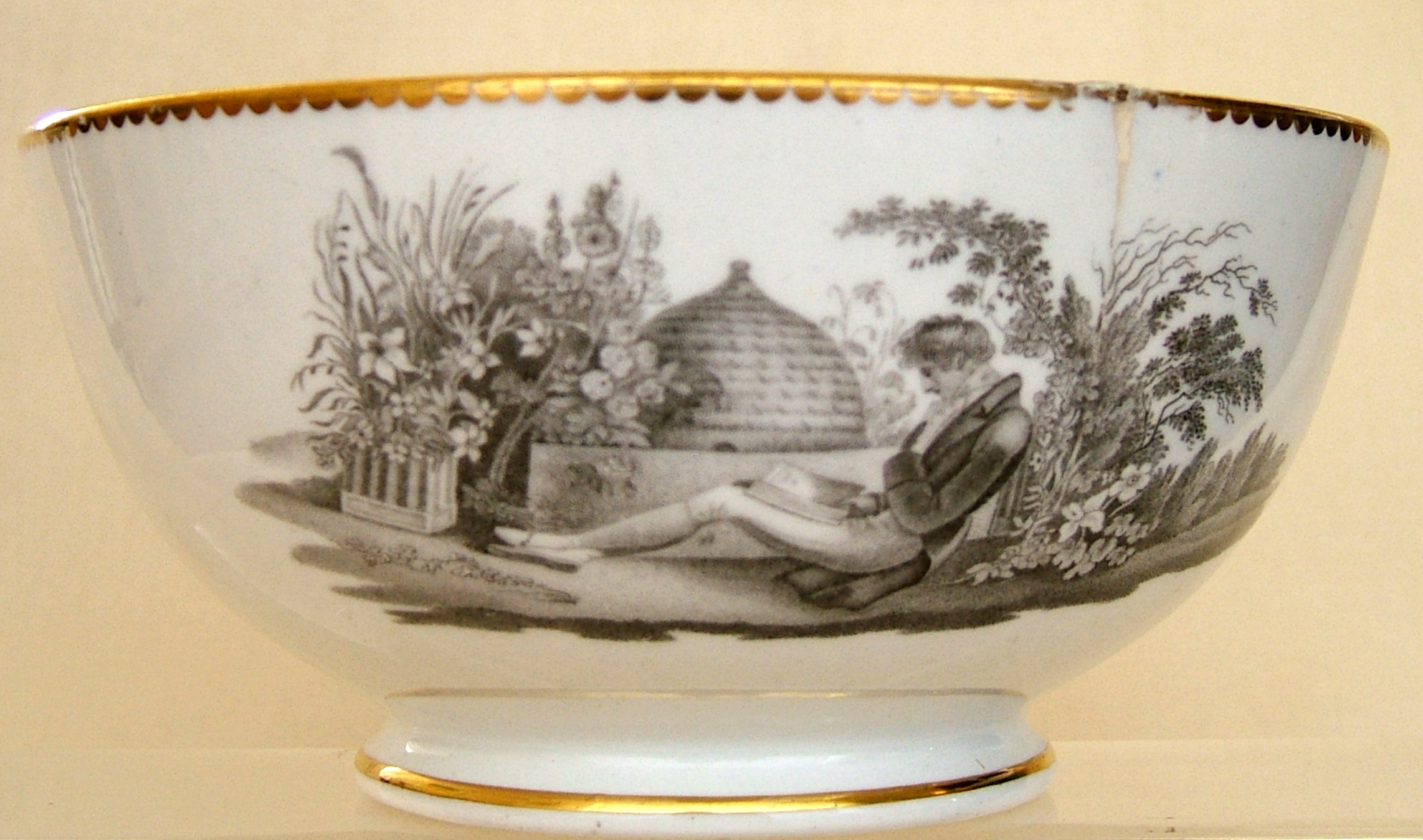
No doubt the elegant gentleman at the foot of this post would have satisfied his reading habit from one of these libraries. (He is sitting in his garden with a large bee skip in the background and is one of my favourite designs from my collection of bat-printed table wares. Bat printing refers to the method, by the way, and has nothing to do with flying mammals!)
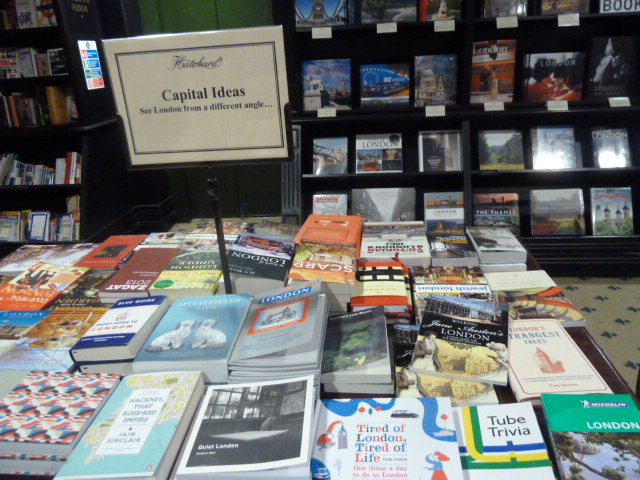
The only bookshop and circulating library of the period that survives today is Hatchard’s in Piccadilly. It was established in 1797 and shared the street with Ridgeway’s and Stockdale’s libraries. The photograph of a modern book display in Hatchard’s was kindly sent to me by a reader who spotted my Walking Jane Austen’s London on the table.Jane Austen in Hatchards. Henshaw (2nd from the right, 2nd row from the front).
Circulating libraries ranged in size from the modest collection of books in a stationer’s shop to large and very splendid collections.

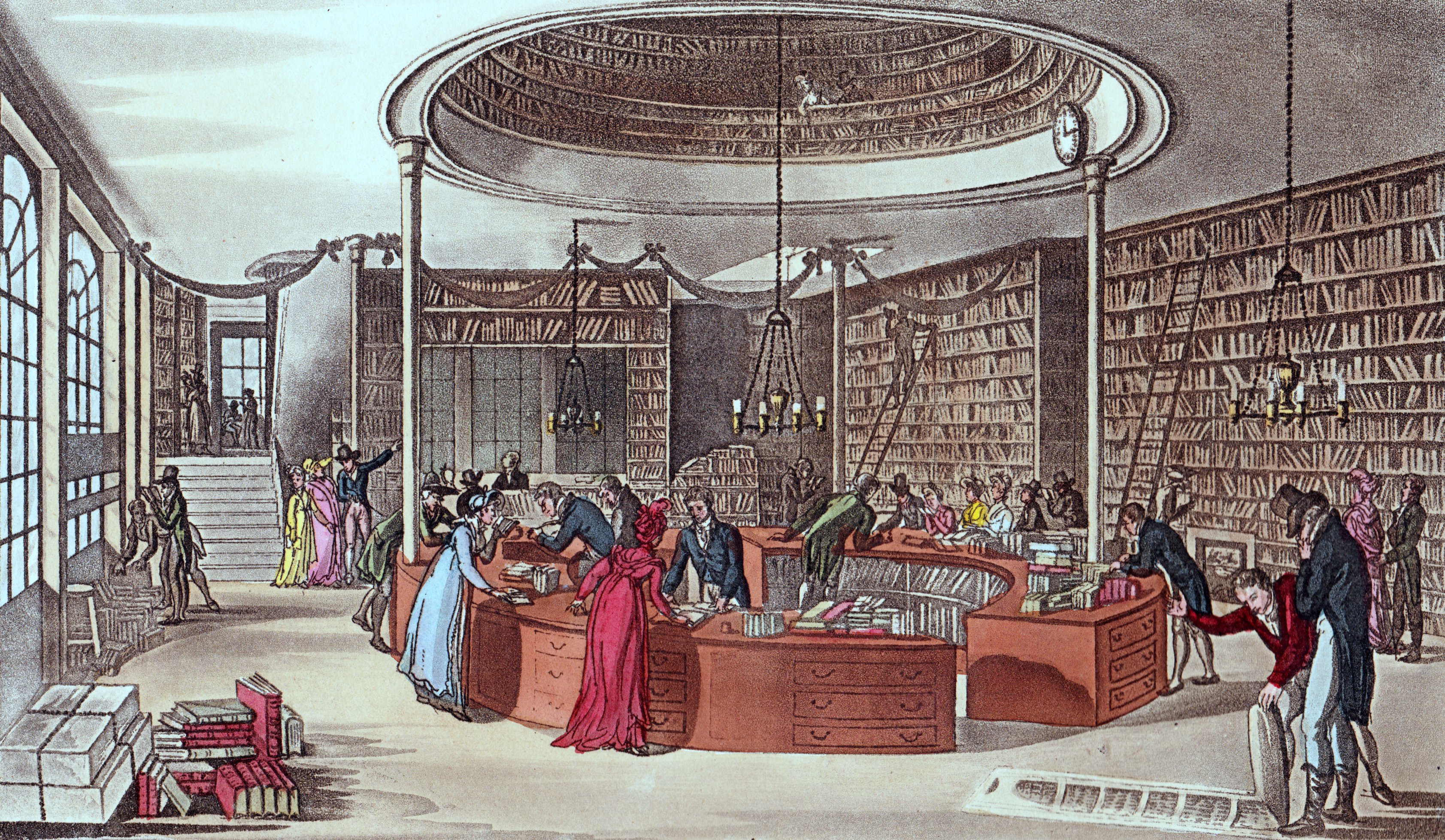
At the top end of the scale was the “Temple of the Muses”, the establishment of Messrs. Lackington and Allen in Finsbury Square. The print shows the main room with the counter under the imposing galleried dome and is dated April 1809. The accompanying text, in Ackermann’s Repository, states that it has a stock of a million volumes. The “Temple” was both a book shop and a circulating library and the pLackingtonsroprietors were also publishers and printers of their own editions. As well as the main room shown in the print there were also “two spacious and cheerful apartments looking towards Finsbury-square, which are elegantly fitted up with glass cases, inclosing books in superb bindings, as well as others of ancient printing, but of great variety and value. These lounging rooms, as they are termed, are intended merely for the accommodation of ladies and gentlemen, to whom the bustle of the ware-room may be an interruption.”
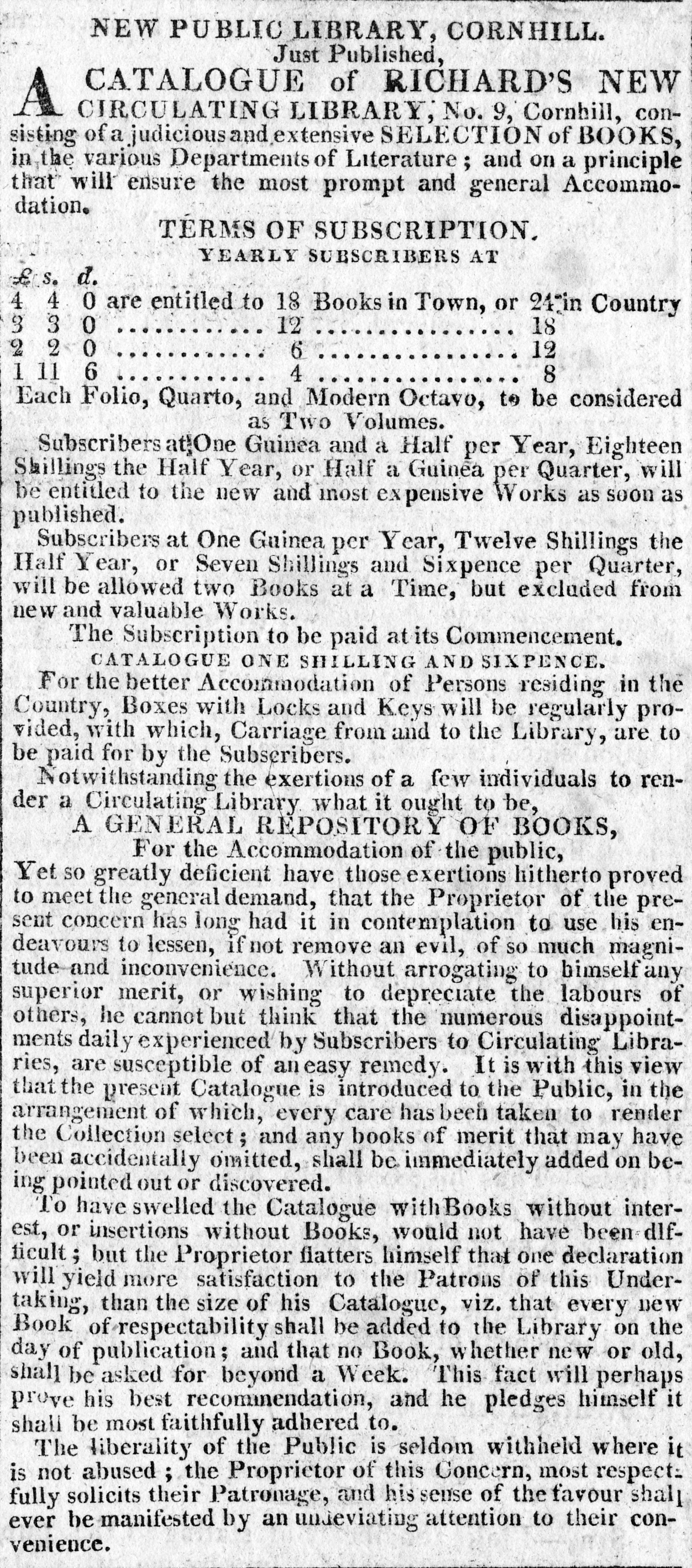
Richards libraryCirculating libraries advertised regularly in all the London newspapers and the advertisement here is a particularly detailed one from a new firm, Richard’s of 9, Cornhill and shows the subscription costs which varied between Town and Country. Special boxes were provided for the transport of books out of London, which was at the cost of the subscriber. Imagine the excitement of a lady living in some distant country house when the package arrived with one of the two books a month her subscription of 4 guineas had purchased!

Reading bat bowl

12 Comments

Filed under Books, Buildings, Entertainment, Gentlemen, Shopping, Street life, Women