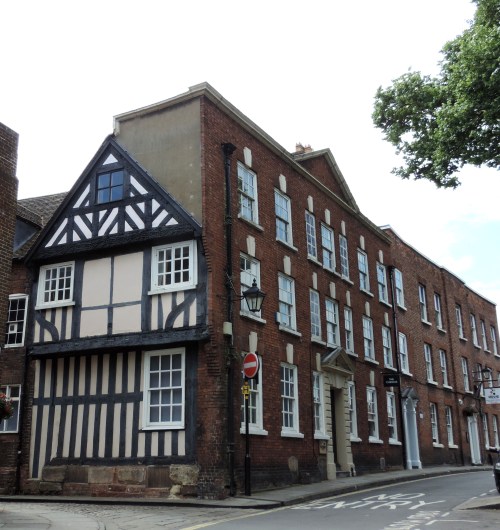
Category Archives: Buildings

Admiring the Adelphi

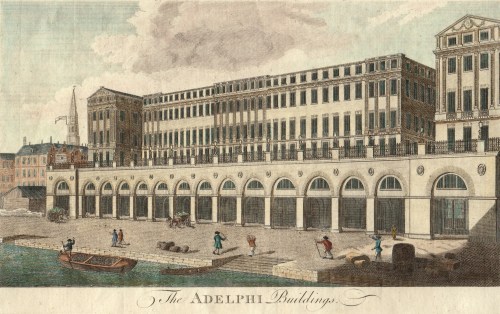
In the 1750s the three acre site between the Strand and the Thames that had once been occupied by Durham House was nothing more than a ruinous network of slum courts. It was to be transformed into the Adelphi (from the Greek for brothers), an elegant housing development, by the family of Scottish architects John, William, Robert and James Adam. They leased the land for 99 years and imported a large team of bagpipe-playing Scottish labourers – cheaper apparently than the local workmen and a source of considerable resentment. (although the unfamiliar bagpipes may have contributed to that).

The Thames was not embanked at that point and the land simply ran down to the muddy foreshore with landing stages and water gates. It required an Act of Parliament in 1771 to allow the Adam brothers to create an embankment with arched entrances into subterranean streets and storage areas and the Corporation of London was none too pleased at this infringement of its rights over the river. As well as the Mayor and Corporation they also managed to upset the Watermen and Lightermen’s Company, the Coal and Corn Lightermen and (somehow) the Dean and Chapter of Westminster Abbey. A popular ditty of the time reveals the general prejudice against the oatmeal-eating Scots.

Four Scotsmen by the name of Adams

Who keep their coaches and their madams,

Quoth John in sulky mood to Thomas

Have stole the very river from us.

O Scotland, long has it been said

Their teeth are sharp for English bread

What seize our bread and water too….

Take all to gratify your pride

But dip your oatmeal in the Clyde.

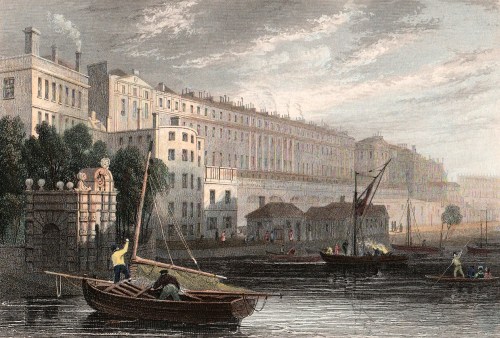
The Adams brother might have got the site at a good price but they soon found themselves in financial difficulties as they constructed the magnificent terrace of eleven houses which made up Adelphi Terrace shown in the print at the top of the post. They had employed top-level craftsmen and artists on the interiors, including painter Angelica Kaufman. Then, no sooner had they begun than there was a spectacular banking crash “the Panic” of 1772  following the collapse of the Ayr Bank. The repercussions were far-reaching and had an effect in both Europe and America. Faced with bankruptcy they held a lottery in 1774 which cleared their debts (probably helped by the fact that, somehow, they managed to win the main prize themselves.) Their next scheme, Portland Place in Marylebone, built between 1776 and 1790, created further financial problems and with house prices in the Capital falling they found it hard to sell the Adelphi properties and cover their costs with prices falling from £1,000 to just over £300 between 1773 and 1779.

However, they persevered and, with the help of royal favour and celebrity endorsement (David Garrick the star of the stage was a friend and the artist Rowlandson lived there for many years) they went on to sell to a number of big names. Behind the Adelphi Terrace itself was a tight set of streets named after the brothers themselves, along with shops and apartments and the Royal Society of Arts (Below. John Adam Street).
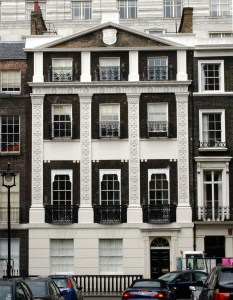
Only a few of the original houses now remain and the fabulous Adelphi Terrace was demolished in 1938 and rebuilt. John Street and Duke Street are now John Adam Street and William Street is Durham House Street.

The vaults under the Terrace still partly exist and can be glimpsed from Lower Robert Street, off York Buildings.

The final print shows the Terrace in the early 19th century. On the left, the little building is the York Watergate, built in 1626 for the Duke of Buckingham to act as a smart entrance to a private landing and steps. It has now been placed in the Victoria Embankment Gardens, completely out of context.
Save

Save

Save

Save

Save

Save

Save

Save

Save

Save

Save

Save

Save

Save

Save

Save

Save

3 Comments

Filed under Architecture, Buildings, Rivers

St George’s Hanover Square – and Its Remarkable Neighbour, Trinity Chapel


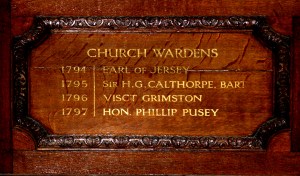
A marriage between the aristocratic hero and his true love in St George’s Hanover Square forms the climax of many a romantic historical novel, and I’ve used that scene myself. The church, completed in 1724, was built to serve the new and expanding residential area between Piccadilly and Tyburn or Oxford Road (now Oxford Street). These handsome streets and squares were a magnet for the upper classes in Society and handsome St George’s was the perfect place to be married or to have your children baptised. The 5th Earl of Jersey, husband of Lady Jersey one of the famous Patronesses of Almack’s, was a churchwarden here, although their marriage was a private one by special licence in their Berkeley Square house.

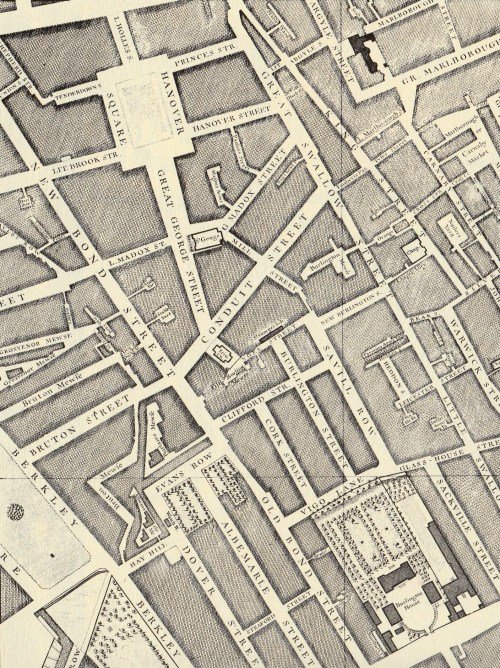
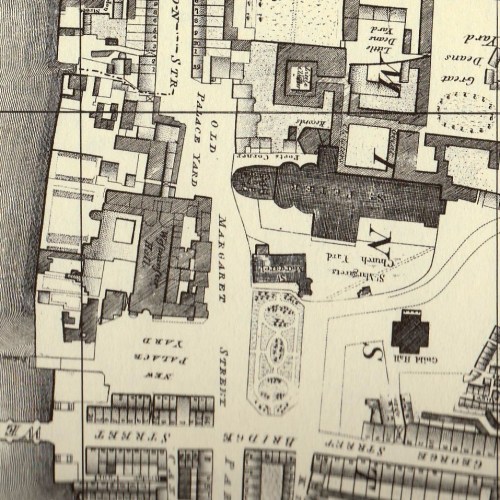
In a detail from John Roque’s map of 1747 (below) the new church sits with Burlington House to the South and Berkley (as it was then spelled) Square to the South West.

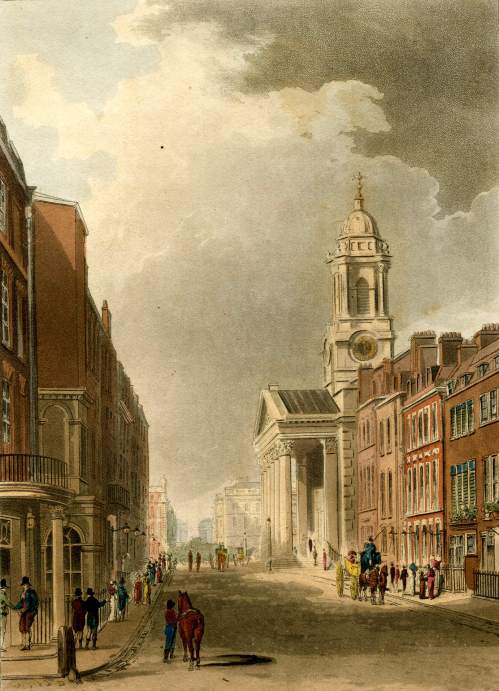
True, it is not in Hanover Square at all, but on the East side of George Street and its position gives the West front a cramped outlook, almost but not quite, looking down Maddox Street. The view at the top of the post (1812, from Ackermann’s Repository) is probably the best angle, then and now.

It is sometimes easy to forget that the occupants of these fashionable squares, great mansions and elegant terraces were serviced by a multitude of tradesmen, servants and labourers, all of whom ‘lived in’ with their employers or set up shop close by or who lodged within easy walking distance of their employment. St George’s was their church too and in between the glamorous christenings and marriages the humbler parishioners were in and out, tying the knot, naming their babies and being buried.

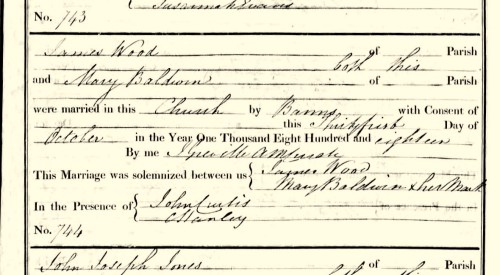
This was brought home to me by discovering my great-great-great grandfather James Wood marrying Mary Baldwin at St George’s. This was a surprise – James was a humble labourer turned chair mender and caner from Berkhamstead in Hertfordshire. What was he doing in London, let alone getting married in Mayfair? Then I discovered that he was a ‘servant’ (no idea what kind) of the Earl of Bridgewater whose country house was at Ashridge, close to Berkhamstead. The Earl had a London home in Albemarle Street (bottom, centre on the map), so presumably James Wood was there serving his employer in some capacity.

After that discovery ancestors marrying or having children baptised at St George’s in the 18th and early 19th century started appearing in large numbers – all from the concentration of piano makers in Marylebone, just North of Oxford Street. Possibly St George’s was seen as an aspirational place to be married because the Marylebone piano key makers, piano string makers, piano striker coverers and occasional dolls’ eyes makers did have other options in the various chapels of ease that had been built to help ease the pressure on the churches in these new and crowded districts.

One of those chapels  can be seen on the map on Conduit Street facing up George Street. This was Trinity Chapel and had one of the strangest histories of any London place of worship. A Chapel of Ease was a chapel either built before a parish church was in existence or added later to take the strain in a very large or crowded parish. This one started life as a moveable Roman Catholic chapel on wheels used by King James II. After he fled the country in 1688 to be replaced by William and Mary, the chapel was abandoned on Hounslow Heath where James had abdicated. Probably he took mass there in one of his last acts as king. It was transported to Conduit Street and turned into an Anglican Chapel of Ease on the initiative of Archbishop Tenison. Later it was acquired by bookseller and High Bailiff of Westminster James Robson, who had it demolished and rebuilt in brick, but because it was on leasehold land it was not eligible to be a parish church, hence the need for St George’s to be built. Unfortunately no images of the remarkable ‘traveling tabernacle’ seem to have survived and Trinity Chapel was demolished in 1875, the owner of the ground having decided that secular buildings would be more profitable.

Save

Save

Save

Save

Save

Save

Save

Save

14 Comments

Filed under Architecture, Buildings, courtship & marriage, High Society, Love and Marriage, Religion

Blowing a Cloud

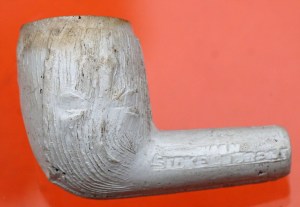
People have been smoking tobacco in Britain since the late 16th century and for most of that time they were using clay pipes to do it. Clay tobacco pipes are a huge study in themselves with learned societies devoted to tracing their manufacturers and the evolution of the various types, but in their day they were virtually as disposable as a cigarette end. I dig them up in my garden occasionally – my house is built on an old farmyard site  – and here are two. The larger, with a shamrock stamped on it is Victorian, the smaller from a time when tobacco was more expensive and bowls were smaller, is 18th century.

The Victorian bowl has a maker’s stamp on it from Stoke on Trent, one of the major centres for pipe manufacture, although they were made anywhere there was a pottery industry. There are still some clay pipe makers around today producing them for film and TV productions and for clubs, but the industrial scale manufacture ended as late as the 1950s.

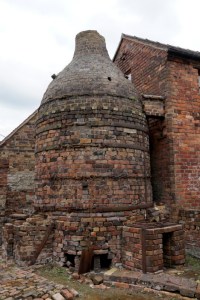
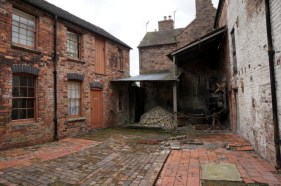
You can still visit a clay pipe factory preserved as it was the day the workers put down their tools for the last time in 1957. The Broseley Pipeworks in Shropshire is now one of the Ironbridge Gorge museums and pipe making began on the site in the 17th century. The factory is housed in converted cottages which adds even more to the atmosphere. In the view of the yard you can see the pile of clay in the shed at the back, waiting to be transformed into pipes by a method that was unchanging for hundreds of years. On the other side of the yard was the oven where the pipes, stacked into containers called saggars (then was actually an occupation of ‘saggar-maker’s bottom knocker’, but that’s for another day…), were fired.


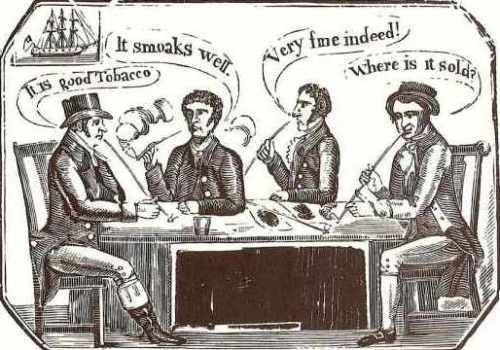
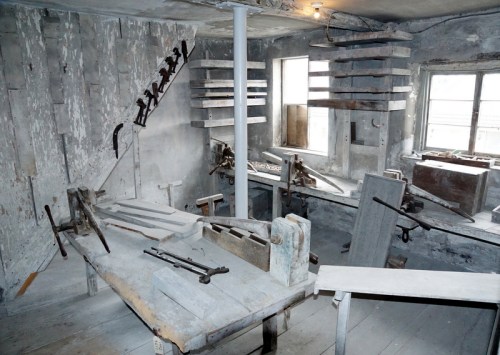
Inside the dusty space are moulds for the long-stemmed ‘churchwarden’ pipes, like those the gentlemen at the top of the post are smoking. The long stem gave a cooler smoke, but they were easily broken. Prints depicting working people often show them smoking pipes with only a stub of a stem so they could safely keep them pipe in their mouths while they worked. One mould, opened out, is on the front bench. The device on the rear bench with the long handle is the press for hollowing out the bowl of the pipe.

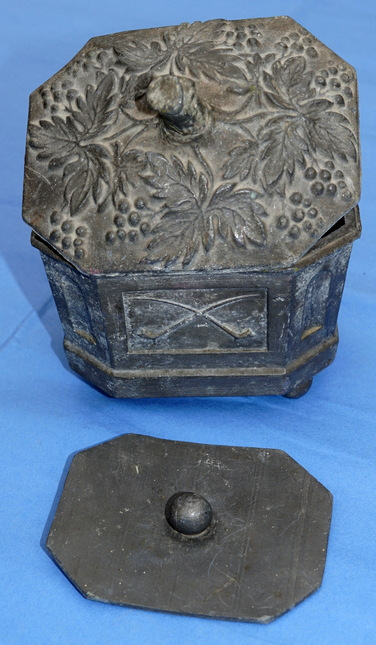
By the 19th century a huge range of pipes with novelty bowls were produced, from erotic (ladies’s legs) to political. The Pipeworks contains showcases of hundreds of different models. The popularity and availability of cigarettes finally killed off the clay pipe but for hundreds of years tens of thousands were turned out. In an inn a customer could order a pipe along with his ale and lead tobacco boxes were provided on the tables for communal smoking. The lead kept the tobacco moist and they contained a weight-plate inside to press it down. They are scarce now – many got knocked off pub tables and the soft lead was damaged on stone floors – but I own a dozen or so. This example, complete with its internal plate and a wonderful lid covered in grape vines, shows crossed churchwarden pipes on its side.



Save

Save

Save

Save

Save

Save

Save

Save

Save

Save

Save

Save

Save

Save

2 Comments

Filed under Buildings, Domestic life, Entertainment, Street life

From Westminster Hall to Antarctica – the Coronation of George IV

I went to Antarctica in the Spring expecting to have a complete holiday from the Regency. When we sailed past Coronation Island in the South Orkney Group I assumed it was named for Queen Victoria’s crowning, or even a later monarch. But no, this island (one of three so named worldwide) commemorates George IV and was named in December 1821 by two very early Antarctic explorers, the sealers Captain Nathaniel Palmer (American) and Captain George Powell (British). Either news was reaching south very fast or Powell, knowing when he had left British shores that George had become king in 1820, named the island retrospectively. He certainly claimed the South Orkneys in the name of the King – quite how much discussion about  that went on with his American colleague is not recorded! If Powell was hoping for royal favour he unfortunately did not live to receive it, dying in Tonga in 1824.

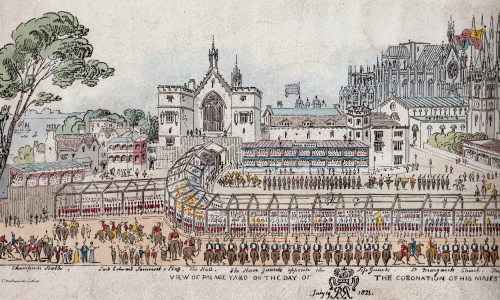
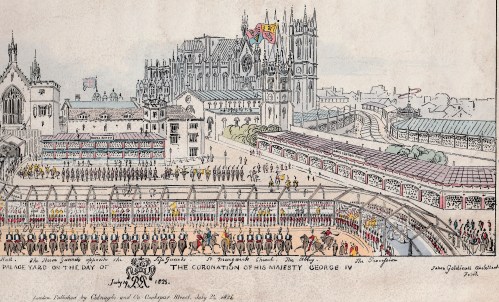
Back in London on 19 July 1821 George IV was crowned in one of the most magnificent, and completely over the top, coronations in British history. The entire day was too packed with incident for one blog post – not least the dreadful spectacle of the distraught Queen trying to gain  admittance to the Abbey – so I’ll just concentrate on the procession itself. The print I am working from was published on July 24th, just three days after the coronation, and the artist is giving the view from approximately what is now the bottom of Whitehall looking out over the modern Parliament Square in the right foreground and New Palace Yard on the left, now enclosed by railings. The Thames can be glimpsed to the left and Westminster Bridge is beyond the large tree.

I have had to scan the print in halves because of its size. It shows clearly the covered processional way (coverings not shown in order to reveal the participants) weaving its way from the front of Westminster Hall on the left, snaking round the gardens in front of St Margaret’s Church (in front of the Abbey with the Royal Standard flying from its tower) and disappearing from sight before its entry at the West door of the Abbey.

The covered walk was twenty five feet wide (almost eight metres), covered in blue carpet and raised three feet (a metre) above the ground so spectators had the best possible view. The route was lined with stands and galleries with ticketed seats selling from two to twenty guineas each. (That might have helped pay for almost half a mile of blue carpet!)

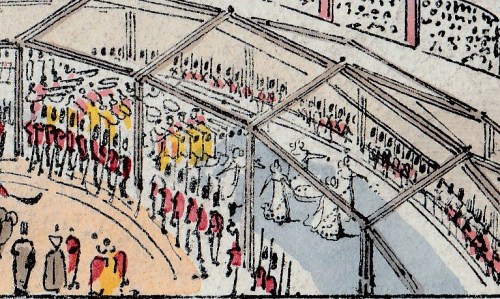
The procession started half an hour late at half past ten in the morning and was headed by the King’s Herb-Woman and six attendant maids scattering sweet-smelling herbs and petals. Behind them came the chief officers of state, all in specially designed outfits and carrying the crown, the orb and the sceptre, preceded by the Sword of State and accompanied by three bishops carrying the paten, chalice and Bible to be used in the ceremony. The peers in order of precedent, splendid in the robes, followed next and those Privy Councillors who were commoners had their own uniform of Elizabethan costume in white and blue satin.
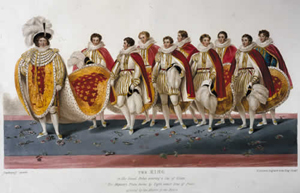
The King wearing a black curled wig and a black Spanish hat with white ostrich feather plumes had a twenty seven foot long train of crimson velvet spangled with gold stars and walked to the Abbey under a canopy of cloth-of-gold carried by the Barons of the Cinque Ports (also in special outfits). Music was provided by the Household Band.

After the ceremony, at four o’clock the King, now very weary, walked back to Westminster Hall and the great banquet served to three hundred and twelve male guests. Ladies and peeresses, who were not served any refreshments, had to watch their menfolk gorging themselves from the massed galleries that had been built inside the Hall. Amongst the food were 160 tureens of soup. 80 dishes of braised beef, 160 roast joints, 480 sauce boats, 1,190 side dishes and 400 jellies and creams.

The climax of the banquet was the arrival of the King’s Champion, in full armour, mounted on a white charger. The Champion threw down his gauntlet three times, but no-one stepped forward to challenge the King who toasted his Champion from a gold cup. Possibly the medieval glamour of the moment might have been diminished if people had realised that the Champion, from a family who long held the hereditary position, was actually the twenty year old son of a Lincolnshire rector and his charger had  borrowed from Astley’s Amphitheatre.

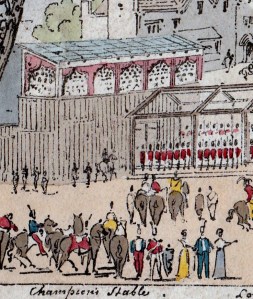
The Champion’s stable is visible on the extreme left of the print.

Save

Save

Save

Save

Save

Save

Save

Save

10 Comments

Filed under Buildings, Gentlemen, High Society, Prince Regent, Royalty, Traditions

A Georgian Facelift

Georgian domestic architecture still impresses us today with its elegant formality, symmetry and fine detailing. Even modest terraces of Georgian houses command good prices and once inside we expect to find high ceilings and a regular ‘rational’ floor plan.

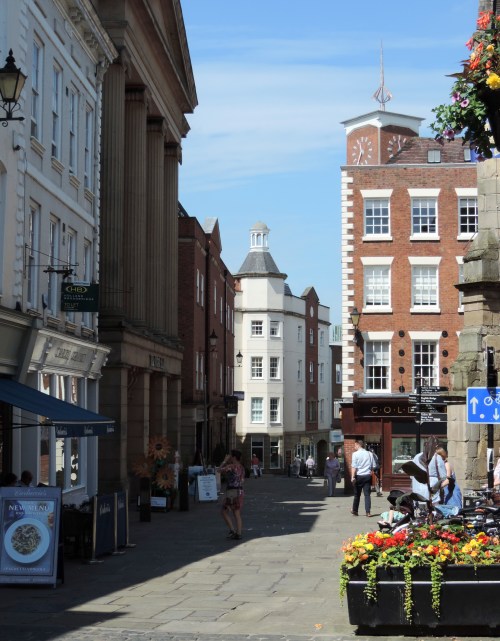
Here is the Square in the centre of the Shropshire town of Shrewsbury – all apparently Georgian with the exception of the medieval market hall just visible on the right and the modern clock tower looming over the rooftops.

But very often all is not as it seems when we view one of these handsome frontages and that was brought home to me when I saw this house, also in Shrewsbury.

The imposing frontage on the corner of Belmont and Belmont Bank dates from 1750, but it has been slapped onto the front of a half-timbered house that is at least a century older. The old house has had new sash windows inserted and the weight of a new front top floor is being carried on the roof beams of the old house. From the front it looks completely Georgian, although the strange brickwork on the side to disguise the jetties of the timber-framed house seems rather odd. But the game is given away the moment one sees it from the side, and as most of the traffic approaching it must have come from that direction it seems a strange economy not to replace both faces. Possibly this would have been structurally impossible, given the way the timber-framed house was constructed – the side face could not be cut back and the frontage was already right onto the pavement, so extending out to cover it was not a possibility.

One wonders just how many of the ‘Georgian’ houses we admire are simply refaced. I have seen some in Bury St Edmunds where the attractive Adam-style fanlights over the door reveal timber beams from the old structure behind them and there are certainly parts of London where entire streets retain early buildings hidden behind more ‘modern’ facades. Jermyn Street in the St James area, for example, appears Georgian and Victorian, but most of those frontages conceal the original 17th century houses. The shopfronts of Paxton & Whitfield (cheesemongers since the mid 18th century) and the historic perfumery firm of Floris are two examples. In Soho many frontages, such as those of Frith Street and Compton Street, conceal buildings of the early 17th century. You can be guided through St James and Soho in Walks through Regency London.

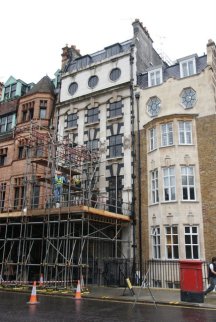
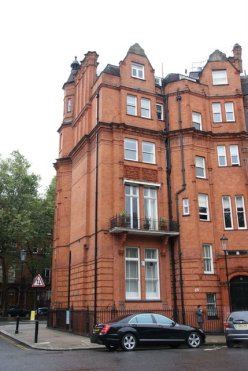
And it wasn’t only the Georgians who saved money by remodelling the exterior of houses, the Victorians did it too. When I was researching for Walking Jane Austen’s London I located two of Henry Austen’s London homes where Jane had stayed. One, in Sloane Street, has no Blue Plaque on at all, the other has one saying that the house, in Hans Square, is ‘on the site of’ Henry’s house. But in fact both of these are simply the Georgian ‘new-builds’ that Henry leased, remodelled and refaced in the late 19th century. Just after the war a researcher managed to gain entry to both and wrote a little book which I managed to track down in the British Library. It describes how the properties were refaced, additional floors added and in the case of the Hans Square House, the front door was moved. It is possible to glimpse the back of the Sloane Street house and see the octagonal room that Jane describes in a letter to her sister Cassandra as the scene of a party that Henry and his wife Eliza threw.

In the images the Sloane Street house is the one with the scaffolding (being remodelled yet again!). Here a new top floor has been added and the whole refaced in 1897. The Hans Square house was refaced in red brick, had a new top floor and the front door shifted in 1884.


Save

Save

5 Comments

Filed under Architecture, Buildings

A Thundering Good Sermon – Going to Church With the Georgians

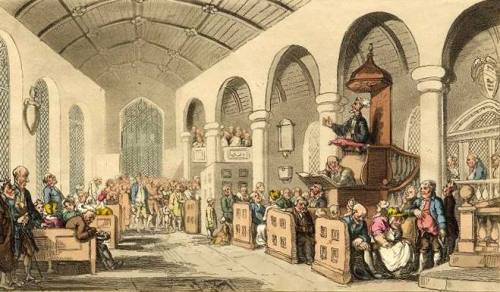
In this print by Rowlandson of Dr Syntax Preaching (1813) virtually all eyes in the crowded church are on the minister at the top of the three-decker pulpit. The owners of the most important house in the district are in their own pew to the extreme right, the high-sided pews and the gallery are packed . Everyone else must stand. The altar is out of the picture – literally.

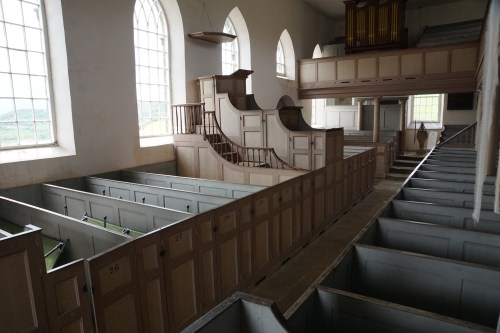
To simplify drastically, by the mid-eighteenth century worship in the Church of England was turning from both ritual and unquestioning belief in what your vicar told you or from the belief in predestination – that some were saved and some were not and that there was not a great deal to be done about it. What mattered by the early 18th century was the decision of the individual to turn to God and to live their lives accordingly – and to do that they needed to hear and understand the Word of God. Sermons became the focus of worship – the minister would expound on a text from the Bible, sometimes for hours. An increasingly literate population was offered texts to study and books of sermons became popular reading. Preachers such as John Wesley and others attracted huge congregations. On Kennington Common in 1739 the radical Anglican clergyman, and Methodist pioneer, George Whitefield, preached nightly in the open air to crowds of between 30-50,000 in the open air. Later that year, fellow Methodists John and Charles Wesley also preached regularly on the Common and attracted similar crowds. The emphasis on preaching became dominant in the parish churches across England. The image below is old Fylingdales church looking west,showing the triple-decker pulpit and the box pews, which are numbered.

Taking communion became something that the congregation would do only a few times a year (five was quite normal)  and therefore the altar moved from being the focus of the church interior, supplanted by the pulpit. In some cases pews were built that faced the pulpit even if that meant their occupants would have their backs to the altar. The pulpit dominated, often a three-decker with a desk at the bottom for the vicar’s clerk, then a desk above that for the vicar to sit at and above that the pulpit where he would climb to deliver the sermon.

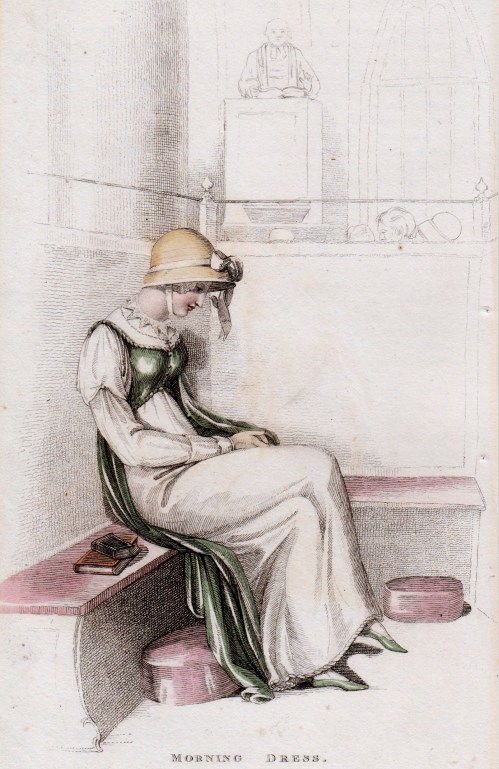
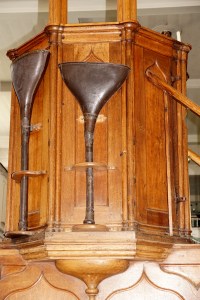
The Rowlandson print shows pews with relatively low sides, but many were introduced with sides so high that only the vicar from his raised position could see into them – these were called box pews, enclosed spaces where the churchgoer could focus entirely on what was being said without distraction from others in the congregation. The print of October 1810 in Ackermann’s Repository [above] shows an attentive listener in her box pew. Hearing what was said was crucial and, as a charming reminder of that, the ear trumpets used by an early 19th century vicar’s wife can still be seen hanging on the back of the pulpit in Whitby church. [Below]

Pews were generally rented out so that the same families would occupy them for each service and, for the more prosperous, they soon acquired extra fittings and more comfort. They might be baize-lined, have wider seats with cushions and carpets on the floor. In winter little portable charcoal foot warmers would be introduced. Aristocratic families might well have extremely ornate pews built, separated from the rest of the church in a gallery, a continuation of much earlier practice. For large households the servants might have their own box pew at the back of the church or would occupy part of the gallery. Those unable to afford pew rents would have to stand or take advantage of free pews, often provided by charitable donations.

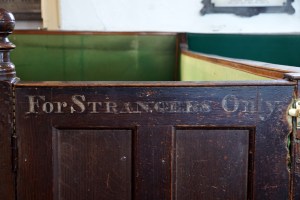
In Whitby church there is a pew marked ‘For Strangers Only’, to accommodate visitors to the town. At a time when not to attend a place of worship regularly might mark you out as a dangerous radical or freethinker, churches were crowded places on Sundays.

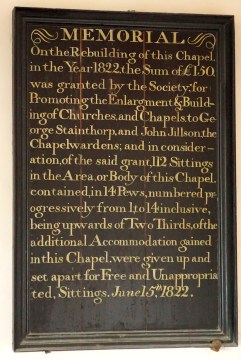
The board in the 1821 Fylingdales church commemorates the number of ‘free’ pews that had been provided in the newly rebuilt church.

But patterns of worship change and by the 1830s there was a move back towards what might be called ‘High Church’. Ritual, communion, vestments, a revival of Gothic styles of architecture and the influence of the Anglo-Catholic Oxford Movement led to another change in church interiors. Box pews were ripped out wholesale, the altar was given renewed prominence and the pulpits were replaced or the old ones cut down in height with the two desk levels removed. Some Georgian interiors suffered more than others. In Coxwold church in Yorkshire the then vicar, Laurence Sterne (author of Tristram Shandy) installed high box pews in the 1760s. In 1906 they were cut down in height by 18 inches. His triple-decker pulpit was reduced in height to a single-decker in the 19th century. Many churches were entirely stripped of their Georgian fittings and ‘restored’ to a Victorian conception of what a medieval church ought to have been. Poet and architectural crusader John Betjeman derided these efforts in his “hymn” The Church’s Restoration.

The church’s restoration

In eighteen-eighty-three

Has left for contemplation

Not what there used to be…

Some churches were spared ‘restoration’, usually by lucky accident or poverty. The old church of St Stephen, perched high above the village of Flyingdales, North Yorkshire, was built in 1821 to replace a medieval church that had fallen into decay. Its interior is therefore complete in the Georgian style with box pews, the three-decker pulpit and seats on the eastern side turned so their occupants faced the preacher, not the altar.

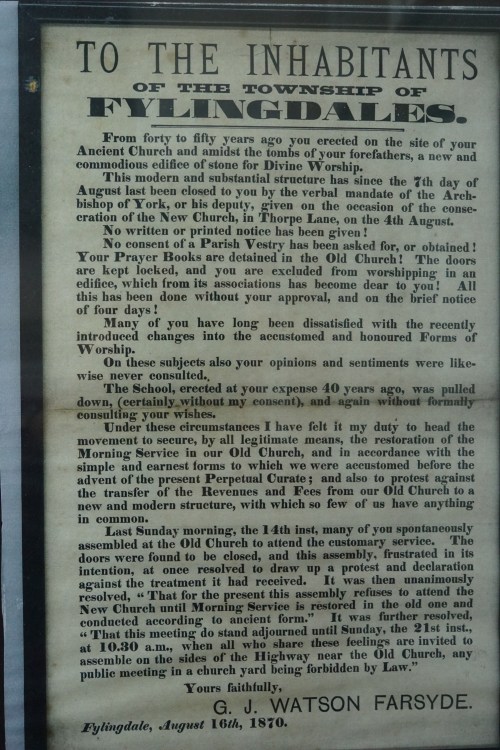
In 1870 the new vicar, apparently despairing of converting the old building (and, reading between the lines, many of the parishioners) to the new ways of worship, had a new church built down in the heart of the village. This was not universally popular and a splinter group kept trying to use the old church for services until the vicar had it locked up except when it was used as a mortuary chapel serving its old graveyard. It is now in the care of the Redundant Churches Fund.


Save

Save

Save

Save

Save

Save

Save

Save

Save

Save

Save

Save

Save

Save

Save

12 Comments

Filed under Architecture, Buildings, Religion

A Fishy Business – Billingsgate Market

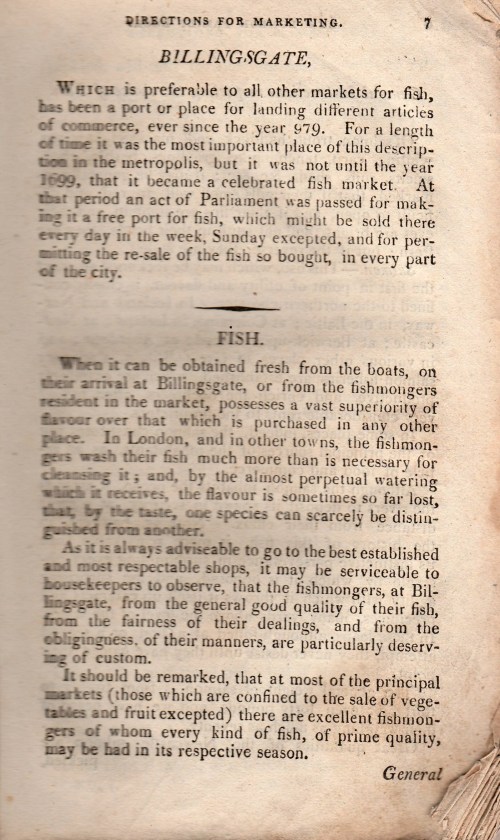
The New Family Cookery or Town and Country Housekeepers’ Guide by Duncan MacDonald (1812) begins its General Directions for Marketing with fish and with Billingsgate Market:

The comment in the penultimate paragraph is ironic, considering Billingsgate’s colourful reputation! When I was researching for my book Regency Slang Revealed I discovered that to talk Billingsgate meant to use particularly coarse and foul language.

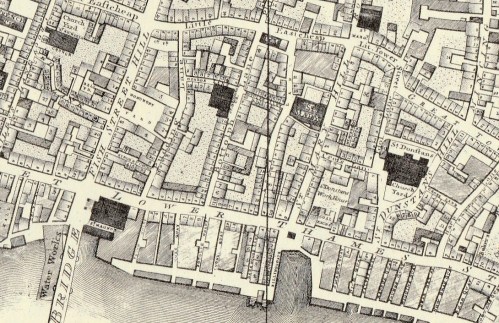
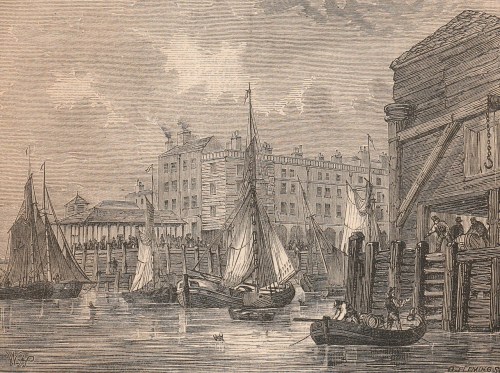
Billingsgate Market was sited at the foot of Lower Thames Street from at least the 10th century until it was moved to the new market site on the Isle of Dogs in 1982. The first set of toll regulations covering it dates from 1016 and by the time of Elizabeth I it was dealing in corn, malt, salt and vegetables, although fish was always the main reason for its existence at the highest point where fish could be unloaded straight from the boats before London Bridge. It can be seen in Horwood’s map of London (c1800) below with the deep indentation of the dock taking a bite out of the waterfront and London Bridge on the left. This dock vanished with the Victorian rebuilding of the market in 1850. That building proved inadequate and was replaced with the present handsome structure by Sir Horace Jones, opened in 1877. It was refurbished after the closure and is now used for various commercial purposes. During the 1988 work extensive remains of the late 12th century/early 13th century waterfront were revealed.

The engraving from a print of 1820 shows the view of the dock from the river. At this date there was no covered market building, simply stalls and tables set out around the dock. In the days before a ready supply of ice dealers would come into Billingsgate from places within about twenty five miles – an outer ring that included Windsor, St Albans and Romford – and fish was sold in lots by the Dutch auction method where the price falls until a buyer is found. Many of the fish were caught in the Thames and in 1828 a Parliamentary Committee took evidence that in 1798 there were 400 fishermen, each owning a boat and employing one boy, who made a good living between Deptford and London catching roach, plaice, smelts, flounders, shad, eels, dudgeon, dace and dabs. One witness stated that in 1810 3,000 Thames salmon were landed in the season. By the time of the Commission,eighteen years later, the fishery had been destroyed by the massive pollution of the river from water closets and  the waste from gas works and factories that went straight into the river.
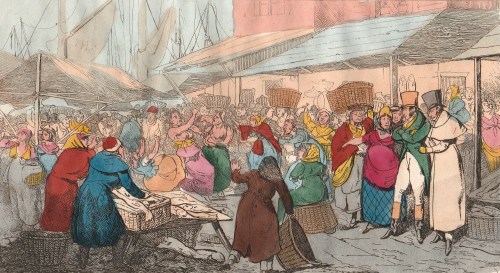
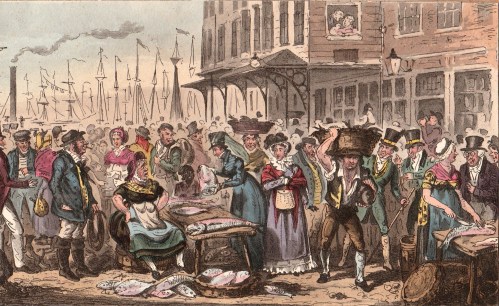
It was the fishwives of Billingsgate who became its most notorious feature. They were tough women, as they needed to be to thrive in such a hard, competitive business, and they did not shrink from either physical violence or colourful language. In Bailey’s English Dictionary (1736) a “Billingsgate” is defined as “a scolding, impudent slut.” Addison referred to the “debate” that arose among “the ladies of the British fishery” and Ned Ward describes them scolding and chattering among their heaps of fish, “ready enough to knock down the auctioneer who did not knock down a lot to them.”

The women of Billingsgate were an inevitable attraction to young bucks and gentlemen slumming, as the two prints below show. The top one is a drawing by Henry Alken for the Tom and Jerry series – “Billingsgate: Tom and Bob taking a Survey after a Night’s Spree.”  Below that is “A Frolic: High Life or a Visit to Billingsgate” from The London Spy.

Here two sporting gentlemen stand out in the crowd of working people as they watch a fight that has broken out between two bare-breasted fishwives. Another has just been knocked to the ground. Amongst the details note the woman sitting on a basket smoking a clay pipe, another (far left) taking a swig from a bottle and the porter’s hat on the man in the centre foreground with its long ‘skirt’ to protect the neck.

This print below is not dated, but as there is the funnel of a steam boat in the background amongst the masts it is probably 1820s.

Here a determined-looking lady in a riding habit, her veil thrown back and her whip under her arm, is negotiating the sale of a large fish head. Behind her is a smartly-dressed woman, perhaps a merchant’s wife, and an elderly gentleman in spectacles is talking to another fish seller on the far right. There are two men in livery, perhaps accompanying the lady in the riding habit. The man standing behind the seated fishwife is a sailor, judging by his tarred pigtail, and the porter walking towards us is wearing one of the black hats whose ‘tail’ can just be glimpsed over his shoulders. It is all fairly orderly and respectable, despite the crowd (and the smell, no doubt) but a hint to the other activities in the area may be the couple in the window!


Save

Save

Save

Save

Save

Save

Save

Save

Save

1 Comment

Filed under Buildings, Food & drink, Rivers, Shopping, Street life, Women, working life

The Cock and Pie Public House – “A Specimen of Ancient Architecture.”

cock-pie-drury-lane

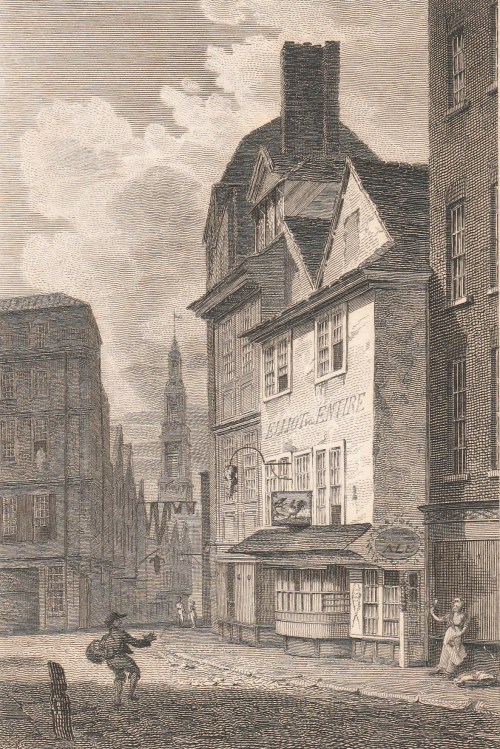
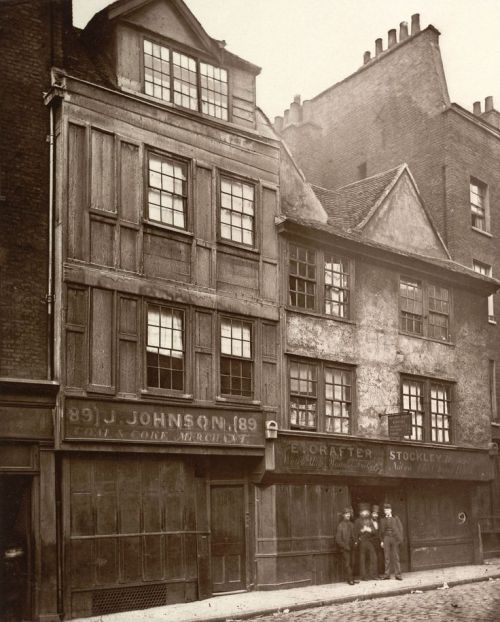
This print “View of the Cock & Pie Public House in Drury Lane” was published in 1807 as the frontispiece to volume 52 of The European Magazine. I was amused by the heading “Specimen of ancient architecture” making it sound as though the Druids, at least, were responsible for it! It isn’t easy to work out just how old it is – certainly 17th century, I imagine. It is said that it was where Nell Gwynne had her lodgings and where Samuel Pepys once saw her standing at the door.

I have been trying to place it along Drury Lane but with no success. It is certainly on the western side because one of the churches in the Strand to the south can be clearly seen at the end. The British Museum notes on their copy of the print that this is St Clement Dane, but I’m not convinced. Looking at maps of the time it seems more likely to be St Mary-le-Strand which stood opposite the end of Drury Lane.

The detail is fascinating. This was not a very respectable area, close to Covent Garden and the theatres (Nell Gwynne again!), and the gentleman walking away from us with a bundle on his shoulder is recoiling in surprise (disgust?) as the on the other side of the street woman toasts him with a wine glass. She is slumped drunkenly against a shop front, a basket of plucked chickens at her feet. Perhaps it was gin in that glass. The odd shape hanging in front of the inn is a bush, or bundle of greenery, the sign for home-brewed liquor being available that stretches back to Roman times. “ELLIOT & Co’s ENTIRE” is painted across the front and translating this took me into the history and mythology of ale, beer and porter making.

According to the Brewery History website which explains all this in exhaustive detail, “Entire, or “intire”, was an expression used by brewers to indicate a beer where the first, second and third mashes had been mixed and fermented together to make one grade of beer, rather than brewed separately to produce three different-strength beers…” This is another name for porter, as opposed to stout, a strong beer made from the first mash, which was the strongest. (If you want to be further confused with the different terms for beer and ale, have a look at my Regency Slang Revealed where I identified over thirty terms for ale and beers.)

The inn sign itself shows a cockerel on the ground and a magpie perched on a branch, a literal depiction of the name. Victorian writers maintain that this is a corruption of “Peacock in Pie” referring to the great banquet dish. Drury Lane was also a cock-fighting area and the cock may reflect that. (An area to the north-west of Drury Lane where St Martin’s Lane  met Long Acre and which became the notorious slum of Seven Dials, is shown on William Morgan’s map of 1682 as “Cock and Pye Fields” – it may have the same derivation.)

cock-pie-1840-2

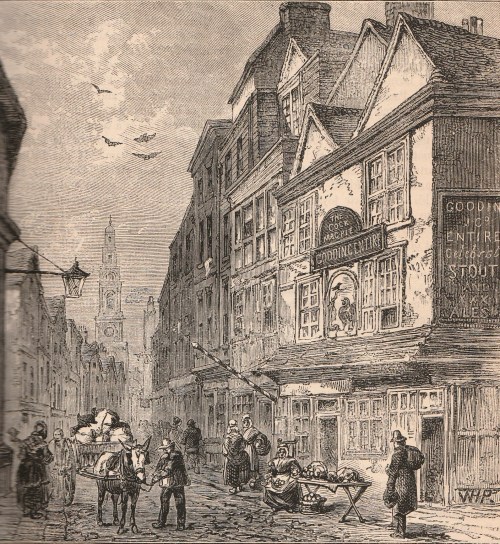
By the time  Old and New London (Edward Walford 1874) was published the building was still standing, although by then it had become “Stockley’s Cheap Bookshop”. The print of 1840 from that book, shows it when it was still a tavern, and indicates how buildings were constantly being adapted and changed. The middle upstairs window has been closed off and the sign is now on that bit of wall, the bush is no longer being displayed and the sheltering overhang over the ground floor front has been continued around the side. It is now “Gooding & Co’s Entire Celebrated Stout and XXX [ie strong] Ales” that are advertised for sale and the buildings on either side have also changed. A barber’s striped pole can be clearly seen and there is street lighting on the opposite building.

Finally here is a 19th century photograph of the poor Cock & Pie, now showing part of it as Stockley’s Bookshop. Does anyone know when Drury Lane was cleared and these old buildings swept away?

cock-pie-late-19thc


Save

Save

Save

6 Comments

Filed under Architecture, Buildings, Food & drink, Street life

The Foundling Hospital

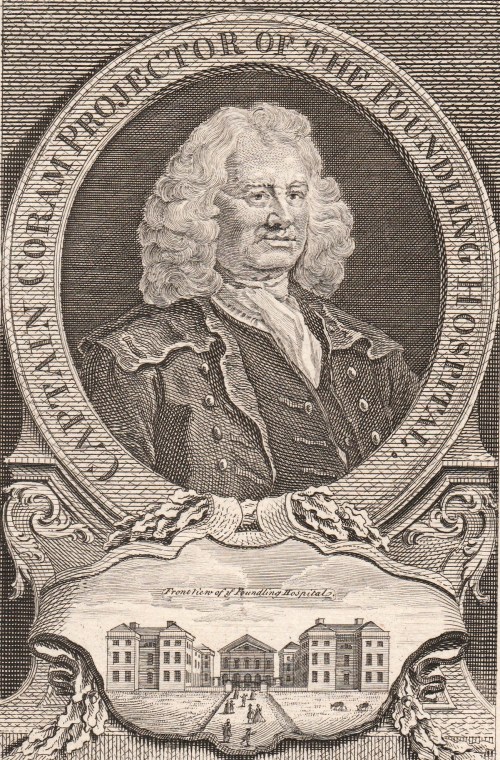
Although the prints in this post are much earlier, the Foundling Hospital would have been well known – and in fact a fashionable place to visit – right through the 19th century. It was founded in 1742 by the man in the portrait below, Captain Thomas Coram, master mariner and shipwright, who was appalled by the plight of the homeless children he saw on the streets of London when he came there to live.

thomas-coram

Coram worked hard for almost twenty years to alleviate the plight of orphaned children, or those abandoned by their parents “to die on a dunghill” before he secured sufficient support from ladies of “Nobility and Distinction” to provide a permanent home for them and a charter from George II in 1739.

After an unsatisfactory beginning in Hatton Garden a large plot – 56 acres – was bought in Lamb’s Conduit Fields, then open fields close to the road to Hampstead and Highgate villages. Work began on a grand hospital to the designs of Theodore Jacobsen and the first children – the boys – moved into the east wing in 1742. The west wing, for the girls, was ready by 1745.

foundling-hospital

The image above is a detail from “A View of the Foundling Hospital” published soon after the building was finished. Such magnificence might seem a waste of money that could have been better spent, but it was essential to attract the patronage of as many fashionable and wealthy people as possible and this fine and eminently respectable building became not only a place to visit but also one of worship in its chapel. Hogarth, and then other major artists, contributed paintings which were also an attraction to visitors who, once they were inside, could be solicited for donations.

Handel was another major benefactor. He donated an organ in 1750, gave concerts there, trained the choir and raised over £7,000 by performances of his Messiah.

The children were, at first, accepted as and when there was room on a first-come, first-taken basis but this proved unworkable because the numbers seeking admission were simply too great. Instead it became a lottery with mothers drawing a ball from a bag. White gave the child immediate admittance, providing they passed a medical exam, red put them on a waiting list and black was rejection. Amongst the most harrowing objects to see in all of London are in the collection of tokens mothers left with their child in the faint hope that one day they could come back to claim them. You can find out more about them at the Foundation’s website.

Once the children reached the age of fourteen they were apprenticed, joined the army or were found positions as domestic servants. Only  tiny handful were ever reunited with their mothers.

In 1926 the hospital moved to Redhill and then to Berkhamsted in Hertfordshire, where its buildings are now Ashlyns school. A smaller building was put up on part of the site and it retains one of the staircases and many of the furnishing and paintings from the original. Even part of the perimeter wall and gates can still be seen – have a look on StreetView at the junction of Guilford Street and Guilford Place, looking north, and you will recognize the centre front feature in the print above, although without its ironwork.


Save

Save

4 Comments

Filed under Architecture, Art, Buildings, Medicine & health, Women

From Palace to Prison – a Short History of Bridewell

prospect-of-bridewell

How does somewhere turn, in the space of thirty years, from a royal palace where the Holy Roman Emperor Charles V was lavishly entertained to a place whose name became generic for prisons for the punishment of vagrants and fallen women?

Bridewell Palace was built for Henry VIII between 1515 and 1520. Its southern façade faced the Thames, its eastern face was on the banks of the River Fleet and it was named for the nearby holy well of St Bride and it was a typical rambling, brick-built Tudor palace around three courtyards. It was the location where Hans Holbein’s famous painting The Ambassadors was set, the venue for masques and celebrations when Charles V visited and the home of Henry’s illegitimate son Henry Blount, Duke of Richmond and Somerset.

Its days as a palace were short-lived after it served as the venue for conferences with the Papal Legate over the royal divorce and Henry’s last meeting with Catherine of Aragon in November 1529. By 1531 it was leased to the French Ambassador and it was there in 1533 that Holbein’s The Ambassadors was painted.

In 1553 Edward VI gave Bridewell away, granting it to the City of London as a home for destitute children and vagrants and as a prison for punishing disorderly and loose women and petty offenders with short periods of incarceration and regular whippings. Queen Mary confirmed Edward’s gift – perhaps not wanting to take back the place of such ill-memories of her mother.

The model of prison, hospital and workrooms proved successful enough for many others to be opened across the country, all called Bridewells. The whippings took place in  public twice a week, there was a ducking stool on the banks of the Thames in 1628 and there were also stocks. The regime appears to have been one of “short, sharp shock”, although it seems doubtful that it was very successful in reducing vagrancy, petty crime and immoral behaviour with no support for its inhabitants once they were released. More fortunate were orphans of City Freemen who were accommodated here for an education before being apprenticed to a trade.

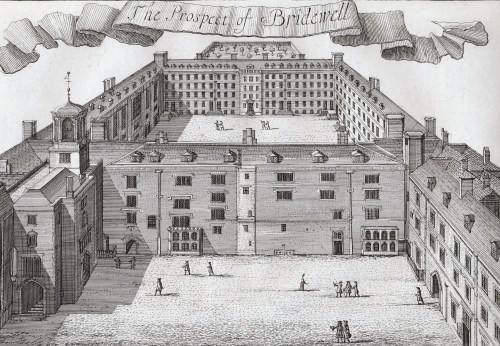
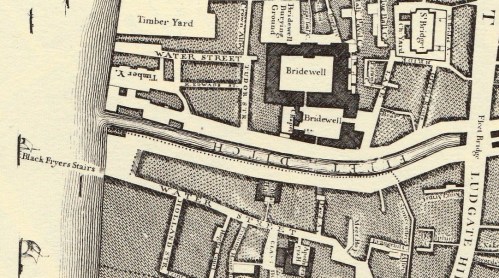
The Great Fire of 1666 destroyed much of the old palace and it was rebuilt in 1667. Judging by the print at the top of this post from a drawing by Jan Kip made in the early 18th century, some of the old Tudor palace survived. It can be seen surrounding the courtyard in the foreground with the 17th century and later additions behind. This version of Kip’s drawing was published in 1720 by John Strype and shows the view from the east – in other words, the artist is hovering above the Fleet River and looking west. The two courtyards of the rebuilt Bridewell can be clearly seen in this detail from John Rocque’s map of 1747 (below) turned to be in the same orientation.

bridewell-roque

Despite the floggings the Bridewell was more liberal than other prisons of the time – it had a doctor in 1700, seventy five years before they were appointed to prisons elsewhere, and in 1788 prisoners were not only given straw for their beds but actual beds to put it in – other gaols had neither beds nor straw. Women were not whipped after 1791. The air quality must have improved somewhat after the Fleet was covered in 1764 with the creation of New Bridge Street down to Blackfriars Bridge (1760-69).

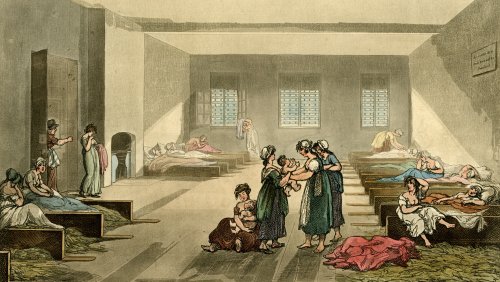
The beds filled with straw can be seen in this print of The Pass-Room at Bridewell, 1808 from Ackermann’s Microcosm of London. Here single women with babies were locked up as punishment for their ‘loose behaviour’. The notice on the wall warns that “Those who dirts Their Bed will be Punished.”

bridewell

Building work and improvements carried on until 1833 when all the Bridewells passed from local control to become part of the government’s prison system. In 1855 the prisoners were transferred to Holloway prison and the buildings were demolished in 1863/4. The only remaining fragment is the façade and gateway of 1802 which is now 14, New Bridge Street.

The outline of the site remains in the block bounded by New Bridge Street to the east, Tudor Street to the south, and Bridewell Place which wraps around the west and north sides. Tudor Street can be seen on the Rocque map and led towards one of the notorious and lawless Alsatias from which many of the inmates of Bridewell probably came.

As with Bedlam, the public could gain admittance to view the unfortunate inmates. Priscilla Wakefield, author of Perambulations in London (1814) wrote, ‘Many of the prisoners who we were permitted to see, were women, young, beautiful and depraved.’ Like much of Wakefield’s moralising writing this fills me with the desire to give her the life-chances those ‘depraved’ young women had and see how she got on!

The print below is from Ackermann’s Repository of May 1812 and shows the view looking south down New Bridge Street from what is now Ludgate Circus where Fleet Street dips down to the Fleet Valley and then rises eastwards up Ludgate Hill to St Paul’s Cathedral. Bridewell is concealed behind the furthest range of brown buildings on the right of the print.

new-bridge-street

This area is included in Walk 8 of my Walking Jane Austen’s London and Walk 9 of Walks Through Regency London.


Save

Save

Save

7 Comments

Filed under Architecture, Buildings, Crime, Rivers