Yearly Archives: 2015

It Is August In London – Eat Oysters on Oyster Day or Run Away to the Seaside?

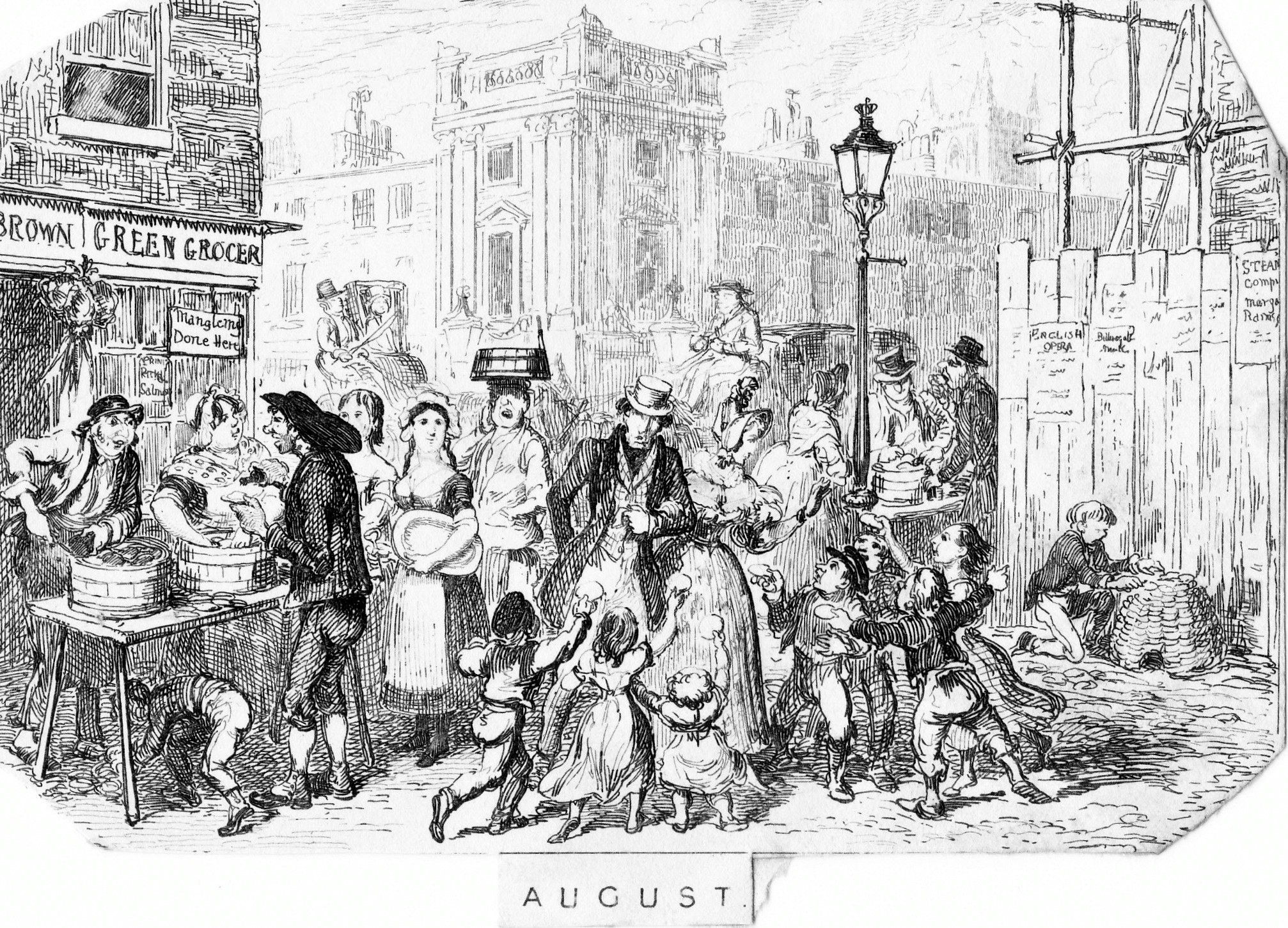
August in London was the time to celebrate “Oyster Day” – the arrival of the first oysters at Billingsgate fish market. The scene on the streets is shown in the first print from Crucikshank’s London Almanac. This was a significant day for the poor for whom oysters was a cheap staple. In London Labour and the Poor Mayhew wrote that “the number of oysters sold by the costermongers amounts to 124,000,000 a year. These, at four a penny, would realise the large sum of £129,650. We may, therefore, safely assume that £125,000 is spent yearly in oysters in the streets of London.”
London August

In the scene working people queue up at two trestle tables to buy oysters. The vendors are opening them and on the left we can see a coal heaver or dustman, distinguished by his hat with a protective neck flap, pouring some kind of relish or ketchup over his.

A small boy is rummaging under the trestle for empty shells and on the right one lad is building them into a construction while other children holding up shells mob a respectably-dressed couple begging for coppers. An article in the Illustrated London News of 1851 explains what must be happening.

“We will not pursue the calculation into how many grottoes might be built from the shells of a year’s supply of oysters…. The coming-in of oysters is observed as a sort of festival in the streets; and in such a nook of the metropolis as the present locality, the grotto is usually built of inverted oyster-shells piled up conically with an opening in the base, through which, as night approaches, a lighted candle is placed within the grotto, when the effect of the light through the chinks of the shelly cairn is very pretty. It is but fair that the young architects should be rewarded for their trouble accordingly, a little band, of what some churl may call urchins, sally forth to collect pence from the passers-by ; and the usual form of collecting the tax [is] by presenting a shell…”

Of course, you might choose to leave the heat and dust of London in August (to say nothing of the smell of discarded oyster shells) and go to the seaside. Brighton, Margate and Ramsgate were closest (if one leaves aside Gravesend, which even in the Georgian period was getting a reputation for being somewhat rough).
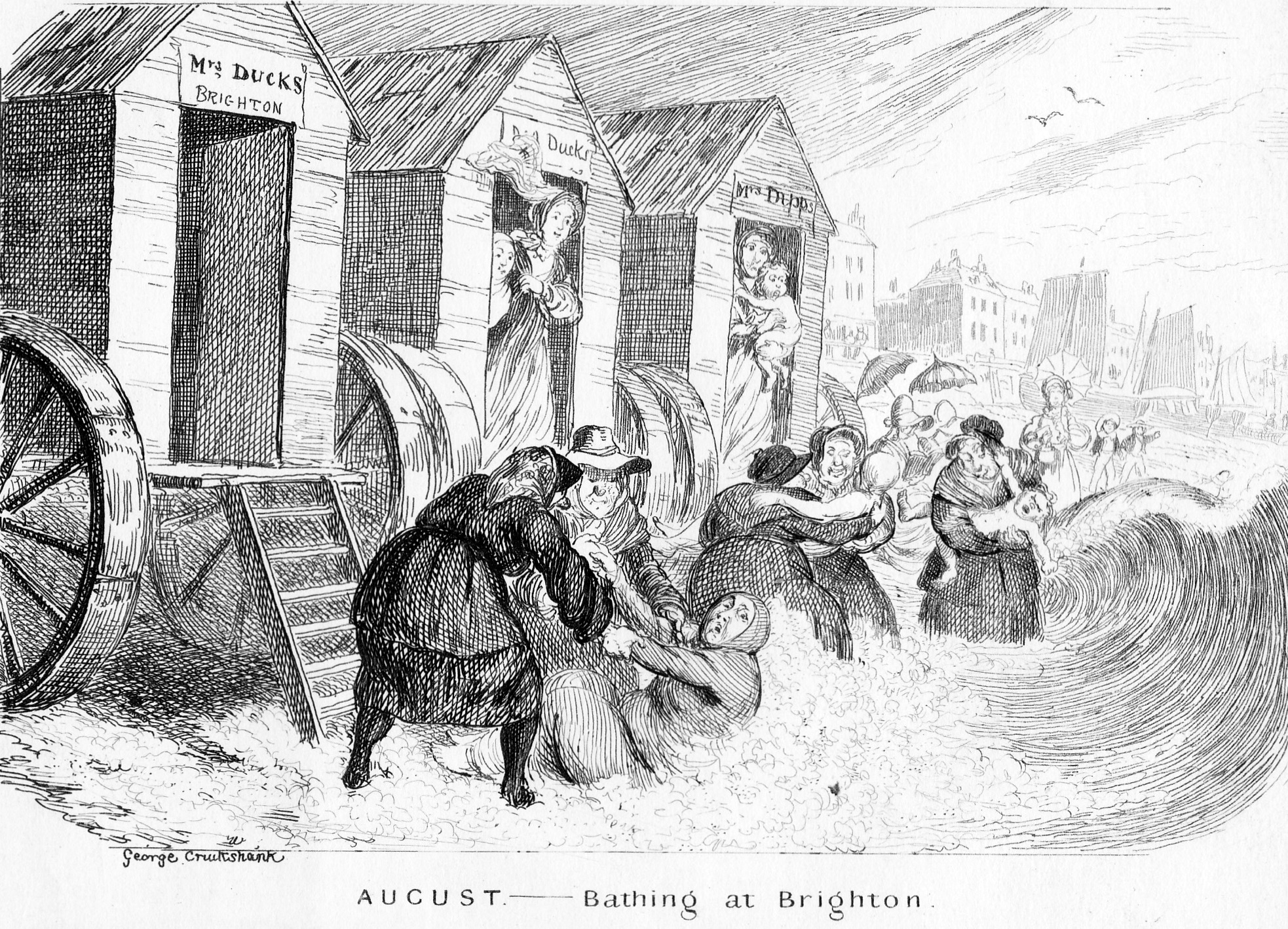
Brighton AugustCruikshank has chosen to show bathing machines at Brighton with four burly female “dippers” dunking their quailing customers in the sea. The machines have boards showing the names of the dippers – two for “Mrs Ducks” and one for “Mrs Dipps”. In the foreground a lady is entirely enveloped, head and all, in a flannel “case” while in the middle two dippers are about to plunge a slight figure – a teenage girl perhaps – in backwards. A furious baby is getting a relentless ducking at the far end.

The Margate design of bathing machine, invented by Quaker Benjamin Beale, had a hood which came down to shelter the bather’s modesty, and perhaps divert some of the force of the waves, but these were not used at Brighton.

Although the seaside holiday is often thought of as a Victorian invention they were very much a feature of the Georgian scene for those who had money and leisure. By 1800 every English county with a coastline had at least one seaside resort. Brighton is perhaps the most famous example, but it was by no means the first – Scarborough probably has best claim to the title, although Margate and Brighton were close behind and all three were flourishing in the 1730s, long before the Prince Regent made Brighton notorious.

Brighton did have the benefit of closeness to London that Scarborough did not. In 1821 Dr John Evans remarked on stagecoaches doing the journey in six hours and predicted that balloon travel would reduce it to four hours in the future and in 1823 Cobbett wrote of “stock-jobbers…[who] skip backwards and forward on the coaches, and actually carry on stock-jobbing, in ‘Change Alley, though they reside in Brighton.” In 1834 four hundred and eight passengers arrived by coach in Brighton in one day, and 50,000 were recorded for the year.

Just as beach-wear and cruise-wear figure in the fashion magazines today, outfits for seaside visits were carefully chosen. Here is one from La Belle Assemblée designed by Mrs Bell for “Sea Coast Promenade”. personally I think the wearer has located the gentlemen’s bathing beach and has no intention of promenading any further…

1809 telescope

6 Comments

Filed under Entertainment, Fashions, Food & drink, Seaside resorts

A Blue Plaque for Georgette Heyer

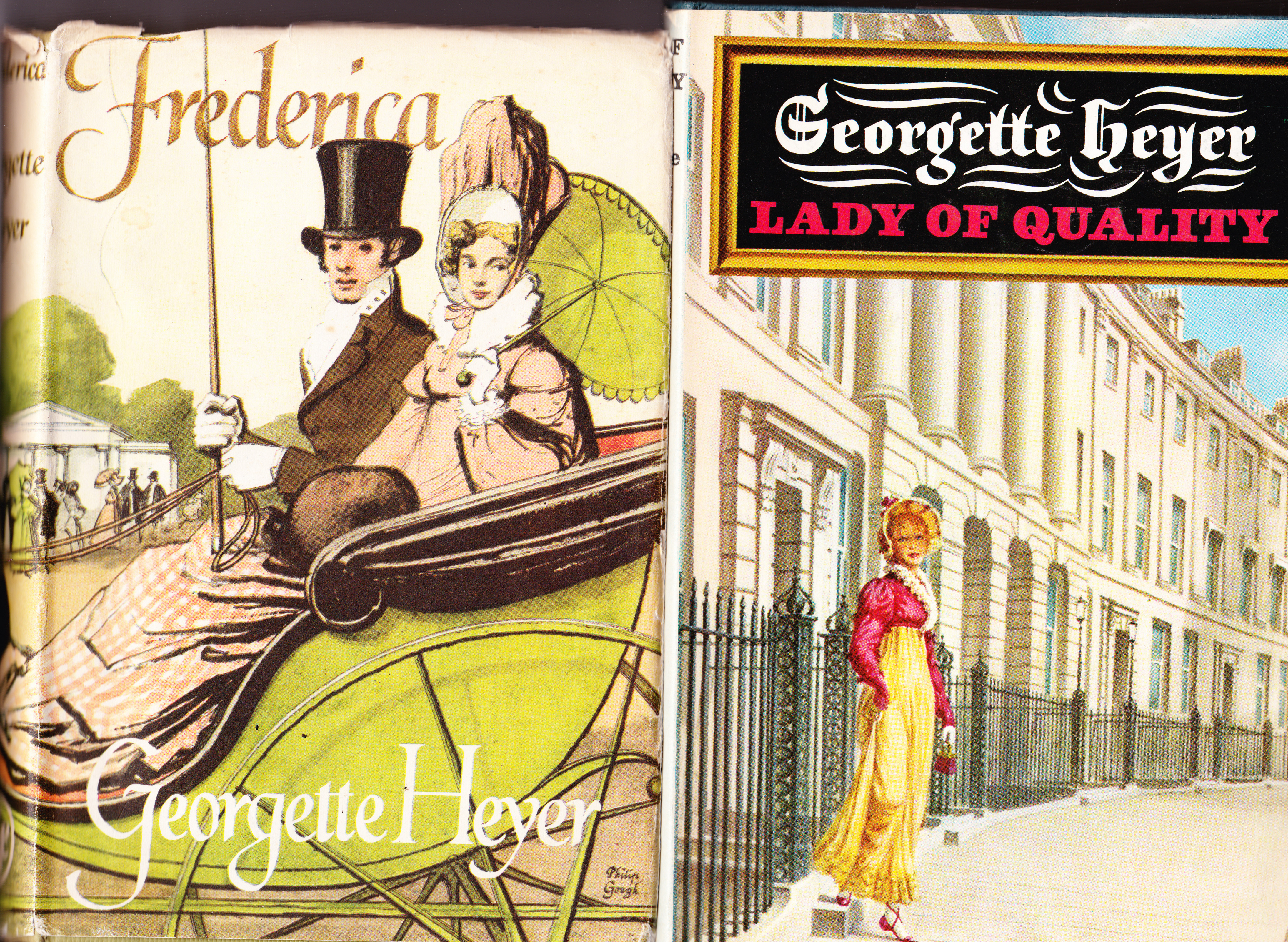
An absolute favourite writer for most lovers of the Regency is Georgette Heyer, and the great news is that on Friday 5th June English Heritage unveiled a Blue Plaque at 103, Woodside, Wimbledon, where Georgette was born on 16th August 1902.
I’ve been a Heyer fan as long as I can remember, and I particularly get a thrill when I’m in the History stacks at the London Library in St James’s Square and recall that this was where she did so much of her research.
Heyer’s novels are a treat for anyone who loves Georgian London and my favourite is Frederica, with its priceless image of the dreadful dog Lufra chasing the cows in Green Park, even if it does contain one of Heyer’s few research failures when she located the Soho Foundry, not in Birmingham, but in…Soho.
For anyone who is inclined to dismiss her writing as romantic froth, I would recommend Jenny Haddon’s post http://jennyhaddon.com/?p=973 “The Space Between the Words” on the understated power of her writing. And if you haven’t already read it, Jennifer Kloester’s biography Georgette Heyer, is the perfect accompaniment to her books.
I’ll leave you with a picture of two books from my collection, including one of my precious first editions. And if you like to see a (good) feature film, made of one of her novels, why not sign the petition http://www.petitionbuzz.com/petitions/georgetteheyerfilm
Heyer_0002

5 Comments

Filed under Books

It’s June and the Pictures Are On the Wall

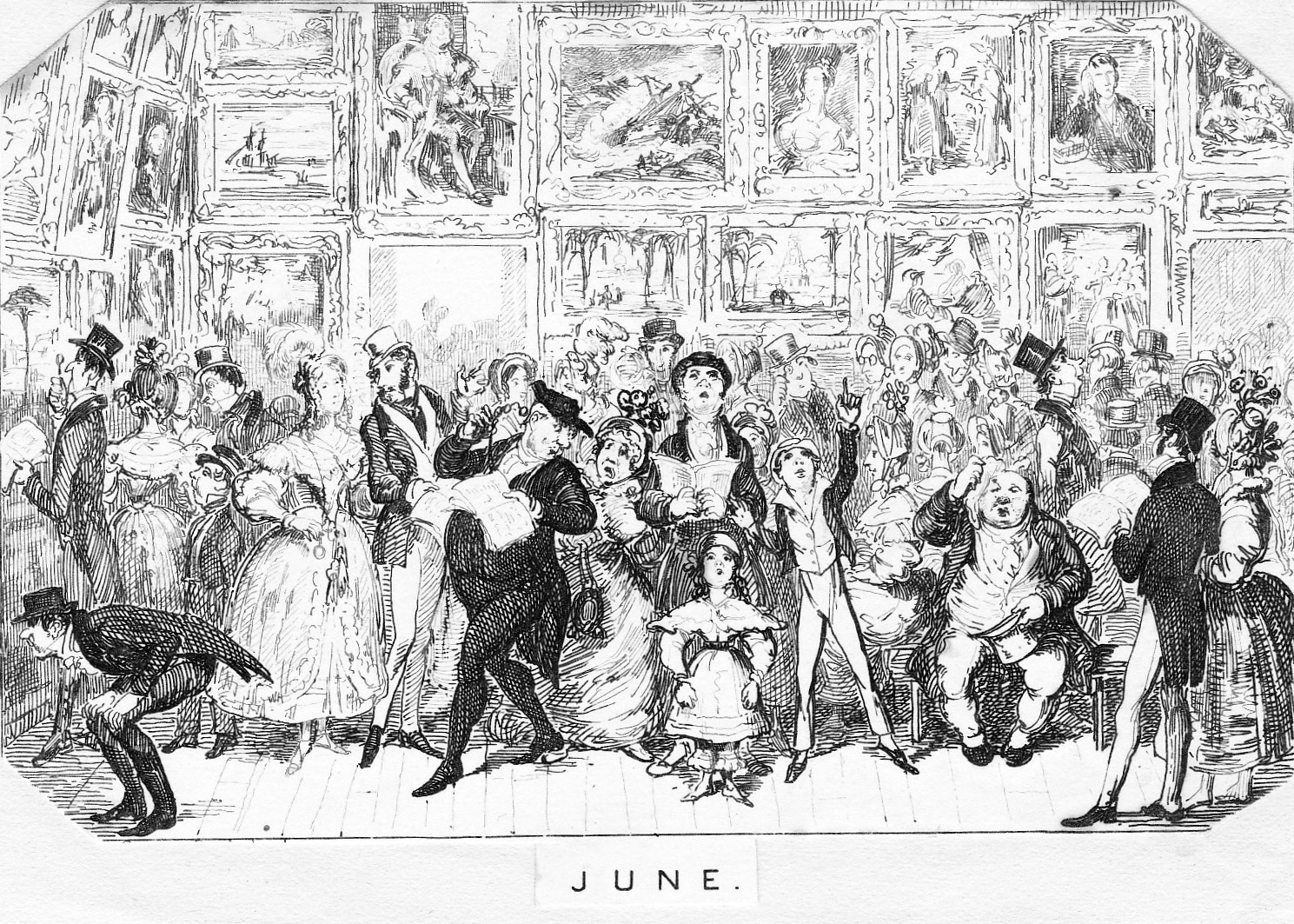
JuneFor the first of June here is another of Cruickshank’s delicious drawings of London life month by month. It shows the Royal Academy’s Summer Show with the gawping crowd of connoisseurs, fashionable types and sightseers, all jammed in to look at the pictures hung floor to ceiling in the fashion of the time. This was one of the major events in the London Season and has been held every year since 1769.

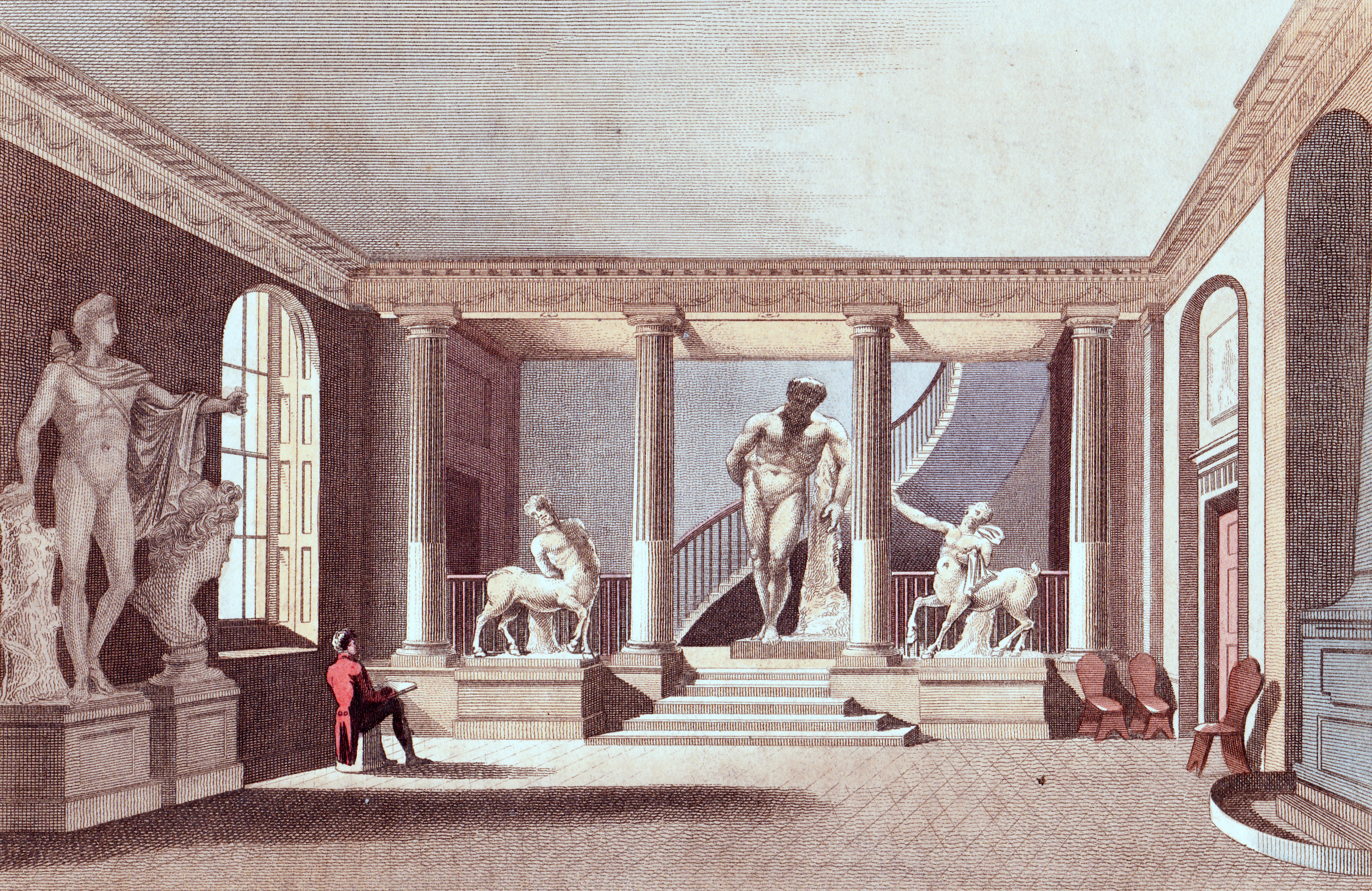
Here is Henry Alken’s view of the same event, drawn in  1821. Summer showThe Royal Academy was initially located in Pall Mall, then moved in 1771 to the first completed wing of New Somerset House, in the Strand. In 1837 it occupied the east wing of the recently completed National Gallery in Trafalgar Square and in 1868 it moved to its present location, Burlington House, Piccadilly. The plate below from Ackermann’s Repository for May 1810 shows the “Hall at the Royal Academy, Somerset House” with an artist sketching one of the plaster casts of Classical statues.

Royal Ac

Leave a comment

Filed under Art, Buildings, Entertainment, High Society

The Road to Waterloo Week 14: Napoleon Presents Eagles, Haymaking Begins & The Cavalry Passes in Review

On the first, and only, sunny Sunday of the entire 100 Days, Napoleon held a great military parade at La Place du Carrousel in Paris. 25,000 troops passed before him, comprising five regiments of line, four of the Young Guard and a party of recruits, not yet in uniform. They shouted Vive l’Empereur as they marched and he came down from his podium to join the Guard. Paris was full of troops now, as they marched through towards the border.
By the end of May the total armed forces available to Napoleon had reached 198,000 with 66,000 more in depots training up but not yet ready for deployment.

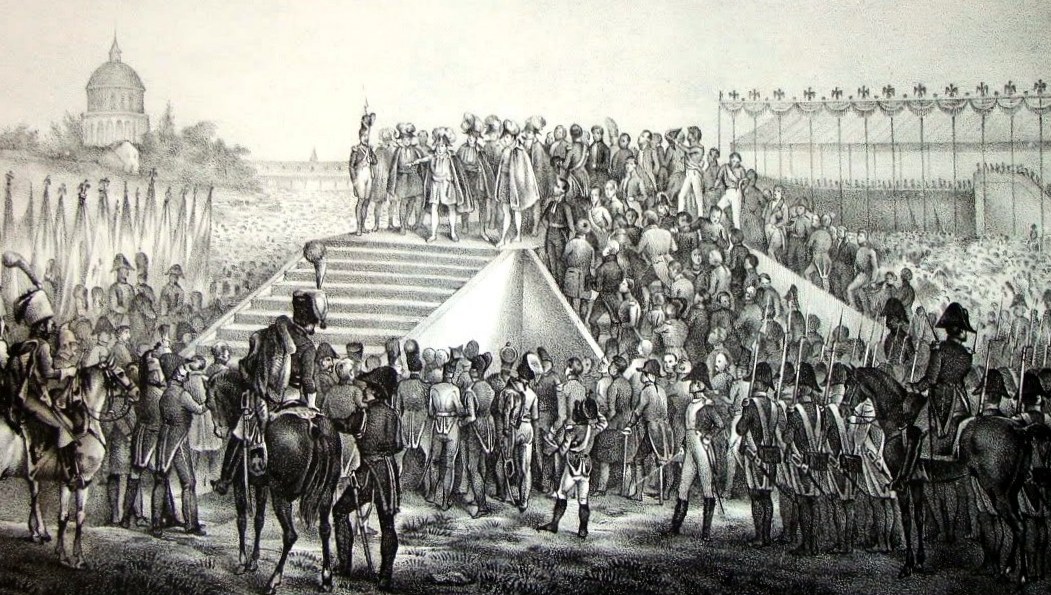
Finally the much-postponed Champ-de-Mai arrived, on June 1st. Champ de Mai The sun had deserted Paris again and it was a cold, grey day as 200,000 people assembled in the Champ de Mars, most of them unable to see what was going on within the wooden arena built for the ceremonial. The court, the university, the magistrates, all turned up in their robes and then had to wait for hours until Napoleon finally appeared in a purple mantle that was too tight and too short and which gave him great problems as he came down the steps to his throne. One observer described him as looking “ungainly and squat”. Declarations and promulgations were read, speeches were made and a Te Deum sung. Napoleon then processed to a throne on a pyramid, surrounded by soldiers brandishing swords and flags while he distributed eagles to the National Guard and the army.

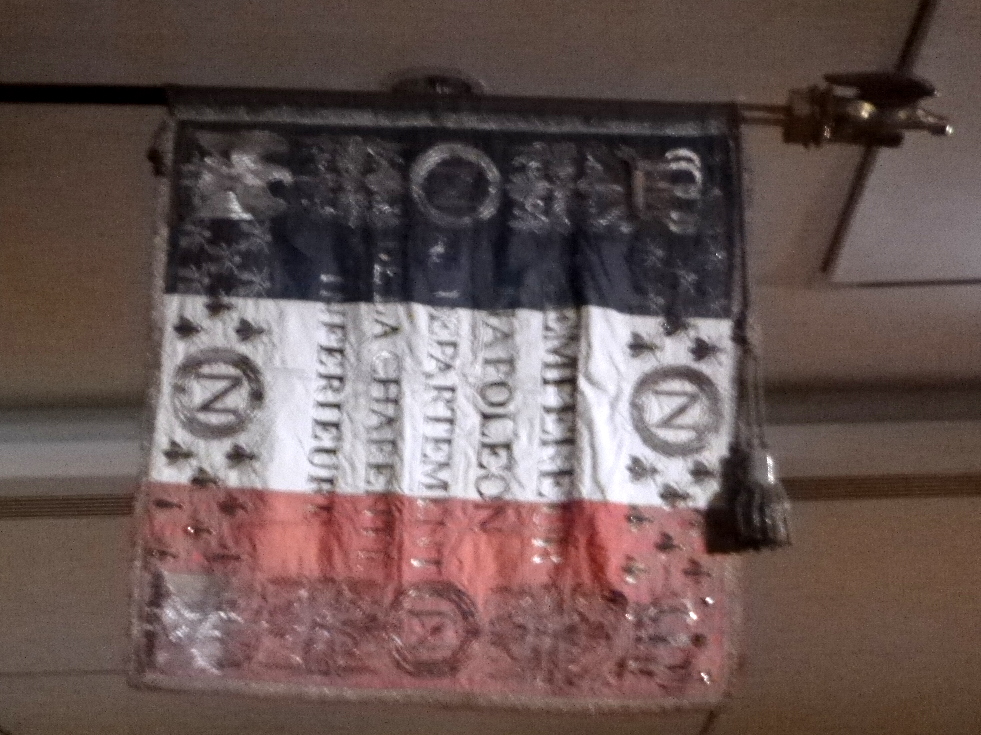
I was thrilled to see two of the actual eagles Napoleon distributed at the “Bonaparte and the British” exhibition at the British Museum. They were captured at Waterloo and sixty seven of them were presented to Wellington by a grateful King Louis. The banners are beautifully worked in silver bullion thread on silk.

EagleA British observer noted that all the enthusiasm came from the troops – the ordinary people were mainly silent.
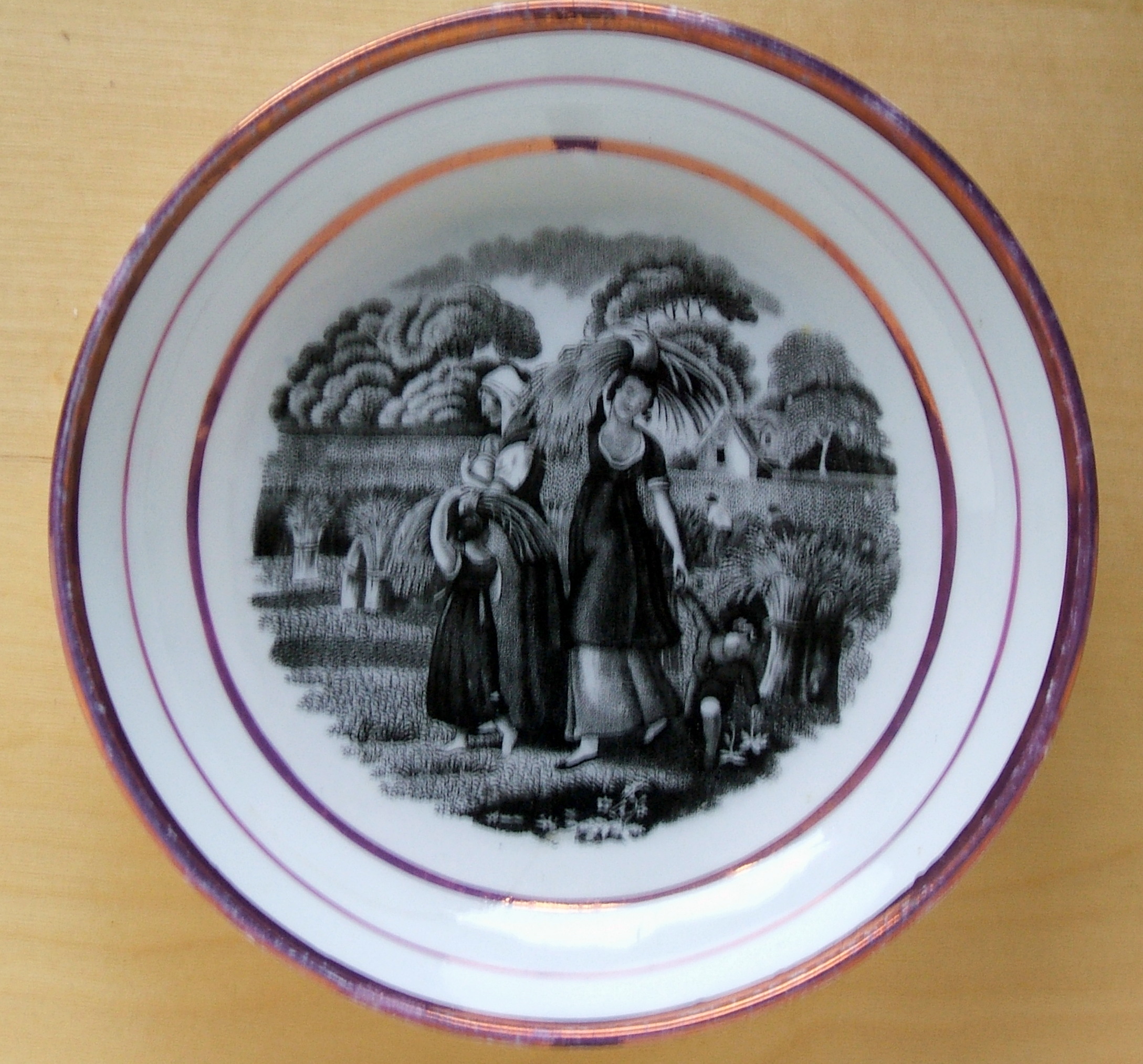
In London the ton were making ready to depart to country estates, spas or seaside resorts.  “Fashionable Departures” noted in the Morning Post for June 1st included the Duke and Duchess of Newcastle, off to Lincolnshire; the Duke of Marlborough to Sion Hill; Mr Drake, MP, for Tunbridge Wells and, more ominously, “Captain Mackenzie for the continent.” The sun was shining at last and farmers were getting ready for haymaking. Below is an idyllic country scene of harvesters

Pic009
Near Brussels things were clearly moving towards a confrontation. On 29th May the Earl of Uxbridge held a review of British cavalry near Ninove, a major event which was attended by Blücher, the Duke of Brunswick, the Prince of Orange and the King of the United Netherlands as well as a large number of Russian and Prussian generals. The day before there was a parade in Brussels and Wellington hosted a dinner. The next day the cavalry assembled in the meadows – almost 7,000 in number. “46 of the finest squadrons of cavalry ever seen were drawn up in a place in their lines, with 6 troops of Horse artillery and a Brigade of rockets,” with thousands of spectators, including “all the haut ton of Brussels,” according to one spectator.
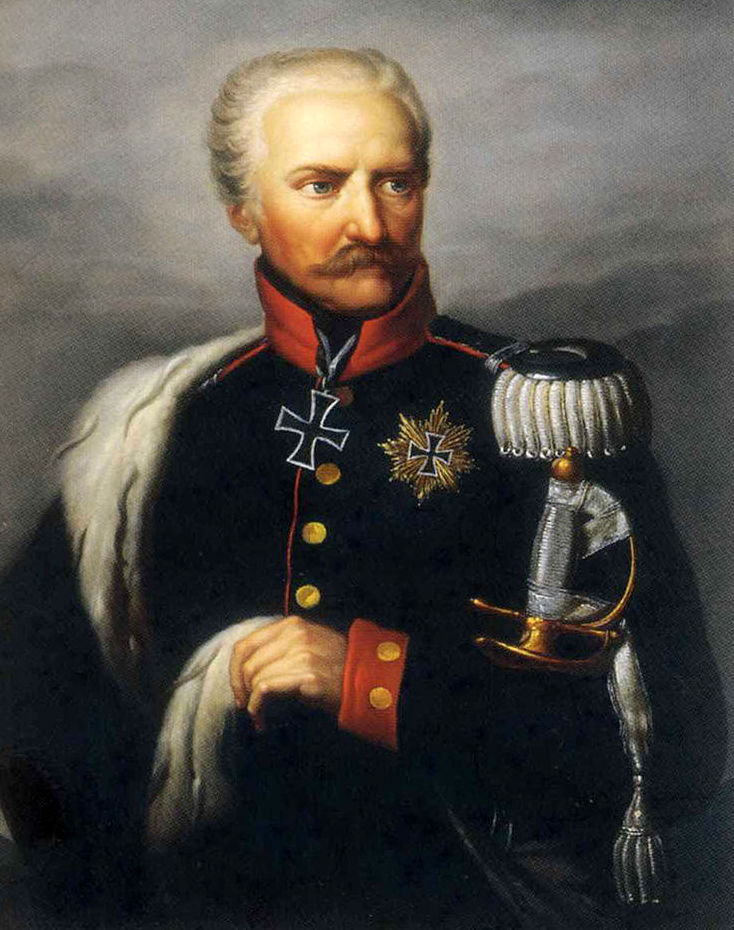
It was followed at 5 o’clock by a banquet for a hundred guests, all accompanied by “the finest wines.” Apparently the meal ended and the party broke up at 8 o’clock, far too early for Marshall Blücher, (shown below left) a man who enjoyed hard drinking.

Blucher
Despite this clear indication that the fighting could not be far off, the British in Brussels thought that the Allied troops would march off to meet the French close to, or over, the border. Visitors to Brussels and to Flanders generally, continued to arrive on sightseeing trips, quite confident of their personal safety.

2 Comments

Filed under Agriculture, Battle of Waterloo, Napoleon

The Road to Waterloo Week 13: War Is Declared at Last, the Prince Regent Builds and the Mob Protests

France was still in the grip of a miserable, cold, foggy Spring but Napoleon would have been encouraged by Britain’s reluctance to declare war, giving him more time to wrestle with his constitutional and political problems and continue to expand his army.
An insecure British government was facing Radical opposition within the Commons and on the streets, the economy was shaky and everyone was depressed by the weather. The price of bread was rising, the farmers were having a tough time because of the rain and the King’s health kept him out of the public eye – “his disorder continues without any sensible alteration,” according to the bulletins.

Carlton House detail
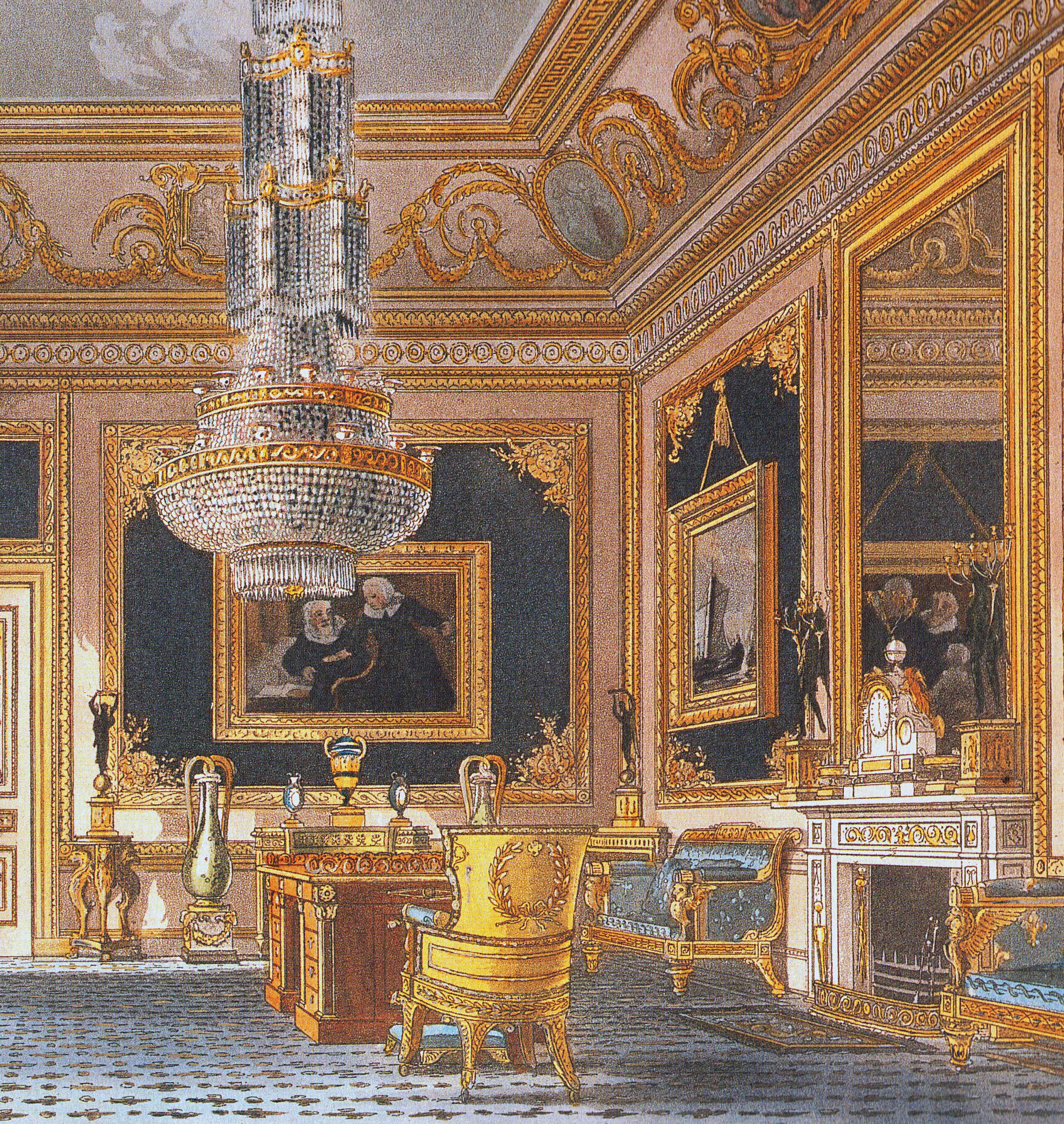
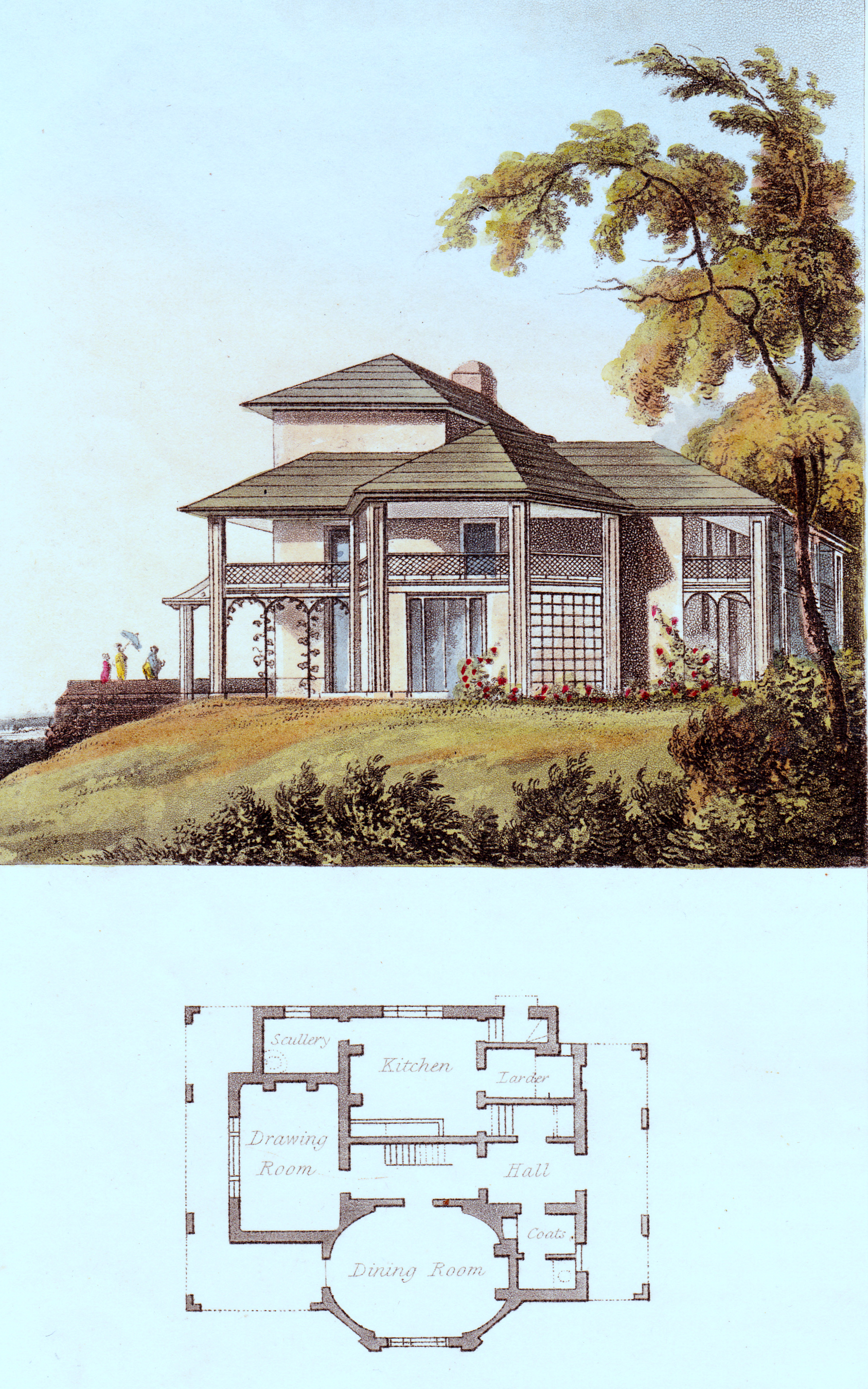
Only the Prince Regent seemed to be in a good mood – or perhaps he was keeping his spirits up with an orgy of lavish building works. A gothic-style dining room was added to Carlton House along with a library in the same style and a golden drawing room. Above is a detail of the Blue Velvet Room at Carlton House, a good example of the Regent’s lavish taste. At the same time John Nash was working on a “cottage” for the Regent in Windsor Great Park, a large and elaborate house the cottage orné style, with thatched roofs, verandas, and a conservatory. (It was demolished by William IV and the Royal Lodge now stands on the site). Nash was also working on further plans for the Pavilion at Brighton. Below is an example of the cottage orné style, although this is a much smaller example than Nash’s would have been. The drawing is from Ackermann’s Repository (November 1816)

cottage ornee
The Whigs were attacking the head of the diplomatic corps, Lord Castlereagh, and, through him the Congress of Vienna, dominated by Russia, Prussia and Austria who, they said, were a threat to independent nations. Vociferously led by Samuel Whitbread they argued that Napoleon had the support of the French people and it was wrong to go to war simply because Britain did not like him. Whitbread argued that the Emperor was now peace-loving, Castlereagh countered that once he had assembled 400,000 troops it would soon become apparent how peace-loving he was.
The harassed government was faced with mobs on the streets protesting about the Corn Law, the Income Tax, the slave trade and the Prince Regent’s extravagance, but they finally decided that Napoleon was secure on the French throne and that war was inevitable. The Allied Treaty, signed at Vienna on 25th March, was laid before the House at last – if Parliament ratified it, it became a declaration of war. It was approved in the Lords by 156 votes to 44 and in the Commons by 331 to 92 on 25th May. War was now inevitable, the only question was – when?
The firebrand Samuel Whitbread fell strangely silent after this, his place as the radical leader taken by Francis Burdett and Henry Hunt. Whitbread may have been in financial difficulty and earlier in the month he had resigned his management of Drury Lane Theatre, in which he had invested a great deal of money.
At Drury Lane on the 24th, there was a benefit performance by Edmund Kean, announced as a never-before performed tragedy by Shakespeare. The newspapers the next day were respectful of Kean, but sarcastic about the play.
“MR KEAN took his benefit last night. A tragedy by SHAKESPEARE – “never acted” had been announced as the performance of the evening; but “insurmountable difficulties” opposing the execution of this design, (no great wonder, bye the bye, for what play, undoubtedly SHAKESPEARE’S, can we at this time of day, take upon ourselves to assert, had never been acted?) the tragedy of the “Revenge”, was substituted, and MR KEAN appeared for the first time as the representative of Zanga.”

Leave a comment

Filed under Architecture, Entertainment, Napoleon, Prince Regent

The Road to Waterloo Week 12 – Income Tax is Here to Stay, A Famous Dipper Dies and Naploleon Digs In

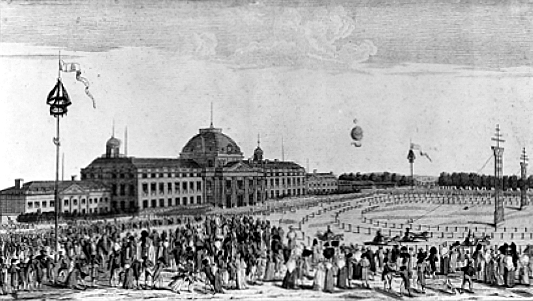
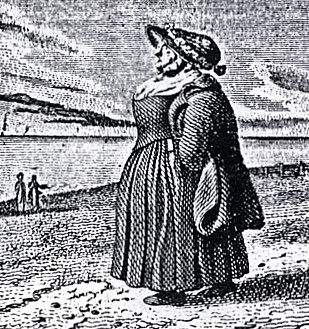
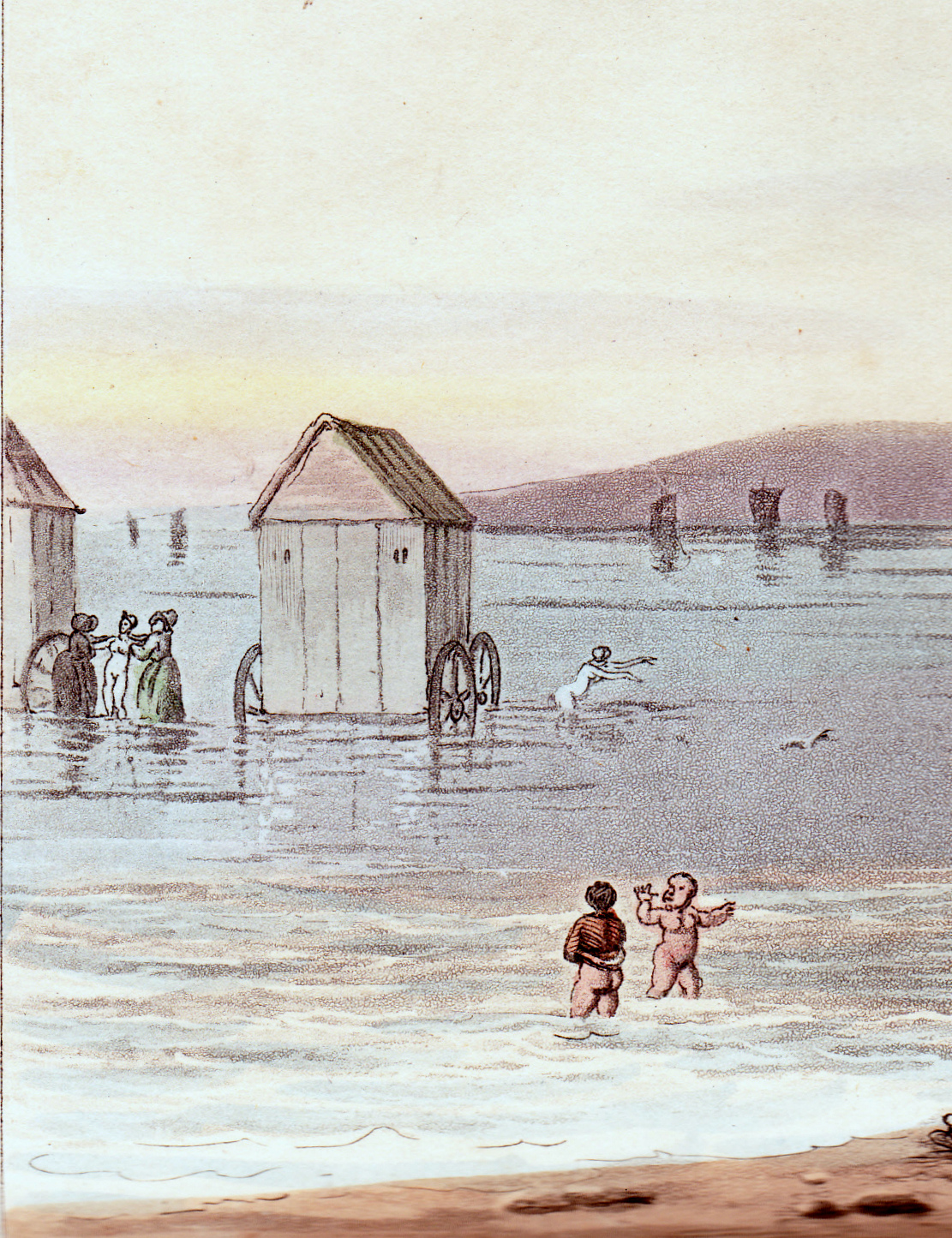
The Fédéres, the hard-core revolutionary group, had attracted tens of thousands of supporters by the second week in May – but this was out of a nation of thirty million and the level of true support for Napoleon was still unclear, not only abroad but also in France. On Sunday 14th May twelve thousand Fédéres marched past Napoleon in the Tuileries, just before the usual Sunday military parade. They were unarmed and appeared in their working clothes – “labouring dresses and dustmen’s hats” according to one observer. While they waited for the muskets that Napoleon promised them (and his Ministers were very dubious about providing) they continued to work on the barricades. Napoleon would ride out every morning to inspect the works which created vast muddy ramparts from Montmartre to Vincennes. Champ de Mars Since early April work had been going on to create a huge temporary amphitheatre on the Champ de Mars. This was intended to house the Champ de Mai which would include a national congress – or perhaps a celebration of the new constitution or… Plans wavered, were changed, fiddled with… but the work went on, with platforms and flag staffs, a vast throne on top of a pyramid and hordes of eagles. Eventually it was held on June 1st. The Champ de Mars still remains as a public park in Paris, located between the Eiffel Tower to the northwest and the École Militaire to the southeast. It was named after the Campus Martius in Rome – the field of Mars, the Roman god of war. The space was intended as a drilling and marching ground for the French army. The print shows the École Militaire end of the Field. In England feelings were unsettled. War had still not been declared, but military encampments were springing up all over the south of England, 6,000 horses had been purchased and sent to the Thames ports and 1.5 million cartridges were shipped out of the Ordnance Wharf at Chatham. To further lower the public mood the weather was atrocious, the price of bread was rising, the King’s health was very poor and the promised abolition of the Income Tax had not occurred – in fact on May 12th a Act had been passed to extend it for another year. Newspapers recorded petitions against the war, but the opinion columns made it clear that a declaration was inevitable. Marth Gunn A notable personality had passed away the week before and on Monday the Morning Chronicle recorded the funeral of Martha Gunn, a famous ‘dipper’ or bathing woman from Brighton. “The whole town was in motion to witness [the funeral]. Her remains were followed to the grave by about forty relatives and friends, chiefly bathers. The ceremony throughout was conducted with the greatest order and solemnity.” The print shows the sturdy figure of Martha – she must have needed that solidity and layer of fat to stand in the sea day in, day out, helping to dunk bathers who had been prescribed regular immersion in the sea by their doctors. Dipping The detail from a coloured print shows two sturdy dippers assisting a completely naked female bather, with another striking out from her bathing machine unaided. This is from Political Sketches of Scarborough (1818) and it is interesting that the bathers are nude and that no-one on shore shows the slightest interest in them.

5 Comments

Filed under Napoleon, Seaside resorts, Women

All About April – Fools and Showers

April showers

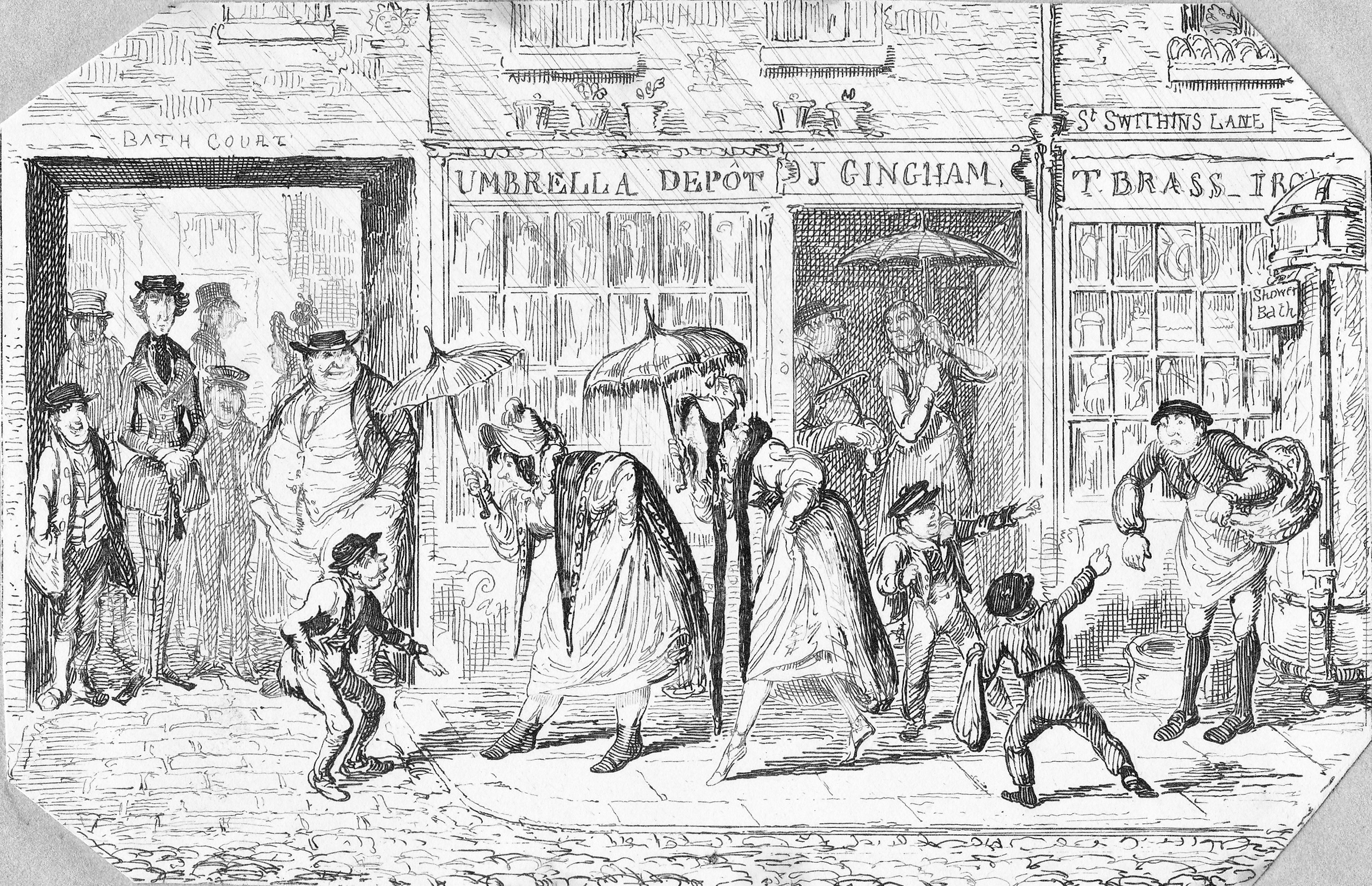
These days April is famous for its showers and its fools, and I love this illustration by Cruickshank showing two ladies caught out in the rain while everyone else is either sheltering under an archway or buying a new umbrella from J. Gingham, Umbrella Depot. I’m not sure what the three lads are doing – possibly they are up to some kind of April Fool’s Day prank. As always with these tiny Cruickshank drawings the fun is in the details – behind the pieman with his basket is a shower bath standing outside T. Brass, Ironmonger. And, of course, the scene is set in St Swithin’s Lane. There is a real lane of that name in London, running between Cannon Street and Lombard Street in the City. St Swithin’s Day is July 15th, but the connection with rain was obviously too much for the artist to ignore.

St Swithun’s day if thou dost rain
For forty days it will remain
St Swithun’s day if thou be fair
For forty days ‘twill rain nae mare.

For April Fool’s Day in the Georgian era I turned to Observations on Popular Antiquities, Chiefly Illustrating the Origin of our Vulgar Customs, Ceremonies and Superstitions by John Brand (1813). They don’t write titles like that any more. Brand considered it to be of Druidical origin (but then he considered a great deal was) and comments that it was observed from ancient times all over the kingdom, and in France. “The wit chiefly consists in sending persons on what are called sleeveless errands, for The History of Eve’s Mother, for Pigeon’s Milk, with similar absurdities. ” He quotes rather a charming little love poem, dated 1798:

To  A Lady, who threatened to make the Author an April Fool

Why strive, dear Girl, to make a Fool,

Of one not wise before;

Yet having ‘scaped from Folly’s School,

Would fain go there no more.

Ah! if I must to school again,

Wilt though my teacher be?

I’m sure no lesson will be vain

Which though canst give to me?

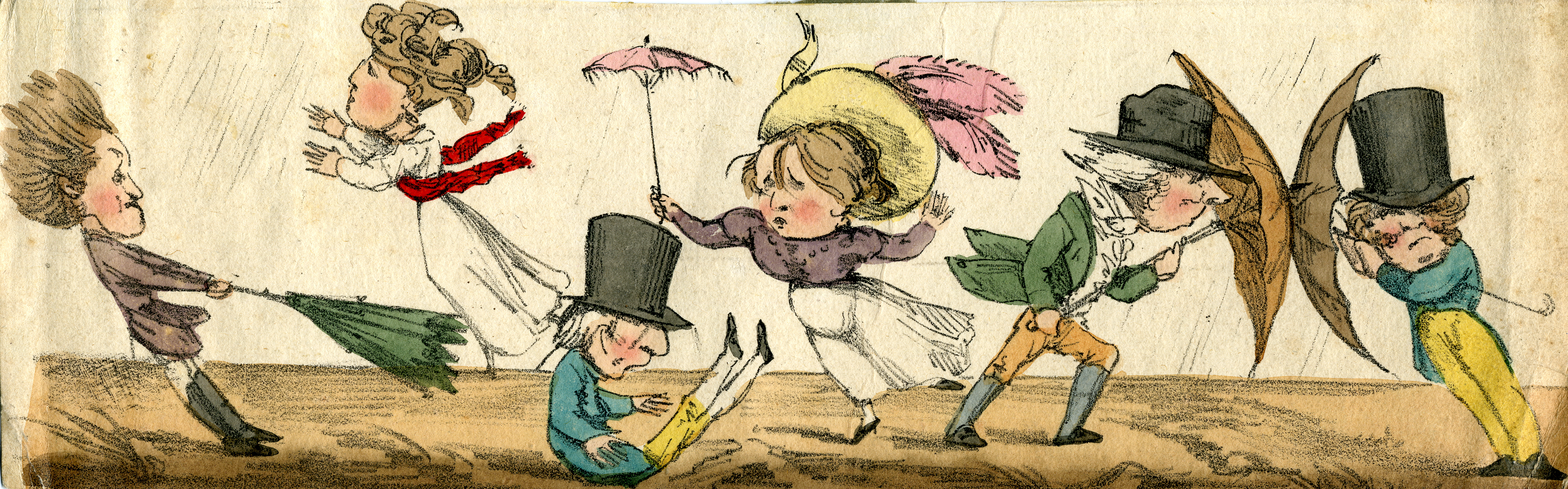
And finally, as we are buffeted here in England with a windy beginning to the month, I’ll leave you with this delightful little watercolour sketch. It isn’t signed or dated, unfortunately.

Windy weather

5 Comments

Filed under Street life, Traditions, Weather

Receiving the News – the Telegraph System

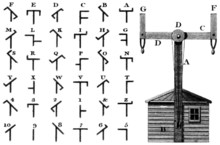
In my blog posts about the weeks leading up to the battle of Waterloo I mentioned how long it took for the news of Napoleon’s escape from Elba to reach Paris. This was particularly surprising because the French had a magnificent telegraph system – defeated on this occasion, just when it was needed most, by poor visibility. The first visual telegraph system was the invention of Claude Chappe, a French engineer, working with his brothers. The French government seized on the invention and installed a network of 556 stations covering the entire country. Stelegraph codestations were updated and added to and the system continued in use until the 1850s when electric telegraphy took over. A Chappe telegraph and the posible positions are shown on the left.
During the French wars the Allies were handicapped by poor communications while the French had this excellent system – provided visibility was good. The brothers invented a simple and robust system with two arms, each with a short upright at the end. This could be controlled by counterweights by one man. A message of 36 letters could reach Lille from Paris in about half an hour. Codes were also developed, so messages, including numbers, could be sent in plain, or code. in addition there was a 3-armed system  used from 1803 onwards at coastal locations to warn of invasion. The Emperor was so convinced of the benefits of the telegraph that he took portable versions with him on campaign.
The British government was quick to see that without a telegraph system they were at a distinct disadvantage. The Admiralty’s Shutter Telegraph was created in 1795 to a design by Lord John Murray and had six rotating shutters which were used to indicate a complicated code. It required a rectangular framework tower with six, five feet high, octagonal shutters on horizontal axes that flipped between horizontal and vertical positions to signal. One was set up on top of the Admiralty building in Whitehall – more or less where the modern telecommunications masts can be seen today doing much the same job.
With a staggering disregard for security it was possible to visit the telegraph station, provided one tipped the operator. Presumably only reputable persons were permitted to enter the Admiralty in the first place, but it is still hard to believe that this was not a security loophole. The newspapers kept an eye on telegraphSt Alabans activity and could deduce when something major was about to happen by the volume of traffic and where it was going, even if they could not decipher it
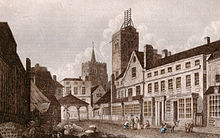
The first line ran from the Admiralty to the dockyards at Sheerness and on to Deal. It had 15 stations along the route and a message took an astonishing sixty seconds. The second went south from London to the naval base at Portsmouth and then on to Plymouth and was opened in May 1806. The third to Yarmouth on the east coast opened in 1808. The image on the left shows the telegraph array on top of the church on St Albans, Hertfordshire.OLYMPUS DIGITAL CAMERA
The intermediate stations were  wooden huts and with a staggering lack of foresight they were all abandoned in 1814 when peace was declared and had to be recommissioned hastily in March 1815 when the news of Bonaparte’s escape from Elba reached London.
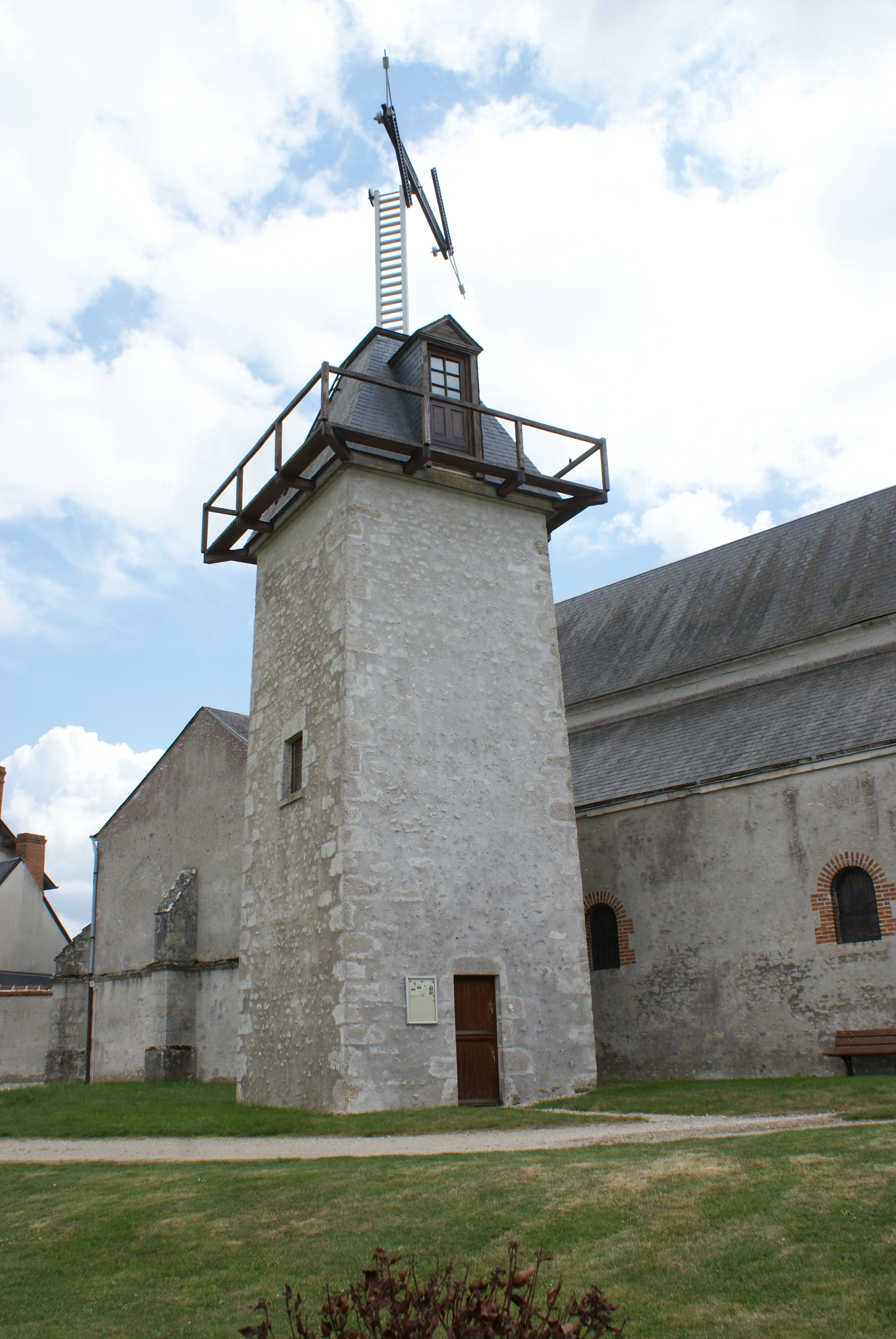
When peace came the enterprising Chappe brothers promoted their system for commercial use and some of their stone towers can still be found – there is one in Saverne, for example, and one at Baccon on the Loire, just west of Orleans which I visited a few years ago. (Photo, left, shows it with its restored telegraph arms).
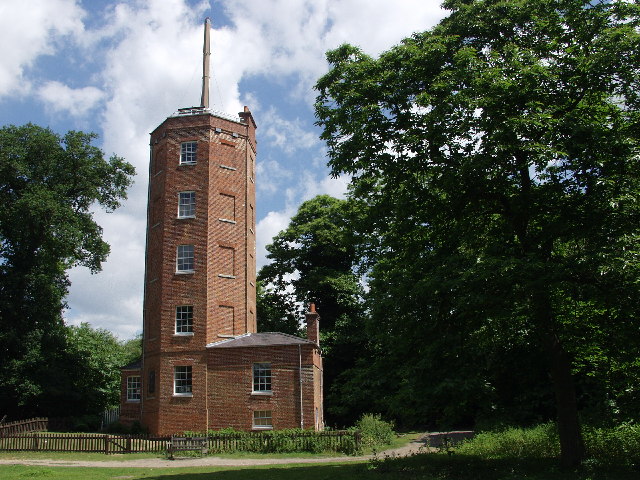
Later in 1815 the Admiralty secured funding for a new system using arms rather than shutters and used the system – weather permitSONY DSCting, until 1847. The brick tower on the right is the semaphore tower at Chatley Heath on the line to Portsmouth. It is now in the care of the National Trust.

8 Comments

Filed under Buildings, Napoleon, Science & technology

Going to the Library In Georgian London

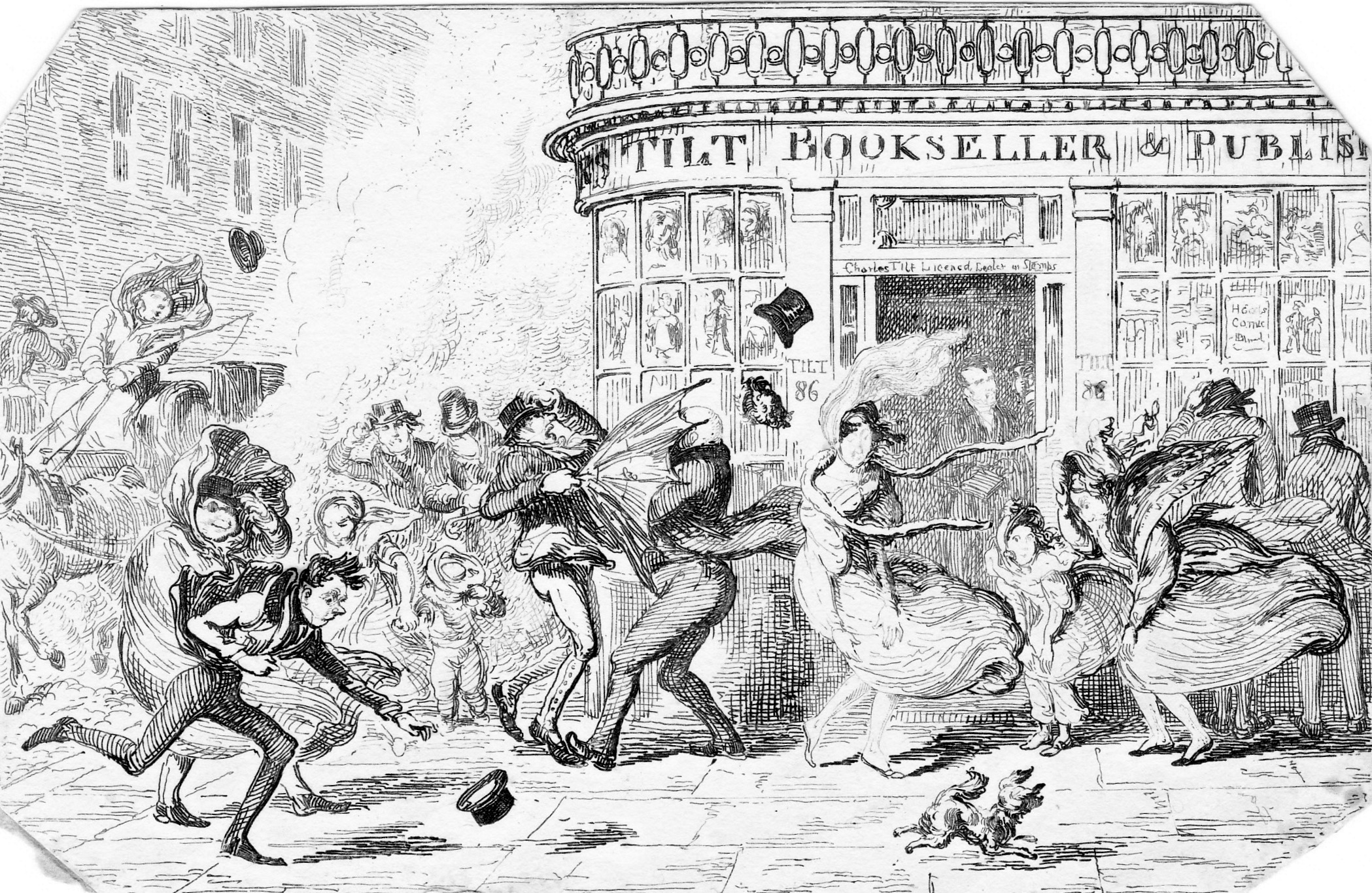
In a recent post I used two of Cruickshank’s delightful monthly views of London to illustrate the state of the streets. When I looked at March I found it showed the effects of March gales on pedestrians passing the doors of Tilt, Bookseller & Publisher, which made me dig further into my collection to see what I had on access to books.

March
For the middle and upper classes in Georgian London reading was a significant leisure pastime, whether the book was a collection of sermons, a political dissertation, a scientific work or a scandalous novel full of haunted castles, wicked barons and innocent young ladies in peril.
To have a library, however modest, was the mark of a gentleman, but not everyone could afford every book that they wanted, or wanted to own every book that they read.  The subscription circulating library came into existence to satisfy the reading habits of anyone who could afford a few pounds annual subscription and who required “Rational Entertainment In the Time of Rainy Weather, Long Evenings and Leisure Hours”, as the advertisement for James Creighton’s Circulating Library at no.14, Tavistock Street, Covent Garden put it in October 1808.

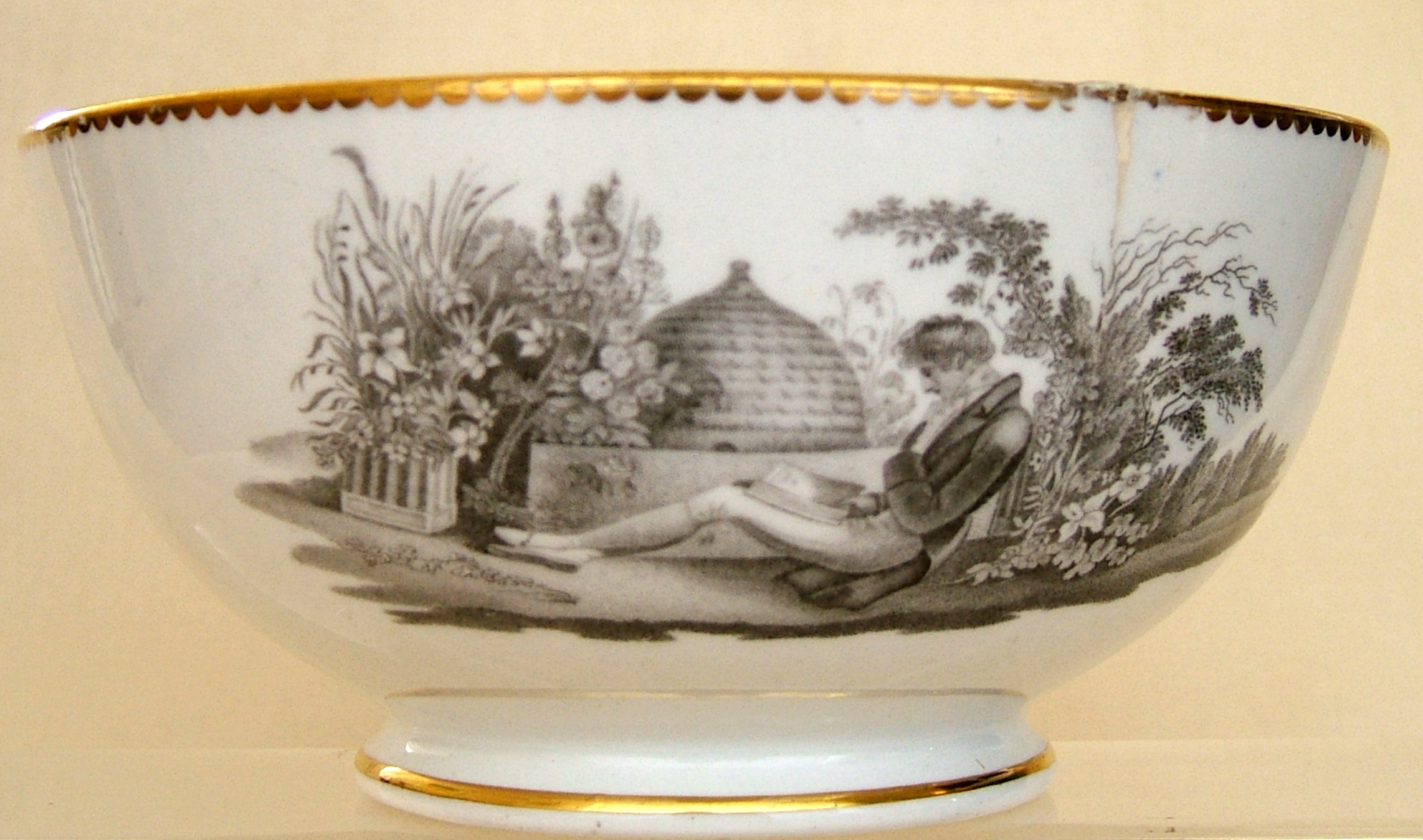
No doubt the elegant gentleman at the foot of this post would have satisfied his reading habit from one of these libraries. (He is sitting in his garden with a large bee skip in the background and is one of my favourite designs from my collection of bat-printed table wares. Bat printing refers to the method, by the way, and has nothing to do with flying mammals!)
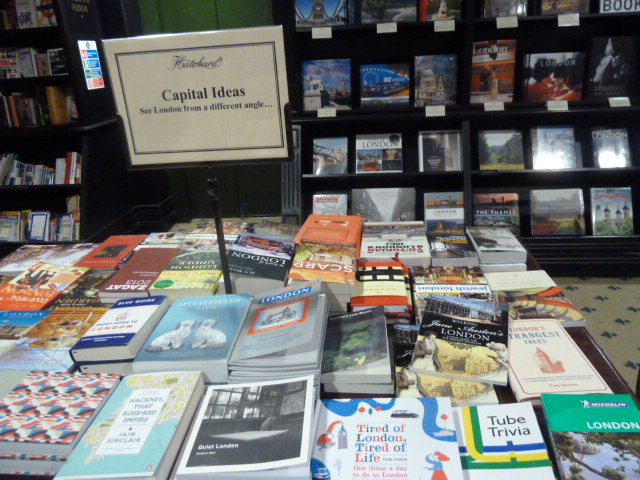
The only bookshop and circulating library of the period that survives today is Hatchard’s in Piccadilly. It was established in 1797 and shared the street with Ridgeway’s and Stockdale’s libraries. The photograph of a modern book display in Hatchard’s was kindly sent to me by a reader who spotted my Walking Jane Austen’s London on the table.Jane Austen in Hatchards. Henshaw (2nd from the right, 2nd row from the front).
Circulating libraries ranged in size from the modest collection of books in a stationer’s shop to large and very splendid collections.

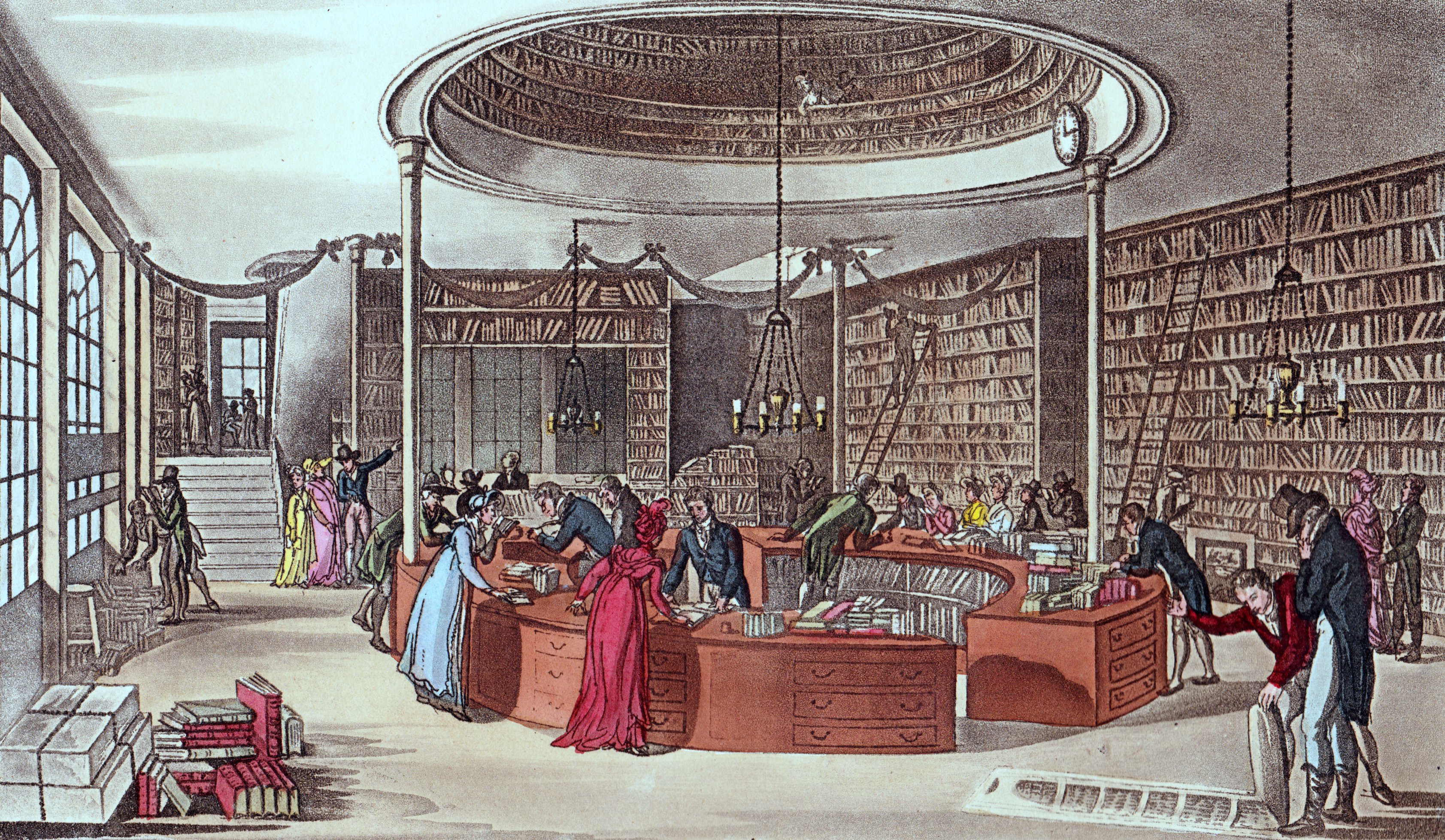
At the top end of the scale was the “Temple of the Muses”, the establishment of Messrs. Lackington and Allen in Finsbury Square. The print shows the main room with the counter under the imposing galleried dome and is dated April 1809. The accompanying text, in Ackermann’s Repository, states that it has a stock of a million volumes. The “Temple” was both a book shop and a circulating library and the pLackingtonsroprietors were also publishers and printers of their own editions. As well as the main room shown in the print there were also “two spacious and cheerful apartments looking towards Finsbury-square, which are elegantly fitted up with glass cases, inclosing books in superb bindings, as well as others of ancient printing, but of great variety and value. These lounging rooms, as they are termed, are intended merely for the accommodation of ladies and gentlemen, to whom the bustle of the ware-room may be an interruption.”
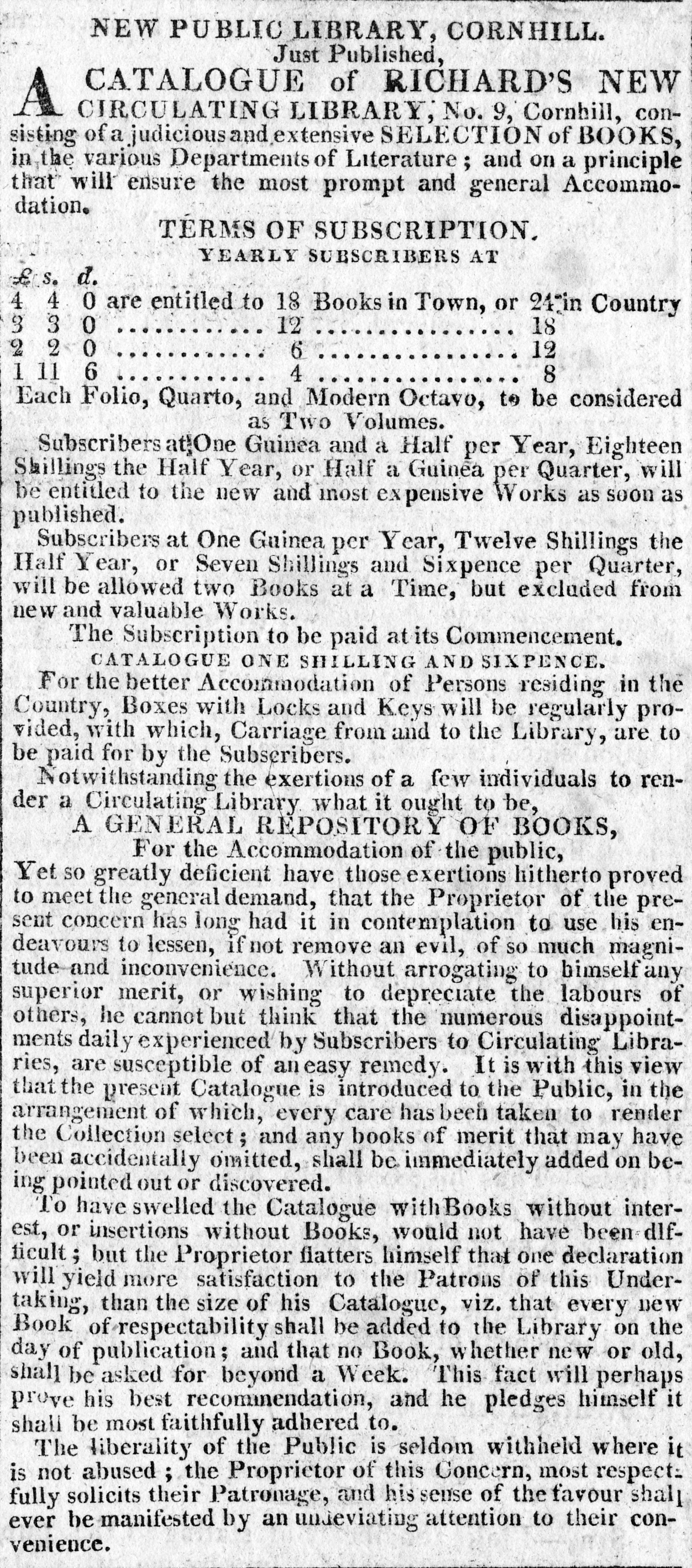
Richards libraryCirculating libraries advertised regularly in all the London newspapers and the advertisement here is a particularly detailed one from a new firm, Richard’s of 9, Cornhill and shows the subscription costs which varied between Town and Country. Special boxes were provided for the transport of books out of London, which was at the cost of the subscriber. Imagine the excitement of a lady living in some distant country house when the package arrived with one of the two books a month her subscription of 4 guineas had purchased!

Reading bat bowl

12 Comments

Filed under Books, Buildings, Entertainment, Gentlemen, Shopping, Street life, Women

The Perils of the Pavement – Winter in Georgian London

February always seems to bring muddier, messier weather than January, perhaps because the ground is already so sodden. Negotiating the slushy snow, puddles and potholes as I crossed the street in my local market town this morning made me think about what London streets were like at this time of year in the early 19th century.Snowfall
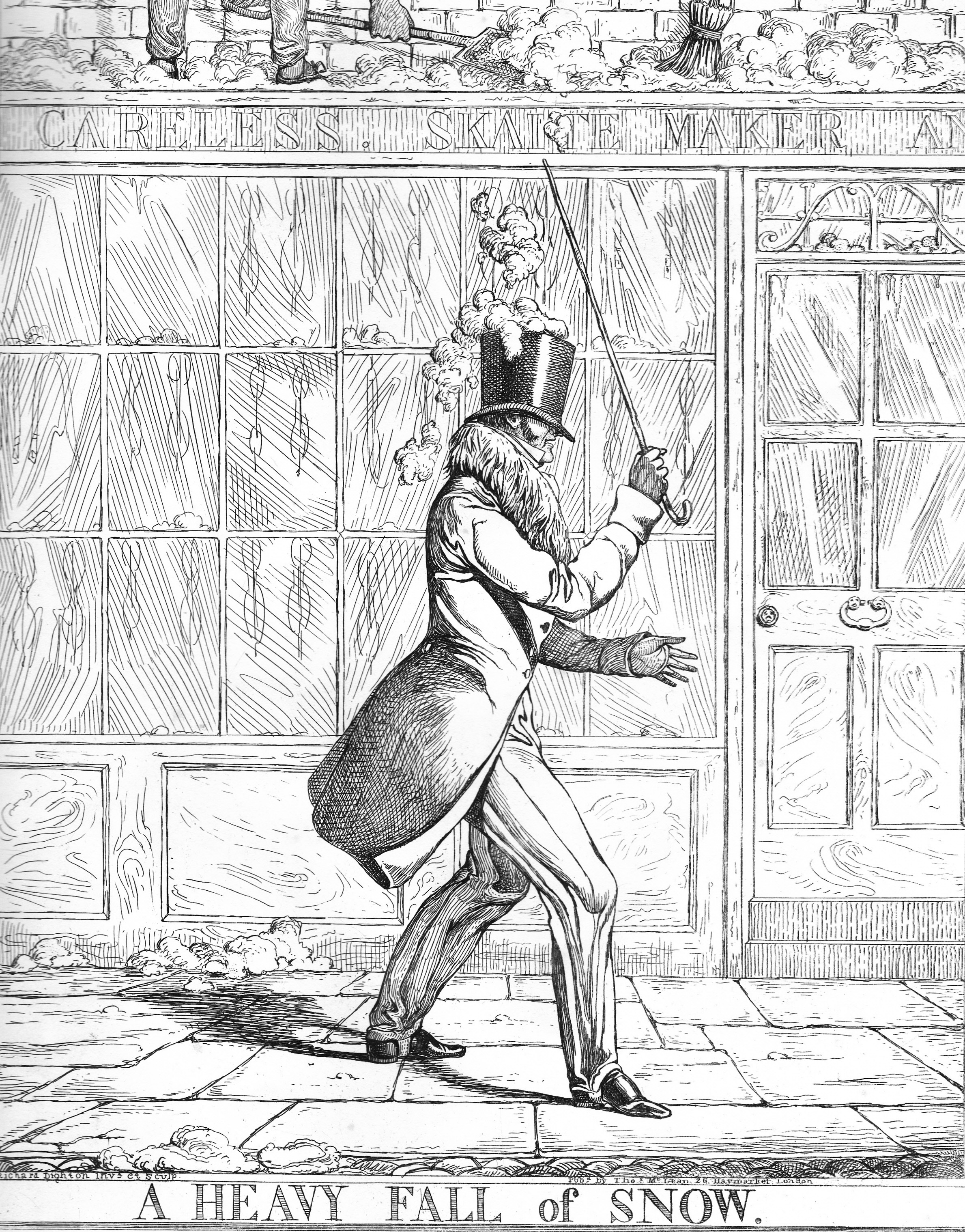
The first print is from Richard Deighton’s London Nuisances series – A Heavy Fall of Snow – with the unfortunate gentleman getting a load of snow on his hat from the men clearing the ledge above the shop he is passing.
Rather appropriately the establishment belongs to Mr Careless, a skate maker, and pairs of skates are hanging in the window. The engraving shows very clearly the flagstones of the pavement, as opposed to the much rougher cobbled street surface which is just visible above the caption.
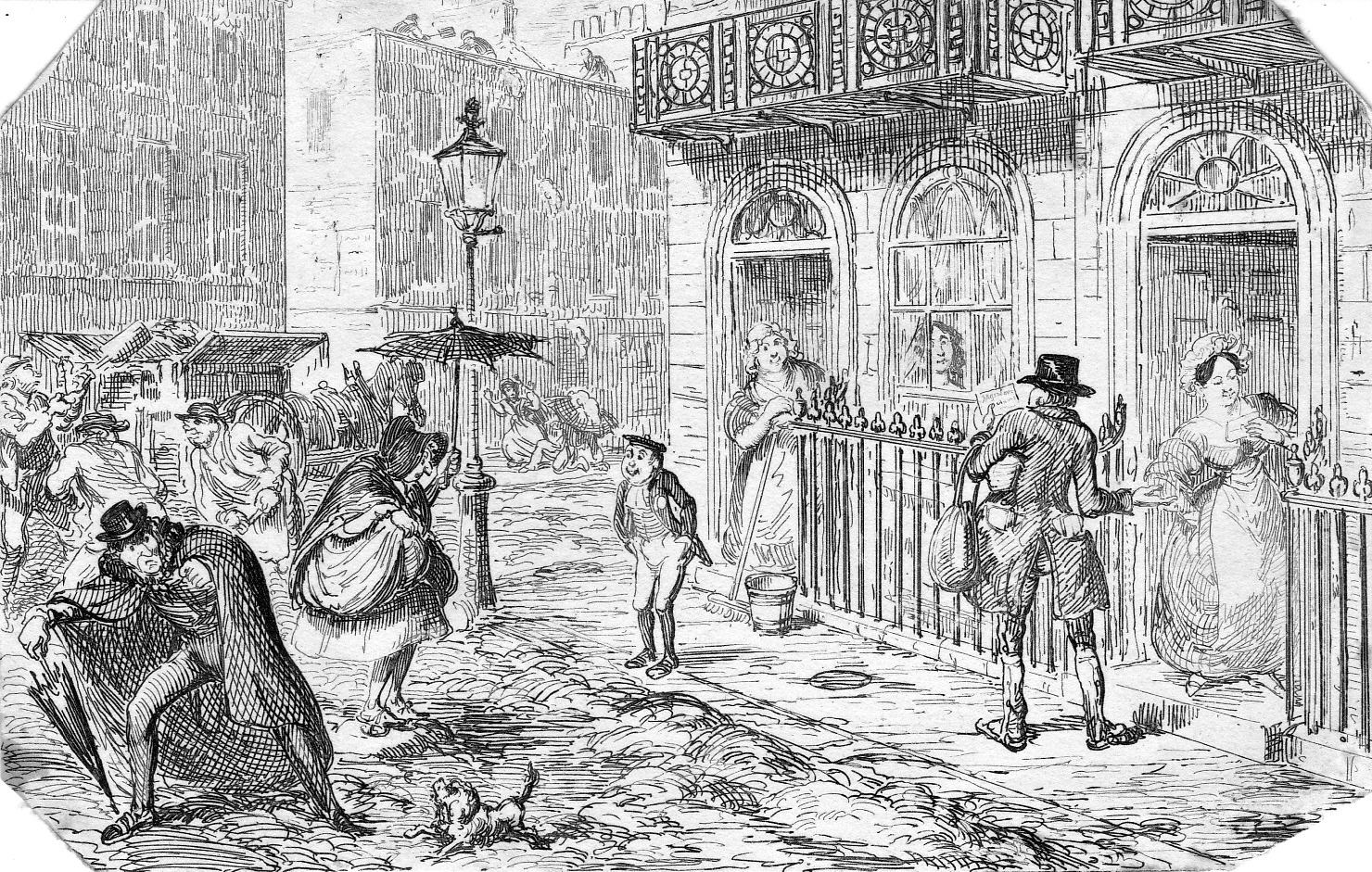
For all the accident with the snow, this seems a very clean and tidy street. For a rather more likely pair of images I’ve copied two of a monthly series of prints of London street scenes by George Cruikshank (thanks to Stephen Barker for the identification!). They were cut out and pasted in an album, hence the clipped corners. Except for the style of the women’s dresses and the gas lamp they could be any time from about 1800.

Street JanIn the first, January, the town is experiencing a hard frost. The men in the carts are breaking up ice and taking it away, while three chilly individuals are marching under a placard reading “Poor Froze Out Gardeners” – presumably with no work because the ground is frozen solid. Behind their placard is the ship of W. Winter, Furrier and the shop window on the left is advertising “Soups”. A gang of boys seems to have fallen to the ground while sliding on the ice.Street Feb
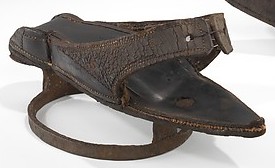
The second scene is February and shows the effects of the thaw. Men are shoveling snow off the high roofs in the background onto unwary passers-by and the cobbled street surface is a potholed mess. The lady in the middle with her skirts lifted almost to her knees is wearing iron pattens on her shoes to raise her out of the mire and street cleaners are shoveling mud into a cart behind her. The housewife on the corner is obviously doing her bit to sweep at least a section of the pavement clean. On the right the postman is doing his rounds. Here is one of a pair of late 18th century pattens like the ones being worn.

54.61.127a-b 0004

6 Comments

Filed under Accidents & emergencies, Street life, working life