Category Archives: Architecture

The Statue of Charles I – a London landmark Jane Austen would have known

chas-i-in-brass

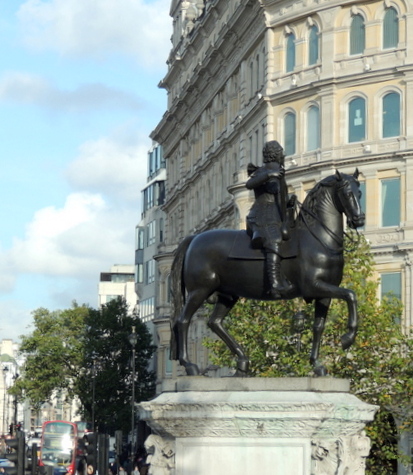
Standing on the southern edge of Trafalgar Square, facing down Whitehall, and in the midst of a permanent traffic jam, stands the bronze statue of Charles I, looking down towards the place of his execution as he has done since 1675. The surroundings have changed beyond recognition, but every Georgian Londoner and visitor would have been familiar with the statue which appears in numerous prints.

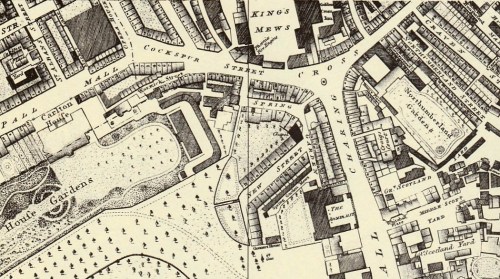
The statue was created by Hubert le Suer in 1633, but it was not erected immediately and by the time of the Civil War it had become a target for the Parliamentarians. It was sold to John Rivett, a brazier, in 1649 on the strict instructions that it was to be melted down. Rivett, obviously both a shrewd political forecaster and a businessman, buried it in his garden and made a great deal of money from small souvenirs allegedly made from the bronze. Charles II acquired it on his restoration and it was erected, more or less on the site of the medieval Charing Cross, in 1675. It can be seen on the map, just below the R of Cross. Behind it is the King’s Mews and the Golden Cross Inn, now occupied by Trafalgar Square. The bulk of Northumberland House is to the east, below the final S of Cross.

chas-i-map

The pedestal is said to have been designed by Wren and carved by Grinling Gibbons.

This print of 1811 from Ackermann’s Repository, shows the view east past Northumberland House and down the Strand.

chas-i-char-x

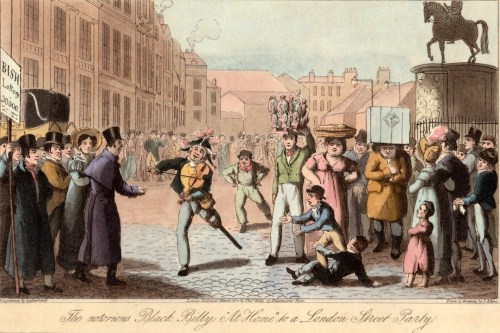
The statue was obviously a familiar landmark that enabled artists to locate their images. The 1823 print of ‘The notorious Black Billy “At Home” to a London Street Party’ (drawn by Samuel Alken, published by Thos. Kelly) shows it surrounded by lively street life. Despite being shown as white, “Black Billy” Waters (c. 1778–1823) was black and is said to have been a slave who escaped by joining the British navy and who lost a leg in a fall from the rigging. Whatever the truth, he was a popular street entertainer with his characteristic feathered hat and violin.

chas-i-black-billy

By the middle of the 19th century street life was rather more decorous and this undated Victorian engraving shows a pristine Nelson’s Column, Trafalgar Square and the National Gallery (with columns recycled from Carlton House).

chas-i-vict

Today the traffic around the statue is unrelenting, and so often jammed solid, that bus and taxi passengers have ample opportunity to study Charles in all his melancholy glory!

chas-i-pic-a

Save

Save

Save

1 Comment

Filed under Architecture, Art, Buildings, Entertainment, Monuments, Street life

“And Many a Frightful Face…”

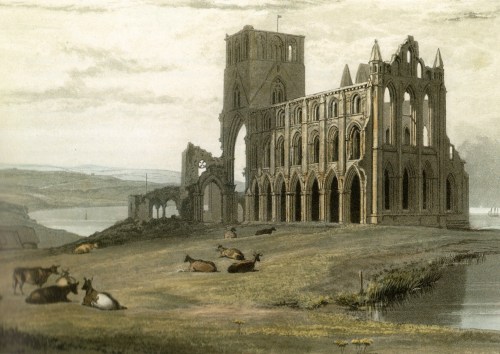
For All Hallows Eve I am writing about Whitby for its connection with Bram Stoker’s Dracula. This Gothic horror story was written in 1897, well outside my usual period, but the tale would have greatly appealed to readers of Gothic novels in the early part of the century and the ruins that inspired Stoker certainly had a spookily romantic effect on an earlier visitor.whitby-abbey-1813

Prince Hermann Ludwig Heinrich von Puckler-Muskau travelled extensively in England during his visits and left detailed diaries. In 1827 he found the little fishing town of Whitby picturesque, but dirty and “miserable”. He did admire the abbey “…now the property of some private individual…[whose] cattle feed among it mouldering walls” just as they do in William Daniell’s illustration (above) in his A Voyage Round the Coast of Great Britain…(1814).

von Puckler-Muskau visited the ruins of the abbey “..by the light of the young moon, and was enchanted by the romantic effect – lofty columns, darting up into the air like the slender trunks of pines; long rows of windows in good preservation, and many finely executed ornaments about them, still as perfect as if the wind of the first autumn now played among their ample arches. Other parts were quite altered and decayed, and many a frightful face lay scattered about, grinning at me in the moonlight.”

Perhaps it was those “frightful faces” that played on Bram Stoker’s imagination when he visited the abbey. Certainly its ruins, high on the cliff, would have been the first thing that was visible when the doomed ship bearing Count Dracula in his coffin full of Transylvanian earth sailed towards the coast. When it crashed to the shore the crew was found to be missing or dead and a great dog leapt ashore to vanish into the darkness…

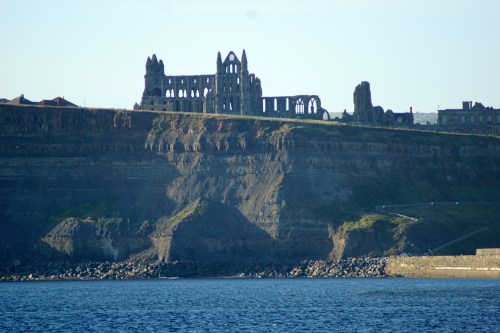
Even in broad daylight the sight is impressive from the sea as I found earlier this year when I sailed into Whitby!

whitby-from-sea


Save

Save

2 Comments

Filed under Architecture, Books, Buildings

The Story of a Square 2: Berkeley Square

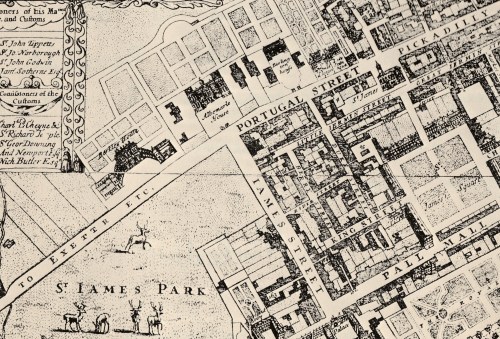
Berkeley (or Berkley as it is often spelled on early maps) Square was built on the farmland owned by John, 1st Baron Berkeley of Stratton, a Royalist military commander in the English Civil War and close friend of James, Duke of York (later James III) who did very well for himself after the restoration of Charles II . Amongst other things he was a co-founder of the Province of New Jersey. Berkeley acquired extensive farmland to the north of the Exeter Road in London, now Piccadilly, and in 1665 he had a mansion built there. Today it would occupy the block bounded by Piccadilly, Stratton Street and Berkeley Street, with its gardens (partly designed by John Evelyn) stretching northwards. In the map below of 1682 ‘Berkley House’ can be seen just above the ‘ETC’  of The Road to Exeter Etc.’ (The area marked ‘St James Park’ is now known as Green Park.)

map-1682

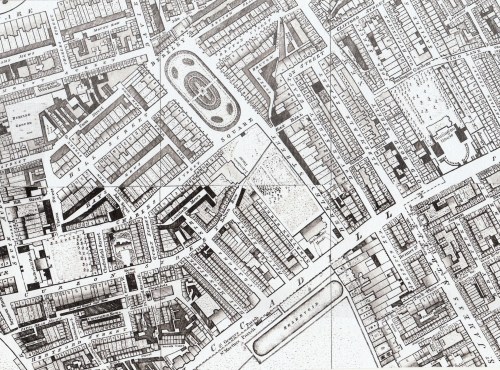
Evelyn records that it cost “neare 30,000 pounds” and called it a “palace”. After Lord Berkeley’s death in 1678 his widow sold off strips at the side of the grounds to create Stratton Street and Berkeley Street, much to Evelyn’s disgust. Princess (later Queen) Anne occupied the house 1692-5 during a spat with her sister Queen Mary and in 1696 it was sold to the Duke of Devonshire and renamed Devonshire House. It was rebuilt after a fire in 1734/7 and this is the house that can been seen in Horwood’s map of 1799/1819. The reservoir in Green Park mentioned in a recent post can be seen at the bottom.

map-horwood

One of the conditions of the sale was that view over the land to the north of the gardens should be unobstructed and this is one reason why, when the area was developed, that Lansdowne House is set to one side with its gardens respecting the view from the rear of Devonshire House and there was no building along the south side of Berkeley Square.

The square was laid out in 1730 with houses on the east and west sides.The east side was the first to be built and was finished about 1738 and the west side was completed in 1745. Of these houses only the western side remains intact – the 1930s saw the replacement of the eastern side and the garden wall of Lansdowne House – and the site of Mr Gunter’s famous establishment in the south-east corner is now under a branch of Prêt. The customers still take their refreshments outside to eat under the plane trees – although rather less elegantly than Mr Gunter’s patrons would have done. It was originally the shop of Dominicus Negri, an Italian pastrycook, who set up there in 1757, trading as The Pot and Pineapple.

In the centre was  an equestrian statue of George III – a not very successful effort whose legs soon collapsed. It was replaced by the little pump house with a Chinese roof which has survived. The famous plane trees are perhaps the most striking survival of the Georgian square and were planted in 1789.

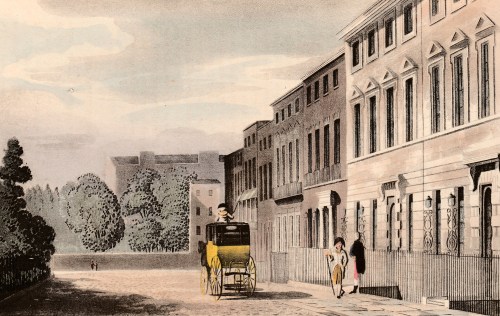
Ackermann’s Repository featured the square in September 1813 with this view which appears to be the south-west corner with the wall of Lansdowne House’s gardens in the background.

ackermann-1813

According to the text “This square is distinguished from all the others in the British metropolis by its situation on the side of a hill, which gently slopes from north to south. the houses on the north side are, upon the whole, rather mean; those which form the east and west sides, though many of them, individually, very good buildings, do not, from the want of regularity, appear altogether to such advantage as where greater attention is paid to that point, and where the site is more favourable to it… The area, which forms an oblong square, containing about three acres, is inclosed by an iron balustrade; and the inhabitants, after the example of their neighbours, have, of  late years, caused it to be planted extensively with shrubs, which have thriven very rapidly, and give a rural air to the whole.”

victorian

This late Victorian print shows the southern end of the square, looking west with the Lansdowne wall on the left.

Nowadays it needs some care to recapture the Georgian spirit of the square, but it can be done, especially when sitting in the shade of the plane trees and looking at the wonderful ironwork of the western side. But don’t expect to hear a nightingale singing in Berkeley Square – they probably flew off in the 1730s when the builders moved in!

You can visit Berkeley Square on the Mayfair walk in my Walking Jane Austen’s London.

Save

Save

Save

Save

1 Comment

Filed under Architecture, Buildings, High Society, Walks

The Story of a Square 1: Cavendish Square

Roque Cav SqIn 1717 the 2nd Earl of Oxford, Edward Harley, began work on the development of his estates north of  “the road to Oxford” or Tyburn Road, that eventually became Oxford Street. The first element in his grand design was Cavendish Square, named for his wife Lady Henrietta Cavendish Holles. The Duke of Chandos bought the entire northern side for a mansion (described by Ackermann’s as a ‘palace’), Lord Harcourt and Lord Bingley bought sites on the east and west and the rest was sold to speculative builders. Work was interrupted by the financial crisis of the South Sea Bubble in 1720 but the Earl persisted, developing streets and Oxford Market to stimulate interest in his scheme.

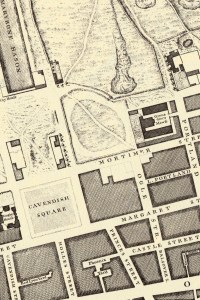
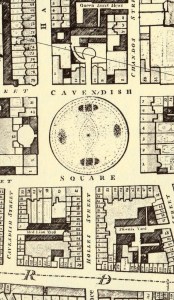
By the time of Roque’s map (1738) there was significant development on all except the North side. Marylebone Bason, a reservoir, can be seen to the north west and what is probably a gravel workings to the north east.  Oxford Street can just be seen at the bottom.Lady Mary Wortley Montagu (poet, letter writer and pioneer of smallpox vaccination) lived at number 5 1723-38.  On the western edge is the beginning of the Earl’s own house which was never completed and eventually the site changed hands and a Mr Tufnell had numbers 11-14 built there in 1771. By 1815  Cav Sq Regencythe Bason and the gravel workings to the north had completely vanished under streets and houses and the whole square had been developed as can be seen in the map to the right.

The centre of the northern side has a gap leading to the mews with a turning circle for carriages. The flanking houses still exist, virtually unchanged outwardly, although the gap between them has a link which carries a sculpture by Epstein.

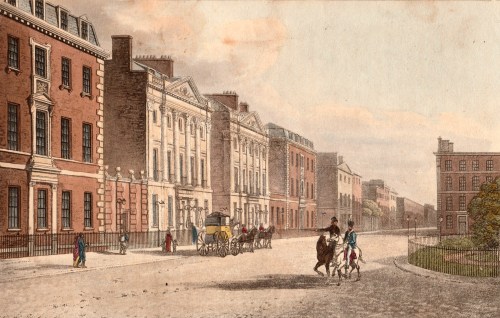
The house on the north-western corner (now no.16) was one of the wings of Chados’s intended ‘palace’. It was the home between 1761-80 of Princess Amelia, one of the daughters of George III. Amelia suffered form serious ill-health, including tuberculosis of a knee joint and the painful skin disease, St Anthony’s Fire. She spent much time at Weymouth taking sea water cures. Tragically she fell in love with Colonel Charles Fitzroy (descended from one of Charles II’s illegitimate sons). She was not permitted to marry him, but considered herself his wife and left everything to him on her death in 1810, aged 27. In the print below the house is the red brick one on the extreme left. It was ‘modernised’ in the later 19th century so the exterior looks a little different now. Lord and Lady Nelson lived in the Square in 1791 and George Romney, the painter at number 32 on the south side (1775-97).

Cavendish Square

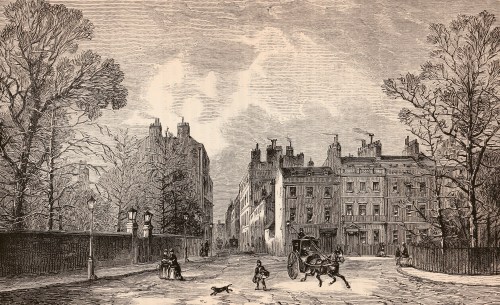
The print of the north side is from Ackermann’s Repository, March 1813. Using Google Street View from the same spot Princess Amelia’s house is still clearly identifiable under later remodeling, a more recent house has been inserted into the space where there is a wall topped with urns and the two houses flanking the entrance to the mews look identical. The circular garden at the centre of the square is till there, but now has an underground carpark beneath it (installed 1971) and the appearance of the square is seriously compromised by the brick wall and entrance lanes of the car park.

I’ll be finding more London squares from my collection of Ackermann prints and seeing how they have changed in future posts.


Save

Save

Save

Save

Leave a comment

Filed under Architecture, Buildings, Royalty

“One of the Most Agreeable Walks in London” – a stroll through The Green Park

Green Park0001

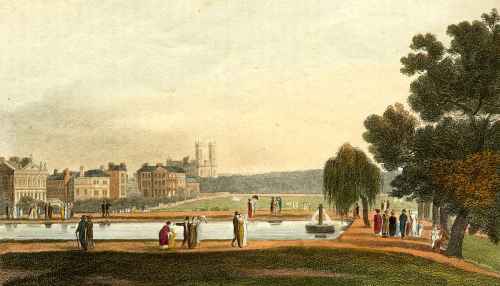
“No inhabitant of the metropolis, and scarcely any person who has visited it, needs to be told that the spot delineated in the annexed view [above] forms one of the most agreeable walks in London.” (Ackermann’s Repository October 1810).

This shows the eastern end of The Green Park (these days ‘The’ is always dropped) from Piccadilly, looking south. It seems the artist would have been somewhere between Clarges Street and Bolton Street. Westminster Abbey can be seen in the distance and on the left are the houses looking out onto the Queen’s Walk. St James’s Palace is hidden behind them at the far end. Nowadays Green Park tube station would be just out of sight on the left with the Ritz (on the site of The White Horse Cellar) just beyond that.

“In summer the eastern end of the Green Park forms a favourite promenade for the inhabitants of the metropolis: and in fine weather, on every evening and on Sundays in particular, is always extremely crowded with genteel and well dressed company. At the north-east corner of this park there is a fine piece of water, which is supplied by the water-works of Chelsea [The reservoir was built in 1775 and filled in in 1856] and forms at once a beautiful embellishment and a useful reservoir. The guards parade every day between ten and eleven o’clock, and a full band of music renders this spectacle cheerful and attractive.” (John Wallis London: Being a Complete Guide 1810)

Green Park is a triangular space of about 53 acres. To the south Constitution Hill divides it from the gardens of Buckingham Palace and St James’s Park butts up to it in the south-east corner with the Mall. In the 17th century it was part of St James’s Park, the Tudor hunting grounds, which swept around the south and west of the palace, but by the time of Roque’s map of 1738 the tree lined avenue of the Mall leading up to Buckingham House cut it off and it is labelled The Green Park. The gardens of Buckingham House were much smaller and the park crossed Constitution Hill, occupying the area that is now the large roundabout of Hyde Park Corner. The second print is from The Beauties of England & Wales Vol. 1 (1801) and shows the view west from the southern edge of the park towards Buckingham House which, by that time, had become The Queen’s Palace or House.

Green Park Q House

Before Henry VIII seized monastic properties St James’s Palace was the site of a religious foundation and a leper hospital and the legend persisted that Green Park was so green (and without flowers) because it was the burial place for the lepers. There is no evidence for this! Charles II was responsible for the park’s lay-out and Constitution Hill is thought to be named because it was a favourite walk, or ‘constitutional’ of his. He also built a snow, or ice, house and the mound can still be seen in the park opposite 119, Piccadilly.

The park, as well as being a fashionable promenade, was also popular for duels in the 18th century. Count Alfieri fought Lord Ligonier the husband of his mistress there and famously remarked (when he returned from the fight to finish watching the play at the Haymarket Theatre with a wounded arm) “My view is that Ligonier did not kill me because he did not want to, and I did not kill him because I did not know how.” The park was also an excellent location for balloon ascents and firework displays such as the 1814 Peace celebrations.

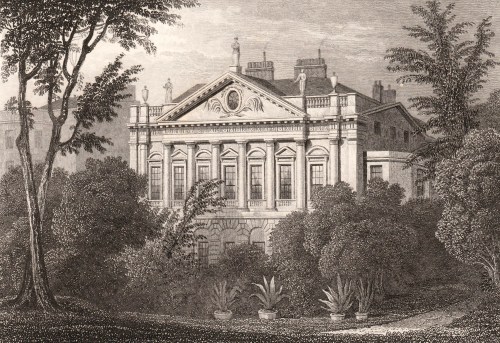
The gravel walk on the eastern boundary of the park is known as The Queen’s Walk and was created for Caroline, the wife of George II. She had a pavilion built for breakfasts looking out on the park, but no trace of it remains. The most distinguished house overlooking the Walk is Spencer House. It can be seen in the top print, identified by the roof ornaments, and in the print below. (1831  Earl Spencer’s House). It is open to the public  on Sundays (except in August) by bookable guided tours.

spencer


Save

Save

Save

Save

2 Comments

Filed under Architecture, High Society, London Parks, Royalty, St James's Park, Walks

1814 – the Summer of Celebrations

The summer of 1814 – and London is en fete to celebrate not only the victory over Napoleon but also the anniversary of Hanoverian rule. For three months Londoners had the opportunity to view, and enjoy, some of the most lavish celebrations the capital has ever seen.

Ack transp

On April 20 there was a triumphal procession for Louis XVII from Hyde Park to Grillon’s Hotel in Albemarle Street where he was staying with his entourage. On June 7 the Russian Czar Alexander I, King William III of Prussia, Marshal Blucher, Prince Metternich, the Prince of Liechtenstein, and Prince Leopold arrived in London and on June 11 the Prince Regent entertained all the Allied Leaders at the opera at Covent Garden. On June 16 they were the guests at a dinner held by the merchants and bankers of London in the City and on June 18 the Prince Regent, Marquess of Wellesley, Lord Liverpool, Marshal Blucher, Prince Metternich, Czar Alexander I, and Catherine Grand Duchess of Oldenburg were guests of honour at a dinner given by the Corporation of London.

On June 20, hopefully having had the opportunity for a rest and some digestion, the Prince Regent, the Duke of York, the King of Prussia, the Czar and  Generals Blucher, Lord Beresford and Hill reviewed 12,000 troops in Hyde Park. At 8pm that evening a re-enactment of the battle of Trafalgar was held in the park on the Serpentine with model ships three feet long (one metre) were deployed to recreate the main events of the battle. At the climax the French ships were sunk as the National Anthem was played.

The evening was staged as a popular entertainment and the park was transformed with stalls, arcades, and follies and pavilions. There were refreshments, taverns and fruit stalls and the crowd could listen to military bands as they watched acrobats or enjoyed the swings and roundabouts.

On June 22 the Allied Sovereigns watched a naval review at Portsmouth before leaving for the continent, but in London the celebrations were by no means over.

On June 28 Wellington was formally welcomed at Buckingham House by the Queen, and on July 1 a great ball was held in the Duke’s honour at Burlington House by White’s Club. It cost £10,000 and amongst the 1,700 guests was Jane Austen’s brother Henry. She was thrilled. On July 7 there was a Service of General Thanksgiving for the victory at St Paul’s Cathedral with Wellington carrying the Sword of State alongside the Regent and as a further sign of his pleasure the Regent held a fete in the gardens of Carlton House to honour the Duke on July 21.

Pagoda

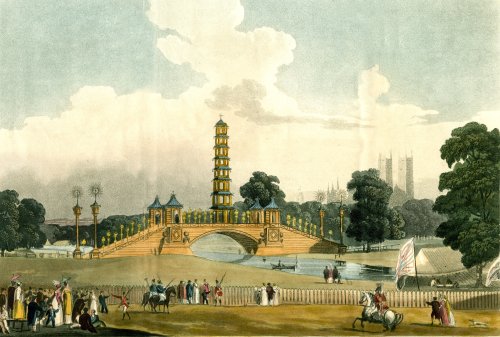
August 1,1814 was the hundredth anniversary of the accession of George I of Hanover to the British throne. The Battle of the Nile was represented by rowing boats on the canal in St James’s Park which was crossed by a new ‘Chinese’ bridge with, in the centre, a seven-storey pagoda. According to Ackermann’s Repository “It appeared a blazing edifice of golden fire, every part being covered in lamps, and glass reflectors at proper intervals relieving the splendour with their silver lustre.” At the height of the fireworks the pagoda caught fire and two men and a number of swans perished, but the crowd thought it was part of the celebrations and cheered wildly.

Meanwhile in Green Park a castle-like structure was built. After firework display that lasted, according to Ackermann’s, “for more than two hours, a discharge of cannon enveloped the whole building in smoke so dense, that no part of it was visible to the innumerable spectators assembled…but when this obstruction cleared away, it burst upon them, metamorphosed into the Temple of Concord, most brilliantly illuminated… and revolving upon its centre.”

Concord

Many shops and businesses also rose to the patriotic occasion and decorated their premises. Ackermann’s Repository at 101, Strand, was decorated by a ‘transparency’ almost 30 feet (10 metres) high and “brilliantly illuminated” from the back “with carbonic gas.”. The lower section shows the seven Christian and Cardinal Virtues with the Royal arms above and the standards of the Allied nations. The upper part is the Temple of Peace with the word REGENT above and all crowned with the Prince of Wales’s feathers. It is shown at the head of this post.

You can  enjoy these two historic parks by taking Walks 4 and 6 in Walking Jane Austen’s London.


Save

4 Comments

Filed under Architecture, Entertainment, London Parks, Prince Regent, Royalty, St James's Park, Wellington

Visiting The Old Doss, The Navy Office and The Stone Pitcher

Few tourists walking up Ludgate Hill towards St Paul’s Cathedral today realise that they are close to three of the major London prisons, but the Bridewell, the Fleet and Newgate are within a stone’s throw.

Coming up New Bridge Street from Blackfriars’s Bridge you are walking over the Fleet River (or Ditch as it had become by the time of Roque’s map in 1747) and passing, on your left, the site of the Bridewell, or as it was known in cant terms, the Mill Doll or the Old Doss. It was built on the site of Henry VIII’s Bridewell Palace (the place where Holbein’s famous painting of The Ambassadors was created). In 1553 Edward VI gave the palace to the City as a refuge for homeless children, but in 1556 it became a House of Correction and workhouse. It dealt with vagrants, beggars, paupers and petty offenders until it burned down in the Great Fire of London, 1666.
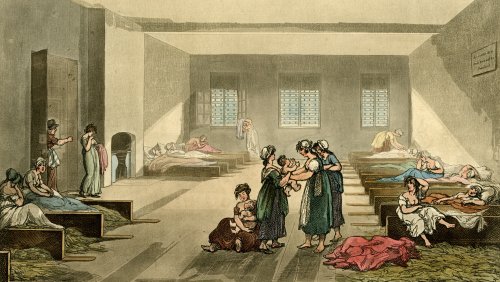
Bridewell

It was rebuilt and, because it was dealing with petty crime, handled a very large number of prisoners – 1,989 committals in 1800, for example. Its medical facilities were considered excellent by the standards of the day and it did give some training to youths and care to the babies born there to unmarried mothers. The image of 1808 shows the ‘Pass-room’ for unwed mothers, each with her bed of straw. The sign on the wall reads ‘Those who Dirts Their Bed shall be Punished.’ The Bridewell closed in 1855 and most of it was demolished, although you can still see part of the handsome façade just south of Costa Coffee.

When you reach the crossroads, with Ludgate Hill to your right and Fleet Street to your left, you are at the site of the Fleet Bridge. In front of you now is Farringdon Street, but this used to be Fleet Market, with the Fleet Ditch paved over and a long line of market stall running north. William Morgan’s map of 1682 shows the Fleet running open here in a canal.

In the angle between the Fleet and the northern side of Ludgate Hill was the Fleet Prison. As a pun on its name its Warden became known as Commander of the Fleet and the prison itself as ‘the Navy Office.’ The site of the Fleet Prison resembled a strange letter P and, as with so many ancient sites in London (it was built in 1197, destroyed during the Peasants’ Revolt in 1381, then in the Great Fire and also severely damaged during the Gordon Riots of 1780), the shape remains – walk up Ludgate Hill and look to the left down the relatively new Limeburner Lane and you can see the curve in the modern buildings on the site.

The Fleet was a debtors’ prison , with about 300 held there, often with their families, until they had discharged their debts. Given that they had to pay their gaolers for absolutely everything from food to having their chains removed, it is hard to see how they could do so without outside help. Many were reduced to begging from the windows of the cells, but those with a trade were permitted to exercise it and, if they had a little money, could take lodgings in the area immediately around the prison – the ‘Liberty of the Fleet.’ Before the Marriage Act of 1753 the Liberty was a prime location for secret or hasty marriages – as many as three hundred in a week.

The prison was frequently condemned for its appalling conditions but it did not close until 1842 and it was demolished four years later.
123For criminals, prisons were not places of punishment until later in the 19th century when the reduction in hangings and floggings meant that new, less physical, punishments such as a term in prison, were devised. In Georgian times they were holding places for prisoners awaiting trial or punishment – hanging, flogging, transportation, time in the stocks or pillory. They were chaotic, filthy and rife with disease and a prisoner’s degree of comfort, if such a thing was to be had, depended on the ‘garnish’ or bribes they could give to the gaolers, just as happened in the Fleet.

Climb Ludgate Hill a little further and you come on the left to The Old Bailey. In the early 18th century this led to a Sessions House – a place where trials took place and now vanished under the southern end of the Central Criminal Courts (1907). Following Old Bailey north you come to Newgate Street where, just to the right was, literally, the New Gate, a massive gatehouse spanning the road. From its southern part Newgate prison extended under what is now the majority of the Central Criminal Courts site. The first records of a prison here are 1188. It was rebuilt after the Great Fire and again in 1770-8, burned down during the Gordon Riots and rebuilt 1780-3.

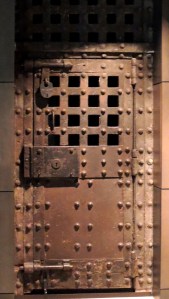
Newgate was so notorious that Grose’s and other slang dictionaries give over fifteen names for it – No.9 Fleet Market, Ackerman’s Hotel, the Stone Pitcher and Newman’s Tea Garden amongst them. An original door from Newgate and now in the Museum of London is shown above.

Roque’s map shows the Old Bailey forking just opposite the Sessions House with Little Old Bailey running up to Newgate Street on the left and leaving a triangular block of buildings in the centre. Old Bailey
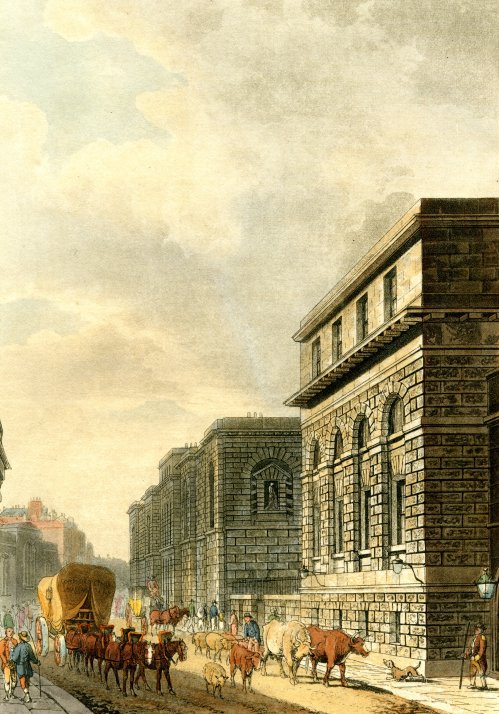
When public hangings at Tyburn were abolished – the long drive across London through jeering and cheering crowds became to be seen as uncivilised, and it certainly disturbed the peace of the smart new developments north of Oxford Street – they were transferred to Newgate in 1783. This was supposed to create a more orderly atmosphere where the watching executions could be experienced with due solemnity. To this end the buildings between the Little Old Bailey and the main street were demolished at the same time as the prison was rebuilt following the Gordon Riots, creating a triangular space which is still open today.In the print above (1814) the Sessions House is on the right with Newgate Prison itself beyond it. The open space faces it, out of sight to the left of the print.

Naturally public executions at the new location were as much of a bear garden as before, with the crowd crammed into the enclosed space and every property with a view making a killing out of renting out window space to view the condemned being led out through the Debtors’ Door.

The print below shows the execution of the Cato Street conspirators, 23 February, 1820. Because they were convicted of treason the initial sentence was hanging, drawing and quartering, a brutal survivor or the middle ages. As a nod to modern times it was commuted to hanging, but the bodies were beheaded symbolically afterwards.catostreet executions
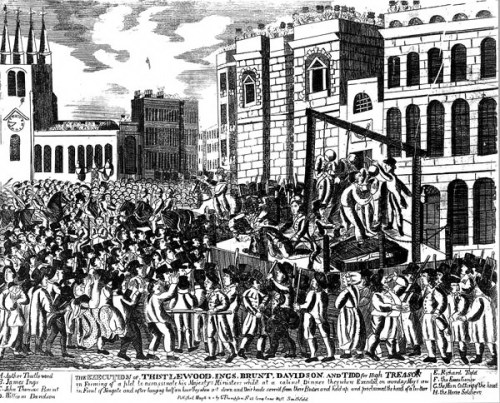
Newgate Prison is seen on the right and the church of St Sepulchre-without-Newgate, where a bell was tolled before a hanging, in the background.

Partly obscured by the cross-beam of the gallows you can just make out a rectangular panel. This was hung with chains and shackles and, when the prison in King’s Lynn was built, that door was reproduced in all its details.
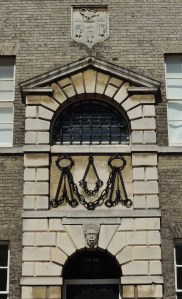
Lynn prison

Public hangings were ended in 1868 and now it takes an effort to stand in the attractive space, with its flower tubs and benches,facing the dignified mass of the Edwardian Central Criminal Courts and with the church still standing to your left and imagine what the place must have been like during an execution.

You can find these prisons on Walk 8 of Walking Jane Austen’s London and if you are intrigued by the slang and cant terms for the prisons you can find more for crime and punishment and the whole colourful world of Georgian and Regency underworld and sporting life in  Regency Slang Revealed.

Save

Save

Save

Save

3 Comments

Filed under Architecture, Crime, Riots

The Real Castle of Otranto

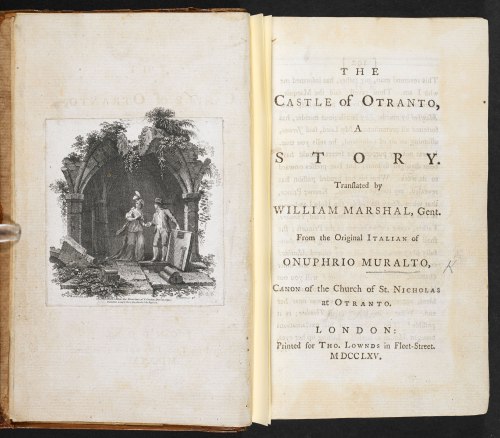
In 1764 Horace Walpole published The Castle of Otranto, A Story. Translated by William Marshal, Gent. From the Original Italian of Onuphrio Muralto, Canon of the Church of St. Nicholas at Otranto. [Image: British Library]

oTRANTO FRONT

Walpole (1717-97) was the son of Robert Walpole, recognised as Britain’s first Prime Minister, and was variously a Whig politician, a dilettante, an antiquarian and the creator of the wonderful Gothic masterpiece, Strawberry Hill, his house in Twickenham.

Walpole’s book – often considered to be the first Gothic novel – has the lot: a giant supernatural helmet that crushes a bridegroom to death, thwarted love, tragic stabbings, lustful noblemen, vengeful fathers, sword fights, ghostly happenings and much, much more. Frankly, attempting to summarise the plot is impossible but a short extract gives the flavour:

Manfred, whose spirits were inflamed, and whom Isabelle had driven from her on his urging his passion with too little reserve, did not doubt but that the inquietude she had expressed had been occasioned by her impatience to meet Theodore. Provoked by these conjectures, and enraged at her father, he hastened secretly to the great church.  Gliding softly between the aisles, and guided by an imperfect gleam of moonlight that shone faintly through the illuminated windows, he stole towards the tomb of Alfonso…

After the success of the first edition, purporting to be a translation of an ancient manuscript, Walpole came clean for the second edition and admitted to writing it. It was hugely popular, spawned an entire genre of fiction and inspired numerous stage melodramas.

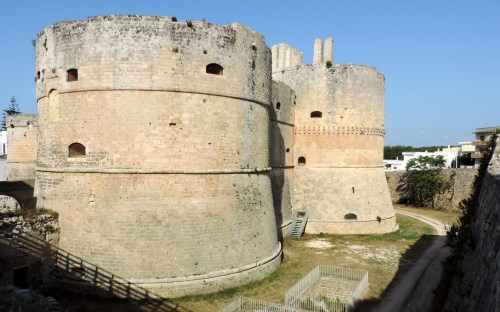
I was recently on a small ship cruise in the Mediterranean in the footsteps of Edward Lear and found myself in the Italian port of Otranto. Obviously the priority was to seek out the castle. I had visions of gothic towers, creepy turrets, gloomy dungeons, gargoyles… Actually, it is nothing like that at all, which was rather a disappointment.Otranto

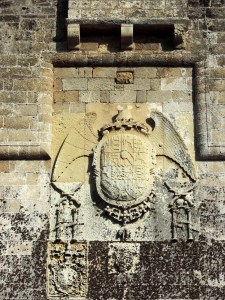
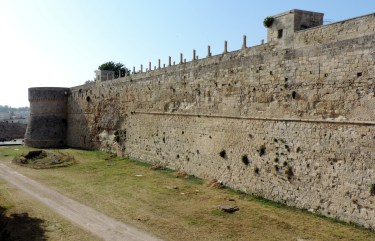
It is known as The Castello Aragonese, was rebuilt by Alphonso II of Naples in 1485–98 and is an aggressively militaristic edifice with not a gargoyle in sight. Over the entrance is the coat of arms of the Holy Roman Emperor Charles V (1500-58) who owned southern Italy when it was part of the Kingdom of Aragon.

Otranto arms

An impressive castle – but not, I fear, the house of horrors of Walpole’s imagination, unless one pictures the huge coat of arms taking off on those strange wings behind it and crashing down on some unfortunate bridegroom…

Napoleon stationed naval ships  in Otranto harbour from 1804 and in 1808 created the hereditary title Duc d’Otrante for his Minister of Police Joseph Fouché when the town became duché grand-fief in the satellite Kingdom of Naples. The dukes now live in Sweden and the title is still extant, apparently without any gothic nightmares to haunt the family.Otranto moat

Save

Save

Save

Save

Save

2 Comments

Filed under Architecture, Books, Buildings, Literature, Napoleon

The Earl of Wittering Goes to the Seaside. Part 3 – Where to Stay?

‘Well?’ The Earl of Witting glares at his  unfortunate secretary making Porrett drop the pile of paperwork he is juggling. ‘Here we are in June already – where have you found us to stay in Weymouth?’

Weymouth estate agent

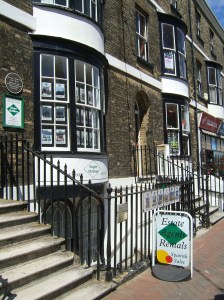
[Porrett would have used a local agent, like this modern Weymouth estate agent. Or consulted advertisements in a guidebook or the local newspapers]

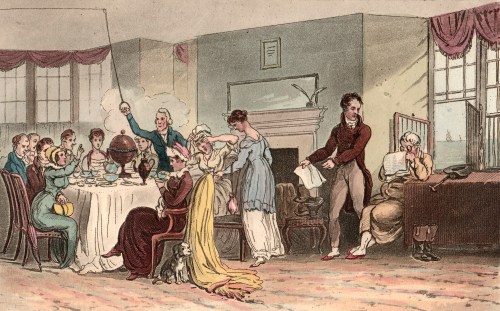
‘As you know, my lord, I returned yesterday and I have fully reviewed the options. There are boarding houses, where meals and domestic services are included in the charge. Meals would be taken communally, however and I am not certain large private drawing rooms will be available…’

lodging house breakfast

‘Communally! Have you taken leave of your senses, Porrett? Gatwicks do not take meals communally. Heavens knows what type of people one might encounter – medical men, clergy – ‘ (A nasty dig that, Porrett’s father is a clergyman) ‘ – merchants, even!’

[Above: a communal breakfast at a boarding house by J Green, etched by Rowlandson, in Political Sketches of Scarborough]

‘Quite, my lord. I dismissed those. Then there are lodgings where one might take a floor or the entire house. The lodgers would have to provide their own servants and cook, however, or rely on paying extra for whatever the landlady has to offer.’ The earl is becoming puce in the face, so Porrett adds hastily, ‘I assume you would be taking Gaston with you?’ Always assuming the French chef would condescend to cooking in an unknown kitchen.

‘Of course we are taking Gaston, unless I can rely on decent food. What about these hotels one reads about? Jumped up inns, eh?’

‘So I understand, my lord, although apparently some are being created with er, new facilities.’

‘Facilities? I should damn well hope they have facilities!’

‘No, my lord, I mean sanitary facilities. Water closets.’

‘Outrageous! Probably most unhealthy. What’s wrong with a chamber pot? So, does Weymouth have hotels?’

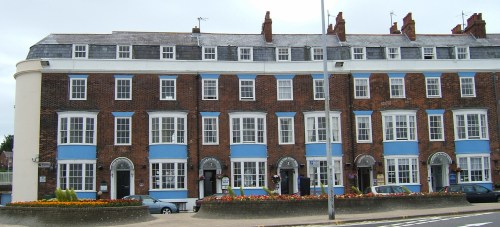
‘Not that you would find acceptable, my lord. I feel that lodgings might be most suitable. My researches show that there are, at present, one hundred and eight lodging houses.’ [Standardized rows of houses were built for lodgings, as these, below, in Weymouth probably were – and they still are ‘lodgings’ today]

Weymouth houses

The colour of his lordship’s face, which had begun to subside, becomes more vivid as Porrett hastens to explain, ‘I have reduced the number to six, my lord.’ And now, the question he has been aching to ask, the question that will tell him whether his summer is to be spent labouring in London on the receiving end of his lordship’s demands by post or whether, oh bliss!, he is to accompany the family. The family and Miss Emily. Emily with her dark curls and blue eyes, Emily with her rosebud mouth and the freckle just on the –

He pulls himself together. ‘How many chambers will be required, my lord? I collect that Viscount Dithermore and his family are to accompany you and the Countess, but will you require me with you, my lord. Or do I remain here?’

‘Hah! Leave you to frivol your time away in Town? The mice at play while the cat’s away? No, you will come with us, Porrett.’

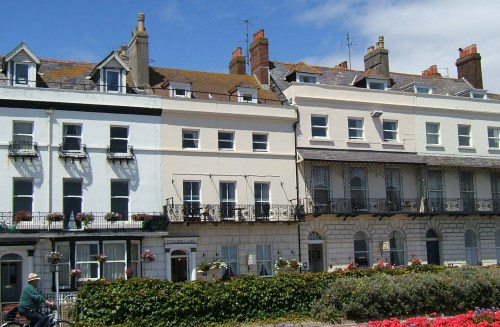
It is hard for Porrett to keep the blissful smile from his lips. ‘I have the perfect house, in that case, my lord. On the Esplanade, newly built with a fine balcony on the principal floor to give views of the sea.’ And a little balcony on the floor above. As soon as he saw that little wrought iron confection he could imagine Emily standing upon it, the breeze stirring her hair as she turned to him. ‘Oh Porrett, Frederick… I have long lov-‘

Weymouth balconies

[Above: could this be Porrett’s romantic little balcony (left?) I’m not certain it would take the weight of two lovers… Houses on Weymouth’s Esplanade]

‘Then reserve it! Don’t stand there with that look on your face like a distressed halibut! We leave within the week.’

‘At once, my lord.’ Ah, bliss….

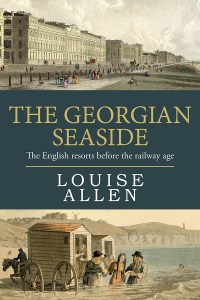
What will the journey be like? Will Gaston condescend to accompany them? Will Emily even notice Porrett? Find out in the next installment and meanwhile read about the vibrant world of the early English seaside holiday  in  The Georgian Seaside: the English resorts before the railways came.The Georgian Seaside Cover_MEDIUM WEB

3 Comments

Filed under Architecture, Seaside resorts

So What Was Wrong With Ranelagh?

Roque map

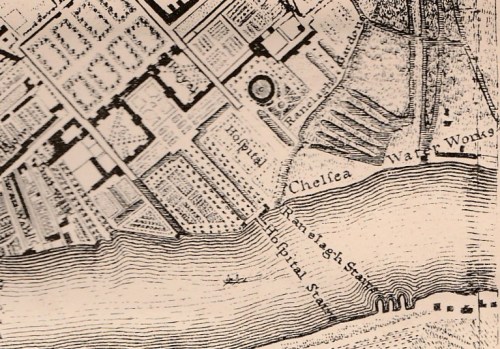
Above: Ranelagh Gardens in Roque’s map of London 1741. The Rotunda is the black circular feature and it can be located exactly with modern maps because the outline of the buildings of the main wings of the Royal Hospital have not changed.

Last week, with friends, I attempted to visit the site of Ranelagh Gardens next to the Royal Hospital Chelsea – only to find them off-limits with the marquees of the Chelsea Flower Show being erected there. A helpful Chelsea Pensioner directed us to the lovely scale model of the Hospital and the Gardens that shows them in their heyday and that whetted my interest to discover why they closed so much earlier than their rival, Vauxhall.

Vauxhall Gardens and Ranelagh Gardens were the most famous of the London pleasure gardens and the two whose name many people can still remember. The Ranelagh Gardens today – simply a small park – is of about the right size and in the same position, and so the name lives on.

The first clear reference to the Vauxhall Gardens, or New Spring Gardens as they were at first, was in John Evelyn’s diary on 2 July 1660 – ‘I went to see the new Spring-garden at Lambeth a pretty contriv’d plantation.’ “New” because the old Spring Gardens, dating to the reign of Elizabeth I, were at the eastern end of St James’s Park. Admiralty Arch now sits in the middle of the area.

By the 1690s these early pleasure grounds were being referred to as “Vauxhall” from the proximity of the old manor of Vauxhall. The name comes from the house of the 13th century Falkes de Breuté – Falkes Hall became Fauxhall, Fox Hall and Vauxhall.

In 1729 an ambitious young tradesman from Bermondsey called Jonathan Tyers obtained a sub-lease on “Vauxhall Spring-Gardens” and set about creating the Vauxhall Gardens that became London’s premier attraction until its sad decline during Victoria’s reign. It closed on 25 July 1859, 199 years from Evelyn’s visit.

Pleasure gardens of various sizes and degrees of sophistication were dotted throughout London and its surrounding area in the 18th century. Many were as simple as a landscaped garden or a bowling green next to a good public house. Marylebone Gardens, the main competition to Vauxhall after Ranelagh, was located next to the Rose of Normandy Tavern (in the area bounded today by Marylebone High Street, Marylebone Road, Weymouth Street and Harley Street) and began as a bowling green and gaming house. The fact that Dick Turpin visited in the 1720s may well be reflected in the fact that Gay used it as a haunt of his highwayman Macheath in the Beggar’s Opera (1728). This reflects the early tone of the place and, even after 1738 when the new proprietor of the tavern, Samuel Arnold, improved things – introducing a sixpence entrance fee, shelters, music and fireworks and increasing its size to eight acres – it never entirely shook off its early reputation and became notorious for gambling and card sharping. It closed in 1778.

Ran int

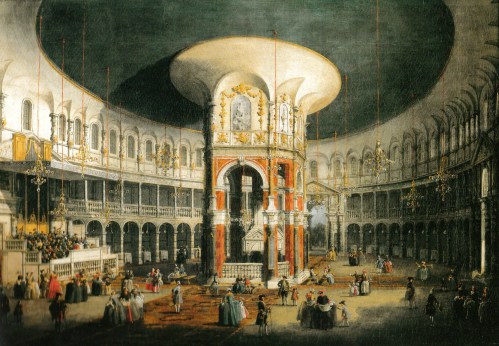
Above: Canaletto. The Interior of the Rotunda at Ranelagh (c1751)

Ranelagh Gardens were set up in 1741 in direct competition to Vauxhall and opened in April 1742. The proprietors, a syndicate of businessmen, had clearly studied Vauxhall, learned from its problems with the weather, and set out to rival, if not surpass it.

The site was promising, located in the village of Chelsea with direct river access. The centrepiece, from the beginning, was a vast Rotunda, an epic space modelled on the Pantheon in Rome. It measured 185 feet (56.4 metres) in diameter and, with the landscaping, cost £16,000. It became a tourist attraction even while it was being built and at night it looked like a giant lantern, blazing light across the gardens. It was immediately obvious to Tyers at Vauxhall that this was the major competition and he responded by buying up the  field that the Ranelagh proprietors had wanted to buy to expand into.

The Ranelagh lessee, William Crispe, was declared bankrupt in 1744, which must have pleased Tyers, but an issue of shares rescued the project and at first it was a huge success, a fact reflected in falling takings at Vauxhall. So what went wrong? The sad truth was, Ranelagh was just not naughty enough.

Horace Walpole was initially enthusiastic. Shortly after it opened he wrote “It has totally beat Vauxhall… You can’t set your foot without treading on a Prince, or Duke of Cumberland.” Yet the novelty soon waned. In June that year Catherine Talbot wrote to a friend that “…it is quite vexatious at present to see all the pomp and splendour of a Roman amphitheatre devoted to no better use than a twelvepenny entertainment of cold ham and chicken.” It probably didn’t help that the structure in the centre of the Rotunda, intended for the musicians, proved to have dreadful acoustics. Nor were the grounds very exciting, with a well-lit (probably too well-lit) circular walk which soon became monotonous.

There was no strong drink available and no gambling. The admission fee of half a crown kept away the riff-raff, as was intended, but it also created a far less exciting ambiance than at Vauxhall. It was favoured by the older, staider visitor but with the Hospital grounds on one side and the field strategically purchased by Tyers on the other, there was little scope for development and change.

To get to Vauxhall one needed to ‘take boat’ and cross the river. As my fellow author Sophie Weston pointed out to me, at night this must have seemed almost transgressive, an exciting, slightly clandestine, beginning to the evening’s adventures. Once there the walks were a mixture of secluded and well-lit, with plenty of opportunity for promenading – or for getting up to something rather naughtier. Tyers learned from Ranelagh’s strengths and weaknesses and adapted constantly, giving his customers a diet of novelty with an edgy frisson, yet within a safe and familiar setting.

Over at Ranelagh you could enjoy your tea and coffee, a safe and brightly lit gardens and the impressive Rotunda – but these were no attraction for the fashionable or the younger sets, despite the addition of a Chinese Pavilion. Ranelagh found it hard to weather the problems of the 1780s with riots in London and the rather more sober mind-set towards frivolous activities engendered by the war with France. Vauxhall survived this period, but Ranelagh gave up the struggle and finally closed in 1803, after sixty one years of operation. The Rotunda (largely built of wood) was demolished in 1805. The organ was moved to All Saints Church in Evesham, but even that was replaced later. Ranelagh has vanished.

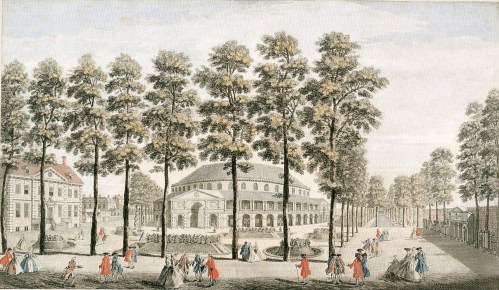
Below: Ranelagh House and Gardens with the Rotunda (1745) T. Bowles after J. Maurer

Ran ext

4 Comments

Filed under Architecture, Buildings, Entertainment, High Society