Be a Man – Leave That Umbrella At Home!

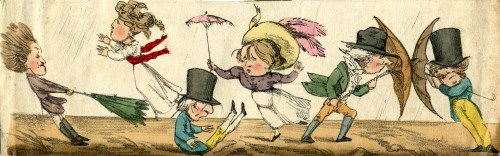
We’ve arrived at that windy season when raising an umbrella is asking for trouble, as this delicious original water colour sketch (unfortunately undated) reminds me.
windy-weather

The interesting thing about this is that the men are using umbrellas, something that they probably wouldn’t have considered before the early 1800s.

Although parasols as protection from the sun date back to the 4th century BC in the Near East, and possibly earlier in China, the idea of using them to hold off the rain appears to be a 17th century innovation in France, Italy and England – but for ladies only. By the mid-18th century continental gentlemen would happily be seen sheltering from a downpour under an umbrella covered in oiled silk and English ladies would routinely use them, but there was a distinct stigma about Englishmen resorting to an umbrella.

Umbrellas were, it seems, ‘French’ and therefore, by definition, an effeminate accessory. Beau Brummell would never carry one, considering that no gentleman should, and advocated taking a sedan chair if there was the slightest risk of rain.

However, some practical men did ignore the jeers, the most well-known of them being Jonas Hanway (1712-1786), a much travelled man, who designed his own, rather large and cumbersome umbrella and persisted in using it. He was verbally attacked by the hackney carriage drivers who saw this as a direct attack on their business but he ignored their threats and one of the slang terms for an umbrella at the time was a Hanway. (The Victorian ‘gamp’ was named after Dickens’s Mrs Gamp, not the other way around.) The below detail from a Victorian imagining of Mr Hanway shows the interest he attracted.

Hanaway2

By the early 19th century practicality had won over prejudice for most gentlemen and the use of a rain umbrella became usual for both sexes. In 1814 in Mansfield Park Jane Austen writes of the rescue of a very wet Fanny Price:

“… when Dr Grant himself went out with an umbrella there was nothing to be done but to be very much ashamed and to get into the house as fast as possible; and to poor Miss Crawford, who had just been contemplating the dismal rain in a very desponding state of mind, sighing over the ruin of all her plans of exercise for that morning, and of every chance of seeing a single creature beyond themselves for the next twenty four hours, the sound of a little bustle at the front door and the sight of Miss Price dripping with wet in the vestibule was delightful.”
Street Feb

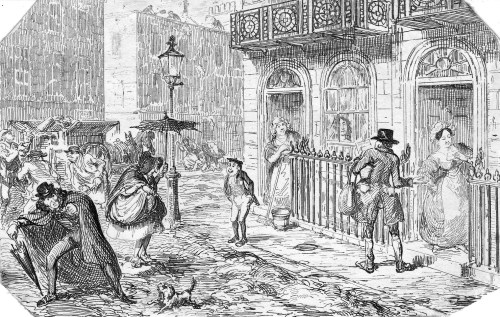
Cruickshank’s delightful series of sketches of various months often show umbrellas. This one (February) has a man using his as a walking aid to negotiate the muddy street while the lady with her skirts hitched up has a far less substantial version.

In this undated sketch (a little earlier than the Cruickshank) both men hold umbrellas, although I suspect that the use of one on horseback may just be part of the joke.wet men

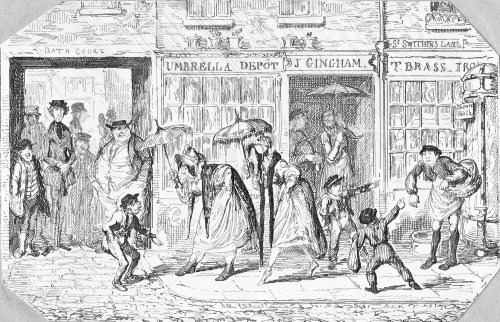
Specialist shops soon started selling umbrellas, as can be seen in another Cruikshank scene which shows one belonging to J. Gingham. The ladies are using what look more like parasols whereas the gentleman inside the shop is having a much more sturdy version demonstrated.
April showers

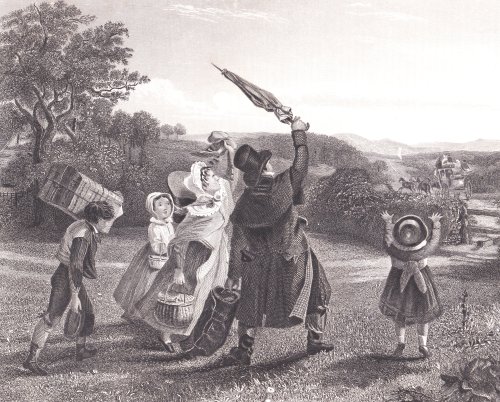
A gentleman travelling by stagecoach might take a umbrella, as can be seen in this image of someone missing the stage –
missing

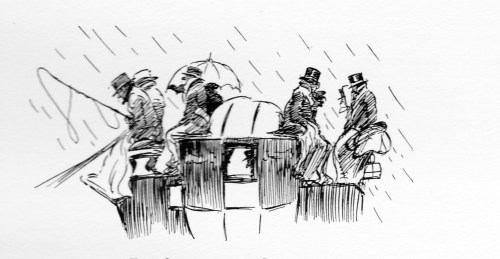
Of course you had to be considerate in how you used your umbrella. In 1822 Stanley Harris recalls sitting in front of a woman with an umbrella who would “shove it below your hat so adroitly as to send a little stream of water down the back of your neck.” This delightful drawing by Cecil Aldin shows the misery of being on top of the stage in the rain, even with a brolly. But even in this downpour, it is only a female passenger who is using one.
Rain

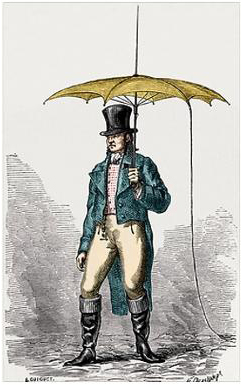
Finally here is a print showing  a French invention – an umbrella complete with lightening conductor. Somehow I cannot see any English gentleman consenting to be seen with such an inelegant contraption!
Umbrella_fitted_with_lightning_conductor

(This is an out of copyright image from Louis Figuier: Les merveilles de la science ou description populaire des inventions modernes (S. 596 ff.) (1867), Furne, Juvet)


2 Comments

Filed under Fashions, Gentlemen, Regency caricatures, Shopping, Street life, Weather

Sea bathing – 1756

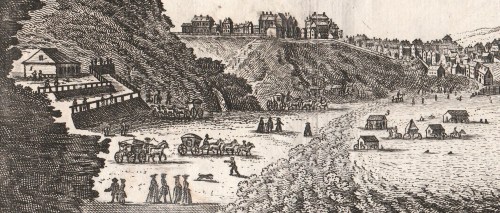
I have recently acquired this  print of Scarborough dated 1756 which I believe was originally a fold-out illustration in the Gentleman’s Magazine.

Scarborough 1

What is so lovely about it is that it shows bathing machines at this very early date. Scarborough was in the vanguard of the new craze for sea bathing, helped by the fact that its original spa was actually on the beach.

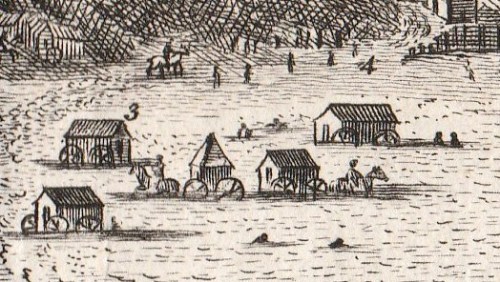
Scarborough 2

The first mention of bathing machines is in 1721 when a Nicholas Blundell mentions “a Conveniency for Bathing in the Sea.” In 1735 “Conveniencies” were being provided at Scarborough for ladies (gentlemen simply walked into the sea naked (regardless of spectators) or jumped in from rowing boats. I can count five machines in the sea and another six waiting at the foot of the cliffs (rather indistinct, but behind the furthest carriage with horses on the beach).

The machines in the sea are of two types – one looks like a modern garden shed on wheels, rectangular with a pitched roof. The other is square with a pyramidal roof.

Scarborough bathing huts

None of them have the “modesty hood” or “tilt” invented in 1753 by Benjamin Beale, a Quaker from Margate. This unfolded like an umbrella at the front allowing the bather to swim modestly hidden. Ladies and gentlemen in elegant clothes have been driven down to the beach in their carriages and would have had a perfect view of the bathers, all of whom would have been naked. Sack-like garments for ladies soon appeared but it was considered effeminate for men to wear anything until well into the 19th century.

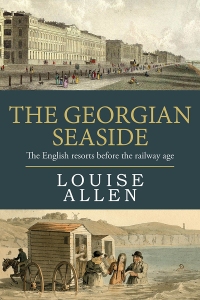
if you want to read about the Georgian Seaside, which was flourishing long before the  Victorian seaside holiday, you’ll find it in my book, The Georgian Seaside: the English resorts before the railway age

The Georgian Seaside Cover_MEDIUM WEB

Leave a comment

Filed under Entertainment, Medicine & health, Seaside resorts

Just the Thing For the Garden

Now the drought is over I am returning to the garden in an attempt to rescue the parched remains and thinking it might be time for a makeover. And where better to turn for landscaping tips than Ackermann’s Repository of the Arts?

Of course, it does help if one has several acres and significant financial resources, to say nothing of strapping young men with spades and wheelbarrows…

Pyne 10002

But I will not be put off by the lack of acres and wheelbarrows (the one on the left is by W H Pyne) because the issue for February 1800 informs me that “Great diversity of surface may, in general, be obtained at no objectionable expense, if the labour be discreetly governed. To sink the valley and raise the hill is a good rule, when properly applied; in which case, the advantages produced are so immediate and striking, as amply to compensate for every exertion for every exertion: hence plants and trees obtain the appearance of several growths, as they are situated on greater or lesser elevations and produce varieties of incident, and opposition of light, shadow, form and colour, that cannot be effected on level ground.”

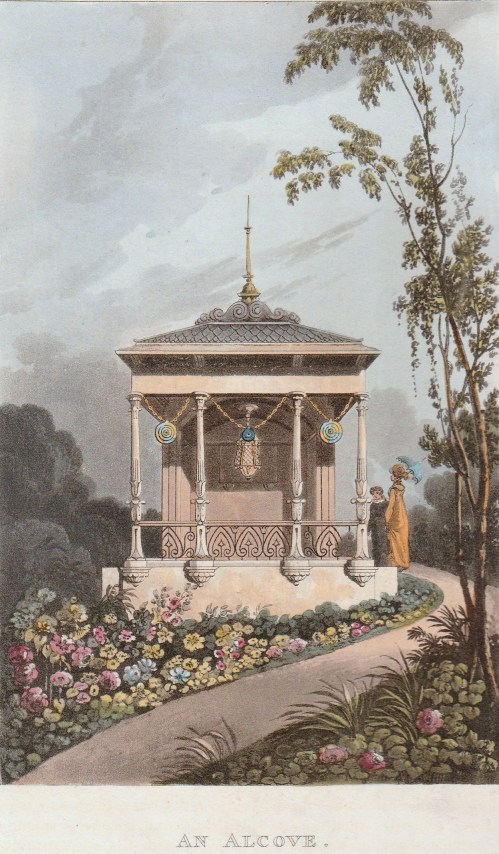
Apparently, once I have excavated and elevated I will have created something ideal for “garden seats, temples and alcoves… suited to retirement and study.” I don’t think a temple would work, but Ackermann helpfully illustrates an “alcove” that might fit in. It would certainly startle the neighbours.

Gardening


“The style of this little building is light and elegant, but of no specific architectural character; and from its arrangements and design, should be rather splendid in its furnishings than otherwise. The pillars are of iron, and from them are suspended china pattera, of rich colours: the chains are gilt, as is the terminal of the roof. The scale-like forms of the roof-covering are of thin lead, and might be richly painted: indeed the whole should be so decorated as to become highly ornamental, and be in splendid harmony with the accompanying parterres and flower-beds.”

Somehow I think this might be more the scale of project that my resources will run to – another Ackermann print, this time from September 1820

1820 gardening001

1 Comment

Filed under Architecture, Buildings, Gardening

Taking A Cold Plunge

In 1702 Sir John Floyer wrote A History of Cold Bathing, promoting immersion in cold water as a cure for just about any disease then known, from scurvy to cancers. Hot springs had never entirely gone out of fashion – the heat must have been a great benefit for all kinds of aches and pains – but bathing of any kind had fallen victim to the displeasure of the church after the Reformation. Partly this was because of the connection with bathing in ancient holy springs and partly because washing the body, let alone taking all one’s clothes off and engaging in a pleasurable activity, suggested sin.

Some bathing houses and plunge pools survive from the 17th century, so the pleasure of bathing, or the belief in its benefits, had never entirely gone away, but it was the 18th century that saw the explosion of the cold bathing craze.

The Georgian Seaside Cover_MEDIUM WEBAs I found when I was researching for my book The Georgian Seaside: The English Resorts Before the Railway Age, sea bathing did not really take off until the mid-18th century, but the same aristocrats who visited spas began to build bathing houses and plunge pools on their own estates decades earlier.
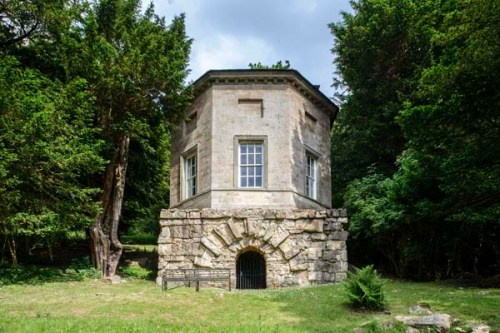
The country was stable under the Hanoverians, there was money to indulge in improvements in their grounds and, as well as the health benefits, an architecturally interesting bathing house made an attractive ‘eye-catcher’ in a landscaped park.

I was lucky enough to stay in one of these delightful buildings at the beginning of the month – The Bath House bathhouse-exterior-main-600x400at Walton in Warwickshire, now a Landmark Trust property.
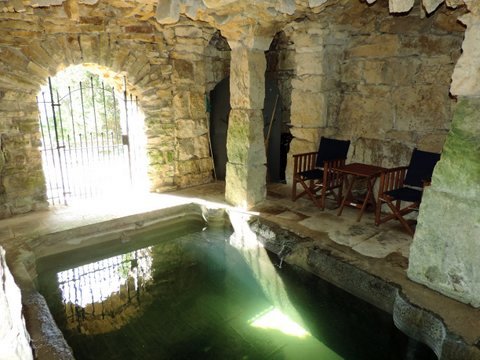
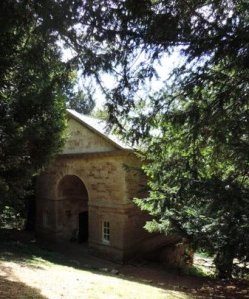
Sir Charles Mordaunt of Walton Hall ordered the bathing house which was completed in 1755. It sits on a hillside in woodland with a glorious view in front and the romantic gloom of the trees behind. The spring-fed plunge bath is approximately 3.5 metres square and deep enough to come up to my shoulders. The chamber is deliberately rustic to appear as though it is a natural cave with a rugged ceiling, vast blocks of stone and a precipitous stair to the room above. Apparently Sir Charles was not averse to people assuming it was of Roman origin – the Fosse Way runs close by.

Bath pool

One of the diseases supposedly cured by cold water bathing was gout and as a sufferer, Sir Charles may have hoped this would help. But he was also undoubtedly influenced by fashion and an element of competition with the many wonderful houses and parks in the area, such as Compton

Bath House entrance

Bath House deerVerney.

The water from deep in the hill, was absolutely icy, the sort of cold that makes your bones ache. But it is also perfectly clear and the flow is strong enough to keep the pool constantly refreshed. The wildlife appreciate it too – there are bats in the ceiling, the Landmark Trust thoughtfully provides a net for frog-removal, and the fallow deer, like these two twin fawns, come to the outfall on the lawn below to drink.

The approach to the Bath House is from the back, through the woods, so there is an element of surprise as you walk in to the incredible drawing room above the bathing chamber.

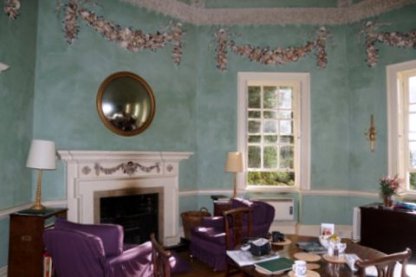
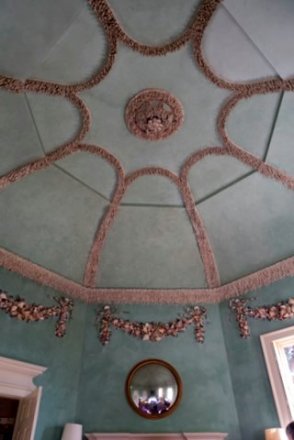
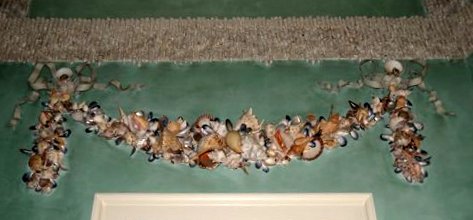
In contrast to the rough-hewn basement the drawing room is an elegant jewel box with a high ceiling, wide widows and fabulous decoration. Great swags of seashells, each almost 3 metres across, decorate the walls and the ceiling has a mass of thousands of plaster ‘icicles’.Bath House Interior 2

Sir Charles was very fortunate to have the advice and practical help of Mrs Mary Delaney, famous for her exquisite flower pictures created in cut paper. She was also an expert in shell-work, then very fashionable for grottos, summer houses and follies and she sourced shells for the Bath House from the West Indies, Naples, Ireland and the Channel Islands. The swags were mounted in boards by Mrs Delaney herself helped by her sister and Sir Charles’s two daughters.Bath House interior

When the building was taken over by the Landmark Trust it had been severely damaged by vandals and the swags and icicles had to be re-made. The interior is now restored to its former Georgian glory and staying there is a wonderful experience. We slept with the shutters open so that when we woke we could look up into the gorgeous ceiling before tip-toeing to the window to see if the deer and their fawns were on the grass below. I have to confess that one dip in the pool was enough and it was fortunate that there were no neighbours – the screams of anguish were so loud!

Bath House swags

3 Comments

Filed under Architecture, Buildings, Medicine & health

Living In History

For those  who are fascinated by the past, or who write about it or who just want to reach out and touch history – I have a recommendation for you – The Landmark Trust.

I’m just back from a stay in one of their properties – Calverley Old Hall in the village of the same name just outside Leeds. This ancient manor house is now stranded in the middle of 20th century development which only added to its air of faint melancholy and mystery.Calverley exterior

The part of the building we were staying in was built at the time of the English Civil War, so we spent our evenings beside the massive hearth dating from about 1640 (see below) or enjoying a bottle of wine at the long table under the beams. But that’s not the best bit – part of the building goes back to 1300 and there’s a 15th century Great Hall and chapel (seen above) and a heart-wrenching story about a father who, in 1604, lost his mind and killed his two sons (and came to a dreadful end). True, the older parts are only viewable from the outside and through the windows, but the entire place was priceless for firing this writer’s imagination.

Calverley interior

The Landmark Trust specialises in saving historic buildings which have lost their purpose and, in some cases, almost their hold on existence. They restore what they can and convert, with integrity, the building as holiday accommodation. There is no TV or radio, phone or wifi, just peace, atmosphere and a well-stocked library relevant to the location. The decoration and furnishing is true to the building as well, with a seemingly endless supply of characterful antiques and near-antiques from their store.

Calverley Old Hall was our 6th Landmark and we are already looking forward to number seven, The Bath House, a mid-18th century folly near Stratford on Avon, built over a bathing pool formed from a natural spring. (One half of the party is completely unimpressed by my remarks that 18th century gentlemen would have splashed happily in the pool in a state of nature and is refusing to assist with my researches into this.)

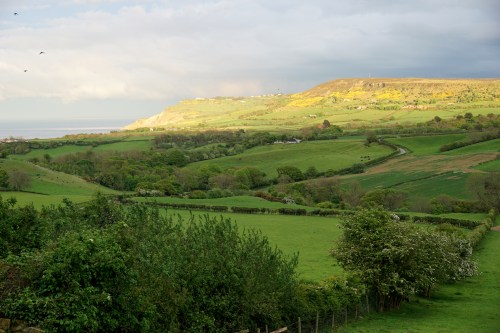
Pigsty exteriorThe others? There was The Pigsty (above) overlooking Robin Hood’s Bay – a miniature Classical temple with a spectacular view built by an eccentric farmer in 1891 for some very pampered pigs. You can see the view below:
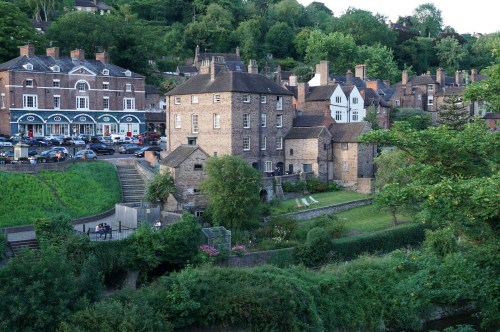
Pigsty view

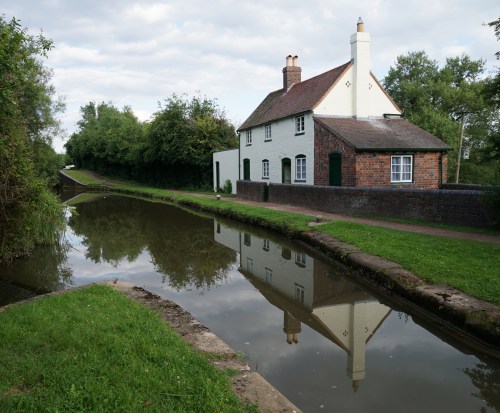
Lock Cottage (below), built 1790/1815 on the Worcester and Birmingham Canal, has a wheelbarrow provided to transport luggage and provides all the entertainment of watching the passing holidaymakers negotiating the flight of locks with various degrees of skill (and colourful language).

Lock Cottage

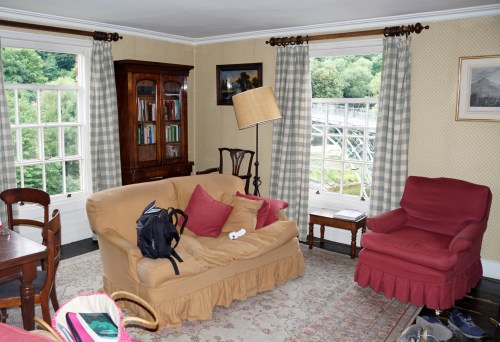
Iron Bridge House (about 1830) is right at one end of the famous Iron Bridge. It is the building right in the middle of the picture.

Ironbridge exterior

There were lovely glimpses of the river and close-ups of the bridge itself  as you can see through the right-hand living room window.

Ironbridge interior

Then there was Beckford’s Tower overlooking Bath with spectacular views from the top of the tower, all 276 feet of it.

Beckfords tower exterior

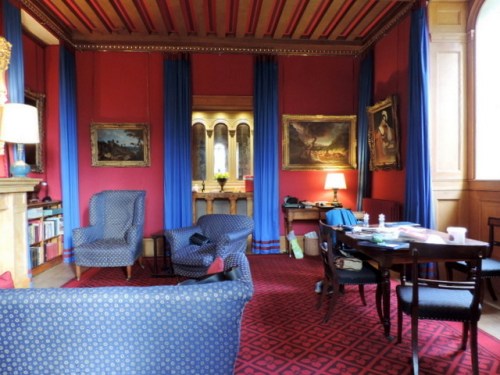
Built by eccentric connoisseur and collector William Beckford it was later given to a Bath church as a graveyard, so one could lie in bed, or in the bath on the ground floor (middle window), and virtually read the gravestones. A little macabre perhaps, but no ghosts were encountered. The living room (below) has been decorated in a colour scheme true to Beckford’s Regency taste.

Beckford's tower interior

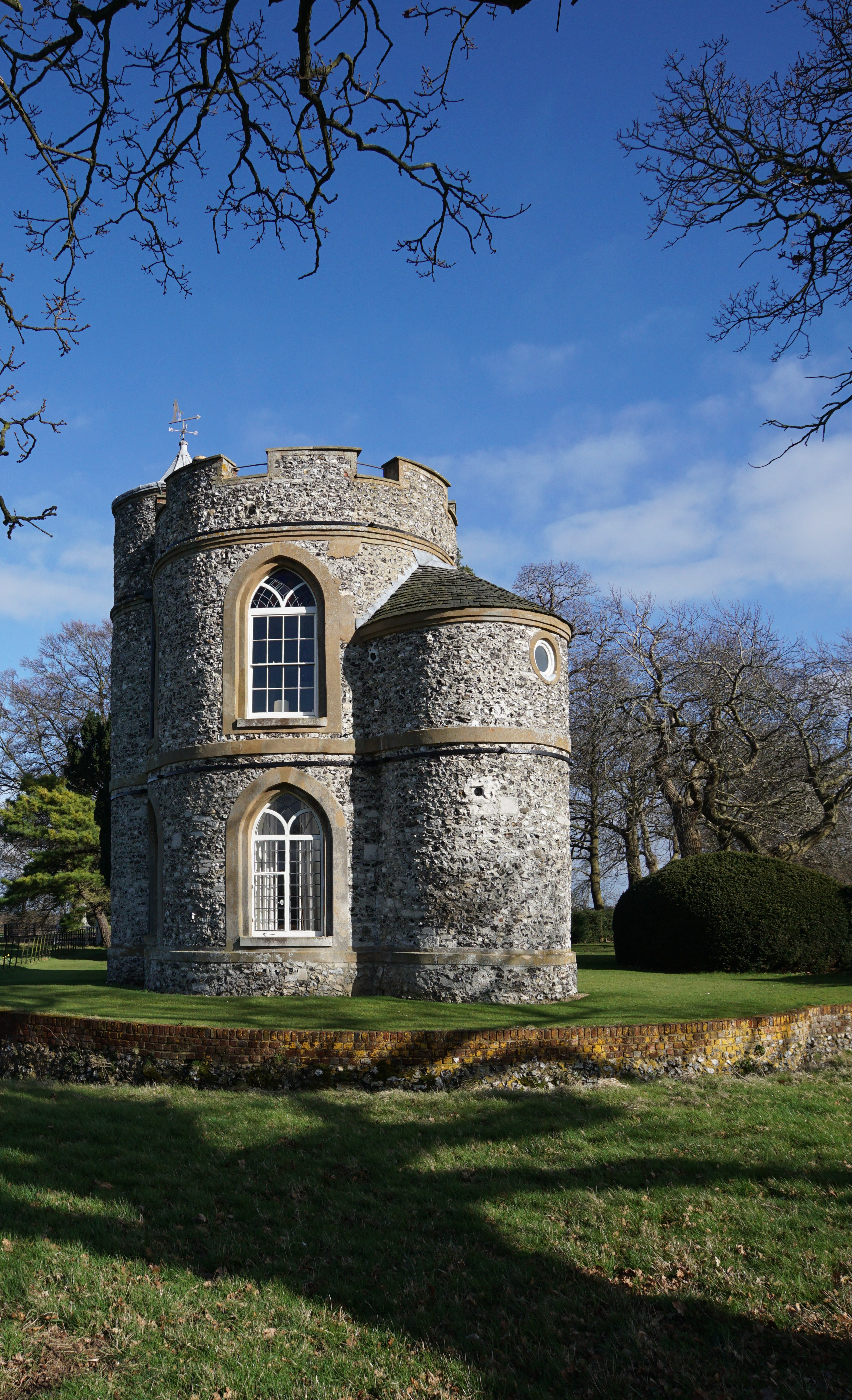
Finally we enjoyed the Prospect Tower, built in 1808 near Faversham by General, later Lord, Harris of Seringapatam as a folly and tea house. In the Edwardian period it became a changing room for the 4th Lord Harris who was an enthusiastic cricketer. It still overlooks the cricket pitch of his home, Belmont Park.

Prospect Tower exterior

There is something very special about living in ancient buildings, I find. Partly it is the tranquility and the lack of modern distractions so my mind can wander freely, part is the thrill of imagining the past inhabitants who looked out of this window, or huddled round that fire in flickering candlelight or gazed out over that view. Why not give it a try?

4 Comments

Filed under Architecture, Buildings

W H Pyne and a View into Rural England

Cover0008

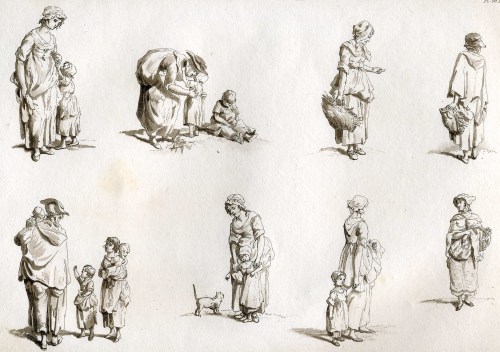
I collect original early 19th century prints – costume prints, London views and, whenever I can lay hands on them, the work of William Henry Pyne (1769–1843). Pyne is not a great artist, but he had the knack of catching the everyday lives of English people, especially the working classes, in a vivid and revealing way.

His The Costume of Great Britain, designed, engraved, and written by W. H. Pyne, was published in 1808 and fetches large sums of money these days – I’ve had to make do with a reprint of the whole book, but I do own a few of the individual plates. You can see two of these at my posts for 5th November 2015 (‘Pray Remember Guy Fawkes!’) and February 18th 2014 (recycling Georgian Style.)

But the work I enjoy the most are the sketches he made and published to help amateur artists populate the landscapes they made with suitable figures. With virtually everyone claiming any degree of gentility being expected to sketch creditably, this must have been a huge market. The first of these came out in Microcosm, or a Picturesque Delineation of the Arts, Agriculture, and Manufactures of Great Britain; in a Series of above a Thousand Groups of Small Figures for the embellishment of Landscape … the whole accurately drawn from Nature and etched by W. H. Pyne and aquatinted by J. Hill, to which are added Explanations of the Plates by C. Gray. That was published in 1803 and was followed by Etchings of Rustic Figures for the Embellishment of Landscape in 1815. I own a number of plates from the first (which I can’t scan at the moment as they are in store: the joys of building work!) and several from the second.

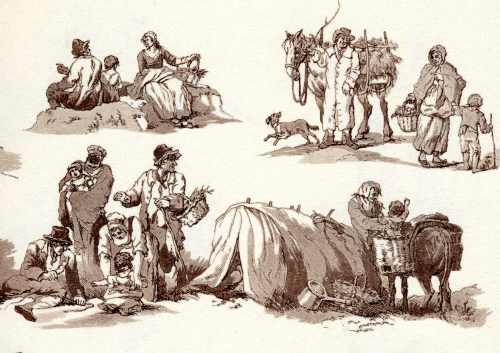
The countrywomen and children at the top of this post are from Etchings of Rustic Figures… as are the Gypsies below.

Pyne0001

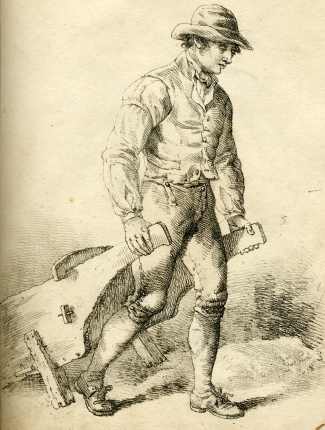
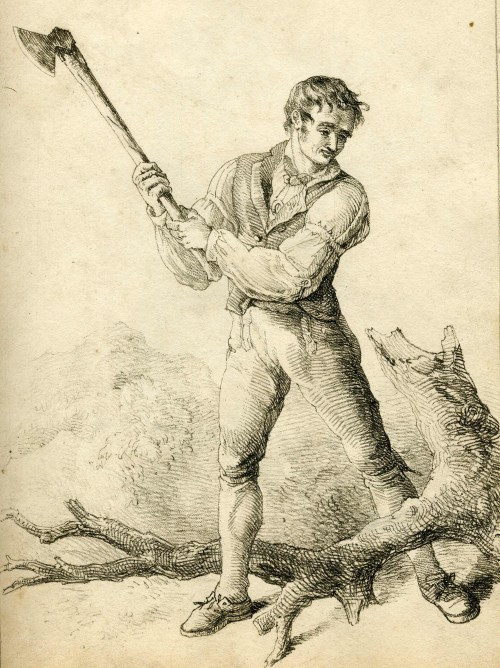
My favorites are from On Rustic Figures in Imitation of Chalk, (1817) and I’m lucky enough to own the whole volume. It was published by Ackermann, of Repository fame and would have fitted in well with the artists’ supplies that they sold from the shop at 101, Strand. Below is the Woodcutter.

Woodcutter from W H Pyne's Rustic Figures

In the Introduction Pyne wrote:

“The study of drawing the characters of the peasantry, or rustic figures, although having its foundation in a certain knowledge of the proportions of the human figure, is nevertheless essentially different from the study of the elegant or classic figure, and, perhaps is as great a degree as the manners and habits of he peasantry differ from those of the most polished of the human race. Not that the rustic is always devoid of dignity; but his is a dignity of a peculiar order, existing in nature, without either the elegance or the affectedness which may be derived from education.”

He goes on to mock the “insipid…rustics of the elegant designer” and points out that “Nothing can be more absurd than to see a race of gods and goddesses, with scythes and hay-rakes, attired in waggoners’ frocks and mob caps.”

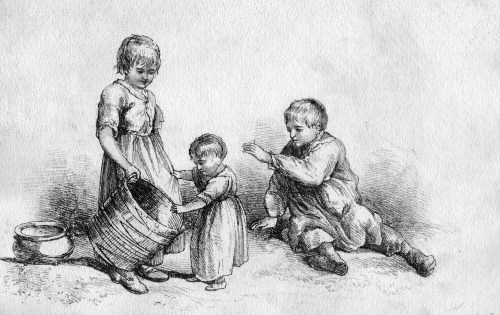
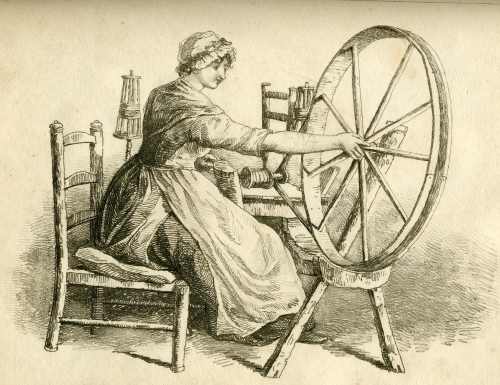
His drawings, even of the poorest, avoid any kind of attempt at caricature or ‘humour’ as so many other images of the day do. These charming children, for example, or the spinner at her wheel, seem to me to be genuine attempts to depict the subjects sympathetically, and realistically, in their setting.

children

Pyne 20001

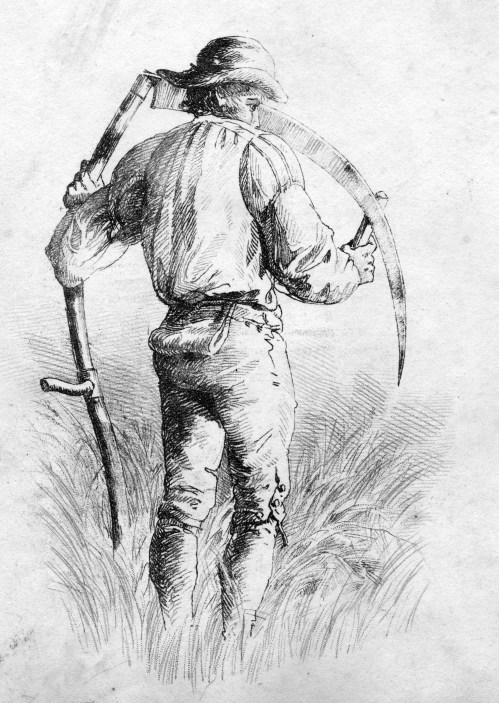
I love the detail in these drawings – the construction of a bucket, the way the spinning wheel works and, in the final example, the man sharpening his scythe. We can see the construction of his clothes but also the holder for the sharpening stone fixed to his belt in the small of his back.

eleven


1 Comment

Filed under Art, working life

Directions to the Cook for March

Shivering as the snow is whirled round the house by winds of over 40mph I’ve turned to my Georgian cookery books for inspiration for today’s blog in the hope of something warming.

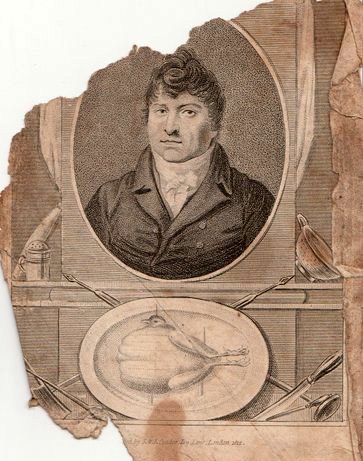
The New London Family Cook or Town and Country Housekeeper’s Guide by Duncan MacDonald “Head Cook at the Bedford Tavern and Hotel [on site of present Maple Leaf, Maiden Lane], Covent Garden, and Assistants” is probably the most comprehensive cookery book I own. My copy, dated 1812, is battered and without its covers or any of the index after “Daffy’s elixir, old receipt for…” but it has a large section of “Instructions for Marketing”, monthly guides to what is in season and several suggestions for entire dinners and recipes and carving instructions. The “Family Recipes” section provides solutions for everyday problems – thinning and falling hair, cramp, scorched linen – and “restoring the life to drowned persons.”

You can see Duncan MacDonald in the damaged frontispiece above surrounded by the tools of his trade. He looks a good advertisement for his recipes!

Many of these recipes and receipts occur in other cookery books – trying to work out who was stealing whose recipes – or copying wholesale, come to that – is a work of archaeology.

For March, Mr MacDonald informs us, beef, mutton, veal “house-lamb” and pork are the meats in season. The poultry and game are turkeys, fowls, capons, chicken, duckling, tame rabbits and pigeons. (I’m not clear what the difference between a fowl and a chicken is.) A wide range of fish is in season including oysters, flounders, eels, roach, crab, turbot and mackarel [sic]. The vegetables he lists are mainly roots and the cabbage family including borecole – what we now call Brussel Sprouts – plus mushrooms, tansy, parsley, fennel and celery. Lettuce and cucumbers are listed – presumably grown under glass – and a wide range of herbs.

The list of fruit is sometimes baffling – “Golden pippins (an apple variety dating from the 17thc), rennetings (one of the group of apples called reinettes now), love (no idea – unless it is ‘love apple’ ie tomato), pearmain and John-apples (there are a number of apples whose name includes ‘pearmain’ but I can’t trace John-apples), the bon-chretien (nowadays usually known as the Williams pear) and double blossom pear, oranges and forced strawberries.

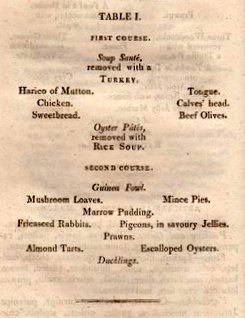
Here is the menu and table layout for the first of his suggested March dinners. This is service à la française – the dishes are brought out all together in two or more ‘courses’ for the diners to help themselves and each other to whatever combination they like, as opposed to service à la russe, the modern method, where each dish is served separately by a waiter or footman.

Given how cold the weather is, I’ll give the two soup recipes – and a warning – I haven’t tried these, so I cannot vouch for what they’ll taste like if you try them at home!

Soup Sante or Gravy Soup

“Take turnips and carrots, shred them small with celery heads about two inches long; wash and steam them separately in a little water until nearly done; when quite done, cut the white of the celery small, likewise a small quantity of leeks, cabbage, cos lettuces, endive and chervil; put all the vegetables to boil til quite tender, with three quarts of cleared brown consumes [presumably consommé]; if in season, add green peas, tops of asparagus, and button onions, stewed, etc.

You may put in a small piece of bouille beef stewed; but dry it with a cloth, and put it in the soup with the vegetables when you serve it. This, however, is not very general.”

Rice Soup

“Put a pound of rice and a little cinnamon [stick, not powder] into two quarts of water. Cover close, and let it simmer till the rice is quite tender. Take out the cinnamon, sweeten it to your taste, grate in half a nutmeg, and let it stand until cold. [This sounds more like a cold rice pudding than a soup.]”

“Another way

Wash a handful of rice in warm water, put it into a stewpan, with as much stock as it is wanted to make, and let it simmer slowly for two hours. Season it to your taste, and serve it up.”

I’m now going to go off and try out the recipe for Portable Soup…

11 Comments

Filed under Domestic life, Food & drink, Shopping

The Story of a Square 6: Queen Square

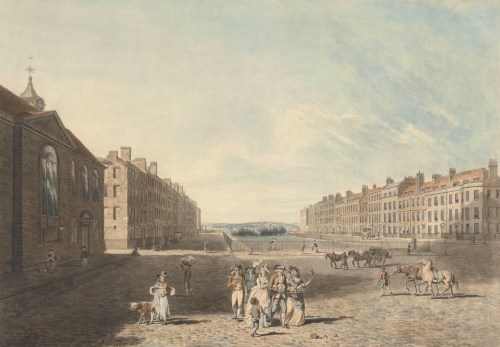
Today I’m visiting Queen Square, built in the first decades of the 18th century and named for Queen Anne. The first image shows it in 1786 in a painting by Edward Dayes. [Yale Center for British Art. Public domain image, US]. This is the view from the south.

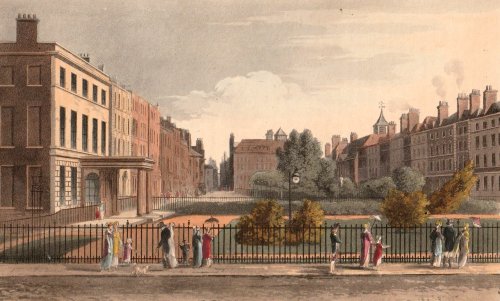
The second image is from Ackermann’s Repository for September 1812 and the artist is standing in Guilford Street on the northern, open edge.

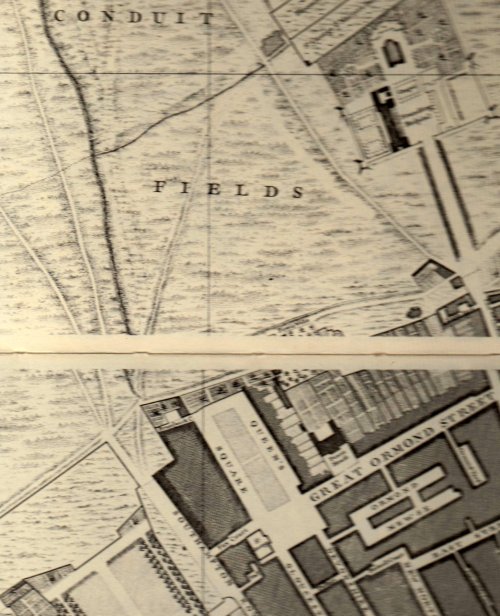
Now there are buildings on the plot of land enclosed by the iron railings but, according to the text with this print, The north side formerly commanded fine views of Hampstead and Highgate. This view can be clearly seen in the Dayes painting and on Roque’s map of 1738 with, to the north-east, Thomas Coram’s Foundling Hospital. Fanny Burney, the novelist, playwright and diarist, lived in the square 1771/2 with her father and wrote of,  A beautiful prospect of the hills ever verdant of Hampstead and Highgate. Dr Burney was visited here by Captain James Cook, just before his second voyage.

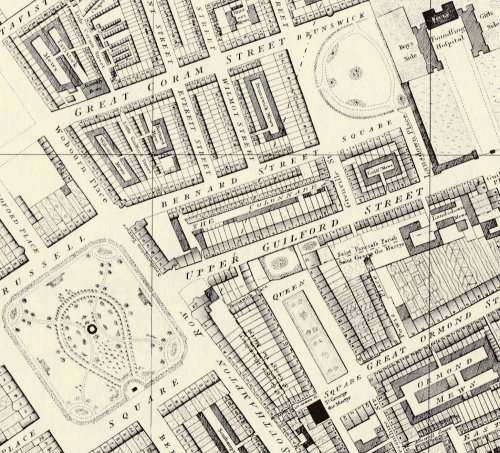
By the time of the 1812 print, Richard Horwood’s map (below) shows the extensive development over what had been Lamb’s Conduit Fields to the north and the private garden in the foreground of the image. Originally the site was an ancient reservoir, part of the waterways that formed the water source for Lamb’s Conduit and which supplied water to the Greyfriars in Newgate Street. If you look at the paved area at the southern end on StreetView you can see a black iron water pump, the late Victorian replacement for the original, which taps into the same source.

Number 31 (east side), now replaced by the Royal Homeopathic Hospital, was a school for young ladies, sometimes referred to as “the ladies’ Eton”. Deportment was clearly of great importance and the young ladies would travel by coach to attend the church of St George the Martyr, just a few metres away on the south-west end of the square. This meant they could practice getting in and out of a carriage in the correct manner and, according to the London Encyclopedia, when the carriage became too ancient to move it was installed in one of the schoolrooms so they could use it there.

St George the Martyr was built at the same time as the square as a chapel of ease, a subsidiary of St Andrew, Holborn. As London expanded these chapels sprang up in all the fashionable new developments and this one was created when (to quote Ackermann’s) several of those who resided at the extremity of the parish [of St Andrew] having proposed to erect a chapel for religious worship, Sir Streynsham Master [a prominent member of the East India Company] and fourteen other gentlemen were appointed trustees for the management of the building. Along with two houses it cost £3,500 and it was intended to recoup the cost by the sale of pews. However, by 1733 the density of new building was such that a new parish was created and the church, bought from the trustees, was named St George’s in honour of Master’s governorship of Fort St George in Madras (Chennai). Originally it was a plain brick building without steeple, and destitute of any pretensions to elegance, though convenient and well lighted. It was remodeled twice in the 19th century, a bell tower was added and the original exterior brickwork covered up, presumably adding some much-needed elegance. The 1786 painting at the head of this post shows the church in its original brick in the left foreground.

When George III first became unwell in 1788 he stayed for a short time in Queen Square with Doctor Willis before being treated at the White House at Kew. The King’s apparent recovery made Willis famous, fashionable and rich. Coincidentally, the statue of George’s wife, Queen Charlotte, that still stands in the square, was erected about 1775.

[Photograph by Stephen McKay, CC BY-SA 2.0, https://commons.wikimedia.org/w/index.php?curid=10043271%5D

1 Comment

Filed under Architecture, Buildings

The Georgian Muff

I wanted to write this blog last week when the blizzards were howling, but I couldn’t get across the back garden to my studio and my print collection. Now the need for a muff has reduced I’ve managed to wade across and retrieve the volume covering 1795-1805. I found it was absolutely stuffed with illustrations of muffs.

For the early history of muffs, and the origin of the name, I can’t do better than refer you to this interesting post by The Costume Historian (snufskins anyone?). During the 17th and 18th century men used muffs too (Samuel Pepys borrowed his wife’s last-season muff and had to buy her a new one) but by the end of that period they were coming to be seen as effeminate and positively French (Horrors!).

Muffs could be made of fur, swansdown or padded fabrics, although all the ones in the prints in my collection look like either fur or the skin of very long-haired sheep, with the occasional one that might be feather. Infuriatingly, even when I have the description with the image they don’t describe the muff. Even if lined with silk and padded with down these vast muffs must have weighed a great deal and it is difficult to see how one could have put both hands into the biggest ones without your elbows sticking out like jug handles. There would certainly be room inside for other things – it was even possible to buy muff pistols, although confronted by a foot-pad it might have been more effective simply to smother him with the muff itself. In one or two images you can see that they are being held by the rim – the idea of a loop handle or strings around the neck doesn’t seem to come in until they reduced greatly in size with the Victorians.

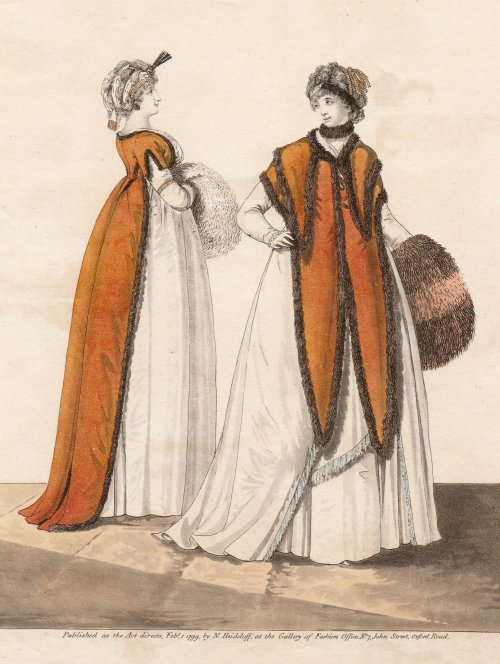
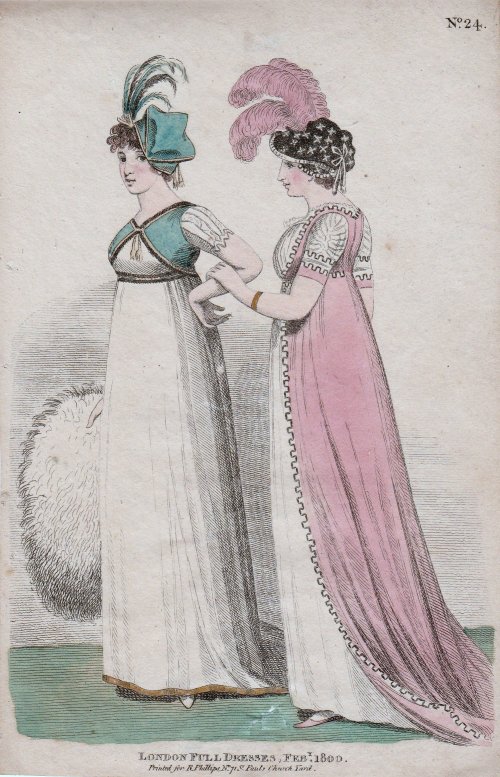
The image at the top of this post is from Heideloff’s The Gallery of Fashion for February 1799 and show large, long-haired fur muffs, the brown one with walking dress and white one used inside. This next plate is from Phillip’s Fashions of London and Paris (February 1800) and shows two Full Dresses, one accessorized by a vast fluffy white muff. Presumably this was simply carried for effect – or would cold rooms have made it necessary?

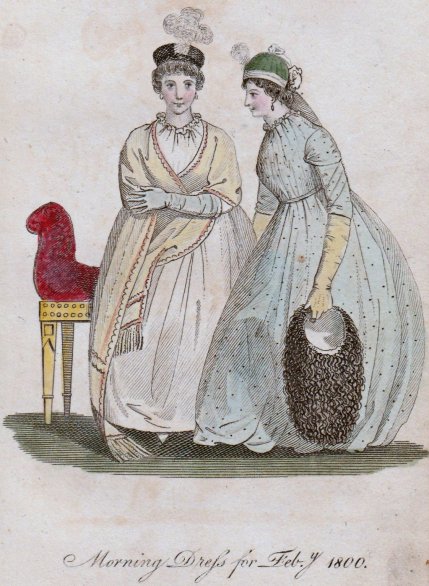
I have a number of plates from The Lady’s Monthly Museum which are notable for their rather plain ladies and decided lack of elegance! Here is a pair of Morning Dresses for February 1800.

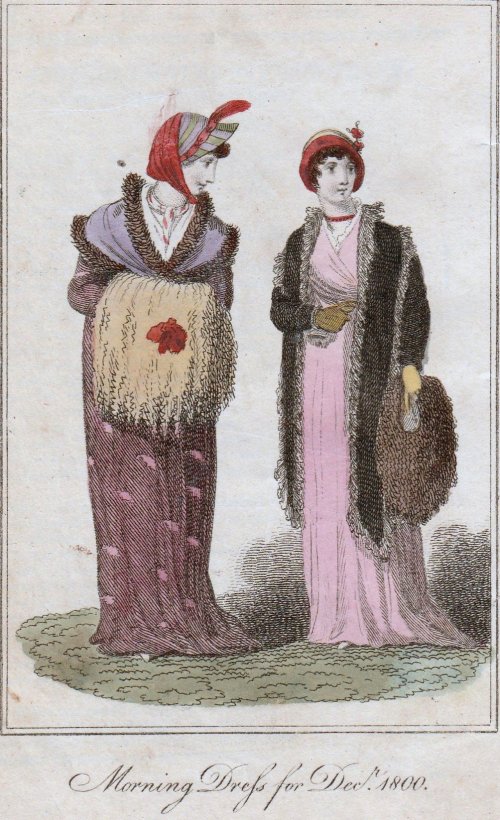
And for December that year two more Morning Dresses with very shaggy muffs. In the descriptions details right down to stockings are described – but not the muffs.

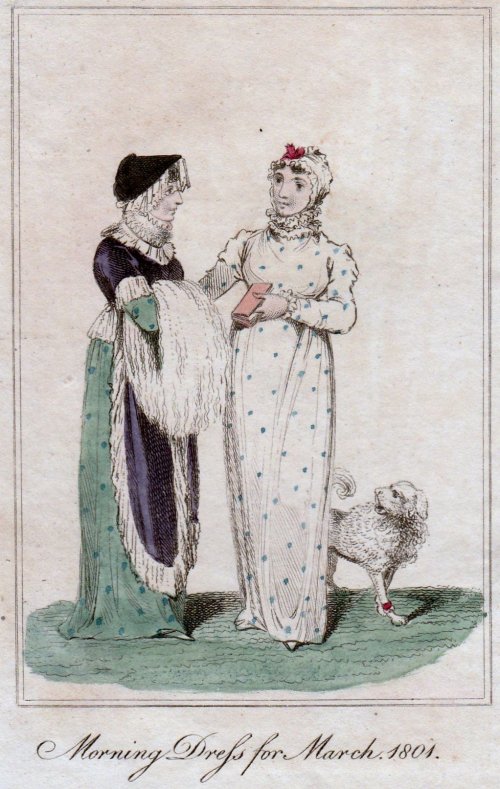
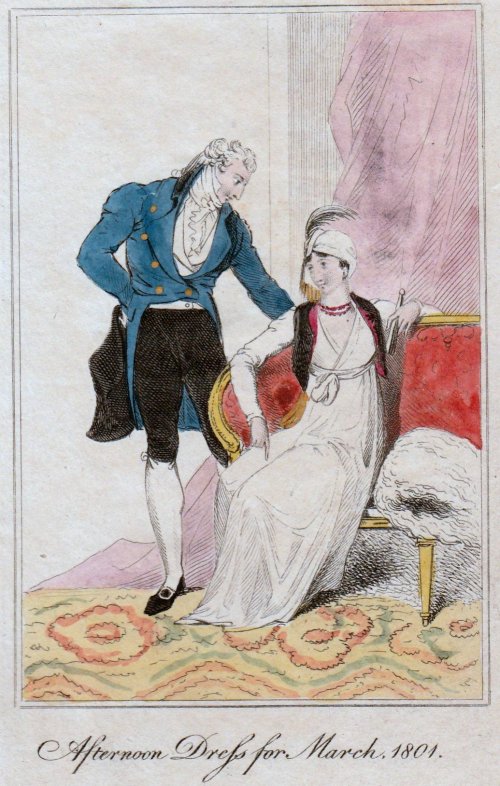
For March 1801 The Lady’s Monthly Museum has a charming pair of Morning Dresses with a poodle who seems to think the large white muff might come from a relative of his and an Afternoon Dress with the muff discarded on the sofa while the very nattily-dressed gentleman makes intense eye-contact.

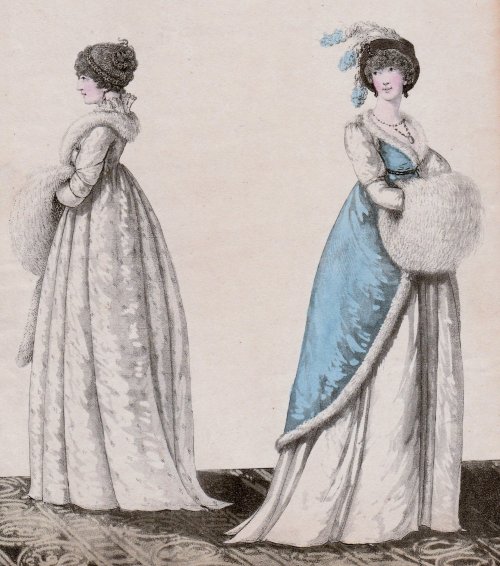
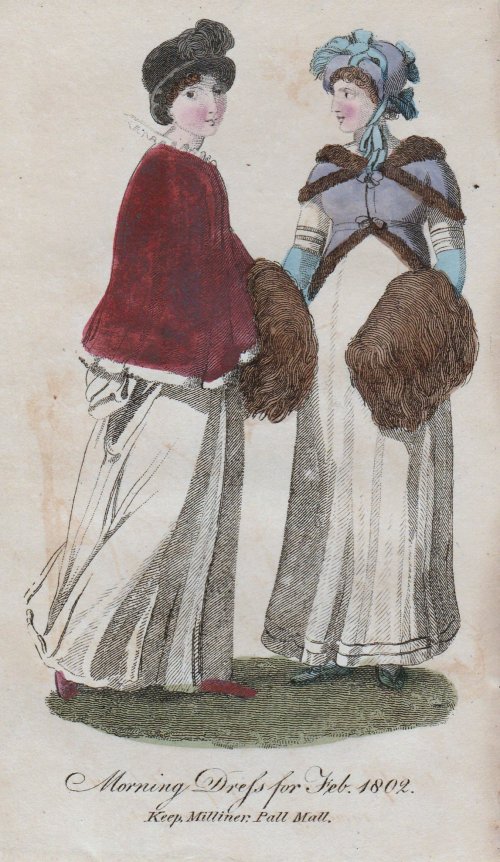
For February 1802 here are two ladies from a very lovely Gallery of Fashion plate with below it Morning Dresses from the much less exclusive Lady’s Monthly Museum.

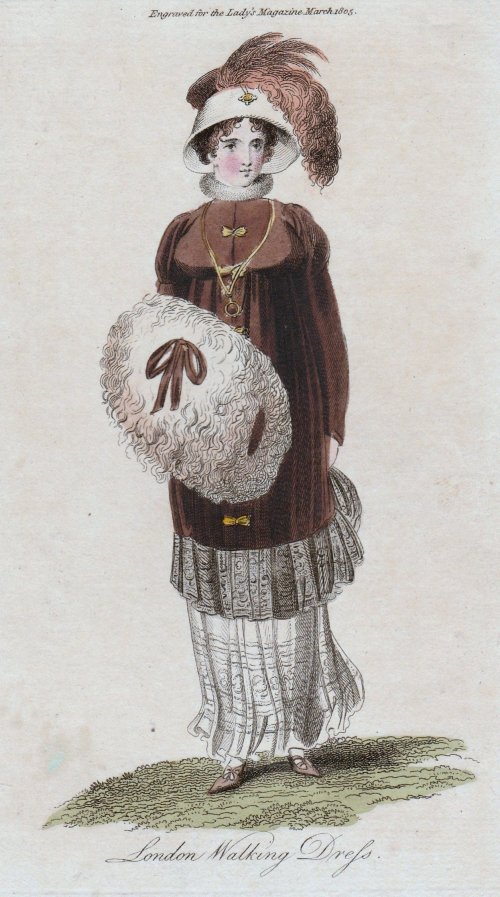
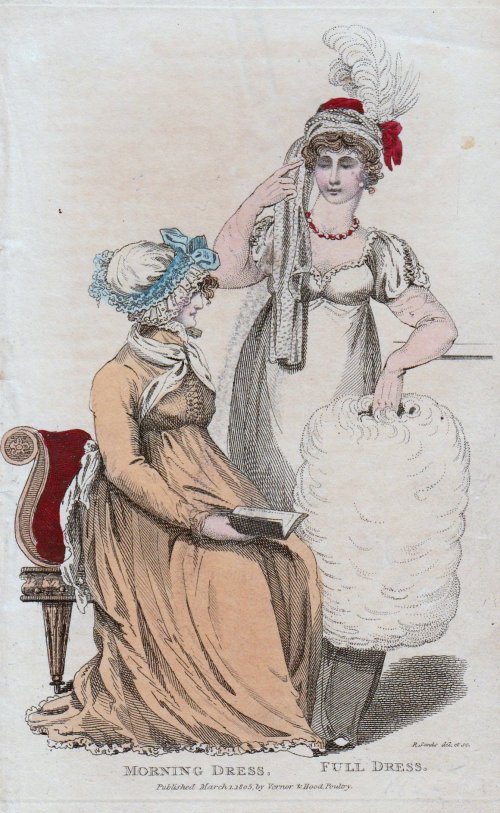
For March 1805 The Lady’s Magazine has a London Walking Dress with a very curly muff and a feather to match and The Ladies’ Monthly Museum a figure in Full Dress with a positively enormous white muff.

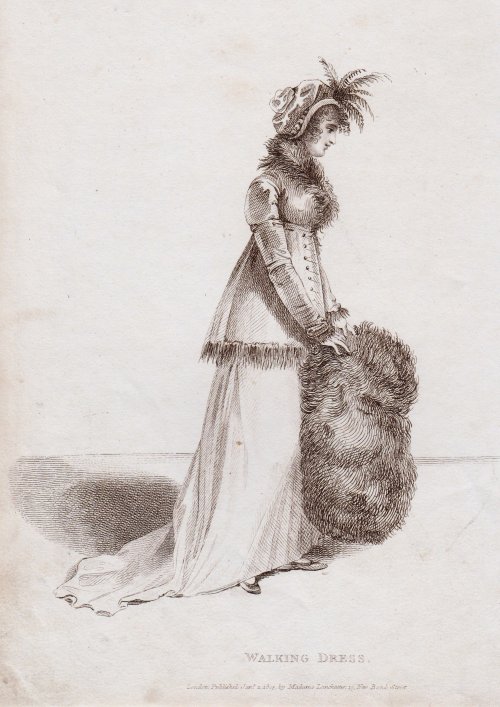
And finally, here is a rare plate from Le Miroir de la Mode by the mysterious Madame Lanchester. I blogged about her here with some more examples from my collection. In this example of a Walking Dress from January 1803 the muff is so large that it seems almost as long as the wearer’s legs!

7 Comments

Filed under Fashions

Bringing Spice to the Kitchen – Or the British and ‘Curry’

The British in India, from the 17th century onwards, cheerfully lumped the many and varied styles of cooking, and the subtle differences in dishes they encountered, under the term ‘curry’, a word copied from the Portuguese. Pietro della Valle (died 1652) described as ‘caril’ or ‘carre’ the ‘broths… made  with Butter, the Pulp of Indian Nuts… and all sorts of Spices, particularly Cardamons and Ginger… besides herbs, fruits and a thousand other condiments [which are] poured in good quantity upon … boyl’d Rice.’

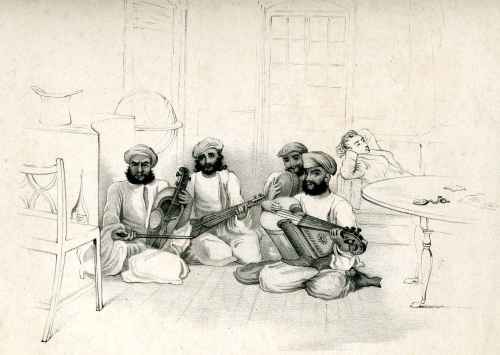
The British in India ate ‘curry’ with every meal, using the term to cover anything in a spicy sauce. No British lady would dream of undertaking her own cooking, so she would have no idea about how the dishes her Indian household served up were made. Eventually curry powder came to be considered a spice in its own right, completely ignoring the infinite varieties and combinations that might be used. Anglo-Indians might think they were immersing themselves in local culture – like the young East India Company employee above, listening to Indian musicians amongst his European furniture – but they seemed to have no appreciation of the subtleties of the cuisine.

As East India Company officials came back to Britain they brought their taste for curry with them and often they brought their Indian cooks with them. These men had learned to create the first Anglo-Indian cookery style to suit their employers and soon curry began to appear in ordinary household cookery books.

One enterprising India entrepreneur, Sake Dean Mahomed [Sidi Deen Mahomet in some sources], opened the first Indian restaurant in Britain in 1810. I discovered it (or, rather, where it had been) when I was researching for Walking Jane Austen’s London. It was located on the corner of George Street and Charles Street, just North of Portman Square, a fashionable area and one that was home to many retired Anglo-Indians.  The Hindostanee Coffee House even had a smoking room where patrons could smoke hookahs. Despite serving ‘Indian dishes in the highest perfection… allowed by the greatest epicures to be unequaled to any…ever made in England’ the business became bankrupt the following year. Possibly his choice of location was unfortunate and many of the Anglo-Indians could eat curry at home made by their own Indian cooks or they preferred to combine business with curry by patronising the various City coffee houses that served curry alongside English food. Norris Street Coffee House on Haymarket had been serving curry since 1773 when its ‘Mistress’ advertised in The Public Advertiser ‘true Indian curey paste.’ ‘At the shortest Notice [she would send] ready dressed Curey and Rice, also Indian Pilaws, to any Part of the Town.’ East India Company merchants had created almost a club for themselves at the Jerusalem Coffee House on Cornhill. No specialist Indian restaurant appeared again in Central London until the 1920s.

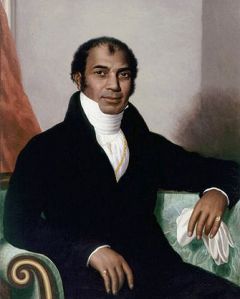
Sake Dean Mahomed (right. Painted by Thomas Mann Baines c.1810) had far more success with his bathing establishment in Brighton. “Mahomed’s Baths. These are ascertained [sic] by a native of India, and combine all the luxuries of oriental bathing. They are adapted either for ladies or gentlemen, and the system is highly salutary in many diseases, independently of the gratification it affords, particularly to those who have resided in the East.”  [W. Scott. The House Book or Family Chronicle of Useful Knowledge (1826)] The ‘luxuries of oriental bathing’, I learned when I was researching for The Georgian Seaside, included shampooing – not of the head, but of the whole body in a foaming massage.

The Epicure’s Almanac (1815) has a section on seasonal foods and for July mentions that ‘various preparations of curry afford a delectable repast to those who have acquired a taste for this Indian diet.’ Ready-made curry powder could be bought alongside other spices and was first mentioned in Hannah Glasse’s Art of Cookery (1747).

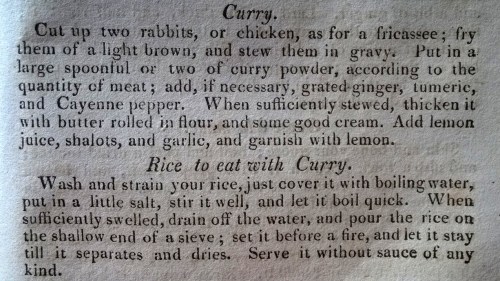
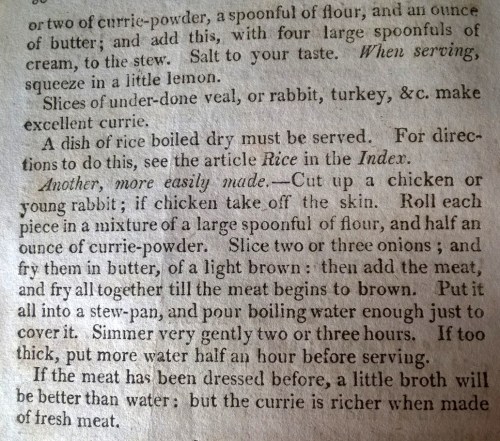
Here is a recipe for curry made with curry powder from The New London Family Cook (1811) by Duncan McDonald, head cook at the Bedford Tavern and Hotel, Covent Garden. The Bedford Tavern and Hotel was a large establishment on the Great Piazza. It opened in 1726 and continued in business throughout most of the 19th century.

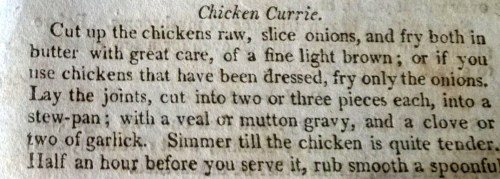
And this is from A New System of Domestic Cookery (1807)

curry 2

curry 3 For a fascinating history of Europe’s love affair with curry, try Lizzie Collingham’s Curry; a biography (2005).
 

2 Comments

Filed under Domestic life, Food & drink, Seaside resorts