Category Archives: Fashions

A Flutter of Fans – A Very British Romance?

mid 18thcWatching the first episode of Lucy Worsley’s fascinating A Very British Romance last night I was inspired to look at my collection of 18th and early 19th century fans to see how they treat romantic love.

Fans were not only a practical necessity at hot and over-crowded balls and receptions, but they were also items of high fashion, conversation pieces and even sources of satire. And, of course, what better aid to romance for a strictly-chaperoned young lady who could deploy an entire range of flirtatious gestures with her fan – peeping over the top of it; hiding, then revealing her face; gesturing an invitation or snapping it shut sharply in rejection.
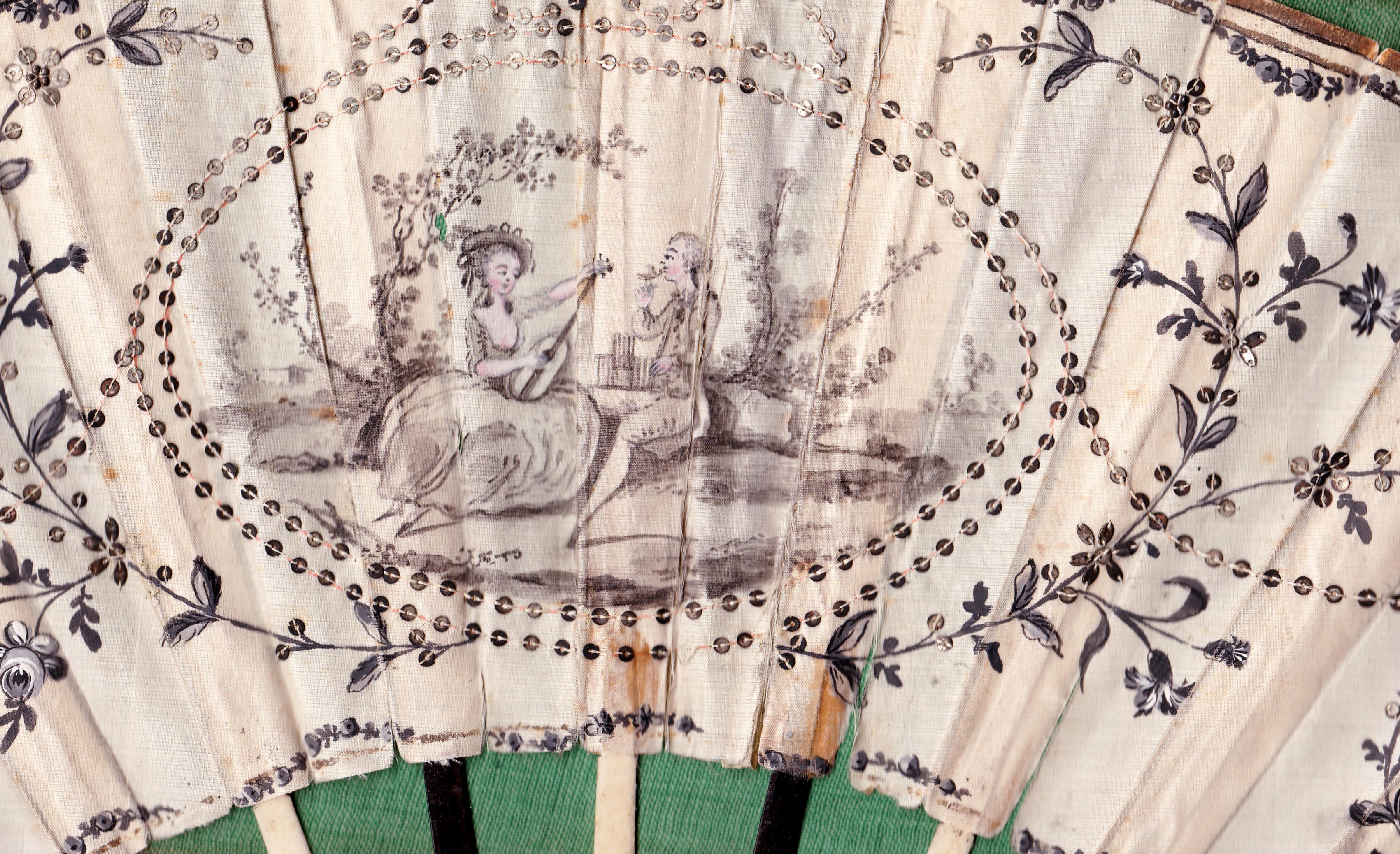
mid 18thcThe earliest – perhaps 1770s – is a simple fan with widely spaced black and white sticks. The leaf is painted on one side only in black, white and grey, with tiny silver sequins sewn through the pattern. The man and woman in the centre have delicate touches of pink on their cheeks, hands and on her bosom. This is a very informal outdoor scene. She is playing a guitar and perhaps singing a romantic song. He is sitting with his legs astride the bank, and raising a small bird to his lips, apparently to kiss its beak. A love bird? From their intense exchange of looks it is quite clear that hers are the lips they would both wish he was kissing.
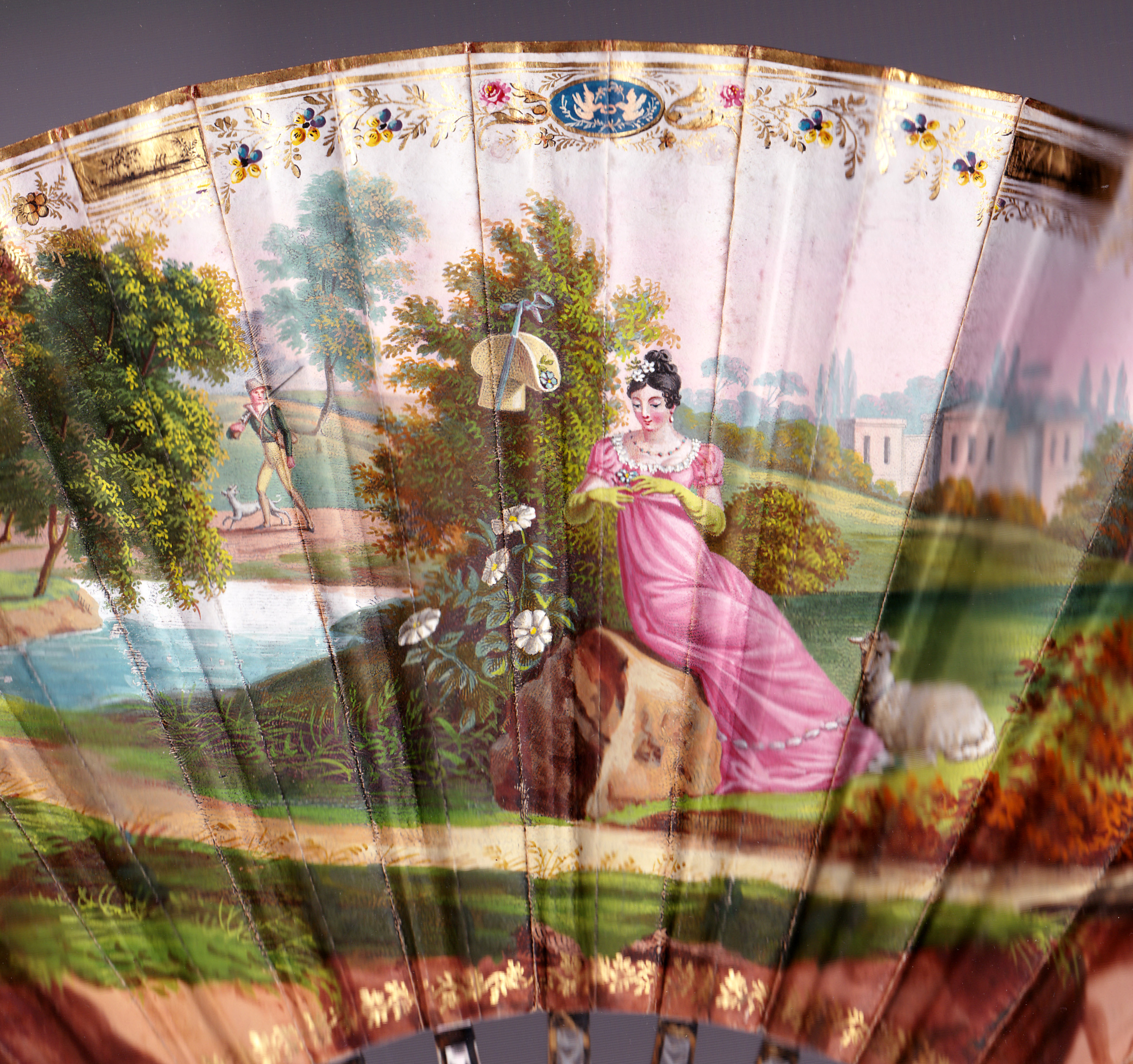
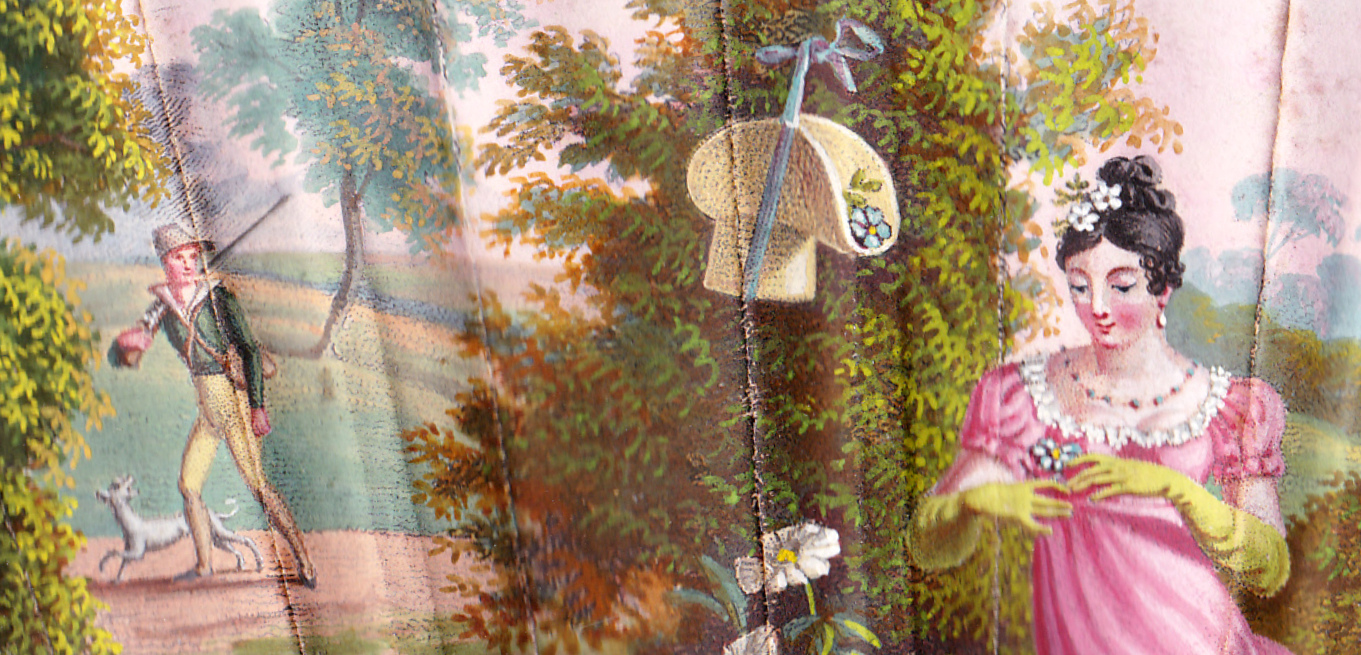
parkThe most modern (c1818?) is also outdoors. It is a detailed hand-painted and gilded scene set in the parkland surrounding a large country house. The young lady in the centre is gathering flowers which she is collecting in the bonnet which she has casually hung from a bush – perhaps an indication that she would like to shed a few more items of clothing if the right circumstances arose. parkOn the other hand, a lamb, a symbol of innocence, is sitting by her side. A young man, his gun over his shoulder and his ammunition pouch at his side, strides off on the other side of the lake with his dog at his heels. He is off hunting – but what or who? He is certainly very aware of the young lady and I would hazard a guess that she is just as aware of him. No doubt she set out early to compose herself into just this charming and innocent pose for his benefit.
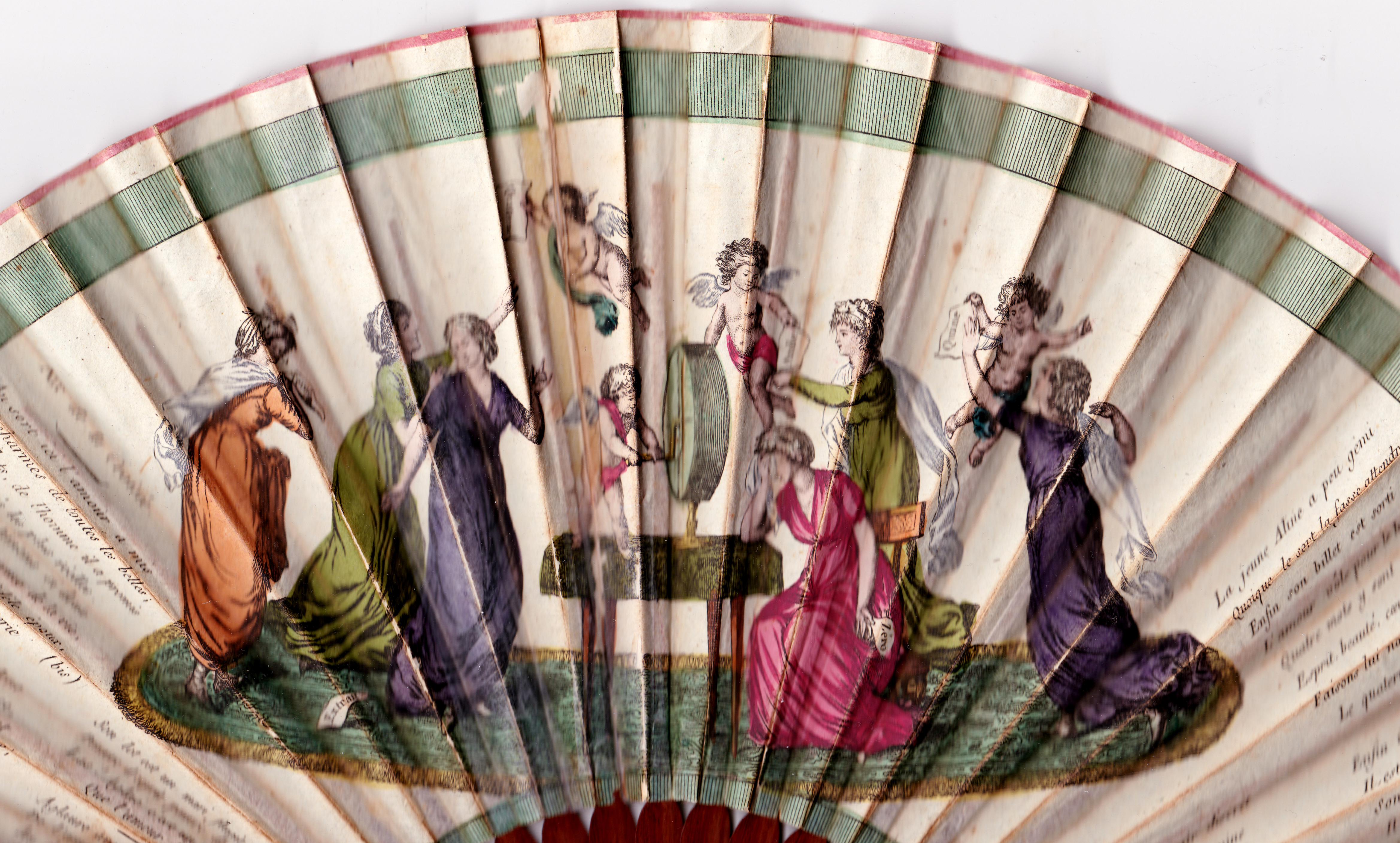
lotteryNow for a fan which I found in circumstances which I can only call romantic, if not downright spooky. I was writing The Piratical Miss Ravenhurst, the last of my Scandalous Ravenhurst series. My heroine was called Clemence – not the most common of English names. I was halfway through the book when I visited an antiques auction and spotted the handle of a fan poking out of a mixed lot of odds and ends. It had no loop on it – an almost infallible sign of an early fan – so I took a quick look and put it back before anyone else saw me taking an interest! In the event I got the whole lot for under £20 and when I had a good look at the fan I could tell it was not only late 18th century, but also French. The scene shows six young women in a lottery for love. The cupids draw a description of the virtues the lover of each will possess, described in very difficult old French in verses around the edge. (I have to thank fellow author Joanna Maitland for the translations!)  Poor Isis is in a hurry to receive her prediction – but her lover will have no virtues whatsoever. The next girl, “Aglaé, le coeur palpitant” – “her heart beating” – is destined for a lover who is articulate, but weak in spirit. Each girl in turn is told of a lover with two, then three, then four virtues. The final young woman is Clémence – my heroine’s name! And not only is her lover going to be handsome but he will surpass her hopes in every way.

Enfin il n’en reste plus qu’en
Il est pour la belle Clémence
Son sort est beau, mais peu commun
Il surpasse son espérence
Dons du Coeur, et dons l’esprit
Vertu, courage et bonne mine
Son amant les a réunit
Elle a gagné le quine.
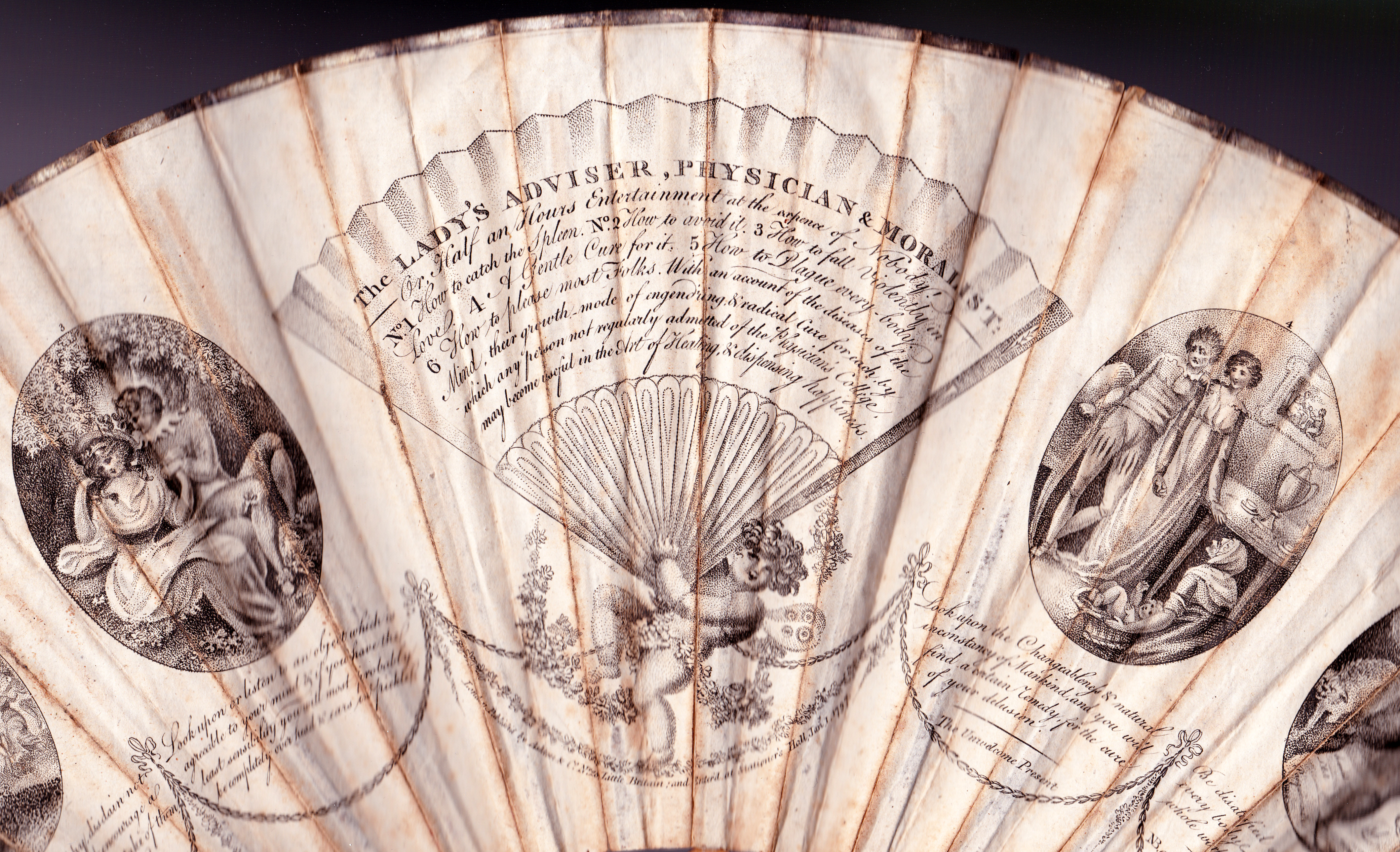
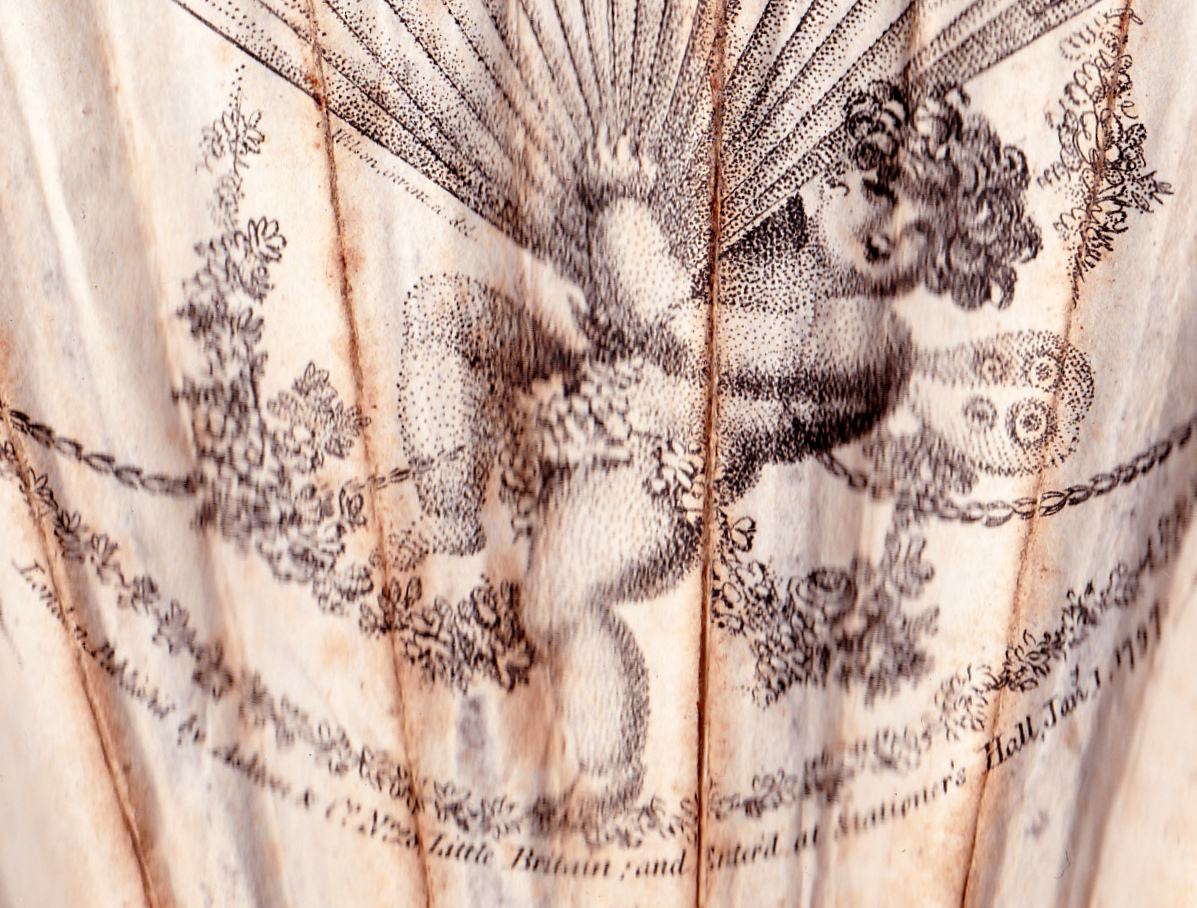
maximsTo counter all that intense romance I’ll end with a rather more cynical view of life and love with a fan produced in 1797. It was doubtless intended to be a conversation piece. The central text, shown on a fan held up by a fat little Cupid, explains that this is:

“The LADY’S ADVISER, PHYSICIAN & MORALIST: Or, Half an Hours Entertainment at the Expense of Nobody”

It has six scenes around the edge. The four not visible in this view show how to “Catch The Spleen” – devote yourself to cats rather than people and seek out unpleasantness; “How to Avoid It” – enjoy life with a virtuous disposition, honour and moderation; “How to Plague Every-Body” – be dissatisfied with everything, declare war against the whole world and finally “How to Please Most Folks” – “Be just to your Enemy, Sincere to Your Friend, Constant to Your Mistress.”

On the left above is “How To Fall Violently In Love”: “Look upon or listen to an object which is agreeable to your mind & if you have the least sensibility you will most probably be completely over head and ears in pickle.”

On the right is “A Gentle Cure For It”. The young couple are  married now and have been interrupted at the breakfast table by a woman with a child in a basket. The scene has the caption “The Unwelcome Present” and from the expression on the man’s face, and his body language, one assumes this child is a bye-blow of his. The text reads:

“Look upon the Changeableness & natural inconstancy of Mankind, and you will find a Certain remedy, for the cure of your delusion.” Really rather a scandalous scene for a lady’s fan!
maxims

6 Comments

Filed under courtship & marriage, Entertainment, Fashions, High Society, Historical Romance, Love, Love and Marriage

It Is August In London – Eat Oysters on Oyster Day or Run Away to the Seaside?

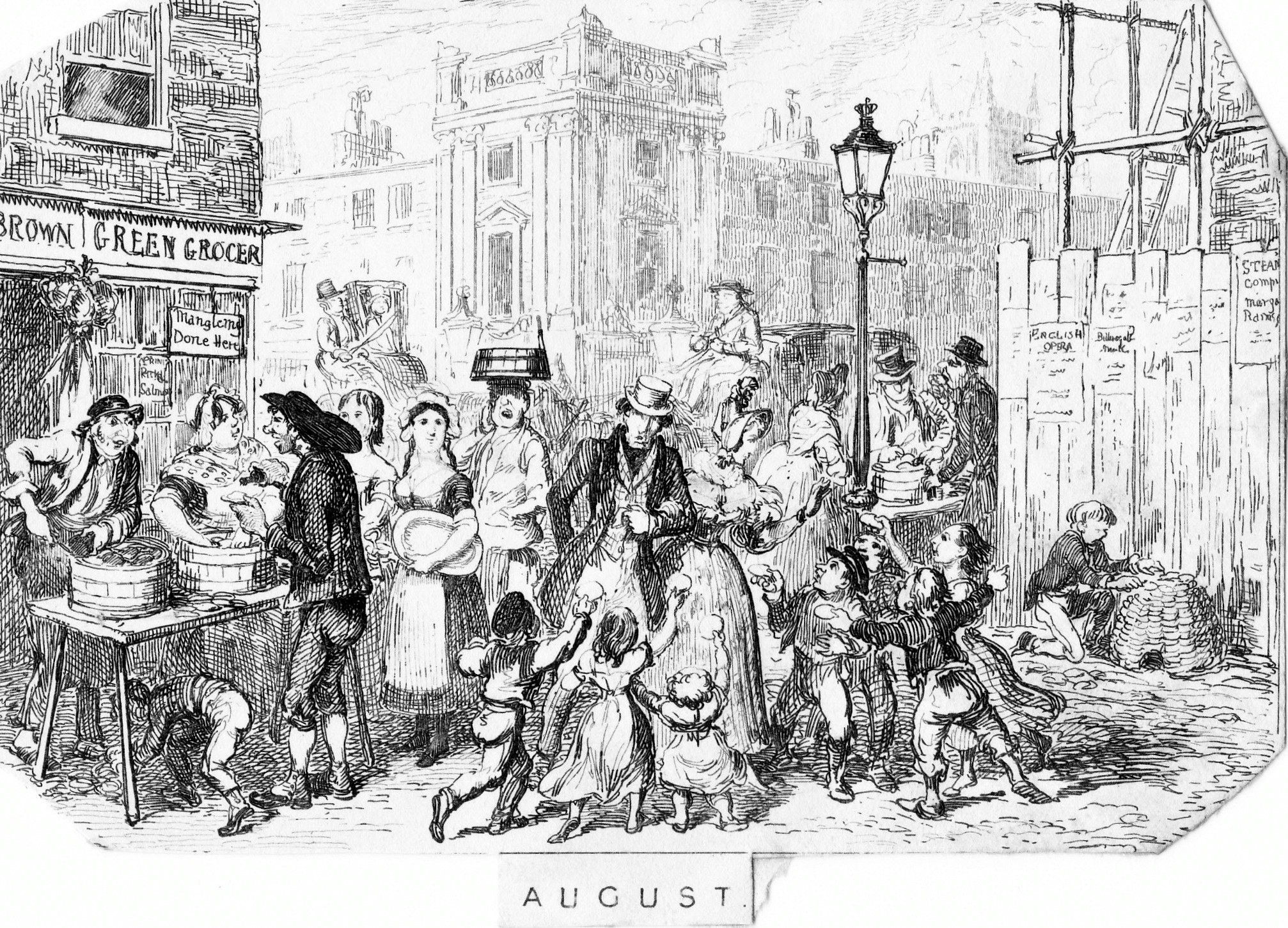
August in London was the time to celebrate “Oyster Day” – the arrival of the first oysters at Billingsgate fish market. The scene on the streets is shown in the first print from Crucikshank’s London Almanac. This was a significant day for the poor for whom oysters was a cheap staple. In London Labour and the Poor Mayhew wrote that “the number of oysters sold by the costermongers amounts to 124,000,000 a year. These, at four a penny, would realise the large sum of £129,650. We may, therefore, safely assume that £125,000 is spent yearly in oysters in the streets of London.”

London August

In the scene working people queue up at two trestle tables to buy oysters. The vendors are opening them and on the left we can see a coal heaver or dustman, distinguished by his hat with a protective neck flap, pouring some kind of relish or ketchup over his.

A small boy is rummaging under the trestle for empty shells and on the right one lad is building them into a construction while other children holding up shells mob a respectably-dressed couple begging for coppers. An article in the Illustrated London News of 1851 explains what must be happening.

“We will not pursue the calculation into how many grottoes might be built from the shells of a year’s supply of oysters…. The coming-in of oysters is observed as a sort of festival in the streets; and in such a nook of the metropolis as the present locality, the grotto is usually built of inverted oyster-shells piled up conically with an opening in the base, through which, as night approaches, a lighted candle is placed within the grotto, when the effect of the light through the chinks of the shelly cairn is very pretty. It is but fair that the young architects should be rewarded for their trouble accordingly, a little band, of what some churl may call urchins, sally forth to collect pence from the passers-by ; and the usual form of collecting the tax [is] by presenting a shell…”

Of course, you might choose to leave the heat and dust of London in August (to say nothing of the smell of discarded oyster shells) and go to the seaside. Brighton, Margate and Ramsgate were closest (if one leaves aside Gravesend, which even in the Georgian period was getting a reputation for being somewhat rough).

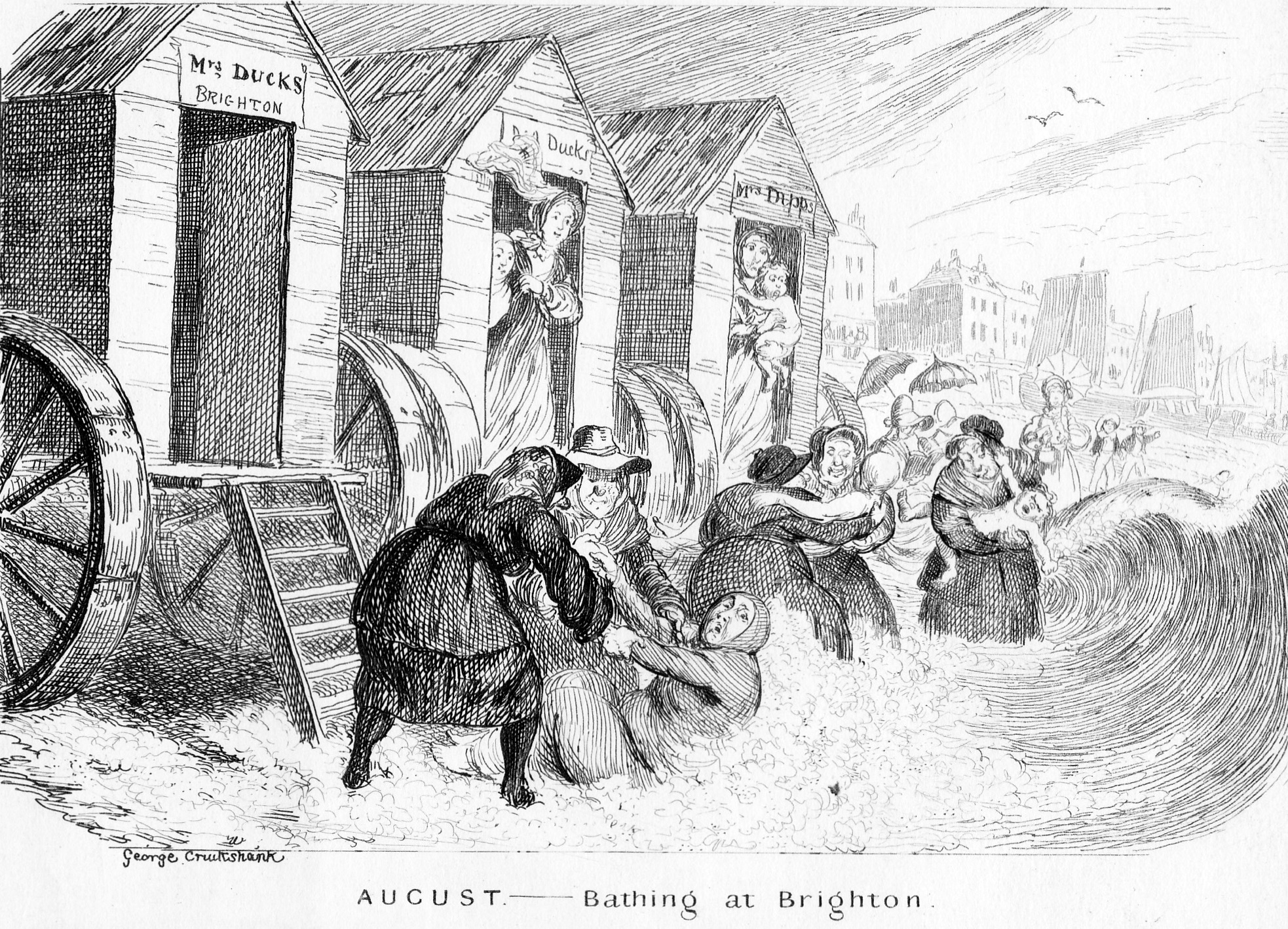
Brighton AugustCruikshank has chosen to show bathing machines at Brighton with four burly female “dippers” dunking their quailing customers in the sea. The machines have boards showing the names of the dippers – two for “Mrs Ducks” and one for “Mrs Dipps”. In the foreground a lady is entirely enveloped, head and all, in a flannel “case” while in the middle two dippers are about to plunge a slight figure – a teenage girl perhaps – in backwards. A furious baby is getting a relentless ducking at the far end.

The Margate design of bathing machine, invented by Quaker Benjamin Beale, had a hood which came down to shelter the bather’s modesty, and perhaps divert some of the force of the waves, but these were not used at Brighton.

Although the seaside holiday is often thought of as a Victorian invention they were very much a feature of the Georgian scene for those who had money and leisure. By 1800 every English county with a coastline had at least one seaside resort. Brighton is perhaps the most famous example, but it was by no means the first – Scarborough probably has best claim to the title, although Margate and Brighton were close behind and all three were flourishing in the 1730s, long before the Prince Regent made Brighton notorious.

Brighton did have the benefit of closeness to London that Scarborough did not. In 1821 Dr John Evans remarked on stagecoaches doing the journey in six hours and predicted that balloon travel would reduce it to four hours in the future and in 1823 Cobbett wrote of “stock-jobbers…[who] skip backwards and forward on the coaches, and actually carry on stock-jobbing, in ‘Change Alley, though they reside in Brighton.” In 1834 four hundred and eight passengers arrived by coach in Brighton in one day, and 50,000 were recorded for the year.

Just as beach-wear and cruise-wear figure in the fashion magazines today, outfits for seaside visits were carefully chosen. Here is one from La Belle Assemblée designed by Mrs Bell for “Sea Coast Promenade”. personally I think the wearer has located the gentlemen’s bathing beach and has no intention of promenading any further…

1809 telescope

6 Comments

Filed under Entertainment, Fashions, Food & drink, Seaside resorts

Books For Christmas

Is Christmas present money or a book token burning a hole in your pocket? Here are four of the non-fiction books I enjoyed most in 2014 and which I’d recommend to anyone interested in London’s history or the Georgian era. They aren’t all 2014 publications, but they were new to me last year.

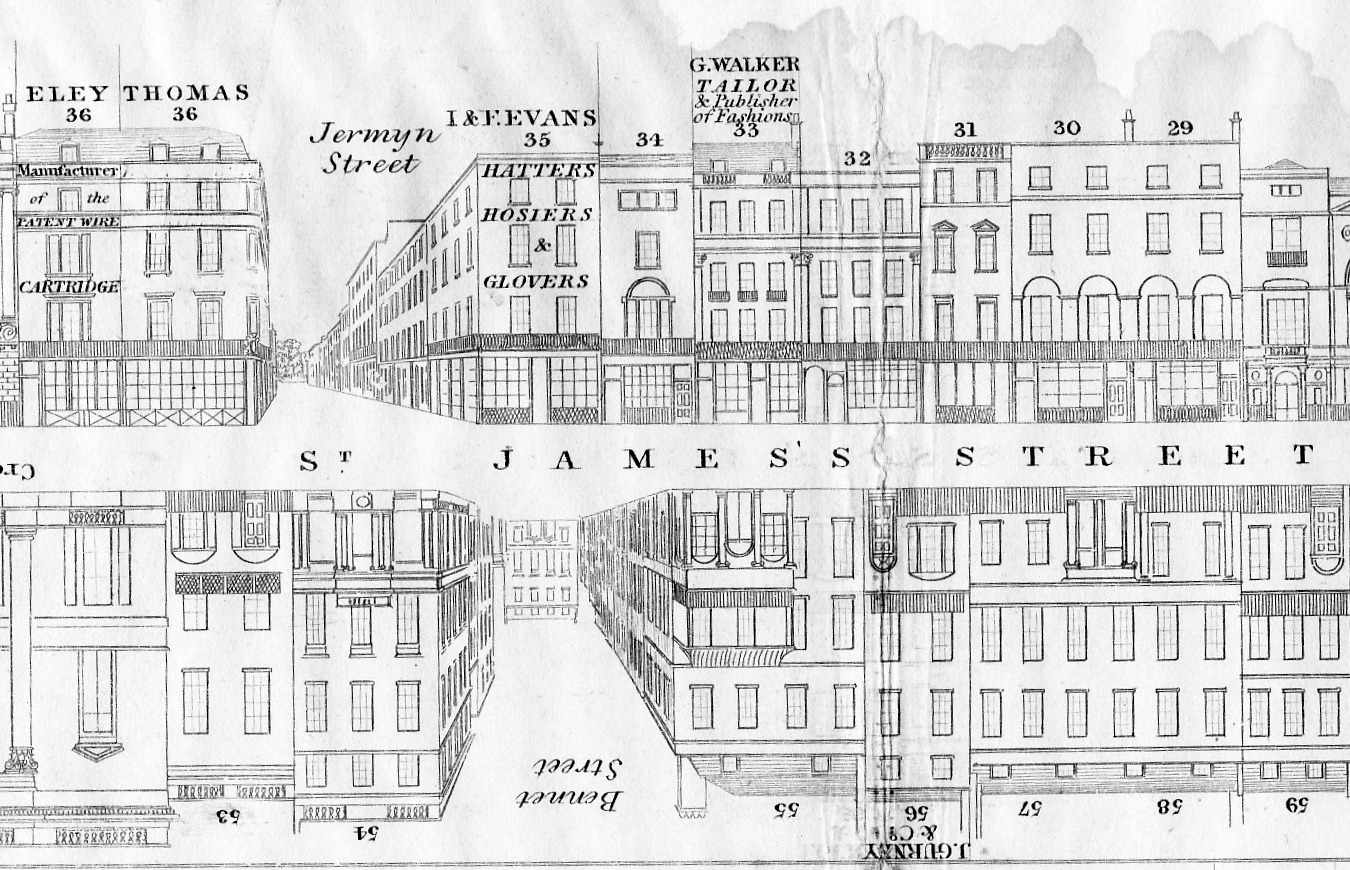
Firstly, and probably my favouriStreet viewte – the London Topographical Society’s reprint of John Tallis’s London Street Views 1838-1840. It has an index, introductory essay and a searchable index on CDRom. The views are a little later than my usual period of interest, but Tallis caught London just before the major Victorian rebuilding and redevelopments got under way and these strips maps showing the elevations of the buildings along each side, plus the names of the businesses in each are incredibly detailed. I own four of the original maps, but it was a lucky chance that I found them at a price I could afford – they are expensive collector’s pieces – so this volume is a real treat.street view actual The example above is a detail from one of my originals and shows part of St James’s Street.

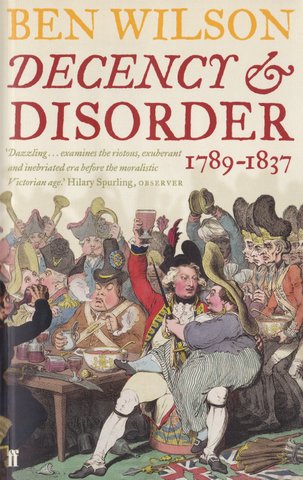
Disorder2 My next choice is Ben Wilson’s Decency & Disorder: 1789-1837, a scholarly, but very readable account of how the boisterous Georgians, valuing liberty and personal freedom above civil order and ‘decency’ and shunning the idea of a police force as foreign and oppressive, changed to adopt ‘Victorian values’ and an organized police force.

I particularly enjoyed the story of the Georgian gentleman who, such was his sensibility, was so overcome by the beauty of the scene that he was lost for words and could only cast himself, face-down, into a flowerbed in Bath. And then there was the member of the Society for the Suppression of Vice who forced himself to buy hand-carved sex toys at a prisoner of war market and then found himself at a loss to send them to the London headquarters. They were, he complained, too bulky to be enclosed in a letter.

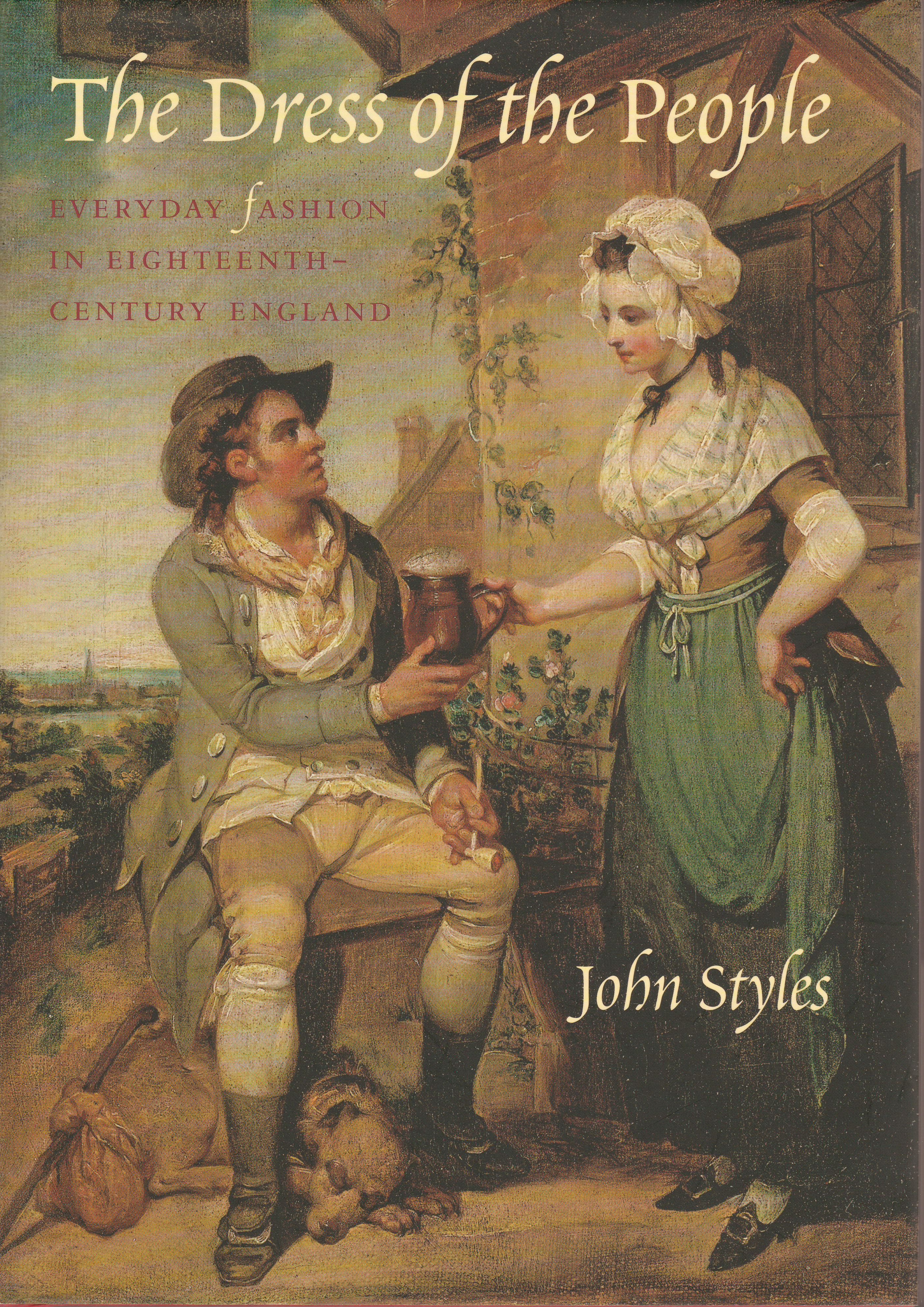
Thirdly there is John Styles The Dress of the Common People: everyday fashion in eighteenth century England. Despite the title this lavishly illustrated and very scholarly work covers the Georgian era rather than the 18th century exactly. I found it in, of all places, the National Park bookstore in Salem, Massachusetts, but it is available in the UK.costume2

It is a refreshing change from books of high-end fashion plates and includes information about fabrics and the cost of clothing, where people bought their clothing and a host of other details.

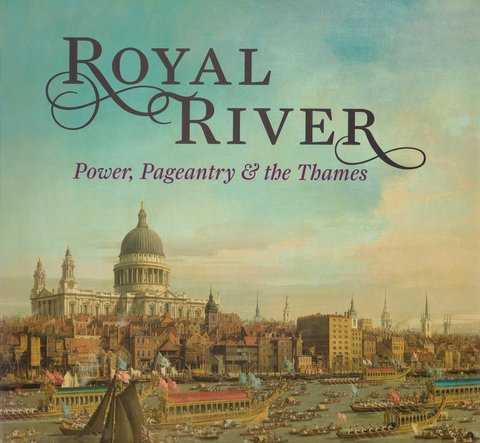
My final choice was too large to go on my scanner, so here is part of the cover of Royal River: power, pageantry and the Thames published for a major exhibition at the National Maritime Museum, Greenwich. (Guest curator, David Starkey).

River The illustrations are gorgeous and the book ranges from topics as diverse as the lord Mayor’s Procession, Lord Nelson’s funeral procession, royal yachts and the transformation of the Thames in the Victorian era.

Best wishes for Christmas and the new year to all my readers!


Louise

2 Comments

Filed under Books, Buildings, Christmas, Fashions, Transport and travel

Cordwainer, Shoemaker, Cobbler? Where would Georgian Londoners Buy Their Shoes?

I have shoemakers in my ancestry through the 15th to 19th century. Sometimes they are described as cordwainers, sometimes shoemakers. So what is the difference, and where would you have gone to buy your shoes if you were a Georgian Londoner – from a cordwainer, a shoemaker or a cobbler?
(Greetings, by the way, if you have Hurst ancestors in Hertfordshire, Buckinghamshire or Oxfordshire we are probably cousins!)
10
The term cordwainer, according to the Honourable Cordwainer’s Company’s website, “is an Anglicization of the French word cordonnier, which means shoemaker, introduced into the English language after the Norman invasion in 1066. The word was derived from the city of Cordoba in the south of Spain… Moorish Cordoba was celebrated in the early Middle Ages for silversmithing and the production of cordouan leather, called “cordwain” in England… Crusaders brought home much plunder and loot, including the finest leather the English shoemakers had seen. Gradually cordouan, or cordovan leather became the material most in demand for the finest footwear in all of Europe.”
Shoemakers who chose to call themselves cordwainers were implying that they used only the finest materials, and therefore produced only the finest footwear. Cobblers, on the other hand, were not working with new leather. They were repairing shoes, or “cobbling together” new shoes from old.

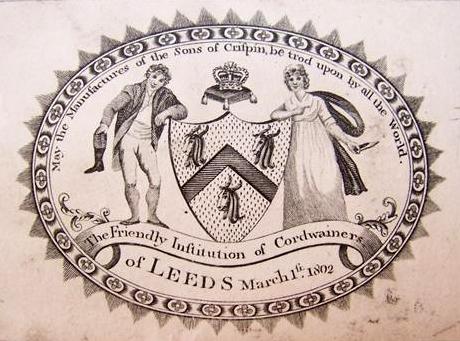
tradecard 1802This trade card was produced by “The Friendly Institution of Cordwainers of Leeds” in 1802. The reference to “the Sons of Crispin” is to St Crispin, the patron saint of shoemakers.
If you were a Georgian in London looking for footwear you had a choice ranging from the finest made-to measure products of a high-end cordwainer to the reworked product of the cobbler on the corner – or even simply second-hand from a market stall.

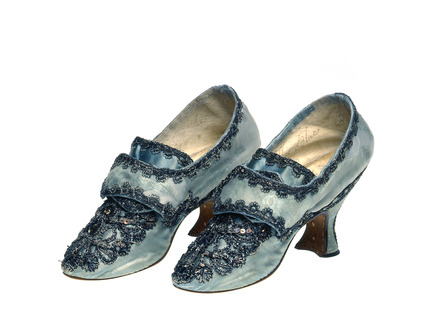
blue shoesThese exquisite blue satin shoes are in the Museum of London and date from the 1760s. The label inside reads ‘Fras Poole, Woman’s Shoemaker in the Old Change, near Cheapside London’. They show the high level of craftsmanship required for top-end footwear – and the range of craftspeople who would have been employed. Much simpler, and closer to Jane Austen’s day, are these delicate pink silk-satin ankle boots with their thin soles and fragile silk laces in my collection (below). They had absolutely no internal support for the sole of the foot.

SONY DSCFor the well-to-do, shoes were purchased from a shop which might display the products of one maker, or several. The trade card at the top of this post shows a fashionable lady being served. In the background are display cabinets containing a range of styles. As the card says, “Large Assortment of Ladies fashionable Shoes always on Sale.” For such a tiny scrap of cardboard the detail is considerable. The lady is seated with a mat in front of her to protect her unshod feet (or the new shoes?). She is being served by a man – the norm in high-class retail establishments – and he is carrying shoes over his arm in a way that shows that pairs were tied together. The assistant is smartly dressed, but wearing a long apron, which makes me wonder whether he would kneel down for the lady to place her foot on his knee.
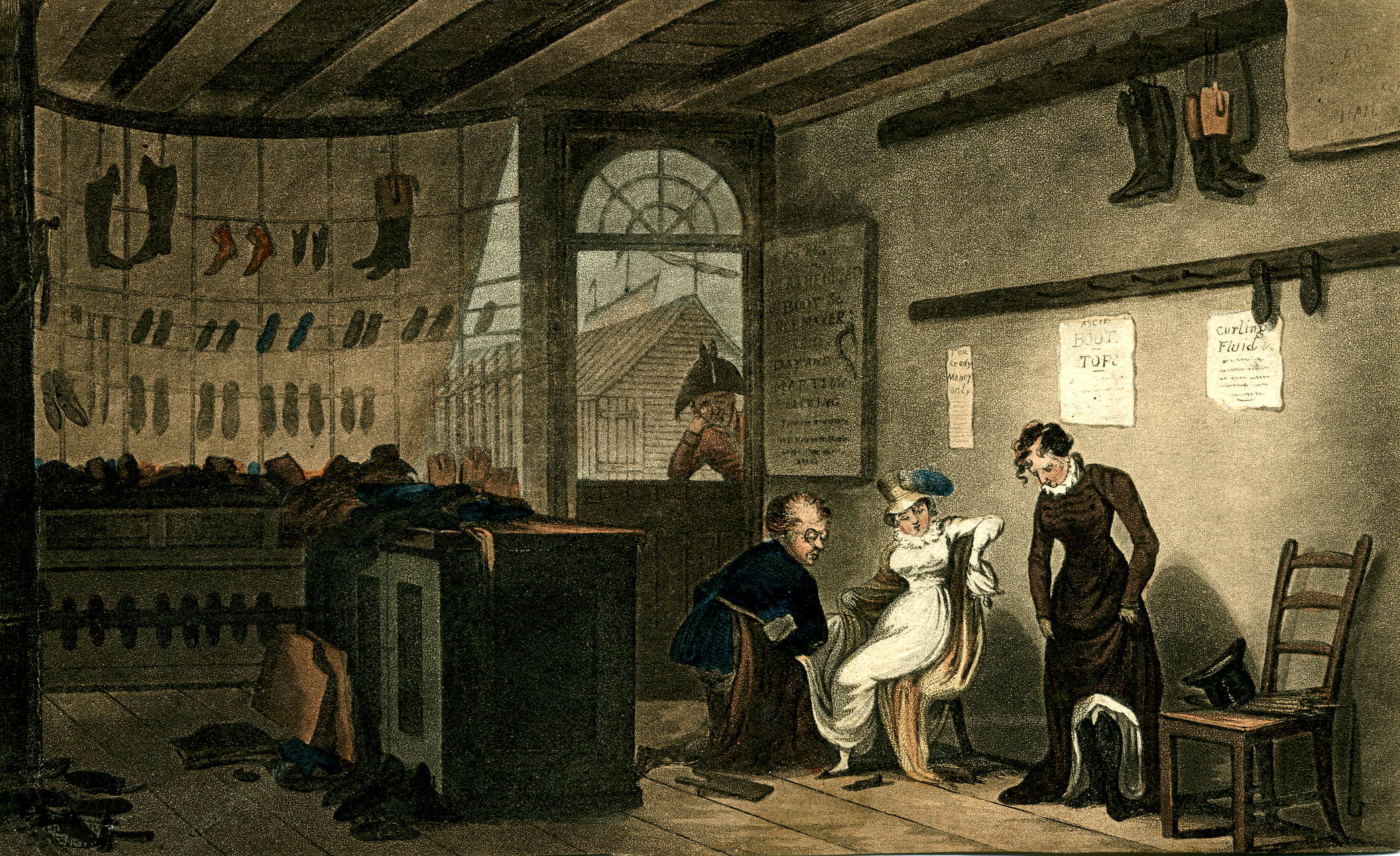
This is certainly the case lower down the social scale. The print below shows a shoe shop which appears to be selling only products made on the premises – both men’s and women’s boots and shoes. One lady has her foot on the knee of the salesman while her friend, wearing a riding habit, tries on a boot. In this much less refined setting a passerby ogles the ladies.

shoe makers

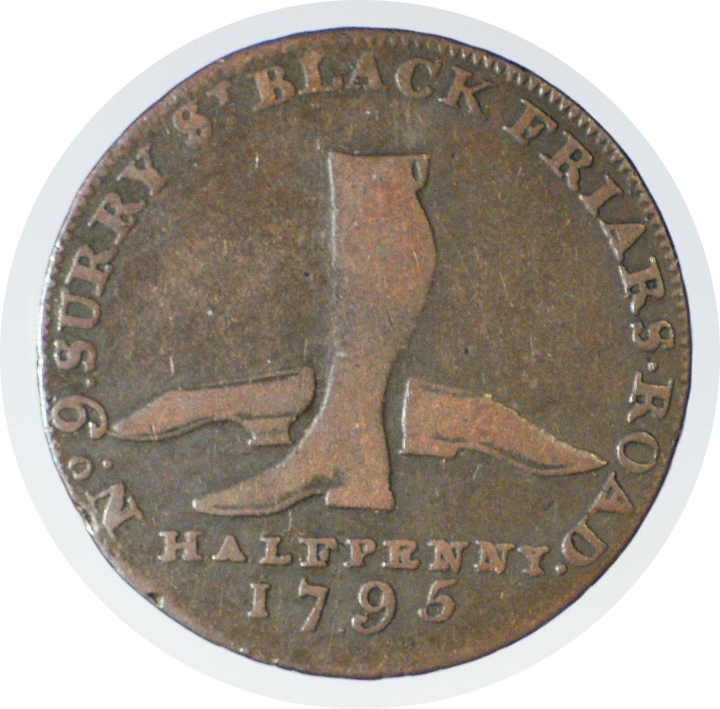
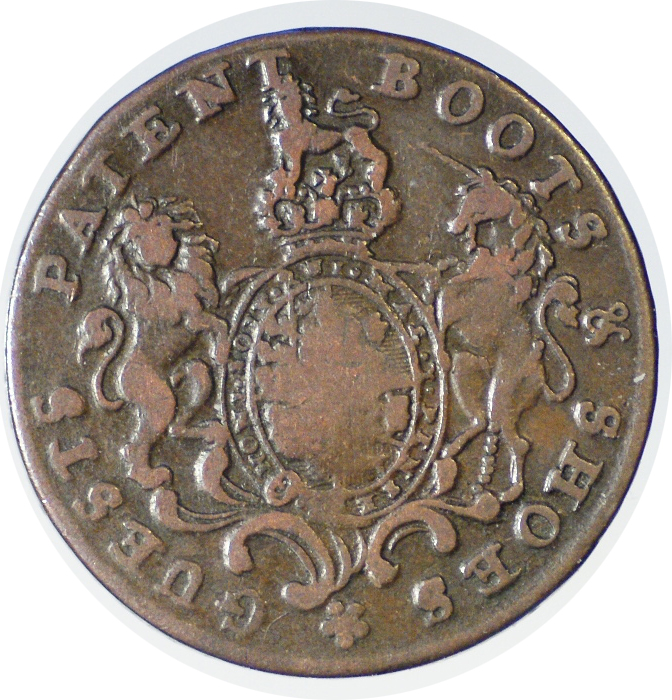
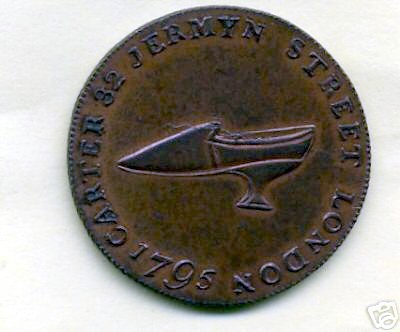
At the end of the 18th century small change was scarce and many businesses produced copper tokens which took the place of low denomination coins. I have two from shoemakers. One is for Carter of Jermyn Street. Dated 1792 it shows an elegant lady’s shoe with heel. The other is for Guests Patent Boots & Shoes of No.9, Surry Street, Blackfriars Road (1795) and shows a lady’s slipper, a man’s shoe and a boot.

Boots 2 copyboots token obv09


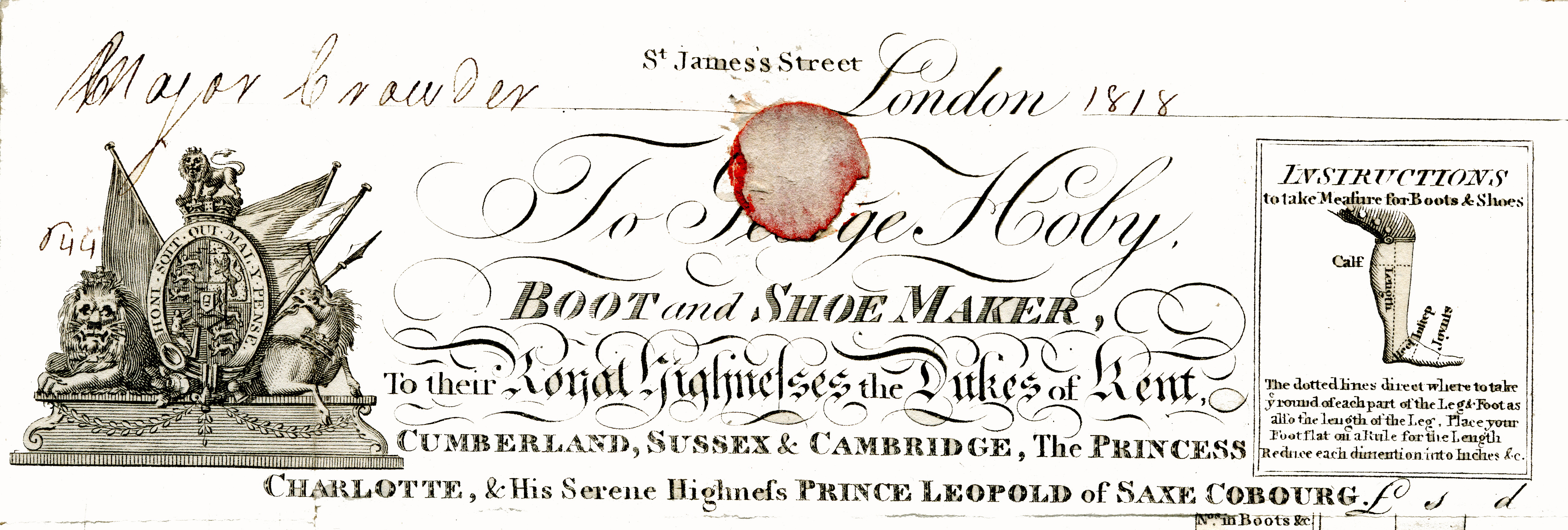
Fashionable gentlemen took great pride in their boots and perhaps the most famous of all the London bootmakers was George Hoby whose shop was at the top of St James’s Street. Hoby was arrogant, and far from subservient to his aristocratic patrons, but he died a very rich man, famous for producing the iconic Wellington Boot to the duke’s special requirements.
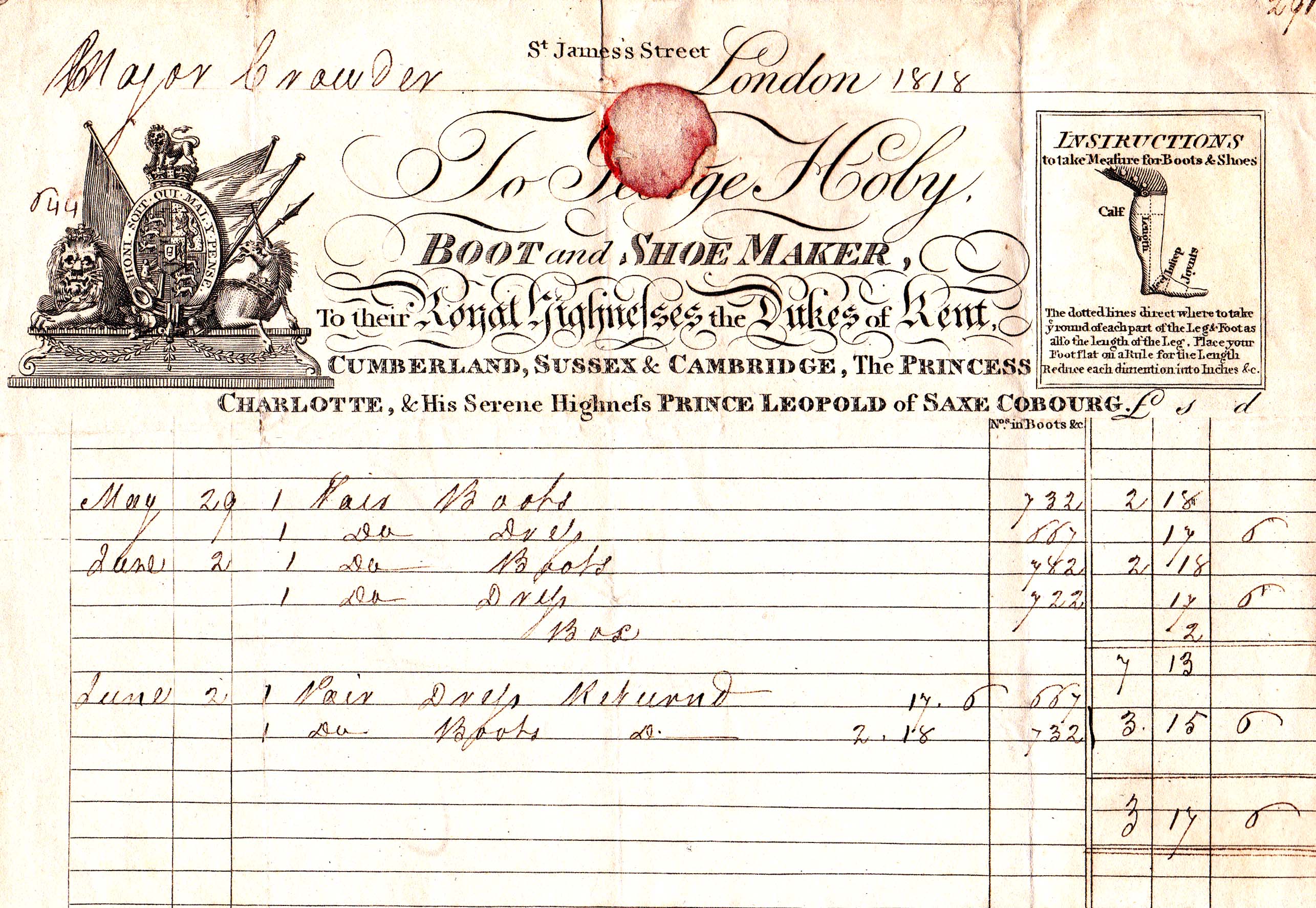
This billhead is from an account sent by Hoby to Major Crowder (who, incidentally, was the officer who intercepted the coach carrying Napoleon’s secret codes in the Peninsula). The billhead shows the royal coat of arms and names Hoby’s royal patrons. It also includes a do it yourself guide for measuring for boots –  presumably this was for the convenience of officers serving abroad, or country gentlemen.

LA44
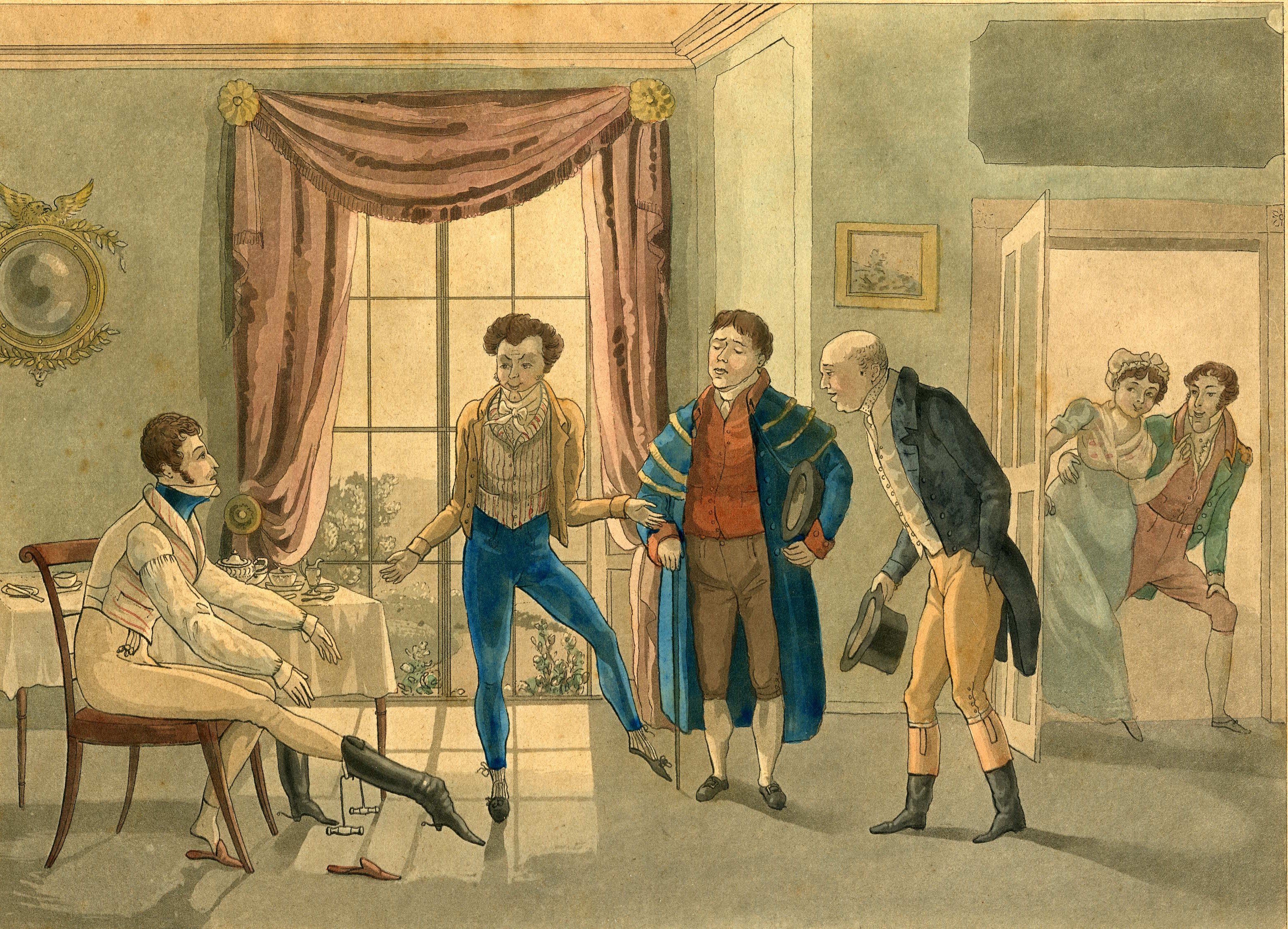
To see a range of men’s footwear across the classes, this print by Thomas Edgerton from the ‘Bores’ series of 1828 is ideal. The gentleman has been interrupted as he pulls on his boots after breakfast. A beadle accompanies an aggrieved father who is complaining about the seduction of his daughter by the valet. These boots are elegant items in very soft leather with the spurs already attached, and they are pulled on using special boot-pullers and loops in the top of the boot. The gentleman’s backless bedroom slippers are by his chair. His valet wears black pumps with natty striped stockings, contrasting to the solid and old-fashioned respectability of the beadle’s buckled shoes. Finally the father wears practical riding boots with tan tops.

valet no text
At the lower end of the market, shoemakers would produce a range of sizes and the customer would come in and buy ‘off the peg.’ For made to measure shoes a wooden last would be made to the customer’s exact measurements, kept in store and modified by cutting away wood, or adding leather patches, as the foot shape changed over time. To see a last-maker in action you can go into Lobb’s in St James’s Street. Although established a little later than the Regency they still produce hand-made shoes in the traditional manner and their display cases have some fascinating old examples.

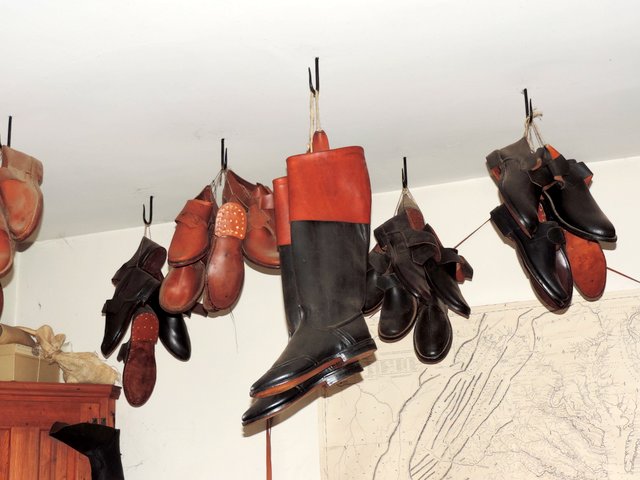
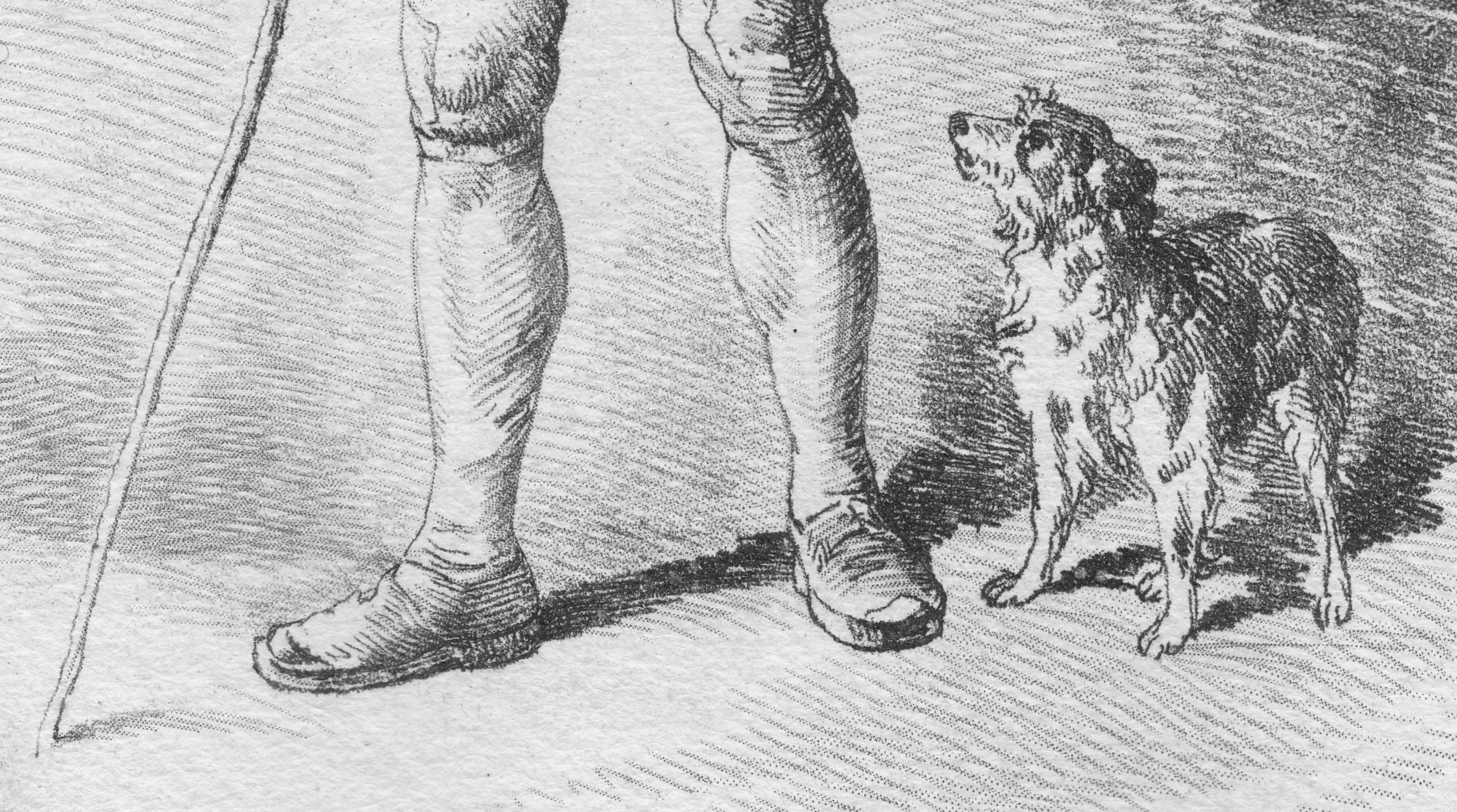
1-DSCN53041-DSCN5305 I was in Colonial Williamsburg, Virginia, recently  and visited the shoemaker’s shop there. The photo is of him working to produce the everyday leather shoes that the re-enactors use on the site. These are sturdy, off the peg styles, and are very similar to the shoes and boots illustrated by W H Pyne in his “Rustic Figures”, a series of sketches to guide amateur artists.

shoes

30 Comments

Filed under Fashions, Gentlemen, Shopping

The Great Parasol Mystery – or Which Way Is Up?

I have a large collection of original fashion prints 1795-1825. All right, I admit it, an indulgently large collection and a bit of a fashion print habit. But having so many does allow me to notice trends I wouldn’t normally spot – how the way long evening gloves are held up changed, how fans were held – and, something that has mystified me ever since I first saw it – the way parasols were carried.

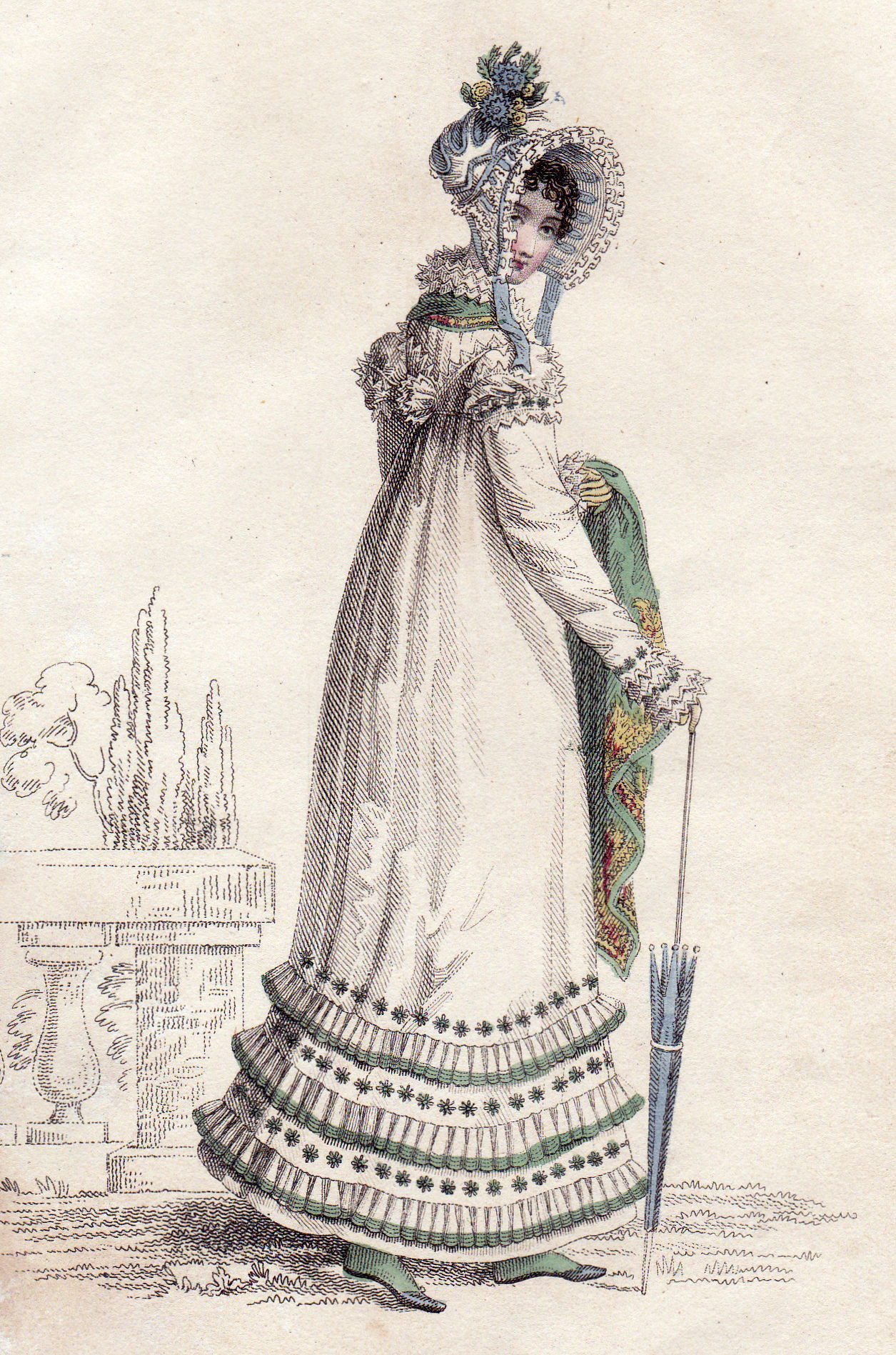
These days we carry our umbrellas (and parasols, if we have them) by the curved handle which finishes the long shaft. At the other end, protruding from the top, is a short extension of the shaft ending in a metal ferrule to protect it when it touches the ground.  The lady wearing a Walking Dress in this print of July 1819 (Ackermann’s Repository) is holding her parasol in this way (Note the ring around it to keep the folds under control).

1819But before about 1816 the vast majority of the prints I own show the parasol being held either at its body like the pair of prints below, or by the short length of shaft at the top.


Ladies' Monthly Museum 1804 (pair to the left) and detail from 1805

I’ve included a variety of prints below to illustrate the ‘upside down’ way closed parasols (and I can only assume umbrellas also) were held.

From The Ladies Own Memorandum Book 1806

From The Ladies Own Memorandum Book 1806

London Walking Dresses July 1807 for La Belle Assemblee

London Walking Dresses July 1807 for La Belle Assemblee

Promenade Dresses Ackermann's Repository August 1809

Promenade Dresses Ackermann’s Repository August 1809

The 1807 print shows a carrying loop at the top of the open parasol and the tasselled design for 1809 shows an opening mechanism just like a modern umbrella. Even when a hooked handle appears (1812 & 1813 prints) it is at the top end.

Then gradually I find them being shown the ‘right’ way up from 1814 onwards, although not exclusively – it doesn’t seem to settle down to the modern way of doing things until about 1817.

But what I can’t understand is why the upside down way of holding the closed parasol persisted for so long. Surely this method meant that the lady risked soiling her gloves with dust, mud or grass when she carried the parasol/umbrella open? None of the books I’ve looked at even mentions this. What do you think?

Promenade Costume Ackermann's Repository September 1811

Promenade Costume Ackermann’s Repository September 1811

Promenade Dress Ackermann's Repository 1812

Promenade Dress Ackermann’s Repository 1812

Morning Walking Dress Ackermann's Repository 1813

Morning Walking Dress Ackermann’s Repository 1813

Journal des Dames et des Modes 1816

Journal des Dames et des Modes 1816

Walking Dress July 1818 La Belle Assemblee

Walking Dress July 1818 La Belle Assemblee


16 Comments

Filed under Fashions, Women

The Funeral of Mr Edward Comely 1811

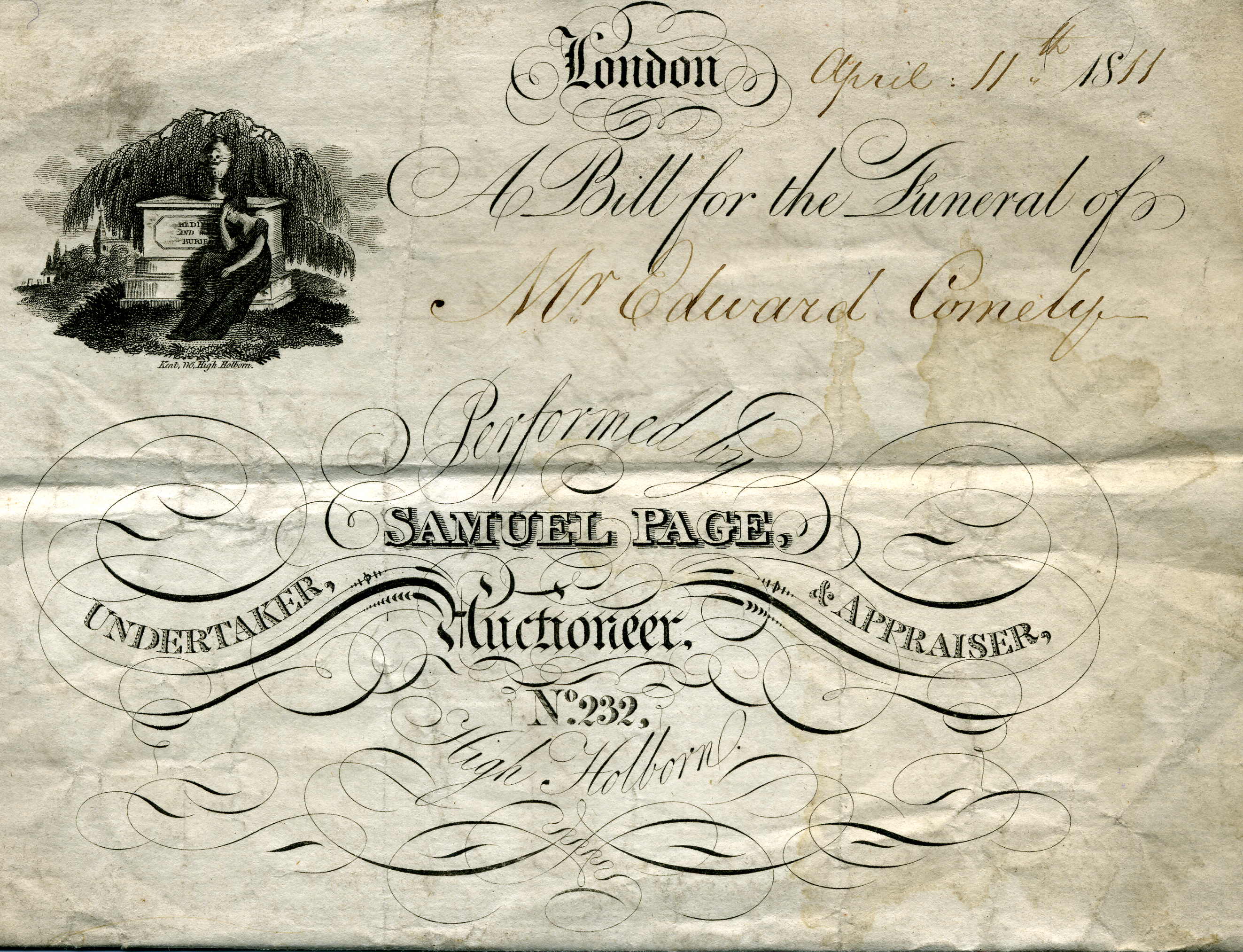
On April 11th 1811 a funeral procession made its way up Gray’s Inn Lane (now Road) to the New Burial Ground of the parish of St Andrew’s, Holborn. The burial ground is still there and is St Andrew’s Gardens now.
The funeral was that of Mr Edward Comely who had died five days earlier on the 11th April and it was “performed” by Samuel Page, Undertaker, Auctioneer and Appraiser of 232, High Holborn.
005 funeral
I have not been able to find out anything about Edward Comely, other than to deduce that the scale of his funeral and the fact that he lived in a City parish make it likely that he was in trade, probably a as merchant or shopkeeper. His executor who paid the bill, very promptly, on 18th April, was James Meycock, who was probably the same man who appeared as a plaintiff in a burglary case at the Old Bailey in 1809. He was a haberdasher in Broad Street in the adjacent parish of St Giles.
Under the handsome billhead with its picture of a black-clad woman mourning next to a tomb in a churchyard is the detailed account which paints a vivid picture of the details of an early 19th century funeral. Spelling and capitalization are as given in the invoice.
A Strong Elm Coffin covered with fine Black Serge close drove with double Rows of the best Japanned Nails on a Double Flowered Plate & Urn. 6 large Cherubim Escutcheons with wrought handles sett off and decorated with enriched ornaments chas’d and Blk Japanned in the best manner. Lined and furnished. £5 10s
A fine crape Mattress 12s
A fine Crape Shroud Cap and Pillow 18s
3 [?] with the Ditto 6s
Strong screws making up the Body [of the coffin] 3s
The use of a Handsome velvet Pall 7s
A Hearse and Mourning Coach with Pairs [of horses] each 12s
2 Coachmens Cloaks 2s
2 Hatbands and gloves for Ditto 10s
2 Porters in proper dresses to stand at the door and walk in procession 12s
2 Hatbands and gloves for Ditto 10s
4 men to Bear the Corpse 10s
2 Mourners Cloaks 3s
2 Hatbands for use of Ditto 2s
2 hoods and scarves 4s
A man attending the funeral 5s
A hatband and gloves for Ditto 5s
Gravedigger 5s

This totalled £13 16s but a discount of 13s 6d (for prompt payment perhaps?) was given.
Church service etc £4 7s
Paid to Mr Peckring (the clergyman?) £1 9s
The total bill came to £18 18s 6d

Price comparisons are notoriously difficult to make, but at this time a footman in a great house would expect to earn between £25 and £35 a year.
Catherine Arnold in Necropolis: London and Its Dead notes that undertaking as a specific trade developed in the 18th century, probably as a reflection of changing attitudes towards death by the middle classes who both wanted to show a refined sensibility by displays of mourning and meditation on death and also to reflect their growing wealth and confidence by a fine display.
The coachmen, coffin bearers, porters and the ‘man attending the funeral’ – presumably the funeral director’s representative – must all be correctly attired in black cloaks and gloves, with black bands on their hats and with long black scarves, the hearse would move at walking pace and passers-by would have ample opportunity to admire the coffin, draped in its hired velvet pall.
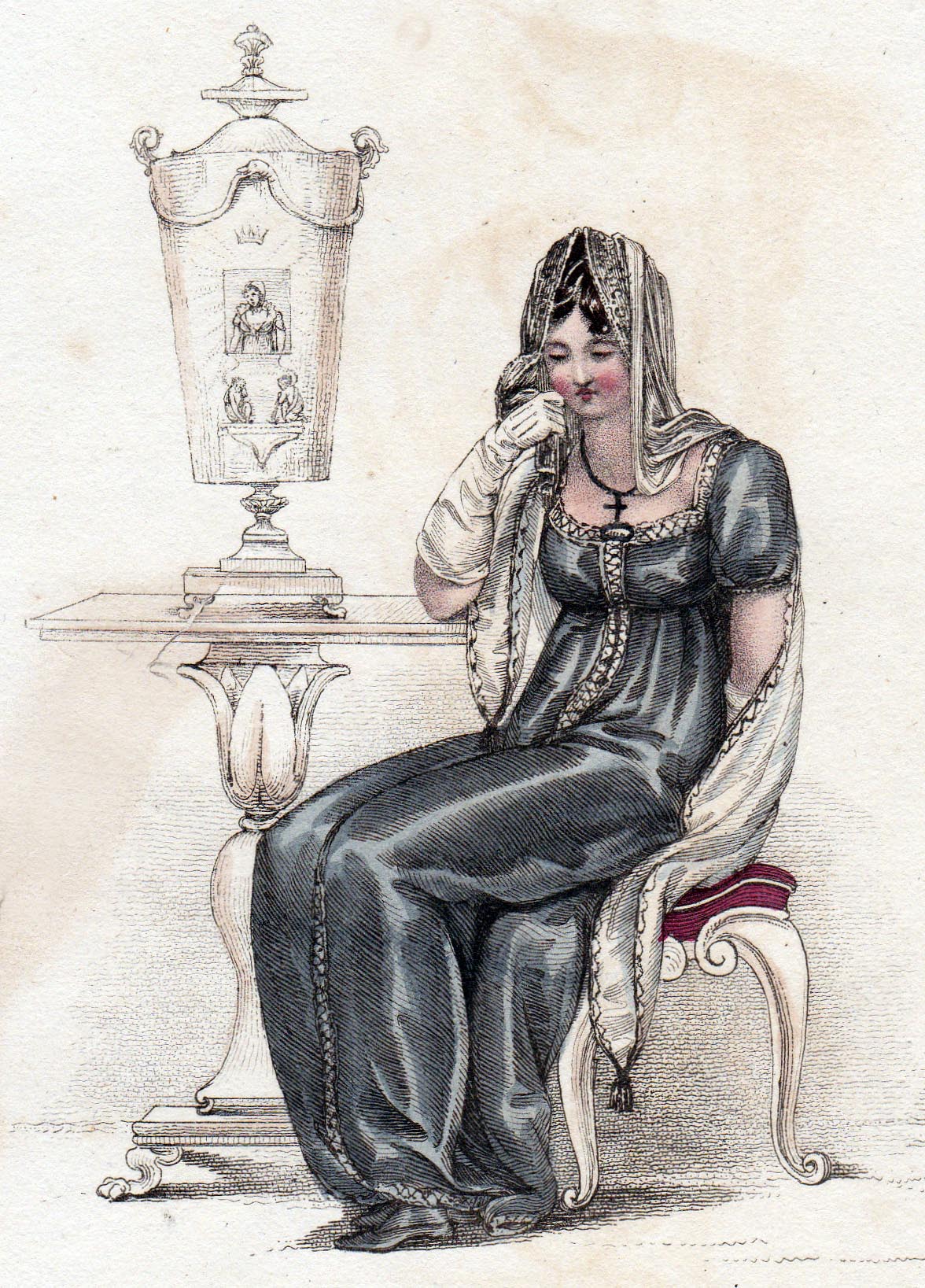
Mourning for the family and relatives would be another major cost to be considered, although that merits a post of its own. However, until I manage to collect all my images and scan them, here is “Evening Mourning Dress” from Ackermann’s Repository December 1810. The afflicted lady sits all in black and white, mopping her eyes next to a suitably funereal urn. Her jewellery is black jet. Although she has dressed formally for the evening she does not seem to be looking forward to socialising, poor thing.

Mourning 1810 crop

3 Comments

Filed under Fashions, Medicine & health

Banns or Licence? Ways To Marry in Georgian England

After Lord Hardwicke’s Marriage Act of 1753 the Georgian couple in England and Wales had three ways of getting married: by banns, by common licence or by special licence. (There was actually a fourth option – to get themselves over the border to Scotland and be married under Scottish law, but I’m leaving the elopements out of this post!)

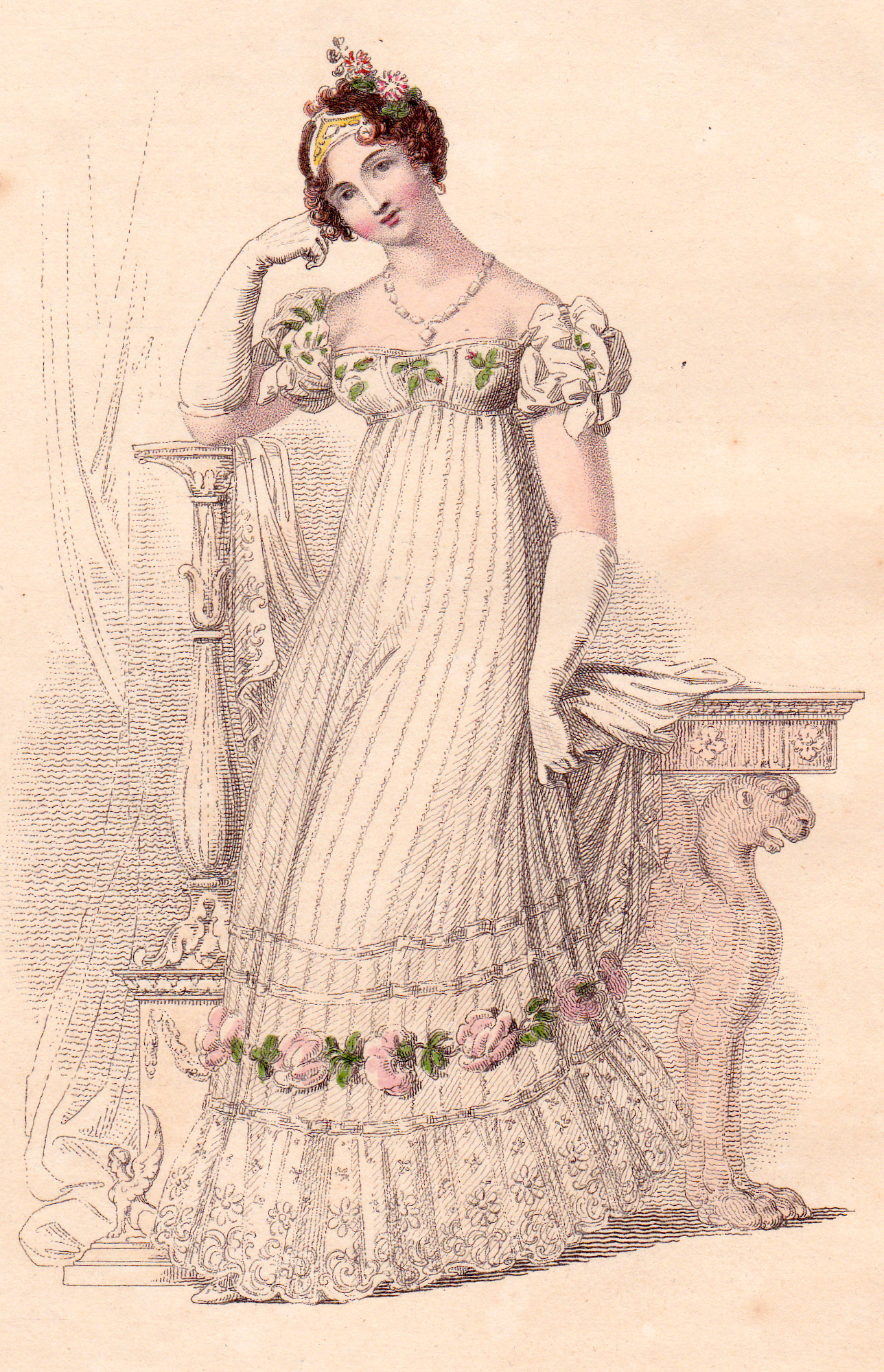
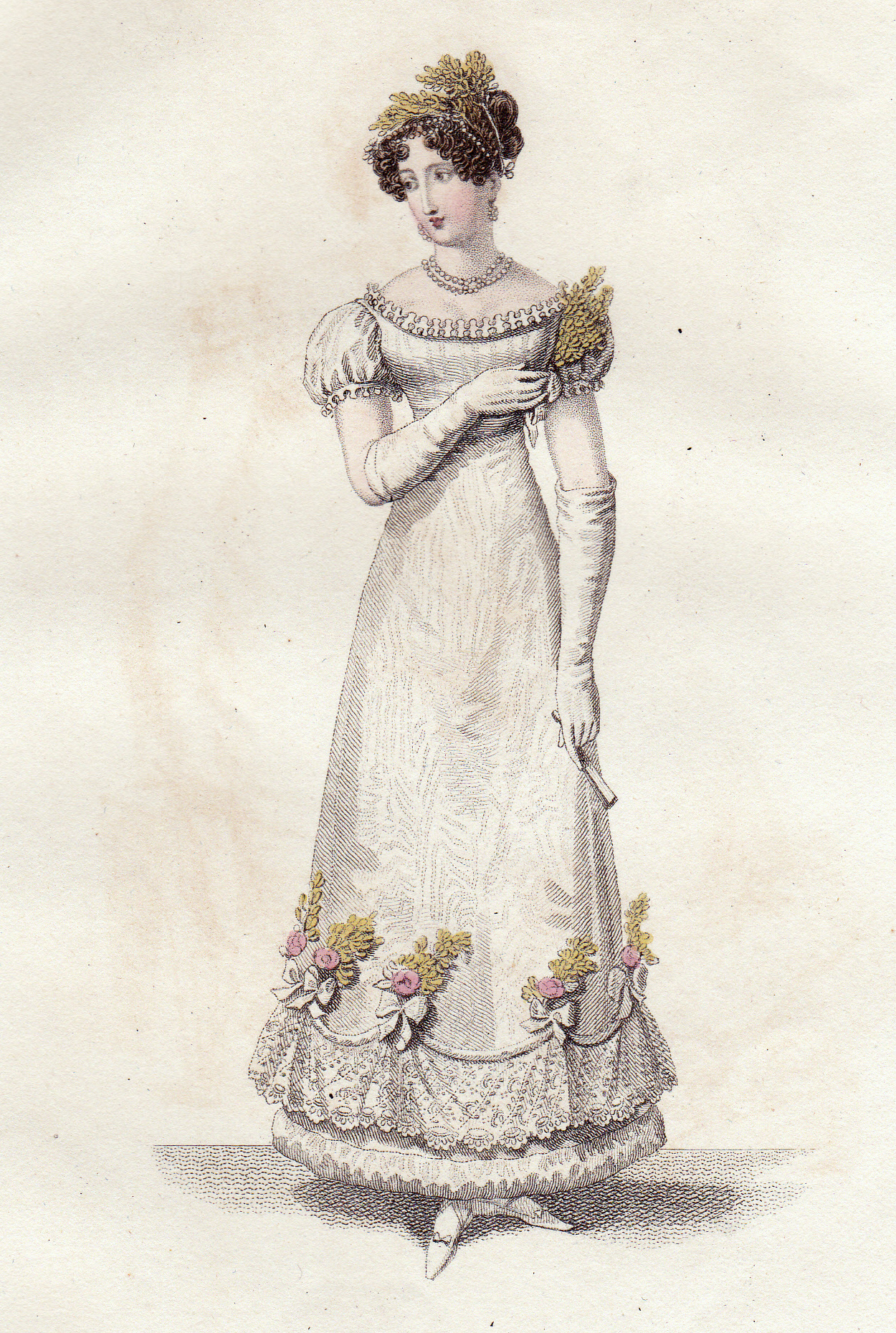
Bridal Dress. Ackermann’s Repository June 1816

Banns are intended to give anyone an opportunity to declare reasons why a marriage may not go ahead and the requirement for banns goes back to 1215. They must be called on three Sundays before the wedding date in the church of the parish where the couple intend to marry. Since 1823 it has been a requirement to call them in the parish or parishes where the bride and groom are resident if that is not the parish where the wedding will take place.

Banns are fine if you have no objection to the whole parish knowing your business, but you might want more privacy or you might wish to marry in a hurry. The alternative was a common licence, which cost more than banns and this was the option chosen by many people with pretensions to gentility and by anyone who could afford it and who wanted a hasty marriage – for whatever reason.

A common licence could be issued by archbishops, bishops, some archdeacons and ministers in parishes which were ‘peculiars’ (eg St Paul’s cathedral). The 1753 Act required a marriage by licence to take place in a parish where one of the spouses had been resident for at least four weeks, but this was often ignored.

To obtain a licence someone, usually the bridegroom, had to apply at the registry for the appropriate jurisdiction and submit an allegation which was a statement, under oath, that there were no impediments to the marriage. Usually the document included the names, ages, occupations and marital status (single or widowed) of the parties and, if one of them was a minor, it had to name the parent or guardian giving their consent. Sometimes a money bond was provided to back up the allegation.

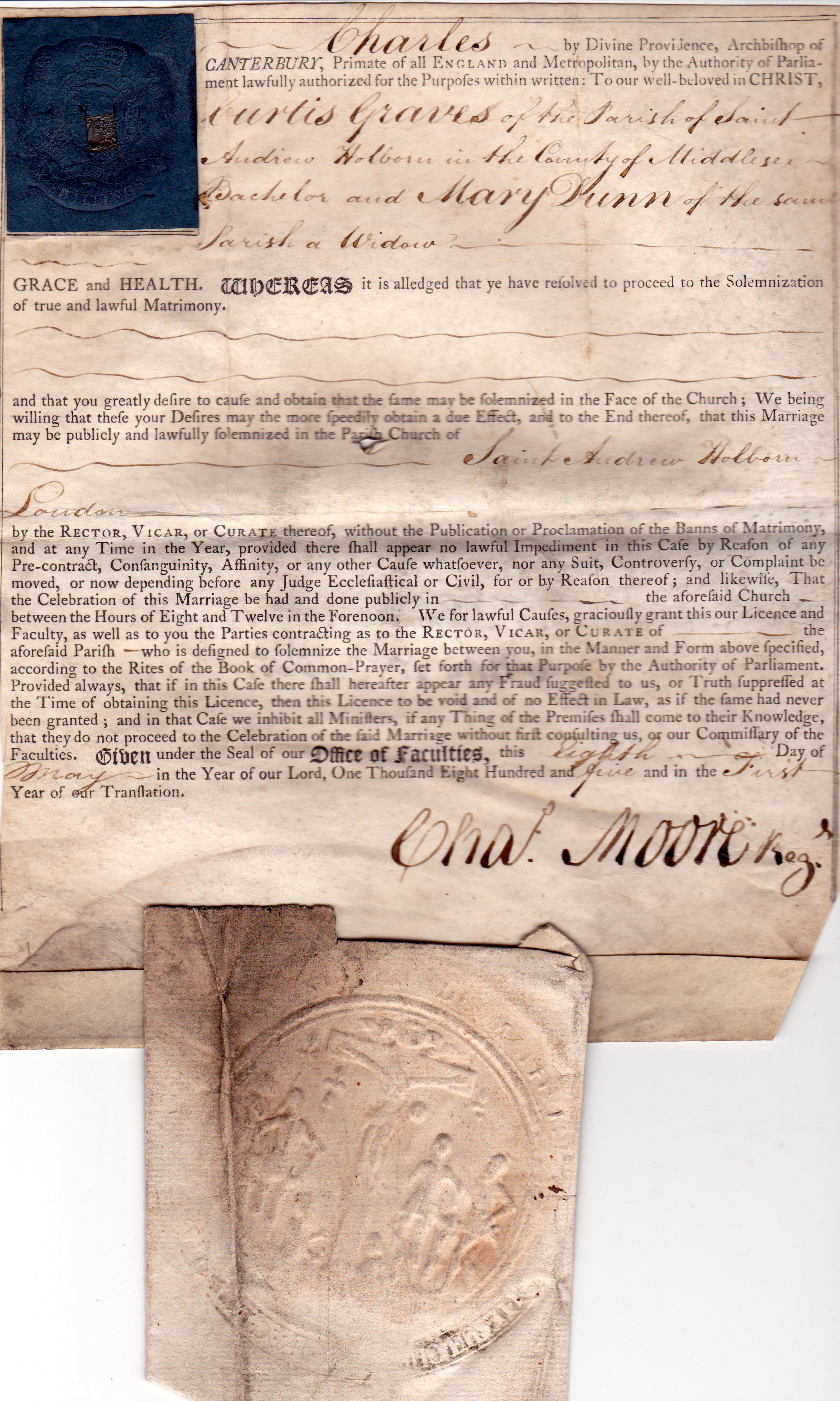
Allegations, bonds and the licences themselves survive quite rarely. The licence was given to the couple to hand to the clergyman who would perform the marriage and, presumably, they often did not give them back, so I was delighted to find the one shown below.


Marriage Licence 3
It has a tax stamp in the top left corner for ten shillings (on top of the cost of the licence) and the Archbishop’s seal is suspended in a paper envelope at the bottom. It reads:
Charles, by Divine Providence, Archbishop of CANTERBURY, Primate of all ENGLAND and Metropolitan, by the Authority of Parliament lawfully authorized for the Purposes within written: To our well-beloved in CHRIST,
Curtis Graves of the Parish of Saint Andrew Holborn in the County of Middlesex, Bachelor and Mary Dunn of the same parish a Widow
GRACE and HEALTH. WHEREAS it is alledged [sic] that ye have resolved to proceed to the Solemnization of true and lawful Matrimony and that you greatly desire to cause and obtain that the same may be solemnized in the Face of the Church; We being willing that these your Desires may be the more speedily obtain a due Effect, and to the End thereof, that this Marriage may be publicly and lawfully solemnized in the Parish Church of Saint Andrew Holborn, London by the RECTOR, VICAR or CURATE thereof, without the Publication or Proclamation of the Banns of Matrimony, and at any Time in the Year, provided there shall appear no lawful Impediment in this Case by Reason of any Pre-contract, Consanguinity, Affinity, or any other Cause whatsoever, nor any Suit, Controversy, or Complaint be moved, or now depending before any Judge Ecclesiastical or Civil, for or by Reason thereof; and likewise, That the Celebration of this Marriage be had and done publicly in the aforesaid Church between the Hours of Eight and Twelve in the Forenoon. We for lawful Causes, graciously grant this our Licence and Faculty, as well as to you the Parties contracting as to the RECTOR, VICAR or CURATE of the aforesaid Parish who is designed to solemnize the Marriage between you, in the Manner and Form above specified, according to the Rites of the Book of Common Prayer, set forth for that Purpose by the Authority of Parliament. Provided always, that if in this Case there shall hereafter appear any Fraud suggested to us, or Truth suppressed at the Time of obtaining this Licence, then this Licence to be void and of no Effect in Law, as if the same had never been granted; and in that Case we inhibit all Ministers, if any Thing of the Premises shall come to their Knowledge, that they do not proceed to the Celebration of the said Marriage without first consulting us, or our Commissary of the Faculties. GIVEN under the Seal of our OFFICE OF FACULTIES, this Eighth Day of May in the Year of our Lord, One Thousand Eight Hundred and Five and in the First Year of our Translation.
[Signed] Chas. Moore Regr.
The back has been signed by Chas. Pryce, St Andrews. May 10th 1805 – the day Curtis and Mary were married.

The Archbishop was Charles Manners-Sutton who was Archbishop 1805-28. Charles Moore Esq. who signed it was one of the Principal Registrers [sic] of the Prerogative Court of Canterbury and the Revd. Charles Pryce who performed the ceremony was elevated to a Prebendal Chair at Hereford Cathedral in 1814.

Bridal Dress Ackermann's Repository April 1818

Bridal Dress Ackermann’s Repository April 1818

There was also the possibility of marriage with a Special Licence which was very rare. These could only be obtained from the Archbishop of Canterbury and allowed a marriage to take place anywhere, not just within a place of worship licenced for marriages. A handful were granted each year, usually to members of the upper reaches of the aristocracy.

Ralph Rylance in his Epicure’s Almanac (1815) describes the scene in the Horn Tavern, Godliman Street. This lay between St Paul’s Cathedral and Doctor’s Commons, which was where the lawyers practicing civil and ecclesiastical law were based and was the easiest place to get a licence for those living in London.
‘…the fond expectant bridegroom sips his soup or savoury jelly, waiting for his licence, which is to be obtained from the Prerogative Court. This soup, jelly, and licence, form the prelude to his occupancy of his (perhaps) equally important bride. Good easy man! He little thinks that the licence aforesaid is to rob him of his liberty for and during the remainder of his, the aforesaid bride-groom’s life.’
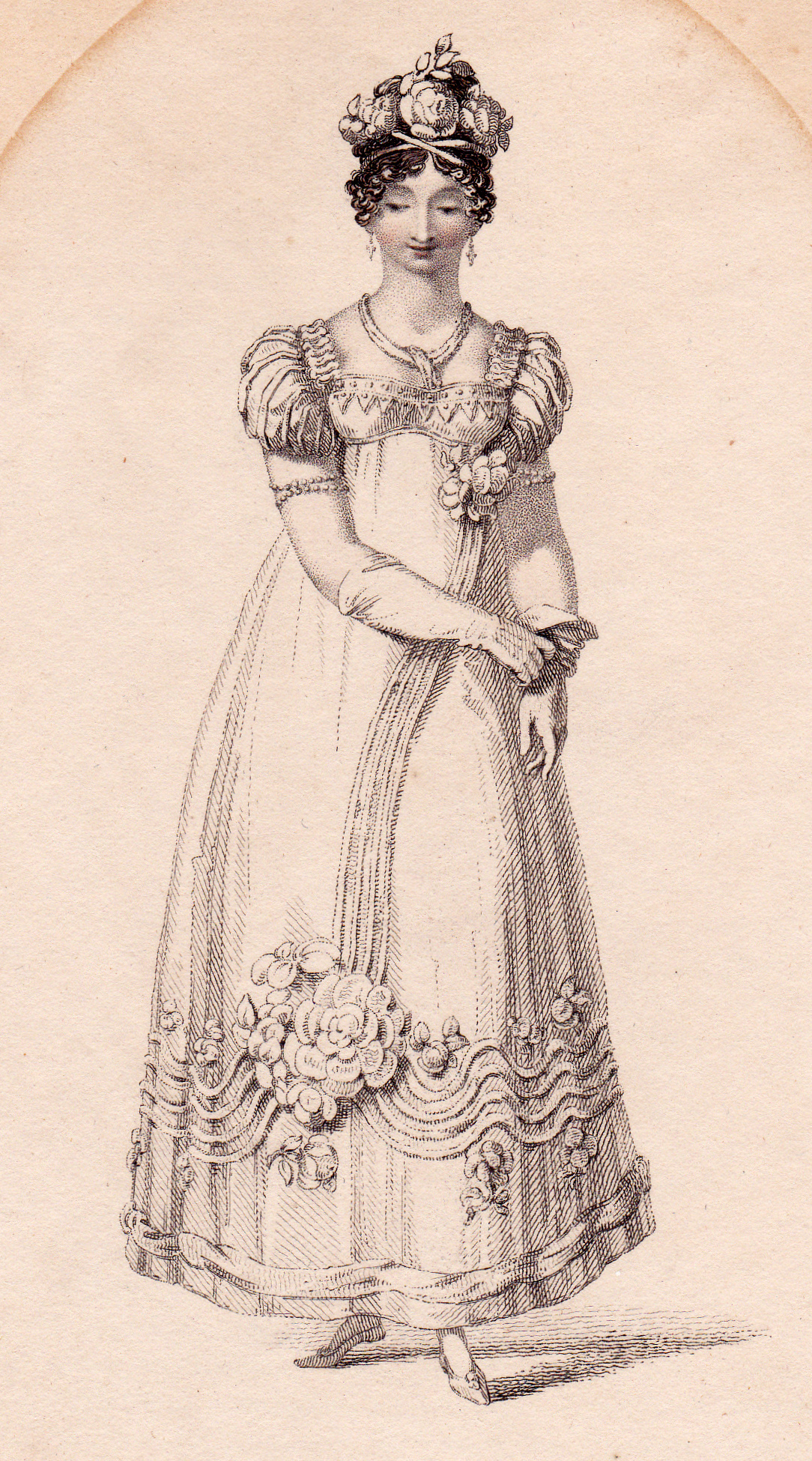
Parisian Evening Bridal Dress La Belle Assemblee October 1819

Parisian Evening Bridal Dress La Belle Assemblee October 1819

26 Comments

Filed under Fashions, Love and Marriage

Shopping is Wonderful – Until Hoby Sends His Bill

Bill Hoby

If you had the money, late Georgian shops were awash with tempting goods. And even if you weren’t so well off, tradesmen would extend credit for considerable periods if your name was good, you were a prominent person or your expectations were favourable. Many a Regency rakehell kept buying on tick for years, dangling the prospect of an inherited estate or a forthcoming marriage settlement before his unfortunate tailor or wine merchant.

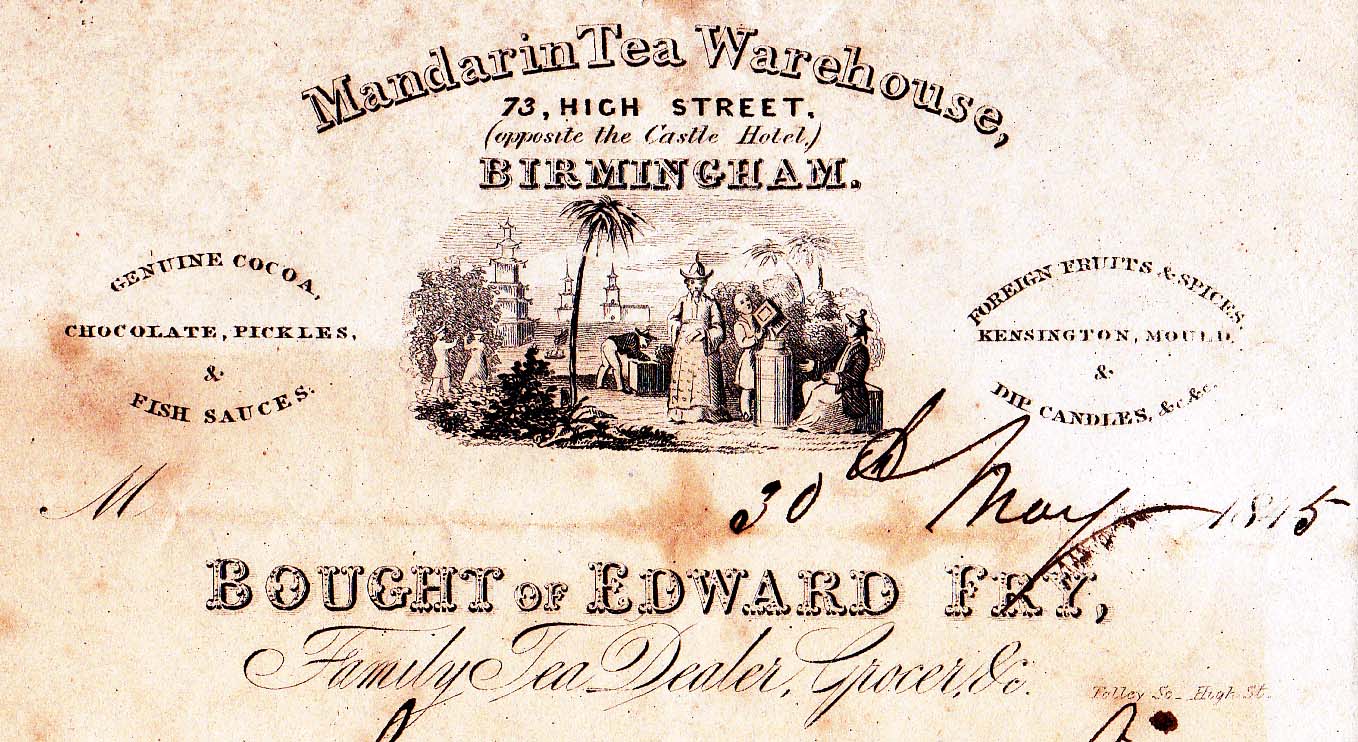
No-one enjoys receiving bills, but distance lends enchantment as far as 18th and 19th century invoices are concerned and we can enjoy them for the insight they throw on shopping habits and prices and the pleasure of their ornate headers. The example at the top of the page is from Hoby, the iconic bootmakers of St James’s Street, to Major Crowder, the officer who captured the carriage with Napoleon’s codes in it during the Peninsula War. It is dated June 1818 and the major had received four pairs of boots and returned two, leaving him with £3 17s 6d to pay. A note on the back says that he did pay it, but does not give a date. Presumably the two pairs came back because he had not measured carefully enough, even with the help of the diagram at the top of the page. The red marks on many of these bills is from the sealing wax used to close them when they were folded up for delivery.

Bill Mandarin tea warehouse The next bill is from a Birmingham merchant, not a London one, but I couldn’t resist the picture of the Chinese tea merchants loading up tea crates with a background of pagodas. It is also from 1815, a time before the East India Company had begun growing tea in India, so all tea drunk in Britain was China tea.

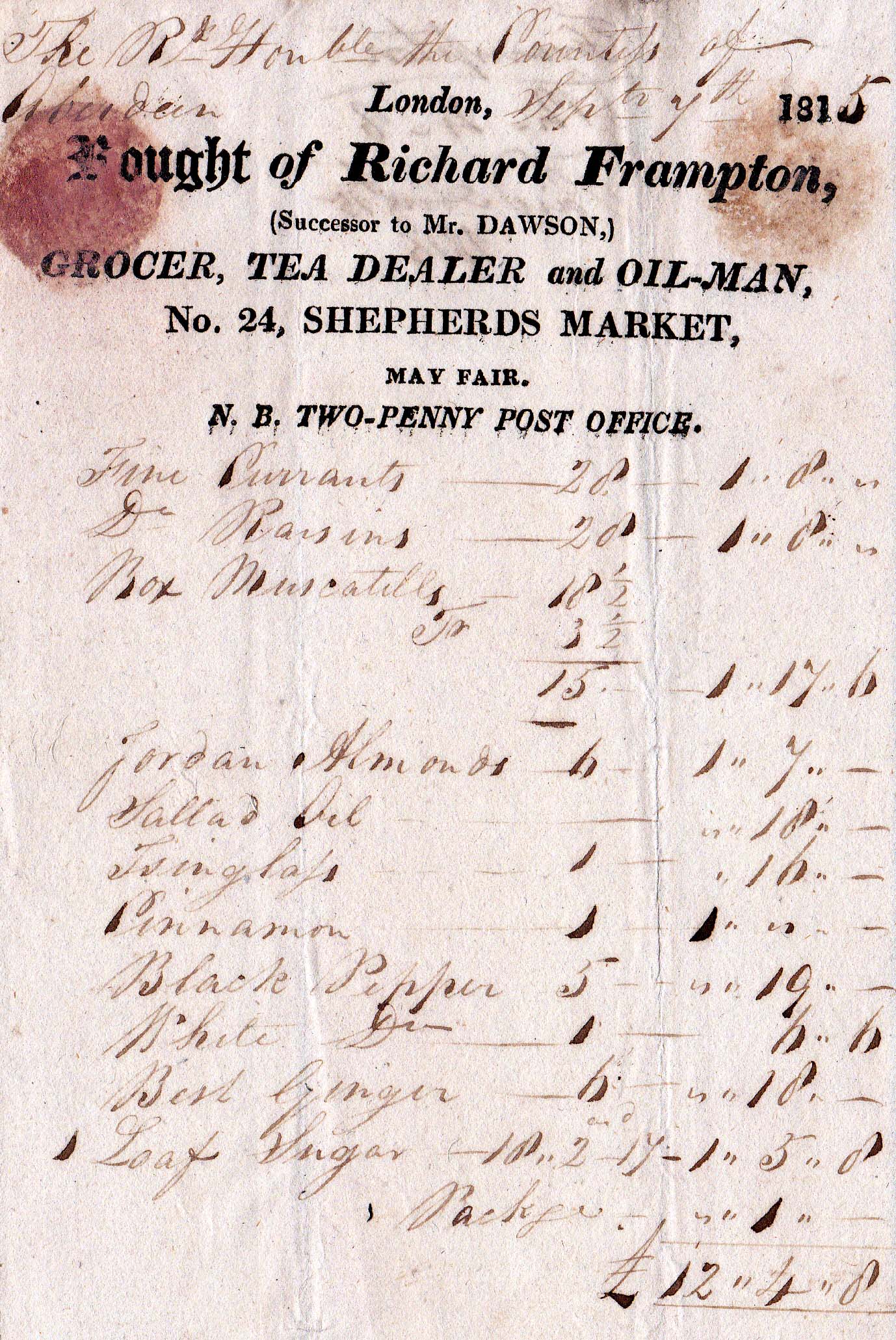
The bill on the right has no ornate header but it is interesting for the location of the businessBill Frampton

and the purchaser of the goods. Richard Frampton was a “Grocer, Tea Dealer and Oil-Man” and also ran a “Two-Penny Post Office”. His shop was in Shepherds Market, the original site of the May Fair that gives the Mayfair area its name today. Shepherds Market now is the lcoation of numerous interesting eateries, but in 1815 was still very much a place to buy essential provisions. Mr Frampton had sold currants, raisins, almonds and spices to the household of the Countess of Fife and submitted his bill for £12 4s 6d on 7th September 1815. He had to wait until August 15th 1816 to be paid.

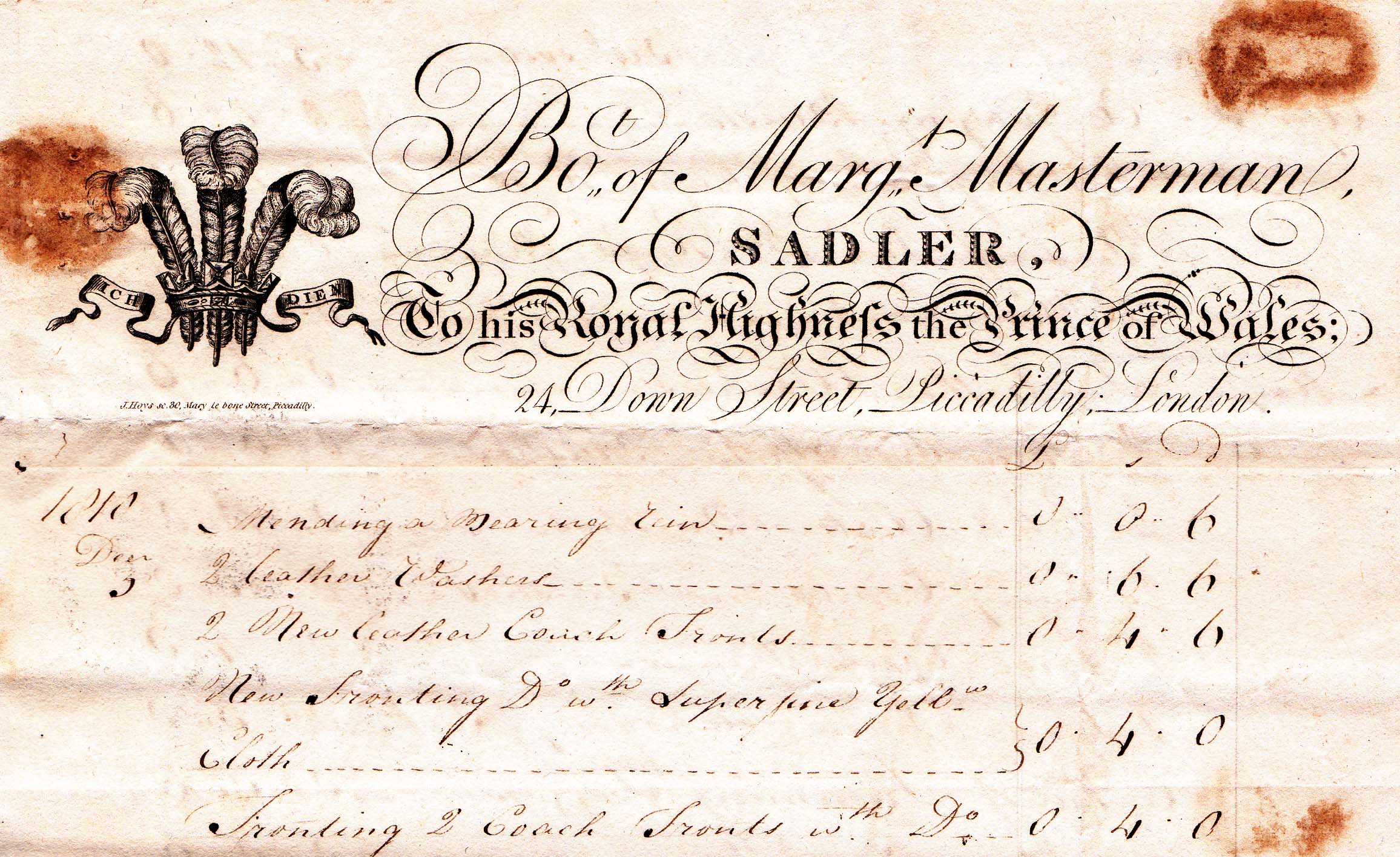
The bill below is a particularly nice one, because not only does it have the royal warrent of His Royal Highness the Prince of Wales and a handsome crest of the Prince of Wales’s feathers, but the business was owned by a woman, Margaret Masterman. Margaret ran her sadlery business from Down Street, off Piccadilly, and submitted a very long account, covering the period December 1810 to May 1811 and amounting to £24 15s 0d. It was paid by John Kitson in June 1811.  Mrs Masterman had repaired harness – “Mending a bearing rein 6d”, “repairing a coach bridle 1s 6d”; provided grooming equipment – “One mane comb 6d”; supplied new saddlery – “Two best Hogskin seated footmen’s saddles £7 7s 0d”and general cleaning equipment for carriages – “A large coach sponge 7s 0d”.

Bill Masterman

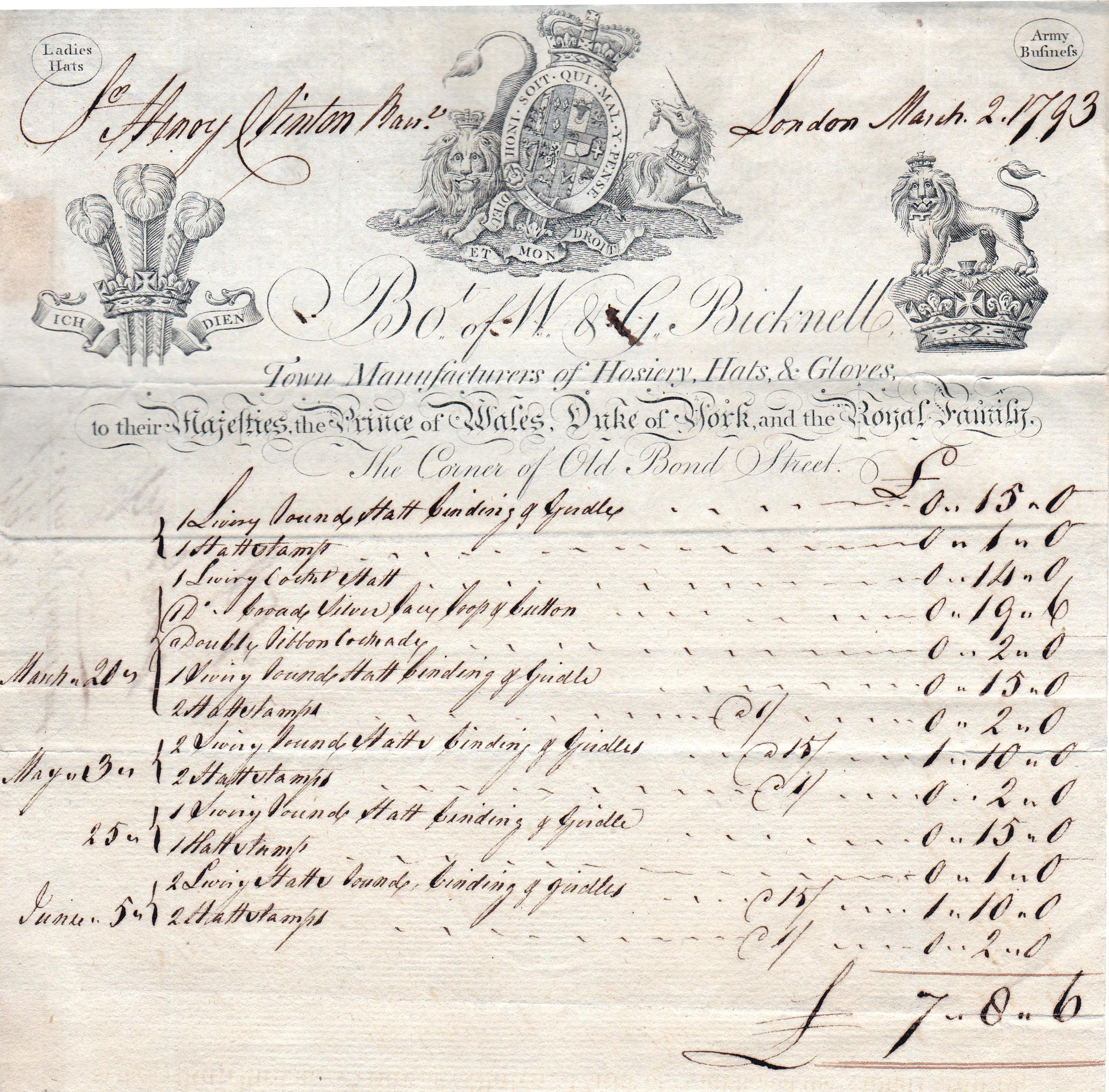
My final invoice is from W & G Bicknell, “Town Manufacturers of Hosiery, Hats and Gloves to their Majesties the Prince of Wales, Duke of York and the Royal Family.” Bicknells’ was located in Old Bond Street and they sent this account to Sir Henry Clinton, bart. in March 1793. He paid it June that year. The handwriting is very difficult to read but Sir Henry was buying ornate livery for his footmen, to a total of £7 8s 6d.

Bill Bicknell

Would it make it any less painful to pay the credit card bills if they came handwritten, with ornate designs at the top? I suspect they would be just as unpleasant., although one of the great advatages of these bills is that there doesn’t appear to be any interest charged, however late the payment!
9 Comments

Filed under Fashions, Food & drink, Shopping

Jane Austen, Stays and Elegant Fig Leaves

At this time of year, when we are all thinking about shedding as much clothing as possible in the heat, I think with even more sympathy about the layers of clothing that women were encumbered with in earlier years – and corsets, or stays as they were more usually known in the early 19th century in particular.

Stays could be made of leather, which was then not washed (a fairly dreadful thought!) or a substantial fabric, which at least could be laundered. Stays normally laced at the back but, before the invention of mass-produced metal eyelets, they could not be pulled as tight as Victorian stays were because the fabric would rip. Their shape and their constricting powers therefore depended on their stiffening of whalebone or thin cane. They pushed the breasts up rather than cupping them and were normally fitted with shoulder straps.

ImageThe print by Gillray is plate 1 from a series called The Progress of the Toilet, dated 1810 and shows a lady being laced into long stays. She is wearing fashionable clocked stockings and, rather daringly, drawers, caught in tight at the knee. Because they resembled masculine costume, drawers were considered very fast.

Jane Austen’s letters contain virtually nothing on the subject of underwear, but she did have very definite views on the subject of stays. In September 1813 she was able to pass on the latest intelligence from London on the subject  to her sister Cassandra. ‘I learnt from Mrs Tickar’s young Lady, to my high amusement, that the stays now are not made to force the Bosom up at all; that was a very unbecoming, unnatural fashion.’

Stays could be made to measure, but were also available off the peg and Mrs Clark, whose shop was at no.56, St James’s Street, advertised in 1807,  ‘…a large assortment of corsets of every size, and superior make, so that ladies may immediately suit themselves without the inconvenience of being measured.’

Ladies living out of town could order stays by mail order as this advertisement from the Morning Chronicle of November 1 1810 shows.

HER MAJESTY’S STAY-MAKER. – MRS. HARMAN No.18 New Bond-street, London, has the honour most respectfully to announce to those Ladies who attend to the elegance of the female figure, that she has now ready for their inspection a very large and fashionable assortment of her much-admired LONG and SHORT STAYS. The great number of Ladies of Rank and Fashion, who honour Mrs. Harman with wearing her Stays, is a most convincing proof of their pleasantness, utility, and superiority to every other Stay. Mrs. Harman’s Stays are finished with that novelty and taste which has procured for her the countenance of Royalty, and the patronage of the first Nobility. Ladies living in the country, by sending a letter (post paid), will have proper directions sent them to send their own measure, so as to insure their fitting.

Newspapers were not constrained by notions of modesty when commenting on ladies’ fashions and undergarments, or their appearance in them as this piece from The Times in 1799 on the flimsiness of fashionable gowns and the fashion for false bosoms shows:

“If the present fashion of nudity continues its career, the Milliners must give way to the carvers, and the most elegant fig-leaves will be all the mode. The fashion of false bosoms has at least this utility, that it compels our fashionable fair to wear something.”

And The Statesman on 2 September 1808 broke into verse to criticise modern fashions compared to those of the days of Queen Anne, managing to incorporate a furniture pun about chests and drawers in the process!

 When panoplied in whalebone stays,

Such as were worn in Anna’s days,

Our fair kept Virtue in their breasts,

And lock’d her safely – in their chests.

 But, since their chests are open’d, how,

And where, do they keep Virtue now?

Is she protected by their lawyers?

Or do they keep her – in their drawers?

Historical re-enactors have told me that they find their stays are supportive, and help prevent backache when they are working in kitchens, so perhaps there was something to be said for stays. What do you think?


6 Comments

Filed under Fashions, Royalty, Shopping

Miss Austen Buys Fabric

The most frequent item mentioned by Jane Austen when she writes home to Cassandra about her London shopping expeditions is fabric for her own use and for Cassandra and their mother. Ready made gowns were unusual and ladies in modest circumstances, such as the Austens, would buy dress lengths of fabric and either make them up at home or use a local dressmaker.

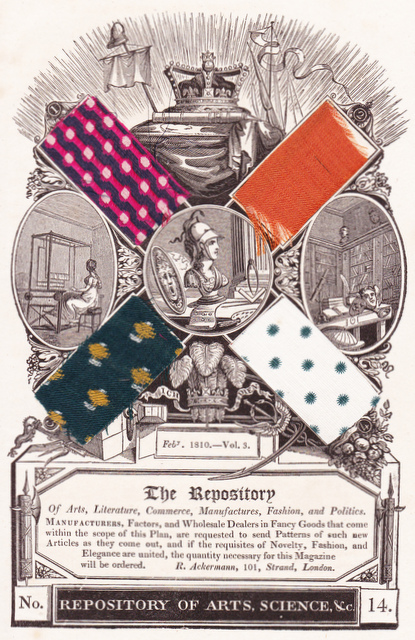
Mostly ladies would browse at the drapers’ shops and make their choices there, but Ackerman’s Repository of Arts, Science etc, was innovative enough to give samples of real fabrics in the magazine and a page for February 1810 is shown here.
1-Ackermann fabrics
Top left: A royal embossed satin: a splendid and elegant article for robes or pelisses. Sold by Harris, Moody & Co., silk-weavers, Pall-Mall.

Top right: A superfine imperial orange bombazeen, particularly calculated for Ladies’ dresses. It is sold, of every colour, by Messrs. Waithman and Everington, No,104, Fleet-street.

Bottom left: An imitative Angola shawl dress of blended green and amber. Sold by Messrs. Brisco & Powley, No.103, New Bond-street, from 38s to 50s per dress.

Bottom right: An India rib permanent green print. A patent has lately been obtained by Hewson, Higgins & Hett, for printing green on cotton goods. Sundry cotton goods for waistcoats are printed exclusively for Kestevens, York-street, Covent-garden.

On 24th May 1813 Jane wrote, “I went the day before (Friday) to Layton’s as I proposed, & got my Mother’s gown, 7 yds at 6/6.” [ie six shillings and six pence a yard]. Layton’s drapery shop, Bedford House, was at 9, Henrietta Street in Covent Garden, right next door to Henry Austen’s bank at number 10. Henry was on the point of moving to live in he apartments over the bank and Jane reports going next door to inspect the work, “which is all dirt & confusion, but in a very promising way…”

She does not say what kind of fabric she had purchased, presumably the ladies had agreed about that in advance, but in mid-September she was staying with Henry at number 10 and reports, “We did go to Layton & Shear’s before Breakfast. Very pretty English poplins at 4 [shillings and] 3 [pence]. Irish ditto at 6 [shillings] – more pretty certainly – beautiful.” Later in the same letter she writes to Cassandra, “…I am going to treat myself with spending [my superfluous wealth myself. I hope at least I shall find some poplin at Layton & Shears that will tempt me to buy it. If I do, it shall be sent to Chawton, as half will be for you … I shall send 20 yards.”

The invaluable English Women’s Clothing in the Nineteenth Century by C.Willet Cunnington describes poplin as being “made of a silk warp and wool or worsted weft, having a fine cord on the surface, and produced in several varieties, brocaded, watered and plain.”

Jane also patronised Christian & Sons at 11, Wigmore Street where she bought dimity (“A stout cotton fabric, plain or twilled, with a raised pattern on one side.”) and Newton’s, just of Leicester Square, for Irish linen.

One of the most up-market fabric shops were Wilding & Kent at Grafton house on the corner of New Bond Street and Grafton Street. On 17 April 1811 Jane and Manon, Eliza Austen’s maidservant, ‘…took our walk to Grafton House, & I have a good deal to say on that subject. I am sorry to tell you that I am getting very extravagant & spending all my Money; & what is worse for you, I have been spending yours too…’ she told Cassandra. It was a very busy shop and in November 1815 Jane complains of ‘the miseries’ of shopping there and most of her references to it mention an early start and long waits to be served – not that this stopped her going there frequently.

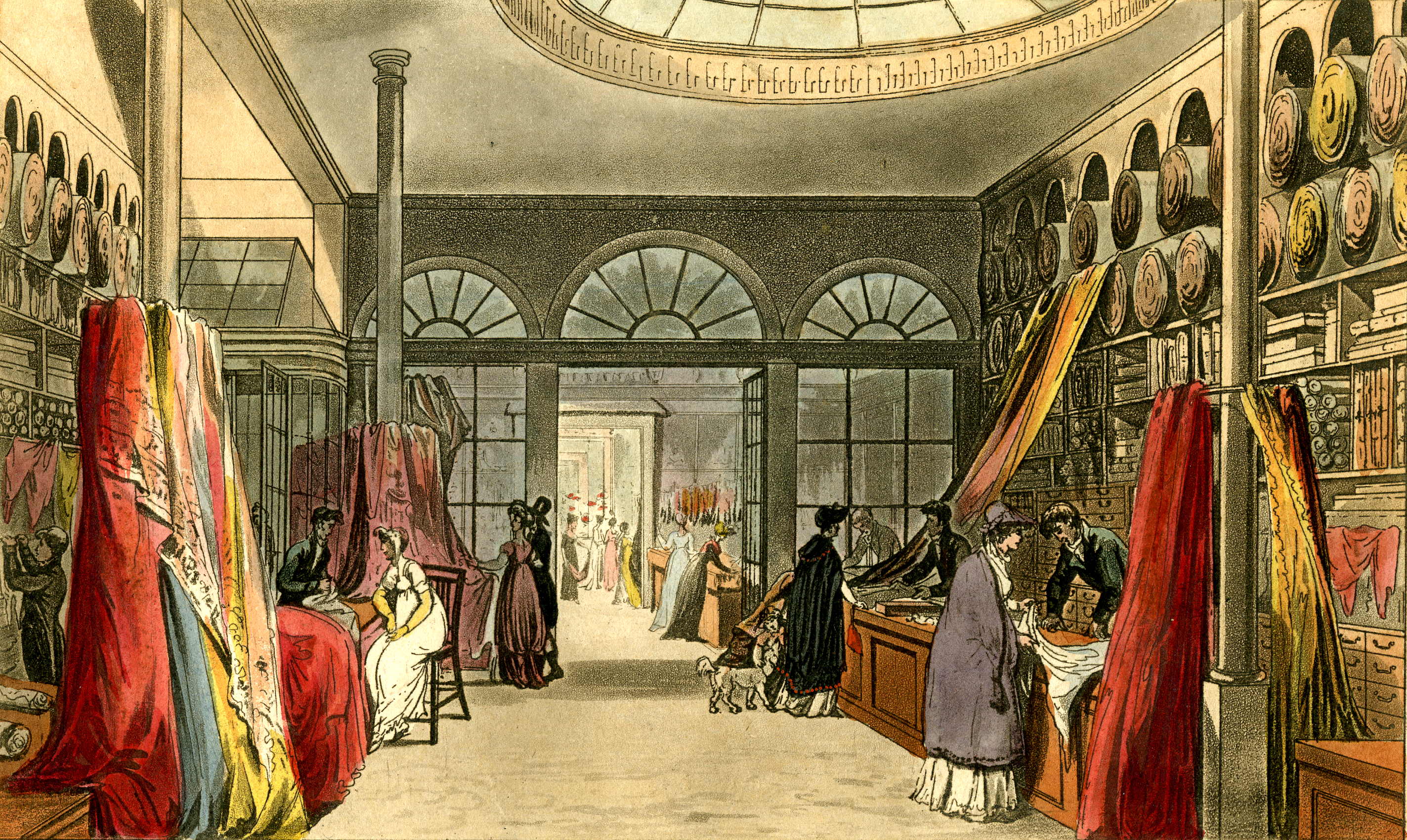
One fashionable drapers, Harding, Howell and Co., is not mentioned by Jane, although she must have known it, for it was located in Pall Mall in the seventeenth century red brick Schomberg House which still stands out in this street of stone and stucco.

According to Ackermann’s Repository, which is where the illustration below appeared, ‘It is fitted up with great taste, and divided by glazed partitions into four departments.’ These were: furs and fans; ‘haberdashery of every description, siHarding, Howel0001lks, muslins, lace, gloves etc.’; jewellery and ornamental items including perfumery and finally, ‘millinery and dresses; so that there is no article of female attire or decoration, but what may here procured in the first style of elegance and fashion.’

12 Comments

Filed under Fashions, Shopping