Category Archives: Buildings

The Rural Beauties of Bayswater – a completely unrecognisable London scene

bayswater

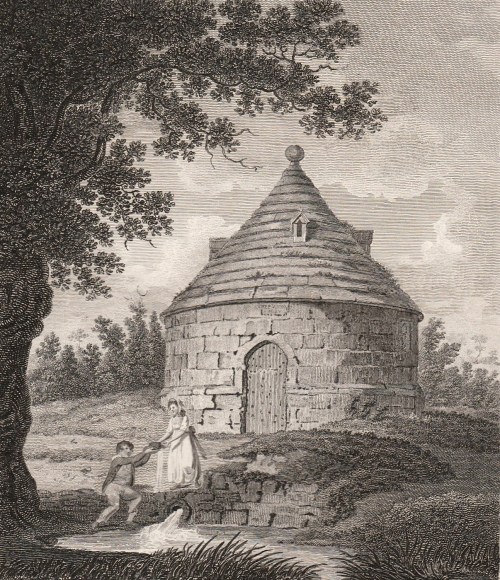
This is a “View of the Conduit at Bays-Water” (1796) To find the location of this beautiful rural scene today  go to Leinster Terrace, about halfway between the Lancaster Gate and Queensway tube stations on the Bayswater Road on the northern edge of Hyde Park. Walk north for about 150 metres to Craven Hill Gardens and there you are.  Have a look on Streetview and you’ll see that you are in the middle of respectable early Victorian houses and shops because, until about 1839, this was open country.

Bayswater was well known for its springs and the name is said to originate in the principal one, Baynard’s Watering, known from the earliest Middle Ages. From 1439 until 1812 the Bayswater Conduit carried water from Baynard’s Watering to supply the City of London and the area around was one of London’s beauty spots. It really needs some imagination to conjure up what lies beneath the pavements!


Save

Leave a comment

Filed under Architecture, Buildings, Rivers

A Fleet Street Church

fleet-st-st-dunstans

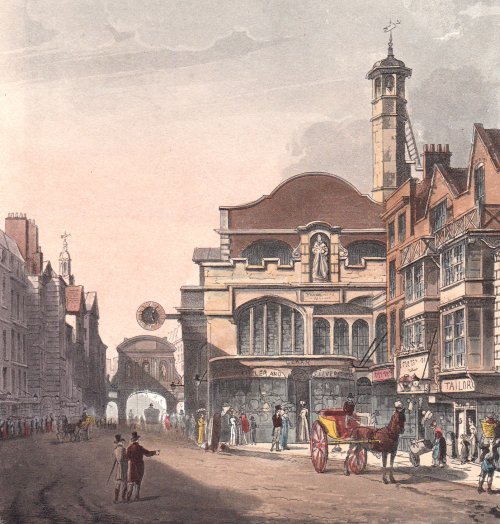
The scene above (from Ackermann’s Repository ) 1812 shows the view west along Fleet Street towards Temple Bar, the point where the City of London becomes Westminster. The Regency Londoner  would have trouble recognizing it today – always assuming they could stand in the same spot without being mown down by the traffic. Temple Bar, after many adventures is now re-erected next to St Paul’s Cathedral and the church whose west end faces us – St Dunstan’s in the West – was demolished and rebuilt in 1830 when Fleet Street was widened by nine metres.

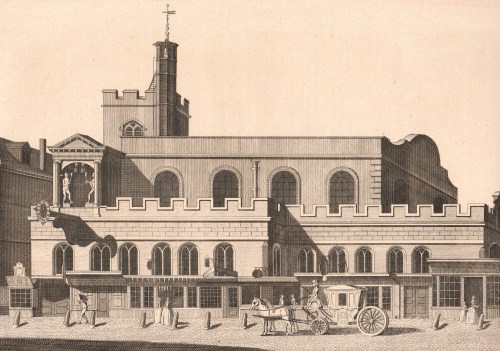
I found a mid-eighteenth century print of St Dunstan’s in a folder I bought at auction a few weeks ago and that image prompted me to look at the one above again. I have to confess an interest in St Dunstan’s – two of my ancestors were in London in 1643, died of the plague and were buried there.

st-dunstans

I love the street scenes these prints show, especially the shops. In the 18th century one you can clearly see the way shops have been built right around the walls of the church itself as was common at the time. Each has its hanging sign and the shop on the far left must be a clockmaker’s. By the time of the 1812 print the shops along the side have been swept away, but the ones of the east end remain.

St Dunstan’s was built in the 12th century, grew and was changed and even survived the Great Fire of 1666 which reached almost to its walls. Samuel Pepys, whose groping is one of his most unattractive features, tried it on with a servant girl while listening to a sermon in St Dunstan’s. She took out a packet of pins in a threatening manner and he took the hint!

Inside there are monuments rescued from the old church and the ring of bells is the original. The only survival of the old church on the outside is the clock projecting from a temple containing the figures of two men with clubs who used to hit a bell every fifteen minutes. It was erected in 1671 by the parishioners as a thank-offering for the escape from the Fire. The clock and the figures are set back a little now, so it is difficult to see them unless you are square in front of them, but they show up well on Streetview. The clock which according to the London Encyclopedia, was the first in London to have minutes marked and to be double sided, was a tourist attraction mentioned by Dickens in Barnaby Rudge and Sir Walter Scott in The Fortunes of Nigel.

When the church was demolished it was removed to the Marquess of Hertford’s Regent Park villa, but it was returned in 1935, thanks to Lord Rothermere the newspaper proprietor who brought it back to the heart of London’s newspaper world, Fleet Street.


Save

1 Comment

Filed under Architecture, Buildings, Shopping, Street life

The Statue of Charles I – a London landmark Jane Austen would have known

chas-i-in-brass

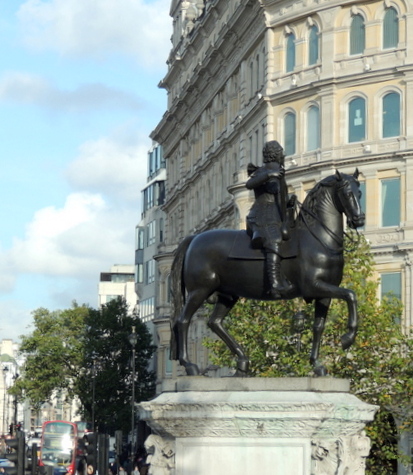
Standing on the southern edge of Trafalgar Square, facing down Whitehall, and in the midst of a permanent traffic jam, stands the bronze statue of Charles I, looking down towards the place of his execution as he has done since 1675. The surroundings have changed beyond recognition, but every Georgian Londoner and visitor would have been familiar with the statue which appears in numerous prints.

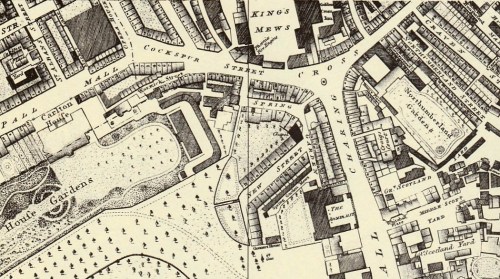
The statue was created by Hubert le Suer in 1633, but it was not erected immediately and by the time of the Civil War it had become a target for the Parliamentarians. It was sold to John Rivett, a brazier, in 1649 on the strict instructions that it was to be melted down. Rivett, obviously both a shrewd political forecaster and a businessman, buried it in his garden and made a great deal of money from small souvenirs allegedly made from the bronze. Charles II acquired it on his restoration and it was erected, more or less on the site of the medieval Charing Cross, in 1675. It can be seen on the map, just below the R of Cross. Behind it is the King’s Mews and the Golden Cross Inn, now occupied by Trafalgar Square. The bulk of Northumberland House is to the east, below the final S of Cross.

chas-i-map

The pedestal is said to have been designed by Wren and carved by Grinling Gibbons.

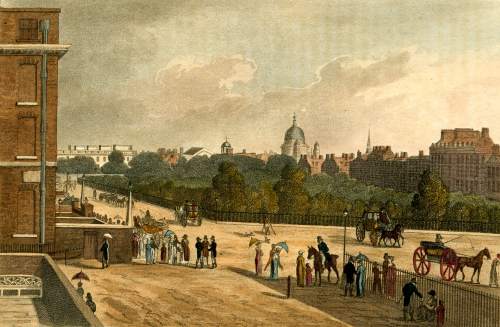
This print of 1811 from Ackermann’s Repository, shows the view east past Northumberland House and down the Strand.

chas-i-char-x

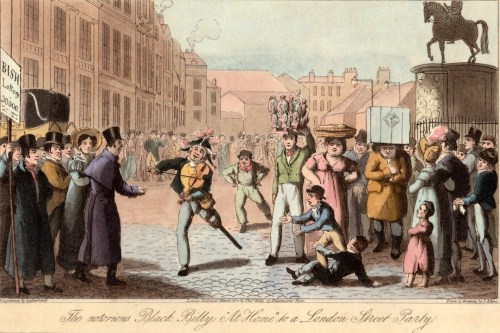
The statue was obviously a familiar landmark that enabled artists to locate their images. The 1823 print of ‘The notorious Black Billy “At Home” to a London Street Party’ (drawn by Samuel Alken, published by Thos. Kelly) shows it surrounded by lively street life. Despite being shown as white, “Black Billy” Waters (c. 1778–1823) was black and is said to have been a slave who escaped by joining the British navy and who lost a leg in a fall from the rigging. Whatever the truth, he was a popular street entertainer with his characteristic feathered hat and violin.

chas-i-black-billy

By the middle of the 19th century street life was rather more decorous and this undated Victorian engraving shows a pristine Nelson’s Column, Trafalgar Square and the National Gallery (with columns recycled from Carlton House).

chas-i-vict

Today the traffic around the statue is unrelenting, and so often jammed solid, that bus and taxi passengers have ample opportunity to study Charles in all his melancholy glory!

chas-i-pic-a

Save

Save

Save

1 Comment

Filed under Architecture, Art, Buildings, Entertainment, Monuments, Street life

The Story of a Square 3: Lincoln’s Inn Fields

lincolns-inn0001

Lincoln’s Inn Fields is the largest square in London and records exist concerning it from the 14th century when it really was a field – or rather, two – Purse Field and Cup Field. They adjoined the west wall of the grounds of Lincoln’s Inn, one of the four Inns of Court, and were the natural playground for the legal students’ ball games. The survival of this vast open space in the middle of the city, surviving Stuart property developers and massive Victorian road improvements and slum clearance, is due to an early example of NIMBYism.

In the Middle Ages, and well into the 17th century, there was nothing resembling a civilized park – the fields were leased out as pasture and, occasionally, used as places of execution. In 1586 the Babington Plot conspirators were hanged, drawn and quartered there, Catholic martyrs were burned in the 1580s and Lord Russell was beheaded in about the centre in 1683 for his involvement in the Rye House Plot.

As London expanded outwards developers began to cast an eye over such a tempting expanse of open ground and the first attempt to build a house there was in 1613. This was successfully resisted by the Society of Lincoln’s Inn – lawyers powerful enough to influence the government on the subject. It was clear that improving the open space would assist in preserving this asset, so the Society and the neighboring parishes petitioned Charles I in 1617 that “for their general Commoditie and health [the fields should be] converted into walks after the manner of Morefeildes.” The proposal appealed to the King and the Privy Council supported the scheme “as a means to frustrate the covetous and greedy endeavors of such persons as dailye seeke to fill up that small remainder of Ayre in these parts with unnecessary and unprofitable Buildings.” Resistance to developers seems to be as strong then as it it now.

Neither development nor improvement as an ordered public space happened immediately, but in the 1630s the leaseholder of the fields petitioned the King to allow the building of 32 houses. After some wrangling the permission was granted but the developer agreed that the centre of the area was  “for ever and hereafter to be open and unbuilt.” The houses were built by 1641 and the area became a fashionable place to live despite the Fields themselves being a dangerous place with fights and robberies (and the odd execution) commonplace.

In 1716 John Gay wrote  in Trivia that, despite the square being railed, it was unwise to venture in at night. The beggar that the benevolent pedestrian had given coins to during the day would turn his crutch into a weapon at night “and fell thee to the ground” and the linkboy offering to guide him through the area will lead him into the clutches of robbers and “quench the flaming brand and share the booty with the pilfering band.”

Nell Gwynne had lodgings here, and another of Charles II’s mistresses, the Duchess of Portland, had a house. Numerous aristocrats, politicians and high-ranking lawyers lived around the Fields in the 17th, 18th and 19th centuries but the person whose name is nowadays most closely associated with the square is the architect Sir John Soane. His house is now one of the most atmospheric and eccentric museums in London and is located in the middle of the north side. The print at the top of this post, from Ackermann’s Repository, shows the view from the north-west corner in 1810 and you can get more or less the same view today by standing at the point where Gate Street and Remnant Street enter the Fields. (The Remnant name reflects the fact that this was once the end of Great Queen Street before the Victorians drove Kingsway through the tangle of medieval streets to the west of the Fields.)

The tall buildings to the right of the print occupy the site of what is now the Royal College of Surgeons which contains the extraordinary Hunterian Museum, a fascinating, if gruesome place to visit for anyone interested in the history of surgery and anatomy.

Lincoln’s Inn Fields is included in Walk 7 of Walking Jane Austen’s London (an excellent stocking-filler for any history buff’s Christmas stocking!) As well as the two museums there are still a number of fine 18th century houses and the gardens themselves to enjoy – open to the public since 1894.


Save

Save

Save

2 Comments

Filed under Buildings, London Parks, Science & technology, Walks

“And Many a Frightful Face…”

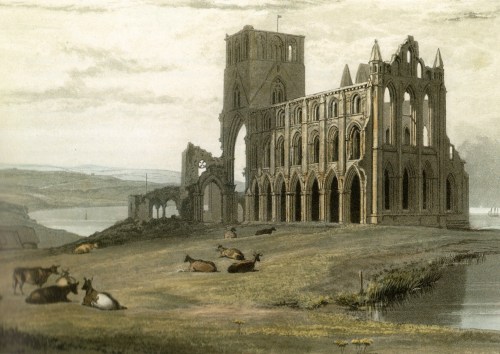
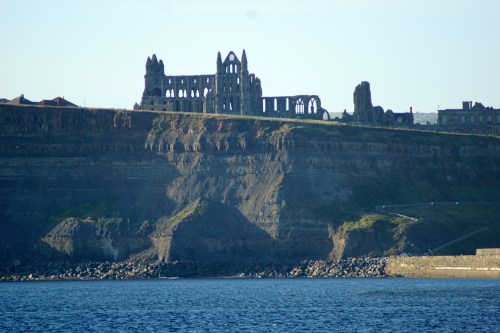
For All Hallows Eve I am writing about Whitby for its connection with Bram Stoker’s Dracula. This Gothic horror story was written in 1897, well outside my usual period, but the tale would have greatly appealed to readers of Gothic novels in the early part of the century and the ruins that inspired Stoker certainly had a spookily romantic effect on an earlier visitor.whitby-abbey-1813

Prince Hermann Ludwig Heinrich von Puckler-Muskau travelled extensively in England during his visits and left detailed diaries. In 1827 he found the little fishing town of Whitby picturesque, but dirty and “miserable”. He did admire the abbey “…now the property of some private individual…[whose] cattle feed among it mouldering walls” just as they do in William Daniell’s illustration (above) in his A Voyage Round the Coast of Great Britain…(1814).

von Puckler-Muskau visited the ruins of the abbey “..by the light of the young moon, and was enchanted by the romantic effect – lofty columns, darting up into the air like the slender trunks of pines; long rows of windows in good preservation, and many finely executed ornaments about them, still as perfect as if the wind of the first autumn now played among their ample arches. Other parts were quite altered and decayed, and many a frightful face lay scattered about, grinning at me in the moonlight.”

Perhaps it was those “frightful faces” that played on Bram Stoker’s imagination when he visited the abbey. Certainly its ruins, high on the cliff, would have been the first thing that was visible when the doomed ship bearing Count Dracula in his coffin full of Transylvanian earth sailed towards the coast. When it crashed to the shore the crew was found to be missing or dead and a great dog leapt ashore to vanish into the darkness…

Even in broad daylight the sight is impressive from the sea as I found earlier this year when I sailed into Whitby!

whitby-from-sea


Save

Save

2 Comments

Filed under Architecture, Books, Buildings

The Story of a Square 2: Berkeley Square

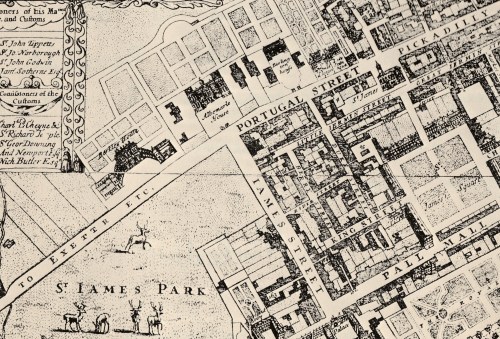
Berkeley (or Berkley as it is often spelled on early maps) Square was built on the farmland owned by John, 1st Baron Berkeley of Stratton, a Royalist military commander in the English Civil War and close friend of James, Duke of York (later James III) who did very well for himself after the restoration of Charles II . Amongst other things he was a co-founder of the Province of New Jersey. Berkeley acquired extensive farmland to the north of the Exeter Road in London, now Piccadilly, and in 1665 he had a mansion built there. Today it would occupy the block bounded by Piccadilly, Stratton Street and Berkeley Street, with its gardens (partly designed by John Evelyn) stretching northwards. In the map below of 1682 ‘Berkley House’ can be seen just above the ‘ETC’  of The Road to Exeter Etc.’ (The area marked ‘St James Park’ is now known as Green Park.)

map-1682

Evelyn records that it cost “neare 30,000 pounds” and called it a “palace”. After Lord Berkeley’s death in 1678 his widow sold off strips at the side of the grounds to create Stratton Street and Berkeley Street, much to Evelyn’s disgust. Princess (later Queen) Anne occupied the house 1692-5 during a spat with her sister Queen Mary and in 1696 it was sold to the Duke of Devonshire and renamed Devonshire House. It was rebuilt after a fire in 1734/7 and this is the house that can been seen in Horwood’s map of 1799/1819. The reservoir in Green Park mentioned in a recent post can be seen at the bottom.

map-horwood

One of the conditions of the sale was that view over the land to the north of the gardens should be unobstructed and this is one reason why, when the area was developed, that Lansdowne House is set to one side with its gardens respecting the view from the rear of Devonshire House and there was no building along the south side of Berkeley Square.

The square was laid out in 1730 with houses on the east and west sides.The east side was the first to be built and was finished about 1738 and the west side was completed in 1745. Of these houses only the western side remains intact – the 1930s saw the replacement of the eastern side and the garden wall of Lansdowne House – and the site of Mr Gunter’s famous establishment in the south-east corner is now under a branch of Prêt. The customers still take their refreshments outside to eat under the plane trees – although rather less elegantly than Mr Gunter’s patrons would have done. It was originally the shop of Dominicus Negri, an Italian pastrycook, who set up there in 1757, trading as The Pot and Pineapple.

In the centre was  an equestrian statue of George III – a not very successful effort whose legs soon collapsed. It was replaced by the little pump house with a Chinese roof which has survived. The famous plane trees are perhaps the most striking survival of the Georgian square and were planted in 1789.

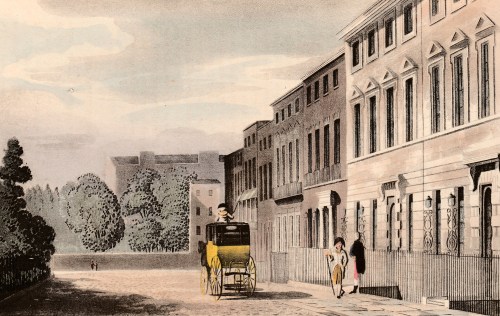
Ackermann’s Repository featured the square in September 1813 with this view which appears to be the south-west corner with the wall of Lansdowne House’s gardens in the background.

ackermann-1813

According to the text “This square is distinguished from all the others in the British metropolis by its situation on the side of a hill, which gently slopes from north to south. the houses on the north side are, upon the whole, rather mean; those which form the east and west sides, though many of them, individually, very good buildings, do not, from the want of regularity, appear altogether to such advantage as where greater attention is paid to that point, and where the site is more favourable to it… The area, which forms an oblong square, containing about three acres, is inclosed by an iron balustrade; and the inhabitants, after the example of their neighbours, have, of  late years, caused it to be planted extensively with shrubs, which have thriven very rapidly, and give a rural air to the whole.”

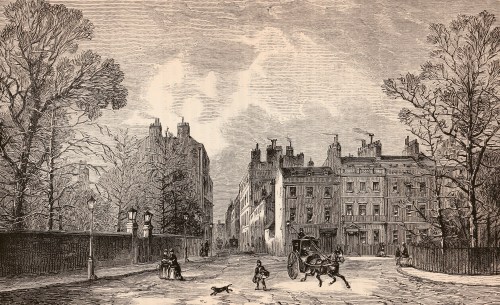
victorian

This late Victorian print shows the southern end of the square, looking west with the Lansdowne wall on the left.

Nowadays it needs some care to recapture the Georgian spirit of the square, but it can be done, especially when sitting in the shade of the plane trees and looking at the wonderful ironwork of the western side. But don’t expect to hear a nightingale singing in Berkeley Square – they probably flew off in the 1730s when the builders moved in!

You can visit Berkeley Square on the Mayfair walk in my Walking Jane Austen’s London.

Save

Save

Save

Save

1 Comment

Filed under Architecture, Buildings, High Society, Walks

The Story of a Square 1: Cavendish Square

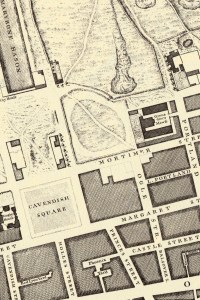
Roque Cav SqIn 1717 the 2nd Earl of Oxford, Edward Harley, began work on the development of his estates north of  “the road to Oxford” or Tyburn Road, that eventually became Oxford Street. The first element in his grand design was Cavendish Square, named for his wife Lady Henrietta Cavendish Holles. The Duke of Chandos bought the entire northern side for a mansion (described by Ackermann’s as a ‘palace’), Lord Harcourt and Lord Bingley bought sites on the east and west and the rest was sold to speculative builders. Work was interrupted by the financial crisis of the South Sea Bubble in 1720 but the Earl persisted, developing streets and Oxford Market to stimulate interest in his scheme.

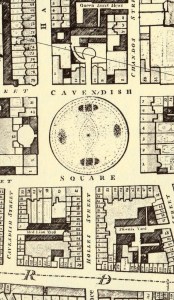
By the time of Roque’s map (1738) there was significant development on all except the North side. Marylebone Bason, a reservoir, can be seen to the north west and what is probably a gravel workings to the north east.  Oxford Street can just be seen at the bottom.Lady Mary Wortley Montagu (poet, letter writer and pioneer of smallpox vaccination) lived at number 5 1723-38.  On the western edge is the beginning of the Earl’s own house which was never completed and eventually the site changed hands and a Mr Tufnell had numbers 11-14 built there in 1771. By 1815  Cav Sq Regencythe Bason and the gravel workings to the north had completely vanished under streets and houses and the whole square had been developed as can be seen in the map to the right.

The centre of the northern side has a gap leading to the mews with a turning circle for carriages. The flanking houses still exist, virtually unchanged outwardly, although the gap between them has a link which carries a sculpture by Epstein.

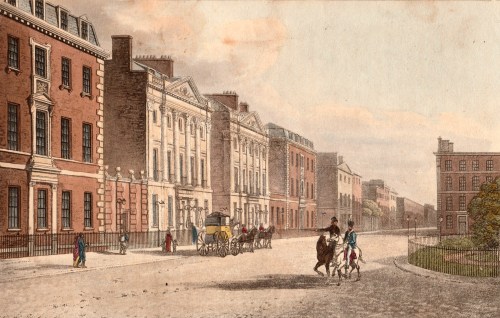
The house on the north-western corner (now no.16) was one of the wings of Chados’s intended ‘palace’. It was the home between 1761-80 of Princess Amelia, one of the daughters of George III. Amelia suffered form serious ill-health, including tuberculosis of a knee joint and the painful skin disease, St Anthony’s Fire. She spent much time at Weymouth taking sea water cures. Tragically she fell in love with Colonel Charles Fitzroy (descended from one of Charles II’s illegitimate sons). She was not permitted to marry him, but considered herself his wife and left everything to him on her death in 1810, aged 27. In the print below the house is the red brick one on the extreme left. It was ‘modernised’ in the later 19th century so the exterior looks a little different now. Lord and Lady Nelson lived in the Square in 1791 and George Romney, the painter at number 32 on the south side (1775-97).

Cavendish Square

The print of the north side is from Ackermann’s Repository, March 1813. Using Google Street View from the same spot Princess Amelia’s house is still clearly identifiable under later remodeling, a more recent house has been inserted into the space where there is a wall topped with urns and the two houses flanking the entrance to the mews look identical. The circular garden at the centre of the square is till there, but now has an underground carpark beneath it (installed 1971) and the appearance of the square is seriously compromised by the brick wall and entrance lanes of the car park.

I’ll be finding more London squares from my collection of Ackermann prints and seeing how they have changed in future posts.


Save

Save

Save

Save

Leave a comment

Filed under Architecture, Buildings, Royalty

The Earl of Wittering Goes to the Seaside Part 9: Adventures in the Bath House

bath house 4

The Earl of Wittering marshals his family after breakfast to decide on the morning’s activities. ‘Porrett has made a recce,’ he announces. (He commanded the local militia for four months and, in his imagination, is forever a soldier…) ‘The bath house is up to standard and there is the choice of taking a machine and having a dunking or using the facilities – plunge pools, shower baths, steam rooms and so forth.’

‘I would like to go in the sea,’ young Arthur announces. ‘I will search for marine life.’

‘In that case Porrett will accompany you.’

Porrett attempts to look delighted at the challenge and not like a man who has already been in the sea once that morning.

‘I will bathe too,’ says Emily casting Porrett a languishing look. ‘I am already quite over-warm.’ Quite how she proposes to get close to Porrett once in the water she has no idea, but pretending to drown might be a good start…

‘Over-warm’ is putting it mildly so far as her grandfather’s besotted secretary is concerned. The sea, he fears, will probably boil around him if she is in it too.

‘I intend sampling the warm bath,’ Lady Wittering announces. ‘You will no doubt wish to join me, Emilia,’ she adds to her daughter in law in clear command.

‘I’ll investigate the billiards room. May try a shower later,’ Viscount Ditherstone remarks. If nothing else, Porrett thinks, the wretched man will be investigating just how separate the male and female facilities are.

‘And I will go for a dunking, I suppose,’ the Earl grumbles. ‘No need for you after all, Porrett, so long as I’m with Arthur.’ Fortunately he does not see the expression on his granddaughter’s face. ‘We’ll go in fifteen minutes.’

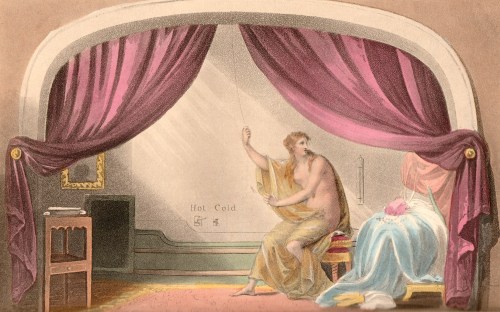
The family is completely delighted with the facilities of the bath house (except for Emily, who is still sulking). The two older ladies take themselves off to the warm baths where Lady Ditherstone, at least, imagines herself as a beauteous Roman lady about to bathe in asses’ milk –
hot baths

The bathers, Emily chaperoned by her very reluctant maid, troop downstairs to their respective bathing machines and Porrett trails after the Viscount into the billiards room. He is not going to succumb to the temptation to take one of the telescopes out onto the balcony, he tells himself as he fidgets around, glancing at the well-stocked selection of newspapers and journals while keeping half an ear cocked for the click of billiard balls.

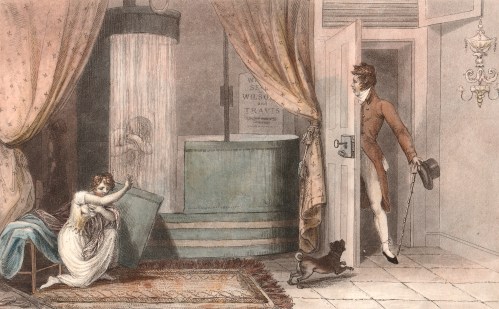
Silence, except for the snores of some elderly gentleman over by the bookshelves. Ditherstone has vanished. Porrett hastens out. Goodness knows what trouble the amorous lord is about to get himself into. No-one is visible in the vestibule but the faint click of boot heels comes from the steps under an arch labelled Ladies’ Rooms. With true valour Porrett rushes down in pursuit, just as a piercing shriek echoes up. In front of him is a door labelled Shower Bath. It is open and just visible are the tips of Lord Ditherstone’s brown tail coat. Porrett seizes them in both hands, drags backwards and yanks the door closed, finding himself embracing an armful of very irritated Viscount.
shower bath

‘Thank Heavens, my lord! You had wandered into the ladies’ section in error,’ he gasps, somewhat impeded by an aristocratic elbow in the stomach as the Viscount storms back upstairs. ‘Really,’ he adds severely to the gawping attendants as they reach the vestibule, ‘You should ensure the notices are more legible. His lordship has just been severely discommoded, as might any gentleman, especially a scholar such as his lordship with weak eyesight.’ The Viscount has occasionally been known to glance at the sporting press but that is as far as his scholarship extends.

‘Coffee and brandy,’ Ditherstone demands. ‘In the billiards room, immediately.’ Porrett follows him, fearing instant dismissal, and finds his hand taken and wrung in a painful clasp. ‘Good man, quick thinking. Two cups and glasses,’ he snaps as the waiter comes in. ‘Mr Porrett will be joining me.’ All Porrett can feel is intense relief that he will not be forced to leave the household, forced to say goodbye to Emily for ever…

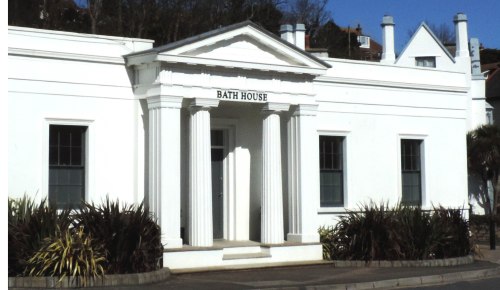
The photograph at the top of the post is of the Greek Revival-style bath house at Ilfracombe. This was a popular style intended to create a link with the Classical world and impart intellectual respectability to the pleasures of the bath. The two other images are from Poetical Sketches of Scarborough (1813).

Discover more about the Georgian bath houses – the gyms and fitness clubs of their day in The Georgian Seaside

Next time the family take some exercise on the beach.

Save

Save

Save

Save

Save

Save

Save

10 Comments

Filed under Buildings, Entertainment, Gentlemen, Medicine & health, Seaside resorts

The Real Castle of Otranto

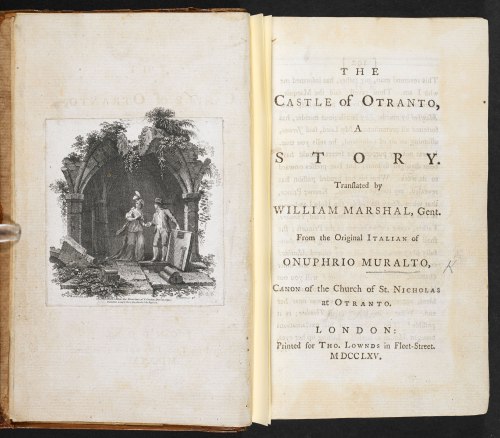
In 1764 Horace Walpole published The Castle of Otranto, A Story. Translated by William Marshal, Gent. From the Original Italian of Onuphrio Muralto, Canon of the Church of St. Nicholas at Otranto. [Image: British Library]

oTRANTO FRONT

Walpole (1717-97) was the son of Robert Walpole, recognised as Britain’s first Prime Minister, and was variously a Whig politician, a dilettante, an antiquarian and the creator of the wonderful Gothic masterpiece, Strawberry Hill, his house in Twickenham.

Walpole’s book – often considered to be the first Gothic novel – has the lot: a giant supernatural helmet that crushes a bridegroom to death, thwarted love, tragic stabbings, lustful noblemen, vengeful fathers, sword fights, ghostly happenings and much, much more. Frankly, attempting to summarise the plot is impossible but a short extract gives the flavour:

Manfred, whose spirits were inflamed, and whom Isabelle had driven from her on his urging his passion with too little reserve, did not doubt but that the inquietude she had expressed had been occasioned by her impatience to meet Theodore. Provoked by these conjectures, and enraged at her father, he hastened secretly to the great church.  Gliding softly between the aisles, and guided by an imperfect gleam of moonlight that shone faintly through the illuminated windows, he stole towards the tomb of Alfonso…

After the success of the first edition, purporting to be a translation of an ancient manuscript, Walpole came clean for the second edition and admitted to writing it. It was hugely popular, spawned an entire genre of fiction and inspired numerous stage melodramas.

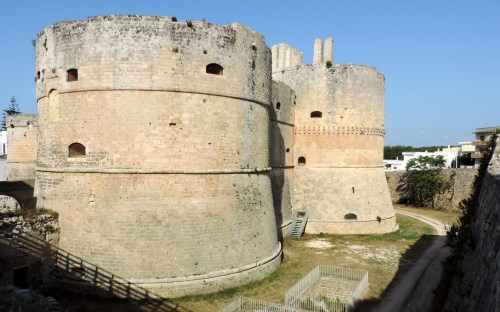
I was recently on a small ship cruise in the Mediterranean in the footsteps of Edward Lear and found myself in the Italian port of Otranto. Obviously the priority was to seek out the castle. I had visions of gothic towers, creepy turrets, gloomy dungeons, gargoyles… Actually, it is nothing like that at all, which was rather a disappointment.Otranto

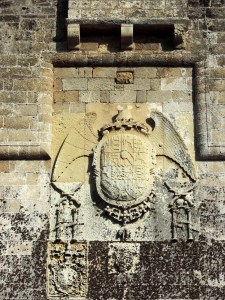
It is known as The Castello Aragonese, was rebuilt by Alphonso II of Naples in 1485–98 and is an aggressively militaristic edifice with not a gargoyle in sight. Over the entrance is the coat of arms of the Holy Roman Emperor Charles V (1500-58) who owned southern Italy when it was part of the Kingdom of Aragon.

Otranto arms

An impressive castle – but not, I fear, the house of horrors of Walpole’s imagination, unless one pictures the huge coat of arms taking off on those strange wings behind it and crashing down on some unfortunate bridegroom…

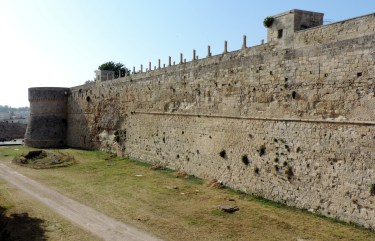
Napoleon stationed naval ships  in Otranto harbour from 1804 and in 1808 created the hereditary title Duc d’Otrante for his Minister of Police Joseph Fouché when the town became duché grand-fief in the satellite Kingdom of Naples. The dukes now live in Sweden and the title is still extant, apparently without any gothic nightmares to haunt the family.Otranto moat

Save

Save

Save

Save

Save
2 Comments

Filed under Architecture, Books, Buildings, Literature, Napoleon

The Earl of Wittering Goes to the Seaside: Part Six The Ladies (and Porrett) Visit the Library

It is raining today, the second of the Gatwick family’s stay in Weymouth, so Lady Ditherstone abandons her father in law and husband to their news sheets, deals firmly with her daughter Emily’s pleas that taking to the ocean in the rain can hardly make you any wetter than you will be already, and carries off her mother in law the Countess of Wittering, Emily and young Arthur to visit the subscription library.

library

‘You have researched the available libraries I trust, Mr Porrett?’ She is inclined to rather like the Earl’s secretary, such a thoroughly nice, intelligent young man and really, once he takes off those wire-rimmed spectacles, quite good-looking. Intelligent, good-looking men are in short supply in the Gatwick household, although young Arthur certainly has a keen interest in natural philosophy.

‘Certainly, Lady Ditherstone. There are several, but most are not of a standard that would suit you, I fear. However there is one excellent one. As The Guide to All the Watering and Sea-Bathing Places remarks, those who frequent a good circulating library rather than a ballroom “frequently enjoy the most rational and the most permanent pleasure.” ‘ He regrets the quote as soon as he makes it, for Miss Emily fixes him with a look that is anything but kindly. So far as she is concerned nothing, but nothing, can exceed the pleasures of the ballroom.

‘Mr Porrett can come with us and carry our books as he is so fond of libraries,’ she says pertly. ‘And the umbrellas.’

Porrett, no fool, even if he is blinded by hopeless love, enlists the umbrella-wielding support of two footmen leaving himself to shelter Miss Emily. He employs the walk to the library with regaining her good graces. ‘They have all the latest fashion journals,’ he assures her. ‘And the latest novels.’ From ahead he can hear young Arthur stating that he needs a book on rocks and something on seaweed as he intends to collect both. Porrett is not certain, but he thinks the Viscountess gives the slightest, most well-bred, shudder. ‘And there is a section selling toys (he means novelties and small frivolities for adults, of course) – all the finest fans and reticules and so forth and souvenirs.’

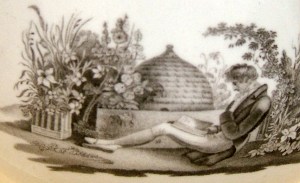
Pic105Emily gives him a beaming smile, much restored by thoughts of shopping, as they reach the circulating library. Porrett, having established that the monthly subscription is eight shillings, deals with the business side, taking out a subscription for both senior ladies. He also subscribes for himself, for he has a secret penchant for poetry and intends to take a slim volume off to the garden where he can brood on his heartache in peace. (Above, the artist of a Regency ‘bat print’ bowl has caught Porrett immersed in his poetry next to a beehive.)
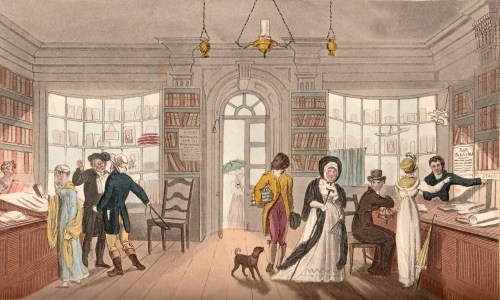
The library they find themselves in very like the one shown at the top of the post (Illustration of 1813 by Rowlandson). Note the shelf of New Arrivals on the right and the two gentlemen in energetic dispute over a political pamphlet on the left. A horn sprouting writing quills hangs in the right-hand window and a poster advertises a new book on Westminster and Its Monuments. The younger ladies shown are all in the height of fashion whereas the older lady with her little dog, long stick and black footman in attendance wisely chooses rather wider skirts and a lower waistline. Note the parasol propped up against the counter – it has the handle at what, today, is the wrong end. This persisted until about 1815 when the point where a parasol or umbrella was held when not in use shifted ends.

This evening the family attends the Assembly Rooms for an evening of dancing and cards. Porrett is thrilled to have been invited to accompany them, but somehow this afternoon, he is going to have to purchase a new pair of black silk stockings. Dare he risk ones with a stripe? What are the shops likely to be like? Find out more in   The Georgian Seaside: the English resorts before the railways came.


4 Comments

Filed under Books, Buildings, Entertainment, Fashions, High Society, Seaside resorts, Shopping