Category Archives: Entertainment

The Earl of Wittering Goes to the Seaside: Part 11 Porrett Saves the Day!

The Georgian SeasideThe Earl of Wittering, his wife, son and daughter in law and grandchildren are all at the theatre, accompanied reluctantly, by Porrett the Earl’s secretary who is in the throes of a violent, whispered quarrel with his granddaughter, Emily.

‘I love you, Frederick!’ says Emily, her declaration covered in the shrieks from the stage where the melodrama put on by the touring company is reaching its climax with bodies strewn in all directions.
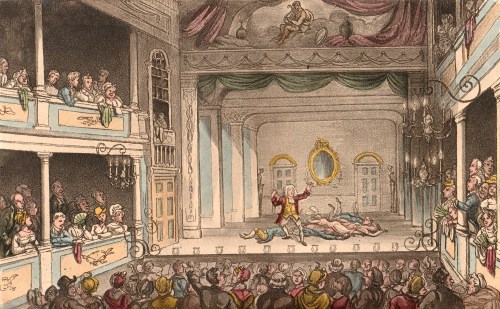
theatre

‘You cannot,’ he whispers miserably. ‘Look at the play – it was a wild success in Chichester.’

‘I don’t care if that is Mrs Siddons out there,’ Emily snaps. ‘Do you mean you do not love me?’

Poor Porrett – to do the honourable thing is to lie. ‘Of course I love you,’ he admits miserably. He cannot lie to his beloved even though, as a gentleman, he should. ‘And it can never be. Your grandfather is the Earl, my employer…’

‘Do not be so feeble,’ Emily says, almost in tears. ‘Tell them all how you feel, ask for my hand!’

‘No,’ says Porrett, resolute in his anguish. ‘I cannot.’ The villain stabs the hero on stage and then falls on his own sword. Porrett knows how he feels. ‘You deserve better.’

Emily makes a sound like a furious kitten and turns her shoulder to him. In the interval her father, the Viscount Ditherstone, announces his intention of taking out a pleasure boat and having a family picnic further along the coast.

‘The fishermen expect high winds tomorrow, my lord,’ Porrett, points out. ‘It might be safer to leave it for another day.’

‘Oh, don’t be such a coward,’ says Emily, nose (somewhat pink) in the air. ‘Papa knows all about sailing, don’t you Papa?’

The Viscount, who has spent two days being seasick on a friend’s yacht ten years ago, smirks ‘No need, for you to concern yourself, Porrett. My father will want you to do some work, I’ll be bound. You needn’t be nervous about getting your feet wet.’

Porrett is still smarting from Emily’s disdain the next morning and indeed, the weather looks set fair as everyone except himself and the Earl set out with picnic hampers to hire a small sailing boat. His last-minute plea to Emily to stay behind was met with a reproachful look and a muttered accusation of not having the courage to stand up to Papa for her sake.

But by midday, as he looks out of the window yet again instead of taking the Earl’s dictation , he sees the black clouds boiling up from the west. The wind is beginning to snap the flags along the promenade. ‘My lord, I have the gravest apprehension about the safety of the sailing party. I should hire a boat and go after them.’

The two men run to the harbour and Porrett hails a pair of fishermen who are just tying up. At first they refuse to take him out, but the sight of the banknotes the Earl is brandishing changes their mind. With Porrett clinging grimly to the mast they set sail. By the time they reach the stretch of coast the Viscount intended to land at for the picnic they see no sign of the boat – but then Porrett spots a slim figure on the shore waving a handkerchief. Emily! And, ‘There’s the boat, sir!’ cries a fisherman and, sure enough, mastless, the little sailing boat with a green-faced Viscount clinging to the thwarts, is just before them. They grapple it and haul him aboard – when he attempted to take the party off again in the face of the rising wind, he was washed out to sea, the mast snapped and the ladies and young Arthur were left stranded on the beach, trapped between the cliffs and the rising tide.shore
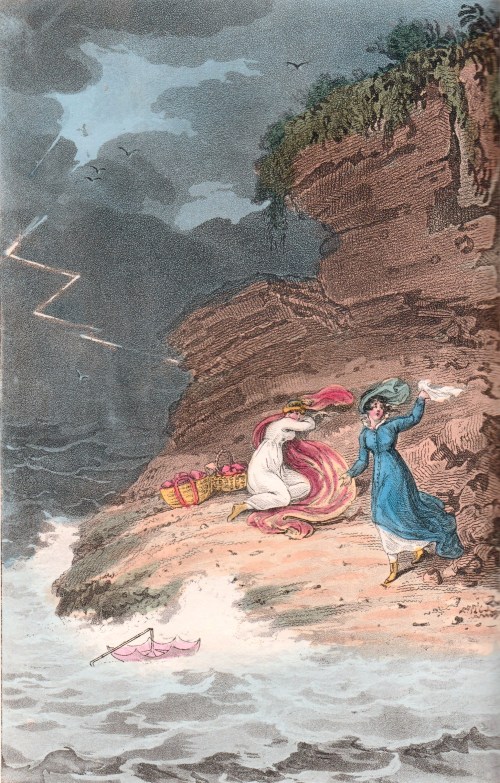
Porrett does not hesitate, he leaps into the fishing smack’s rowing boat, casts off and rows for shore. It is rough, dangerous and he is exhausted, but he makes it to land, runs onto the beach, helps the Viscountess and young  Arthur in, then takes Emily in his arms, kisses her passionately and wades into the sea to set her gently into the little craft. He feels he could swim back, he is so elated, but he rows back to the smack and is disconcerted when the Viscountess throws her arms around his neck and kisses him, declaring that he is their saviour, their Galahad, their knight in shining armour. Emily just sits and gazes at him with tears in her eyes. When they reach the jetty the Earl, with a look on his face that promises retribution later for his feckless son and heir, hurries his womenfolk and grandson back to the lodgings. Porrett is left to trudge, wet and exhausted, behind.

He is disconcerted to discover a note commanding him to attend the ball at the Assembly Rooms that evening, wishing instead that he could just put his feet up and nurse his broken heart in decent privacy. But an order is an order. He comes down to join the family in the drawing room and, to his amazement, the Earl embraces him warmly, hails him as a hero and announces that he has secured him an influential post in the Home Office. ‘You’ll need it to keep my little Emily in the manner to which she has become accustomed,’ he announces. ‘I’ve had my eye on the pair of you and you, young Porrett, have the makings of a great man about you. More than my clodpole of a son,’ he murmurs in the stunned secretary’s ear. ‘Well, get on and ask her, don’t stand there like a looby.’

So Porrett finds his voice and, in front of the entire family, goes down on one knee and begs Emily for the honour of her hand in marriage. And Emily, throws her arms around him the moment he stands up (almost knocking him flat), bursts into tears and declares that no-one was ever such a hero as he is.

So off they go to the ball. You can see them just slipping off to the terrace (which leads to the gardens) in the far left of the picture. Sometimes Porrett is not quite such a saint as the Earl believes him to be…
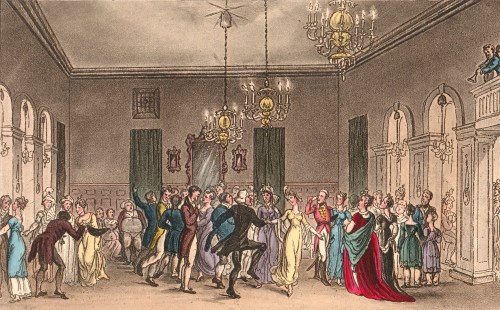
ballroom

Pleasure boats were an essential part of the Georgian seaside holiday, but accidents were not at all uncommon, including one Margate party who were tossed around at sea for more than 24 hours before being rescued – no mobile phones, no life jackets…

You can find out more about the perils of the seaside, the Assembly Rooms, the theatres and their travelling companies of players, or, in fact any aspect of the life of the coastal resorts before the railways came in The Georgian Seaside.
 

Save

Save

Save

Save

Save

Save

Save

Save

7 Comments

Filed under Accidents & emergencies, courtship & marriage, Dance, Entertainment, High Society, Love and Marriage, Seaside resorts

The Earl of Wittering Goes to the Seaside Part 10: A Walk on the Beach

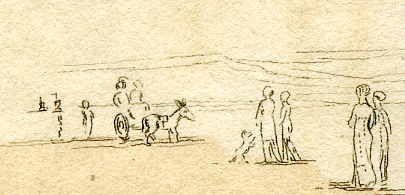
The broad sweep of sand was one of the factors that had decided Porrett in his selection of Weymouth for the Earl’s seaside visit. Now he finds himself delighted with his choice as the Countess and her daughter in law drive off in one of the charming little donkey carts for hire, their husbands stride along the seashore, young Arthur rummages happily amongst the seashells on the tide line and he is left to escort Miss Gatwick – Emily.

beach scene

She clings to his arm and laughs as they pass small children happily building sandcastles. ‘Mama would never have let me do that when I was small.’

‘The followers of Rousseau believe that childish play is healthy,’ Porrett observes, wondering why he has to sound so incredibly pompous when he speaks to Emily. ‘And here on the beach there is so much more room than at the inland spas. Children can play without disturbing anyone else.’

So can adults,’ Emily says as her mother and grandmother pass them in their donkey cart, Mama holding onto her hat and laughing. ‘Oh, do look at that very fetching bathing dress.’

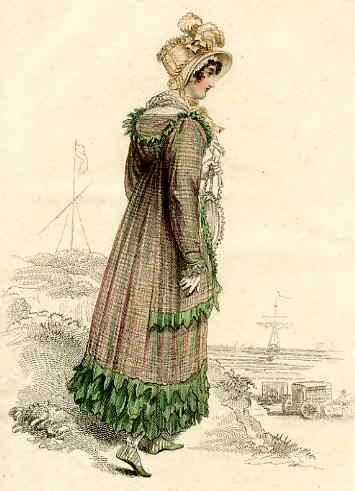
She points to a lady wearing (to Porrett’s vast relief) a costume designed for the walk to a bathing machine rather than the actual costume for immersion itself. He is still finding the somewhat casual approach to ladies’ dress embarrassing.  ‘I assume it is supposed to be trimmed with seaweed,’ he says dubiously, hoping that Emily will not want to wear something so outlandish. (The example shown here is from La Belle Assemblee for 1809. In her hand she is holding the bag for her Bathing Preserver, the costume she will actually wear in the water, an invention of Mrs Bell, the modiste who was also responsible for this subtle little number.).

1809 Bathing dress‘Such a pity green does not suit me.’ They wander on a little, Porrett tongue-tied with love, Emily uncharacteristically silent. Finally she blurts out, ‘You went swimming this morning.’

‘Er, yes. I felt I should check the facilities.’

‘I saw you. From the window.’ She pauses and gulps audibly. ‘With Papa’s telescope.’

Porrett feels the blood drain from his face and tries very hard not to think about where it is heading. Emily had been watching him swimming. Him swimming naked. With a telescope. ‘Miss Gatwick…’

‘Emily, please, Frederick. You looked magnificent rising from the waves. Like a sea god,’ she adds breathlessly.

Porrett has no illusions about his personal charms. He is rather less than six foot tall, has sandy hair,  takes strenuous exercise to prevent a stoop as a result of so much desk work and has to wear wire-rimmed spectacles for documents in small print. If Emily thinks he looks like a god then either she is seriously ill and hallucinating or she… she…

1816 Costumes Parisien‘We cannot,’ he mumbles with nothing like his normal fluency. ‘You are the granddaughter of an earl. I am…’
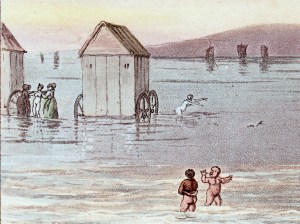
‘The third son of a bishop and the second cousin of a duke,’ Emily says just as there is a shriek and a lady is hauled spluttering to the surface by two burly female dippers.

Porrett closes his eyes in dismay – this lady has gone in without her flannel ‘case’ – then opens them again with a yelp when Emily digs her elbow into his ribs in a most unlover-like manner. ‘Oh, Papa,’ she says. ‘Do go and distract him before he causes a riot.’ And, of course, the Viscount is on the waterline gawping. Porrett, ready to tackle dragons to save Emily the slightest embarrassment, strides off to deal with her father. Yet again. Dipping crop

Find out more about the many attractions of a walk on the beach and the changing attitudes to children’s play in The Georgian Seaside.

Next time – a rift between the lovers puts Emily’s life in danger. Can Porrett save the day and win her hand? Find out in the concluding episode.

Save

Save

5 Comments

Filed under Entertainment, Fashions, Seaside resorts

1814 – the Summer of Celebrations

The summer of 1814 – and London is en fete to celebrate not only the victory over Napoleon but also the anniversary of Hanoverian rule. For three months Londoners had the opportunity to view, and enjoy, some of the most lavish celebrations the capital has ever seen.

Ack transp

On April 20 there was a triumphal procession for Louis XVII from Hyde Park to Grillon’s Hotel in Albemarle Street where he was staying with his entourage. On June 7 the Russian Czar Alexander I, King William III of Prussia, Marshal Blucher, Prince Metternich, the Prince of Liechtenstein, and Prince Leopold arrived in London and on June 11 the Prince Regent entertained all the Allied Leaders at the opera at Covent Garden. On June 16 they were the guests at a dinner held by the merchants and bankers of London in the City and on June 18 the Prince Regent, Marquess of Wellesley, Lord Liverpool, Marshal Blucher, Prince Metternich, Czar Alexander I, and Catherine Grand Duchess of Oldenburg were guests of honour at a dinner given by the Corporation of London.

On June 20, hopefully having had the opportunity for a rest and some digestion, the Prince Regent, the Duke of York, the King of Prussia, the Czar and  Generals Blucher, Lord Beresford and Hill reviewed 12,000 troops in Hyde Park. At 8pm that evening a re-enactment of the battle of Trafalgar was held in the park on the Serpentine with model ships three feet long (one metre) were deployed to recreate the main events of the battle. At the climax the French ships were sunk as the National Anthem was played.

The evening was staged as a popular entertainment and the park was transformed with stalls, arcades, and follies and pavilions. There were refreshments, taverns and fruit stalls and the crowd could listen to military bands as they watched acrobats or enjoyed the swings and roundabouts.

On June 22 the Allied Sovereigns watched a naval review at Portsmouth before leaving for the continent, but in London the celebrations were by no means over.

On June 28 Wellington was formally welcomed at Buckingham House by the Queen, and on July 1 a great ball was held in the Duke’s honour at Burlington House by White’s Club. It cost £10,000 and amongst the 1,700 guests was Jane Austen’s brother Henry. She was thrilled. On July 7 there was a Service of General Thanksgiving for the victory at St Paul’s Cathedral with Wellington carrying the Sword of State alongside the Regent and as a further sign of his pleasure the Regent held a fete in the gardens of Carlton House to honour the Duke on July 21.

Pagoda

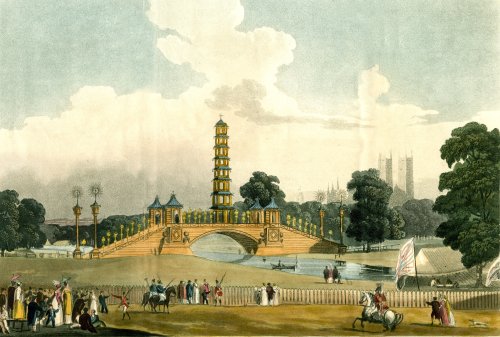
August 1,1814 was the hundredth anniversary of the accession of George I of Hanover to the British throne. The Battle of the Nile was represented by rowing boats on the canal in St James’s Park which was crossed by a new ‘Chinese’ bridge with, in the centre, a seven-storey pagoda. According to Ackermann’s Repository “It appeared a blazing edifice of golden fire, every part being covered in lamps, and glass reflectors at proper intervals relieving the splendour with their silver lustre.” At the height of the fireworks the pagoda caught fire and two men and a number of swans perished, but the crowd thought it was part of the celebrations and cheered wildly.

Meanwhile in Green Park a castle-like structure was built. After firework display that lasted, according to Ackermann’s, “for more than two hours, a discharge of cannon enveloped the whole building in smoke so dense, that no part of it was visible to the innumerable spectators assembled…but when this obstruction cleared away, it burst upon them, metamorphosed into the Temple of Concord, most brilliantly illuminated… and revolving upon its centre.”

Concord

Many shops and businesses also rose to the patriotic occasion and decorated their premises. Ackermann’s Repository at 101, Strand, was decorated by a ‘transparency’ almost 30 feet (10 metres) high and “brilliantly illuminated” from the back “with carbonic gas.”. The lower section shows the seven Christian and Cardinal Virtues with the Royal arms above and the standards of the Allied nations. The upper part is the Temple of Peace with the word REGENT above and all crowned with the Prince of Wales’s feathers. It is shown at the head of this post.

You can  enjoy these two historic parks by taking Walks 4 and 6 in Walking Jane Austen’s London.


Save

4 Comments

Filed under Architecture, Entertainment, London Parks, Prince Regent, Royalty, St James's Park, Wellington

The Earl of Wittering Goes to the Seaside Part 9: Adventures in the Bath House

bath house 4

The Earl of Wittering marshals his family after breakfast to decide on the morning’s activities. ‘Porrett has made a recce,’ he announces. (He commanded the local militia for four months and, in his imagination, is forever a soldier…) ‘The bath house is up to standard and there is the choice of taking a machine and having a dunking or using the facilities – plunge pools, shower baths, steam rooms and so forth.’

‘I would like to go in the sea,’ young Arthur announces. ‘I will search for marine life.’

‘In that case Porrett will accompany you.’

Porrett attempts to look delighted at the challenge and not like a man who has already been in the sea once that morning.

‘I will bathe too,’ says Emily casting Porrett a languishing look. ‘I am already quite over-warm.’ Quite how she proposes to get close to Porrett once in the water she has no idea, but pretending to drown might be a good start…

‘Over-warm’ is putting it mildly so far as her grandfather’s besotted secretary is concerned. The sea, he fears, will probably boil around him if she is in it too.

‘I intend sampling the warm bath,’ Lady Wittering announces. ‘You will no doubt wish to join me, Emilia,’ she adds to her daughter in law in clear command.

‘I’ll investigate the billiards room. May try a shower later,’ Viscount Ditherstone remarks. If nothing else, Porrett thinks, the wretched man will be investigating just how separate the male and female facilities are.

‘And I will go for a dunking, I suppose,’ the Earl grumbles. ‘No need for you after all, Porrett, so long as I’m with Arthur.’ Fortunately he does not see the expression on his granddaughter’s face. ‘We’ll go in fifteen minutes.’

The family is completely delighted with the facilities of the bath house (except for Emily, who is still sulking). The two older ladies take themselves off to the warm baths where Lady Ditherstone, at least, imagines herself as a beauteous Roman lady about to bathe in asses’ milk –

hot baths

The bathers, Emily chaperoned by her very reluctant maid, troop downstairs to their respective bathing machines and Porrett trails after the Viscount into the billiards room. He is not going to succumb to the temptation to take one of the telescopes out onto the balcony, he tells himself as he fidgets around, glancing at the well-stocked selection of newspapers and journals while keeping half an ear cocked for the click of billiard balls.

Silence, except for the snores of some elderly gentleman over by the bookshelves. Ditherstone has vanished. Porrett hastens out. Goodness knows what trouble the amorous lord is about to get himself into. No-one is visible in the vestibule but the faint click of boot heels comes from the steps under an arch labelled Ladies’ Rooms. With true valour Porrett rushes down in pursuit, just as a piercing shriek echoes up. In front of him is a door labelled Shower Bath. It is open and just visible are the tips of Lord Ditherstone’s brown tail coat. Porrett seizes them in both hands, drags backwards and yanks the door closed, finding himself embracing an armful of very irritated Viscount.

shower bath

‘Thank Heavens, my lord! You had wandered into the ladies’ section in error,’ he gasps, somewhat impeded by an aristocratic elbow in the stomach as the Viscount storms back upstairs. ‘Really,’ he adds severely to the gawping attendants as they reach the vestibule, ‘You should ensure the notices are more legible. His lordship has just been severely discommoded, as might any gentleman, especially a scholar such as his lordship with weak eyesight.’ The Viscount has occasionally been known to glance at the sporting press but that is as far as his scholarship extends.

‘Coffee and brandy,’ Ditherstone demands. ‘In the billiards room, immediately.’ Porrett follows him, fearing instant dismissal, and finds his hand taken and wrung in a painful clasp. ‘Good man, quick thinking. Two cups and glasses,’ he snaps as the waiter comes in. ‘Mr Porrett will be joining me.’ All Porrett can feel is intense relief that he will not be forced to leave the household, forced to say goodbye to Emily for ever…

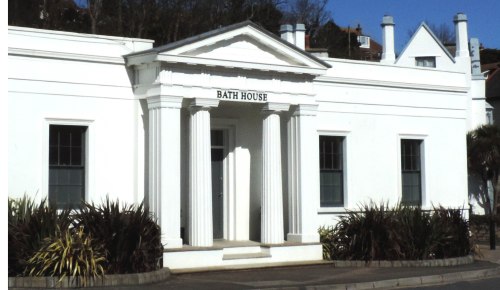
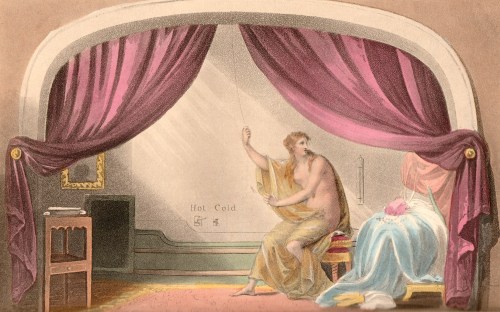
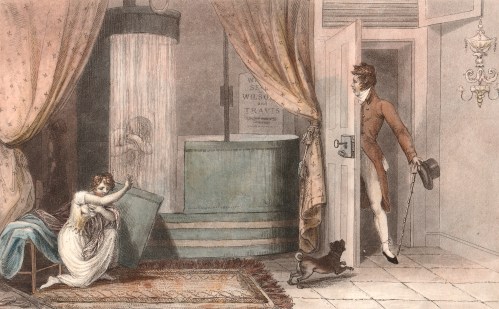
The photograph at the top of the post is of the Greek Revival-style bath house at Ilfracombe. This was a popular style intended to create a link with the Classical world and impart intellectual respectability to the pleasures of the bath. The two other images are from Poetical Sketches of Scarborough (1813).

Discover more about the Georgian bath houses – the gyms and fitness clubs of their day in The Georgian Seaside

Next time the family take some exercise on the beach.

Save

Save

Save

Save

Save

Save

Save

10 Comments

Filed under Buildings, Entertainment, Gentlemen, Medicine & health, Seaside resorts

Catching a Cawchery in a Slap-Ang Shop – Eating In the Regency Underworld

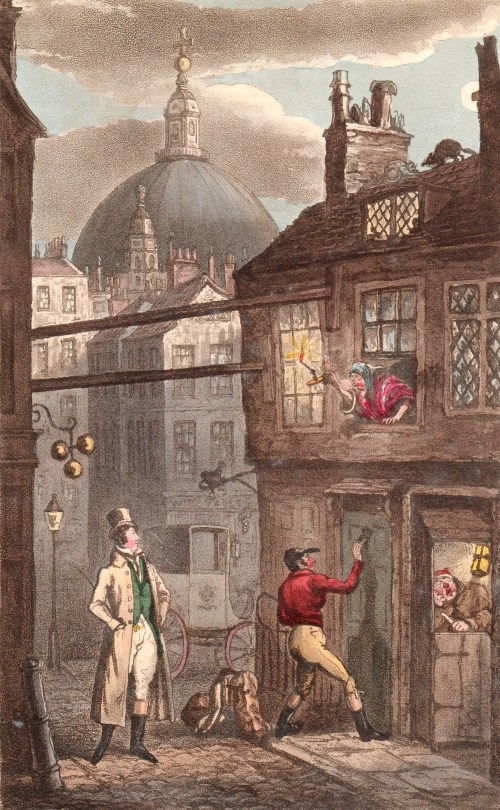
lodgingsYou are slumming it in Regency London – perhaps you’re in cheap lodgings avoiding your creditors, or dodging a furious father armed with a shotgun or your gambling habit has got the better of you and you are seriously out of pocket. You have found your cheap lodgings – a miserable, unheated room that you share with bedbugs, fleas, mice and the other inhabitants of your straw pallet – now you need to find something to eat. [The print above is of Logic’s lodgings in one of the Tom & Jerry tales by Pierce Egan. Note the dome of St Paul’s behind and the pawnbroker’s shop with its three gold balls on the left.]
A respectable eating house with a decent daily ordinary might be within your means, otherwise you’ll be looking for a grubbery and, in this kind of area, it is probably a hand-in-pocket shop where ready money is expected and no credit is given or even a slam-bang or slap-ang shop, the lowest form of cook shop. Even if you are clammed, sharp-set or positively gutfoundered, you’ll still be hoping that it isn’t run by a cook ruffian, a really bad cook who’ll beat all to a todge, or unrecognisable mess.

If all you can afford is buster and beeswax or bread and cheese, it will taste better if it has been toasted to make a Welsh rabbit or, failing the cheese, you may have to make do with a scratch platter or tailor’s ragout of bread and sliced cucumbers slopped in vinegar.

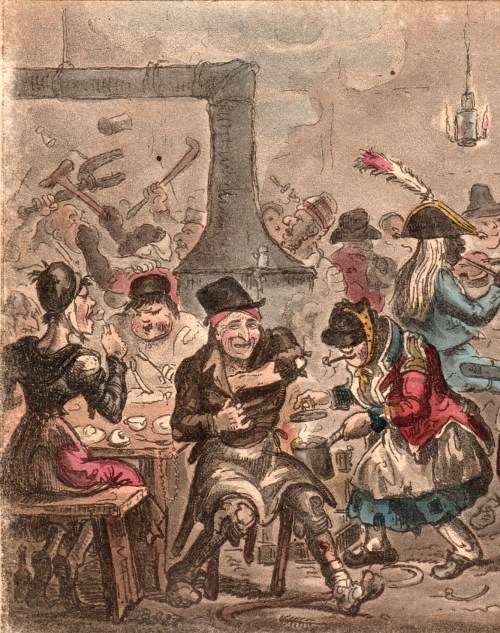
If there’s a smell of cooking meat the chances are it will be a sheep’s head  – baked to make a Bloody Jemmy or Field Lane Duck or boiled with onions which makes a German Duck. But that might be too expensive so you settle for a galimaufry, a hodge-podge of leftovers or a cawchery, a stew (best not to investigate the ingredients). If you are lucky it might be padded out with some naked boys – rather lumpy dumplings. Below is a detail from “Tom and Jerry Masquerading Among the Cadgers in the Back Slum in the Holy Land” with the diners tucking into their food next to the stove while a riot breaks out in the background.

slum eating

Just when it all seems hopeless and you are contemplating a diet of flummery – oatmeal and water boiled to a jelly – one of your friends turns up with a loan and you can foul a plate and polish a bone with them and treat yourselves to an alderman – a fine roast turkey with a garland of sausages in place of the alderman’s chain of office.

As for what you’ll drink with your alderman, that’s another story – but the chances are you’ll be washing it down with a tankard or two of heavy wet.

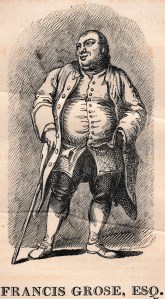
GroseFrancis Grose toured the back-slums and the rookeries of London in the 1780s collecting cant and slang terms for his Dictionary of the Vulgar Tongue,  assisted (or possibly supported) by his servant Batch. Judging by his portrait Grose had sampled plenty of naked boys, aldermen and Bloody Jemmys himself. He inspired a number of imitators (and downright plagiarists) but all these late Georgian slang dictionaries are arranged in alphabetical order of the terms defined.  Regency Slang Revealed  takes four of them and organises them thematically, with an index – the perfect guide for the explorer of the Regency underworld. Regency Slang Revealed Cover MEDIUM WEB

Save

Save

Save

Save

Save

Save

Save

1 Comment

Filed under Books, Entertainment, Food & drink, Street life

The Earl of Wittering Goes to the Seaside: Part Six The Ladies (and Porrett) Visit the Library

It is raining today, the second of the Gatwick family’s stay in Weymouth, so Lady Ditherstone abandons her father in law and husband to their news sheets, deals firmly with her daughter Emily’s pleas that taking to the ocean in the rain can hardly make you any wetter than you will be already, and carries off her mother in law the Countess of Wittering, Emily and young Arthur to visit the subscription library.

library

‘You have researched the available libraries I trust, Mr Porrett?’ She is inclined to rather like the Earl’s secretary, such a thoroughly nice, intelligent young man and really, once he takes off those wire-rimmed spectacles, quite good-looking. Intelligent, good-looking men are in short supply in the Gatwick household, although young Arthur certainly has a keen interest in natural philosophy.

‘Certainly, Lady Ditherstone. There are several, but most are not of a standard that would suit you, I fear. However there is one excellent one. As The Guide to All the Watering and Sea-Bathing Places remarks, those who frequent a good circulating library rather than a ballroom “frequently enjoy the most rational and the most permanent pleasure.” ‘ He regrets the quote as soon as he makes it, for Miss Emily fixes him with a look that is anything but kindly. So far as she is concerned nothing, but nothing, can exceed the pleasures of the ballroom.

‘Mr Porrett can come with us and carry our books as he is so fond of libraries,’ she says pertly. ‘And the umbrellas.’

Porrett, no fool, even if he is blinded by hopeless love, enlists the umbrella-wielding support of two footmen leaving himself to shelter Miss Emily. He employs the walk to the library with regaining her good graces. ‘They have all the latest fashion journals,’ he assures her. ‘And the latest novels.’ From ahead he can hear young Arthur stating that he needs a book on rocks and something on seaweed as he intends to collect both. Porrett is not certain, but he thinks the Viscountess gives the slightest, most well-bred, shudder. ‘And there is a section selling toys (he means novelties and small frivolities for adults, of course) – all the finest fans and reticules and so forth and souvenirs.’

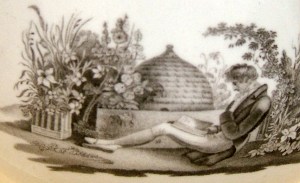
Pic105Emily gives him a beaming smile, much restored by thoughts of shopping, as they reach the circulating library. Porrett, having established that the monthly subscription is eight shillings, deals with the business side, taking out a subscription for both senior ladies. He also subscribes for himself, for he has a secret penchant for poetry and intends to take a slim volume off to the garden where he can brood on his heartache in peace. (Above, the artist of a Regency ‘bat print’ bowl has caught Porrett immersed in his poetry next to a beehive.)
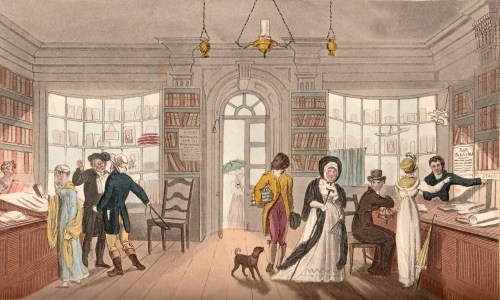
The library they find themselves in very like the one shown at the top of the post (Illustration of 1813 by Rowlandson). Note the shelf of New Arrivals on the right and the two gentlemen in energetic dispute over a political pamphlet on the left. A horn sprouting writing quills hangs in the right-hand window and a poster advertises a new book on Westminster and Its Monuments. The younger ladies shown are all in the height of fashion whereas the older lady with her little dog, long stick and black footman in attendance wisely chooses rather wider skirts and a lower waistline. Note the parasol propped up against the counter – it has the handle at what, today, is the wrong end. This persisted until about 1815 when the point where a parasol or umbrella was held when not in use shifted ends.

This evening the family attends the Assembly Rooms for an evening of dancing and cards. Porrett is thrilled to have been invited to accompany them, but somehow this afternoon, he is going to have to purchase a new pair of black silk stockings. Dare he risk ones with a stripe? What are the shops likely to be like? Find out more in   The Georgian Seaside: the English resorts before the railways came.


4 Comments

Filed under Books, Buildings, Entertainment, Fashions, High Society, Seaside resorts, Shopping

The Earl of Wittering Goes to the Seaside: Part Five The First Day

The Gatwick family are up early this first morning in their rented house on the Esplanade in Weymouth, even the Earl who has been parted from Gaston his chef and his breakfasts for three days, so is eager to get back to his devilled kidneys.

Lady Wittering relies on Porrett, the Earl’s secretary to have researched what the procedure is this first day. ‘But I want to go in the sea,’ complains Emily, making Porrett feel slightly faint – then seriously overheated – for a moment.

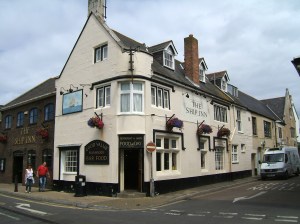
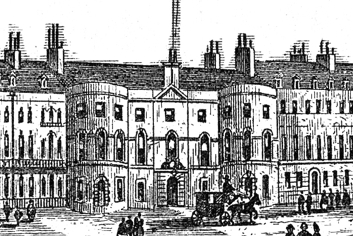
‘It would be advisable for the family to inscribe your names in the Master of Ceremonies’ book at the Assembly Rooms,’ Porrett explains when he has recovered from the mental image of Emily in the sea, breasting the waves… Oh goodness, now he needs a cold dip. ‘He will then call and inform the ladies of all the events planned for the next few weeks, ensure he knows your preferences, offer to perform any introductions you might wish and recommend suitable shops. I would suggest that after the Rooms that the ladies might like to inspect the libraries and see which they wish to subscribe to and call at the bath houses to decide which will have their patronage and view the various facilities available.’ Weymouth had gone through a number of Assembly Rooms and the new ones were at the Royal Hotel, only a few steps away from their lodgings. [The first Assembly Rooms were at the Ship Inn, below and the ones that the Gatwicks would patronise are below that to the right. ]

Pic165

Weymouth ass rooms

‘Facilities?’ Emily turns her large brown eyes on Porrett. ‘I thought it was just bathing machines for hire?’

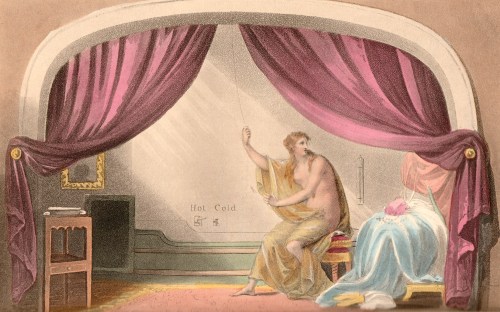
‘Oh no, Miss Gatwick. Shower baths, hot and cold seawater baths, steam rooms…’ Porrett’s brain begins to steam up giving him a vivid picture of Emily in the Warm Bath. He can’t cope with the thought of the Hot Bath… [Image from Political Sketches of Scarborough]


hot baths

‘Will you be accompanying us, Wittering? Ditherstone?’ The Countess studies her husband and son, both of whom have the air of men who would much rather take themselves off into town to locate the best library for the sporting papers, make enquiries about the prospects for some shooting, billiards and cards and generally avoid having to be grovelled to by the Master of Ceremonies.

‘I think not, my dear. I must go to the bank for one thing,’ Witttering emerges from his newspaper, obviously delighted to have found such an unexceptional excuse.

‘So must I,’ his son adds hastily. ‘Why not take Porrett to squire you about?’

Pic172‘I would be honoured, my lady. And, as it is such a pleasant day, perhaps you would care for a stroll along the main shopping streets?’ asks Porrett, in a seventh heaven. ‘I believe that Master Arthur has forgotten his hammer for extracting rock samples, so that could be purchased.’
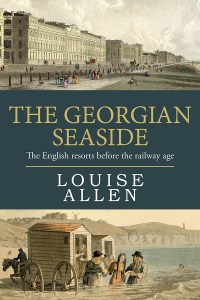
‘Very well. Almira, Emily, Arthur, we will meet in the drawing room in one hour.’

Porrett makes a mental note to bring a footman along as well. he can hardly offer his arm to the countess (or, blissful thought) Miss Emily, if he is encumbered with a pile of shopping.

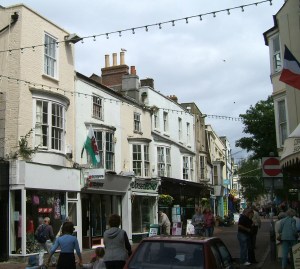
[Porrett will doubtless be taking his party along one of Weymouth’s bustling shopping streets – still full of Georgian buildings today]

The Georgian Seaside Cover_MEDIUM WEB

The Georgian Seaside: the English resorts before the railways came.


7 Comments

Filed under Buildings, Entertainment, Seaside resorts

The Earl of Wittering Goes to the Seaside Part 2 – Where to go?

A week after the first suggestion that they should spend the summer at a seaside resort the Witterings gather in the Egyptian (soon to be Chinese if the countess has her way) drawing room before dinner to decide where to go.

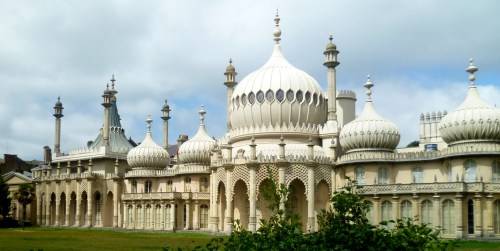
‘Brighton,’ says Viscount Ditherstone decisively. Wherever Prinny favours is bound to be lively and he might be able to get an invitation to the Pavilion. (Photo below) Besides, he has heard that all the Cyprians decamp to Brighton during the summer, so there is sure to be some high-class lightskirts to… er… admire.

Brighton pavilion

‘Certainly not,’ two firm female voices announce in concert. For once his wife and his mother are in accord. ‘One hears the most disgraceful things about the company there,’ his wife Almira adds with a significant look in the direction of her daughter.

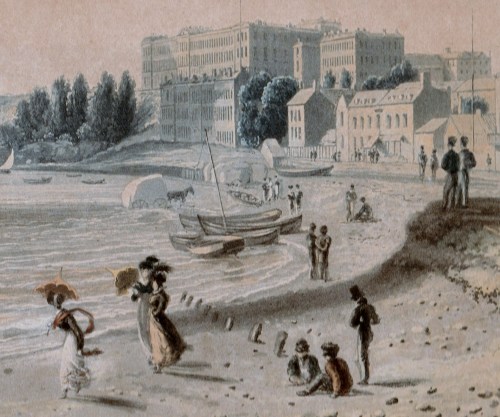
‘Weymouth is highly respectable, as is Hastings,’ she suggests. ‘And dear Princess Charlotte visited Southend on several occasions (Print below). I have heard it is most select.’

Southend

‘The scenery is nothing out of the ordinary in any of those places.’ The countess is eager to draw scenes of wild seas and craggy cliffs. ‘The Isle of Wight or Scarborough, now, those are said to have fine Romantic views.’

‘Scarborough? Full of northern merchants, I’ll be bound,’ the Earl snorts. ‘You’ll be suggesting Blackpool next! And the Isle of Wight involves a sea crossing.’

‘Fossils and geology though,’ young Arthur pipes up. ‘The Isle of Wight, that is. And interesting sands and cliffs and the Needles for Grandmama.’

‘A good Assembly Room, a theatre and shops are essential.’ Miss Emily, seventeen, has heard about the troops stationed along the Channel coast. So many officers in scarlet coats. Why, it must be a patriotic duty to flirt with such heroes. But she knows better than to mention the fact.

‘Weymouth,’ the Earl decides with unusual firmness. Respectable, lively and good enough for the royal family. ‘You’ll have all the views a person could want, my dear and there are bound to be rocks for young Arthur. And it is as far as I’m prepared to drive, so let that be an end to it. Porrett!’

Weymouth bay from Weymouth and Melcombe Regis New Guide-cropped

His secretary, lurking discretely in a corner where he can sigh over Miss Emily’s perfect profile, jumps like a scalded cat. ‘My lord!’

‘Weymouth it is. Sort out accommodation. We will travel at the beginning of June and stay until the end of August.’

‘My lord, I will attend to it with all dispatch.’

Where will Porrett find them to stay? Will Porrett be allowed to come too? You can follow their summer adventures here over the next few months and read about the vibrant world of the early English seaside holiday  in  The Georgian Seaside: the English resorts before the railways came.The Georgian Seaside Cover_MEDIUM WEB


5 Comments

Filed under Entertainment, Seaside resorts

The Earl of Wittering Plans His Summer

This May morning in 1816 the Gatwick family gather around the breakfast table in the Small Dining Room of their vast Mayfair mansion. It is obvious that the head of the family, the Earl of Wittering, has something on his mind, although the Countess of Wittering supposes it is only his bowels troubling him again. Like most of the upper classes of his age his diet – heavy on meat and alcohol, low on fruit and vegetables – means that his lordship frequently feels liverish, or to put it more bluntly, he’s appallingly constipated. She makes a mental note to send off another order to Savory & Moore, chemists (by Royal Appointment) in New Bond Street. (Shown below) Thomas Field Savory is making his fortune after acquiring the patent for internationally best-selling laxative, Seidlitz powders but, naturally, she does not mention such a subject at the meal table.

028

The Countess would much rather finish her toast and return to her sitting room where she is putting the final touches to a highly imaginative, and exceedingly dramatic, sketch of an Alpine pass. What she would really like would be to paint the sea. Ever since she read Edmund Burke’s tract On the Sublime and the Beautiful and learned that the ocean was “an object of no small terror” she has been fascinated by it.

On either side of the breakfast table sit the Earl’s heir, the Viscount Ditherstone (coughing, as is his irritating habit at breakfast) and his wife, flanked by their children, seventeen year old Emily and twelve year old Arthur. Ditherstone, ever tactless, enquires if there is anything on his father’s mind.

Porrett, the earl’s secretary has, it transpires, been making enquiries about his lordship’s intentions for the summer so that he can begin to put in place the arrangements and, for once, Lord Wittering is undecided. Normally, after the London Season the family embark on a lengthy round of summer visits to the far-flung branches of the family, their travels greatly eased by the splendid condition of the network of turnpike roads across the country. The tour would always culminate in two weeks spent toadying to his elderly, terrifying and exceedingly wealthy aunts. But the aunts had died that winter, their money left, as he had always desired, to their godson, Master Gatwick, the future earl. Now his lordship wonders if he really wants to spend three months travelling about before he can retire to his country estate for the autumn and set about slaughtering anything with fur, feathers or fins. What he would like to do is recover his health in a spa, as his father would have done, but Bath is hopelessly dull these days, quite out of fashion.

“Perhaps we should take a house at a seaside resort,” ventures his daughter-in-law. “I am sure the pure air would be a benefit to Ditherstone’s lungs.” Ever since she read that amusing novel Emma she has not been able to forget the phrase, The truth is, that in London it is always a sickly season. Nobody is healthy in London, nobody can be. And was it not the case that the great Mr Wordsworth was only able to write his beautiful verses “Upon Westminster Bridge” The beauty of the morning; silent, bare, Ships, towers, domes, theatres, and temples lie Open unto the fields, and to the sky; All bright and glittering in the smokeless air… because he was amazed to find, for once, the atmosphere free of polluting smoke?

Ditherstone himself perks up. He rather fancies a dip or two in the briny. He’s heard exciting stories about the ladies bathing and what they might, or might not wear, to say nothing of amorous encounters in bathing rooms. And all kinds of dashers visit the seaside, so his bachelor friends tell him.

“Oh, Grandpapa,” Emily breathes. “I would love to go to the seaside.” She bats her eyelashes. “The south coast, they say, is so warm and quite delightful.” And, facing the enemy France, as it does, it is stuffed with troops. All those officers in scarlet coats. Oh, the opportunities for flirtation. (Below: tourists admire the militia parading at Cromer in Norfolk)

Cromer militia

Young Arthur extracts his nose from a scientific journal – he is showing an alarming tendency (in his grandfather’s opinion) towards natural philosophy and not manly sports. “The south coast, it said in a paper I was reading the other day, has much of interest to the fossilist and the mineralogist. I would like to go.”

The Earl glowers down the table. He doesn’t like change. On the other The Georgian Seaside Cover_MEDIUM WEBhand the sea-water cure sounds as though it would be helpful for what ails him. His wife keeps leaving prints of craggy cliffs and tossing waves about, so he supposes it would keep her happy and the rest of the family seemed keen enough. He would think on it.

What will the earl decide? Will the Gatwicks go to the seaside and, if so, to which resort? You can follow their summer adventures here over the next few months and read about the vibrant world of the early English seaside holiday (definitely not a Victorian invention!) in  The Georgian Seaside: the English resorts before the railways came.

Meanwhile, now the smog has gone, you can find Savory & Moore’s shop for yourself in Walk 2, Walking Jane vis1Band admire Wordsworth’s view in Walk 6, of Walking Jane Austen’s London
8 Comments

Filed under Buildings, Entertainment, Gentlemen, High Society, Medicine & health, Military, Seaside resorts, Travel

So What Was Wrong With Ranelagh?

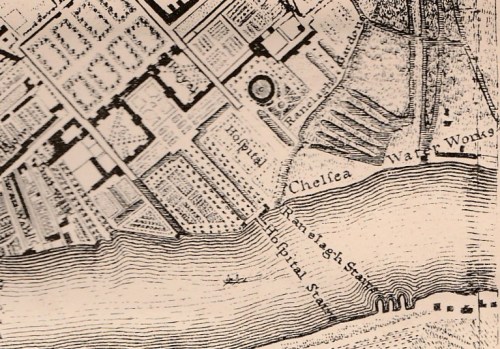
Roque map

Above: Ranelagh Gardens in Roque’s map of London 1741. The Rotunda is the black circular feature and it can be located exactly with modern maps because the outline of the buildings of the main wings of the Royal Hospital have not changed.

Last week, with friends, I attempted to visit the site of Ranelagh Gardens next to the Royal Hospital Chelsea – only to find them off-limits with the marquees of the Chelsea Flower Show being erected there. A helpful Chelsea Pensioner directed us to the lovely scale model of the Hospital and the Gardens that shows them in their heyday and that whetted my interest to discover why they closed so much earlier than their rival, Vauxhall.

Vauxhall Gardens and Ranelagh Gardens were the most famous of the London pleasure gardens and the two whose name many people can still remember. The Ranelagh Gardens today – simply a small park – is of about the right size and in the same position, and so the name lives on.

The first clear reference to the Vauxhall Gardens, or New Spring Gardens as they were at first, was in John Evelyn’s diary on 2 July 1660 – ‘I went to see the new Spring-garden at Lambeth a pretty contriv’d plantation.’ “New” because the old Spring Gardens, dating to the reign of Elizabeth I, were at the eastern end of St James’s Park. Admiralty Arch now sits in the middle of the area.

By the 1690s these early pleasure grounds were being referred to as “Vauxhall” from the proximity of the old manor of Vauxhall. The name comes from the house of the 13th century Falkes de Breuté – Falkes Hall became Fauxhall, Fox Hall and Vauxhall.

In 1729 an ambitious young tradesman from Bermondsey called Jonathan Tyers obtained a sub-lease on “Vauxhall Spring-Gardens” and set about creating the Vauxhall Gardens that became London’s premier attraction until its sad decline during Victoria’s reign. It closed on 25 July 1859, 199 years from Evelyn’s visit.

Pleasure gardens of various sizes and degrees of sophistication were dotted throughout London and its surrounding area in the 18th century. Many were as simple as a landscaped garden or a bowling green next to a good public house. Marylebone Gardens, the main competition to Vauxhall after Ranelagh, was located next to the Rose of Normandy Tavern (in the area bounded today by Marylebone High Street, Marylebone Road, Weymouth Street and Harley Street) and began as a bowling green and gaming house. The fact that Dick Turpin visited in the 1720s may well be reflected in the fact that Gay used it as a haunt of his highwayman Macheath in the Beggar’s Opera (1728). This reflects the early tone of the place and, even after 1738 when the new proprietor of the tavern, Samuel Arnold, improved things – introducing a sixpence entrance fee, shelters, music and fireworks and increasing its size to eight acres – it never entirely shook off its early reputation and became notorious for gambling and card sharping. It closed in 1778.

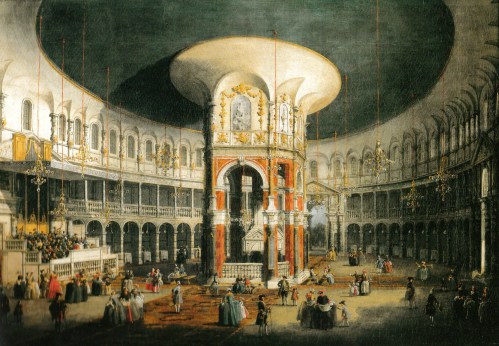
Ran int

Above: Canaletto. The Interior of the Rotunda at Ranelagh (c1751)

Ranelagh Gardens were set up in 1741 in direct competition to Vauxhall and opened in April 1742. The proprietors, a syndicate of businessmen, had clearly studied Vauxhall, learned from its problems with the weather, and set out to rival, if not surpass it.

The site was promising, located in the village of Chelsea with direct river access. The centrepiece, from the beginning, was a vast Rotunda, an epic space modelled on the Pantheon in Rome. It measured 185 feet (56.4 metres) in diameter and, with the landscaping, cost £16,000. It became a tourist attraction even while it was being built and at night it looked like a giant lantern, blazing light across the gardens. It was immediately obvious to Tyers at Vauxhall that this was the major competition and he responded by buying up the  field that the Ranelagh proprietors had wanted to buy to expand into.

The Ranelagh lessee, William Crispe, was declared bankrupt in 1744, which must have pleased Tyers, but an issue of shares rescued the project and at first it was a huge success, a fact reflected in falling takings at Vauxhall. So what went wrong? The sad truth was, Ranelagh was just not naughty enough.

Horace Walpole was initially enthusiastic. Shortly after it opened he wrote “It has totally beat Vauxhall… You can’t set your foot without treading on a Prince, or Duke of Cumberland.” Yet the novelty soon waned. In June that year Catherine Talbot wrote to a friend that “…it is quite vexatious at present to see all the pomp and splendour of a Roman amphitheatre devoted to no better use than a twelvepenny entertainment of cold ham and chicken.” It probably didn’t help that the structure in the centre of the Rotunda, intended for the musicians, proved to have dreadful acoustics. Nor were the grounds very exciting, with a well-lit (probably too well-lit) circular walk which soon became monotonous.

There was no strong drink available and no gambling. The admission fee of half a crown kept away the riff-raff, as was intended, but it also created a far less exciting ambiance than at Vauxhall. It was favoured by the older, staider visitor but with the Hospital grounds on one side and the field strategically purchased by Tyers on the other, there was little scope for development and change.

To get to Vauxhall one needed to ‘take boat’ and cross the river. As my fellow author Sophie Weston pointed out to me, at night this must have seemed almost transgressive, an exciting, slightly clandestine, beginning to the evening’s adventures. Once there the walks were a mixture of secluded and well-lit, with plenty of opportunity for promenading – or for getting up to something rather naughtier. Tyers learned from Ranelagh’s strengths and weaknesses and adapted constantly, giving his customers a diet of novelty with an edgy frisson, yet within a safe and familiar setting.

Over at Ranelagh you could enjoy your tea and coffee, a safe and brightly lit gardens and the impressive Rotunda – but these were no attraction for the fashionable or the younger sets, despite the addition of a Chinese Pavilion. Ranelagh found it hard to weather the problems of the 1780s with riots in London and the rather more sober mind-set towards frivolous activities engendered by the war with France. Vauxhall survived this period, but Ranelagh gave up the struggle and finally closed in 1803, after sixty one years of operation. The Rotunda (largely built of wood) was demolished in 1805. The organ was moved to All Saints Church in Evesham, but even that was replaced later. Ranelagh has vanished.

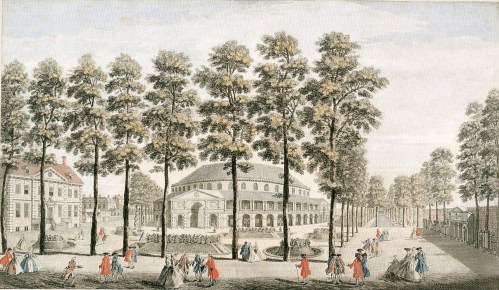
Below: Ranelagh House and Gardens with the Rotunda (1745) T. Bowles after J. Maurer

Ran ext

4 Comments

Filed under Architecture, Buildings, Entertainment, High Society