
I live in Norfolk, one of the major centres in the 18th and 19th centuries for rearing geese and turkeys for the London market. Both were favourites for eating at Christmas and in the weeks before the roads to the Capital were full of flocks of geese being walked slowly to their doom, their feet protected by being dipped in tar and then sand. The arrival of the stagecoaches made transporting birds much faster and they could be slaughtered in Norfolk, then loaded onto the coaches and arrive without having walked off a good part of their condition.
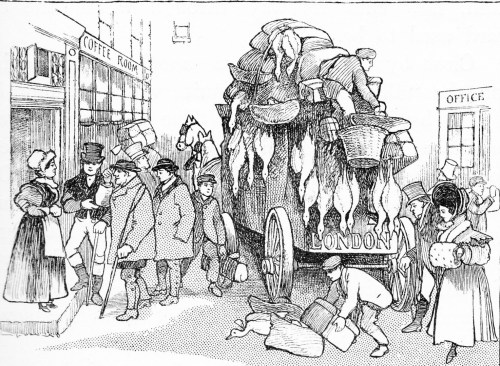
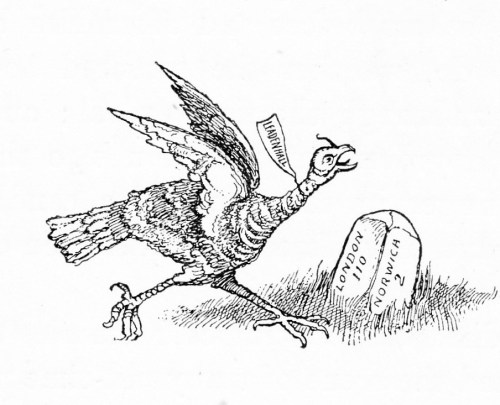
The image above shows the Norwich stage arriving at the Bull Inn in London hung about with geese, but turkeys were transported in the same way. Not all were dead, as Cecil Aldin’s marvellous little sketch of an escaping bird at the top of this post illustrates. the label around his neck says, ‘Leadenhall Market’ and he’s wisely heading back to Norfolk as fast as he can!
 Turkey was not just food for the well-off and middle classes as I discovered when researching for Regency Slang Revealed The slang for all kinds of poultry was hollow, presumably because birds were cooked hollow inside. A turkey was a Bubbly Jock or a Gobbler, references to the sounds they make, or a Cobble Colter. A roast turkey garnished with a string of sausages was an Alderman, a reference to the chain of office. Not much was wasted at this level of society – the part of a chicken we call the parson’s nose was the Pope’s Nose to the Regency underworld and The Devil was a dish comprising the gizzard of the bird, scored, peppered until it was very hot to the taste and then broiled.
A New System of Domestic Cookery; formed upon principles of economy by A Lady (various editions in the early 19thc, mine is 1829) has advice for the prudent housewife on selecting your turkey:
“A Turkey Cock – If young, it has a smooth black leg with a short spur. If fresh, the eyes full and bright and the feet supple and moist. If stale the eyes will be sunk, and the feet dry. Hen-Turkey is known by the same rules; but if old, her legs will be red and rough.”
This book contains a number of recipes for turkey including a version of the Devil, mentioned above:
“An Incomparable Relish, or Devil, of Turkey
On the rump, gizzard , and a drum-stick, put salt, pepper and Cayenne. Let them be broiled, and brought back as hot as possible; cut them in small pieces, pour over a ladle of mustard, ditto of melted butter, a spoonful of soy, ditto of lemon-juice, and some of the gravy out of the dish; mix quickly, and hand round.”
The instructions for roast turkey give the traditional accompaniments still served today. The stuffing is sausage meat with chopped shallots, breadcrumbs and a beaten egg. Sausages and bread sauce are served separately along with the gravy.
When I transcribed the receipt book of Regency housewife Mrs Jean Mills for Mock Oyster Sauce and a Cure for Corns I found only one turkey recipe, for Turkey Pie, which involved leaving the meat seasoned with pepper, salt, nutmeg, pounded clove and mace overnight before baking it in a rich gravy.
However Mrs Mills does include the instructions for Plum Pudding, that other staple of the Christmas dinner. She often gives the name of the person who gave her a particular recipe and she attributes this one to her late first husband, Captain Ryan of the East India Company. Like all the recipes for plum cake and plum puddings that I can find in Georgian recipe books this does not include plums!
Captain Ryan’s Receipt for Plum Pudding
12 Eggs, 1 lb Suet, 1 lb Raisins, 1 lb Currants, 3 Table Spoons Grated Biscuits, 3 of Sugar, 1 Nutmeg, 1 Tea Spoon grated ginger, a little sweetmeat, 1 Glass Brandy. This pudding takes 4 hours to Boil.
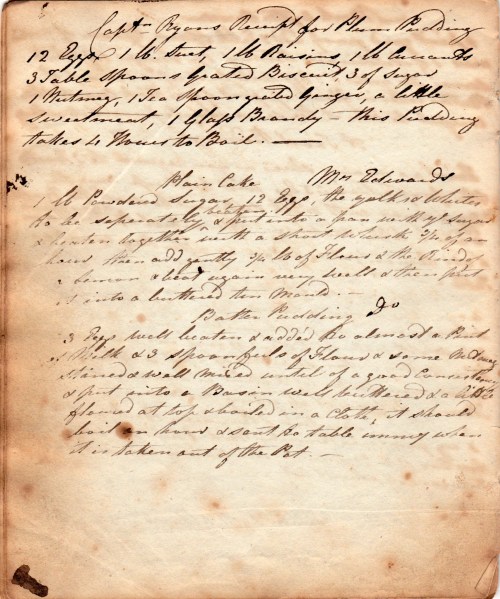
If you want to try this with modern weights and measures, 1 lb = 453.5 grams.
On the same page you can see Mrs Edwards’ Plain Cake and Batter Pudding. The ‘do’ – ditto – makes me think Mrs Edwards contributed that too.
Have fun planning your Christmas dinner!

 If you are intrigued by the experience of travelling in Georgian Britain you can retrace some of the iconic routes in
 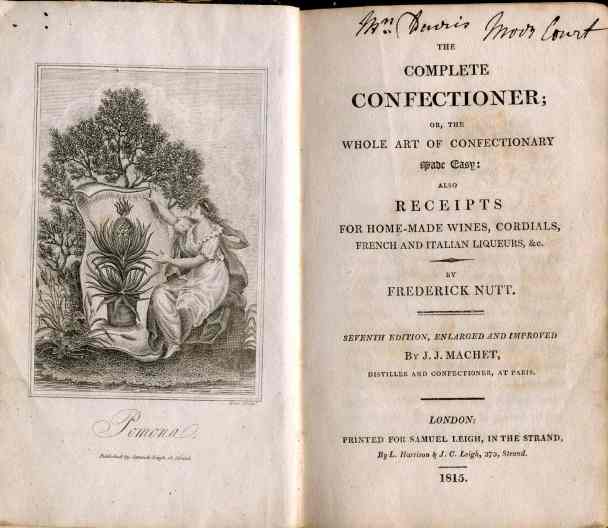 I love ice cream – which is fortunate as my husband, who is the cook in our house, has bought an expensive Italian ice cream maker which means we’ve got to eat lots to make it earn its keep!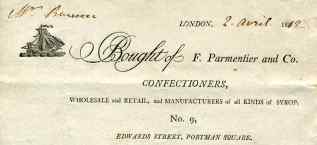
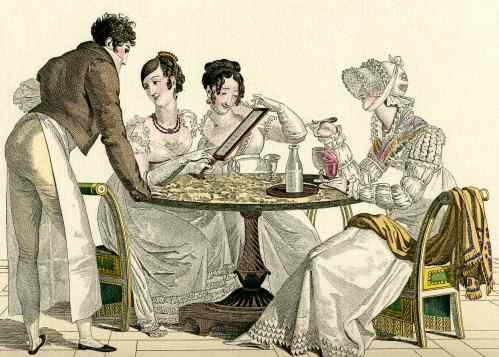
 The image above is from La Belle Assemblée for October 1809 and shows ‘Sea Coast Promenade Fashion.’
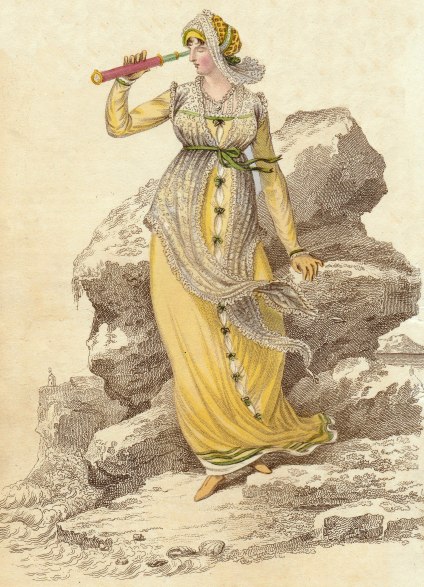
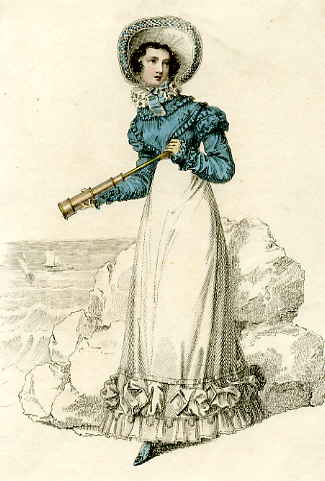 Somewhat later – I do not have a date for this, but it is c1820 – is this ‘Walking Dress’ from Ackermann’s Repository. I can’t help feeling that this lady is looking positively shifty as she readies her telescope.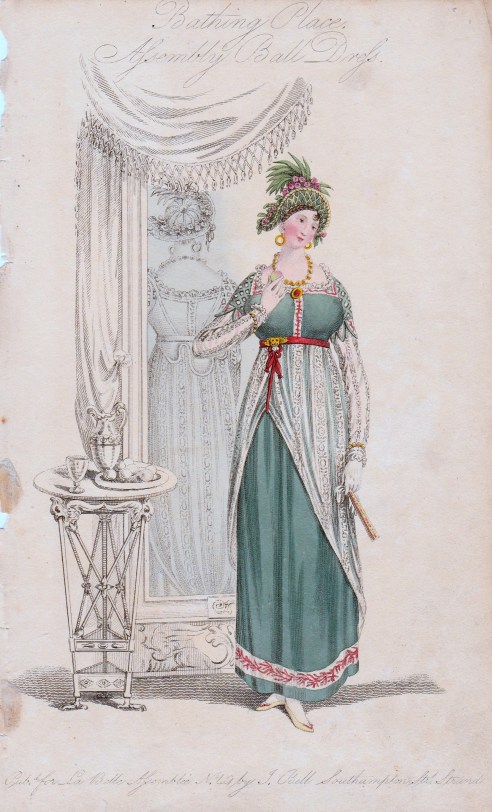

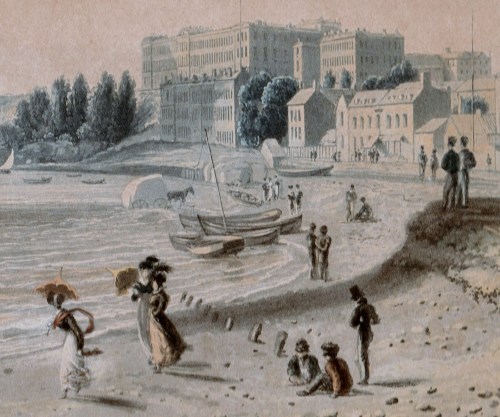
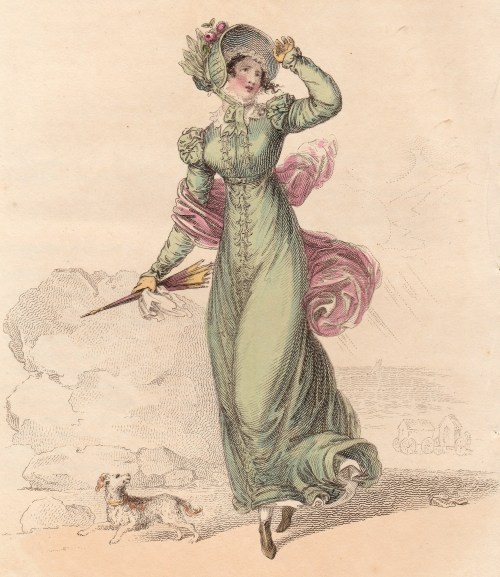
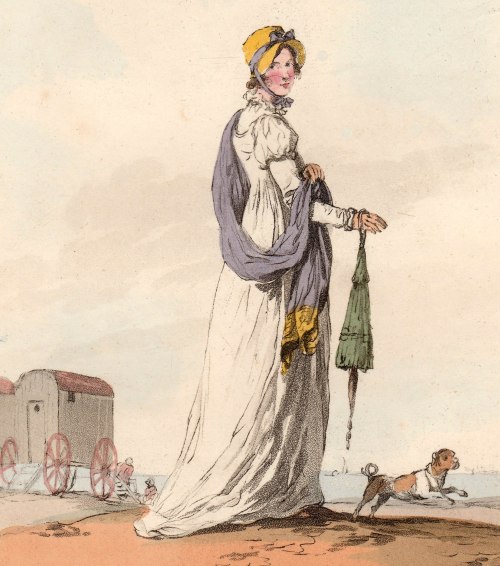
 What did one wear to get to and from those bathing machines? The ever-inventive Mrs Bell produced a magnificent ‘Sea Side Bathing Dress’ for the August 1815 edition of La Belle Assemblée. This is not the costume for entering the sea but for wearing to get there, and it is lavishly trimmed in drooping green, presumably to imitate seaweed. Note the bag she is carrying. This contains Mrs Bell’s ‘Bathing Preserver’ which she produced in 1814. You can see it in its bag again below (La Belle Assemblée September 1814). Here the lady is wearing ‘Sea Side Morning Dress’ with ‘Bathing Preserver. Invented & to be had exclusively of Mrs Bell, No.26 Charlotte Street, Bedford Square.’ The Preserver is in the bag lying beside her chair.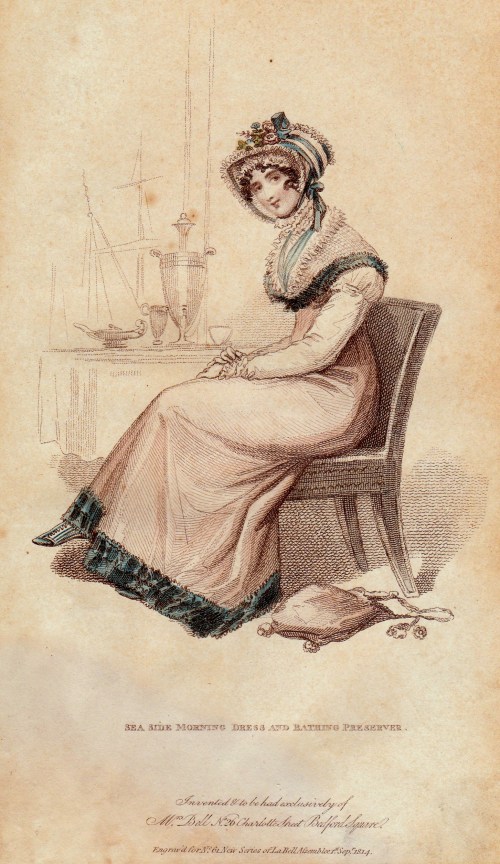
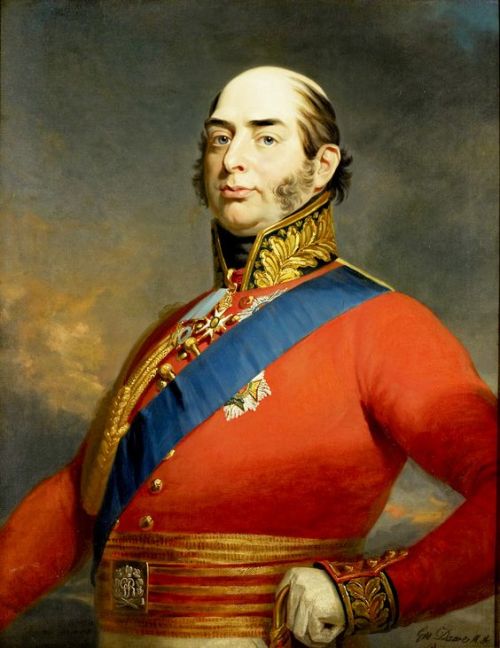


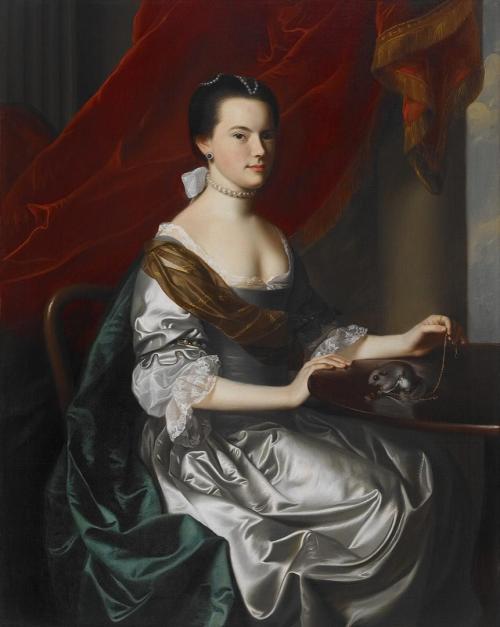 Frances was the wife of the Governor of New Hampshire and, as Loyalists, they and many others had been forced to flee by the American forces. Apparently she was very unhappy in Canada, missed her son who was in London and fretted at her diminished social status. An affaire with a prince must have raised her morale considerably! However, her husband wrote to the King to complain and William was recalled to England. (In the painting above of 1765 by John Singleton Copley she was still married to her first husband, Theodore Atkinson. he was her cousin, as was John Wentworth whom she married withing a week of Theodore’s death. Image in public domain.)
 Jane Austen's London