
We’ve arrived at that windy season when raising an umbrella is asking for trouble, as this delicious original water colour sketch (unfortunately undated) reminds me.
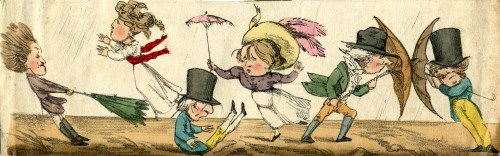
The interesting thing about this is that the men are using umbrellas, something that they probably wouldn’t have considered before the early 1800s.
Although parasols as protection from the sun date back to the 4th century BC in the Near East, and possibly earlier in China, the idea of using them to hold off the rain appears to be a 17th century innovation in France, Italy and England – but for ladies only. By the mid-18th century continental gentlemen would happily be seen sheltering from a downpour under an umbrella covered in oiled silk and English ladies would routinely use them, but there was a distinct stigma about Englishmen resorting to an umbrella.
Umbrellas were, it seems, ‘French’ and therefore, by definition, an effeminate accessory. Beau Brummell would never carry one, considering that no gentleman should, and advocated taking a sedan chair if there was the slightest risk of rain.
However, some practical men did ignore the jeers, the most well-known of them being Jonas Hanway (1712-1786), a much travelled man, who designed his own, rather large and cumbersome umbrella and persisted in using it. He was verbally attacked by the hackney carriage drivers who saw this as a direct attack on their business but he ignored their threats and one of the slang terms for an umbrella at the time was a Hanway. (The Victorian ‘gamp’ was named after Dickens’s Mrs Gamp, not the other way around.) The below detail from a Victorian imagining of Mr Hanway shows the interest he attracted.

By the early 19th century practicality had won over prejudice for most gentlemen and the use of a rain umbrella became usual for both sexes. In 1814 in Mansfield Park Jane Austen writes of the rescue of a very wet Fanny Price:
“… when Dr Grant himself went out with an umbrella there was nothing to be done but to be very much ashamed and to get into the house as fast as possible; and to poor Miss Crawford, who had just been contemplating the dismal rain in a very desponding state of mind, sighing over the ruin of all her plans of exercise for that morning, and of every chance of seeing a single creature beyond themselves for the next twenty four hours, the sound of a little bustle at the front door and the sight of Miss Price dripping with wet in the vestibule was delightful.”
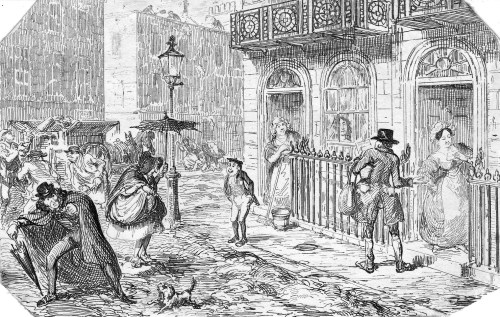
Cruickshank’s delightful series of sketches of various months often show umbrellas. This one (February) has a man using his as a walking aid to negotiate the muddy street while the lady with her skirts hitched up has a far less substantial version.
In this undated sketch (a little earlier than the Cruickshank) both men hold umbrellas, although I suspect that the use of one on horseback may just be part of the joke.
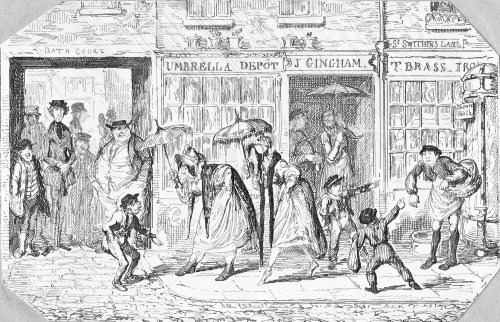
Specialist shops soon started selling umbrellas, as can be seen in another Cruikshank scene which shows one belonging to J. Gingham. The ladies are using what look more like parasols whereas the gentleman inside the shop is having a much more sturdy version demonstrated.
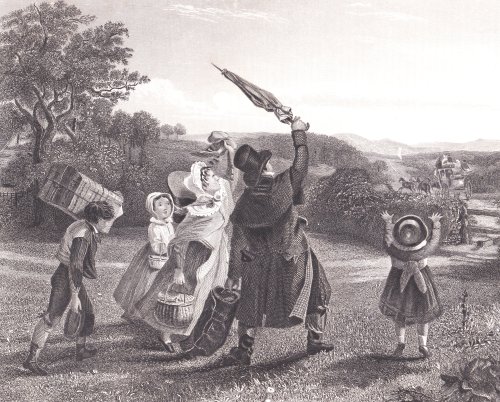
A gentleman travelling by stagecoach might take a umbrella, as can be seen in this image of someone missing the stage –
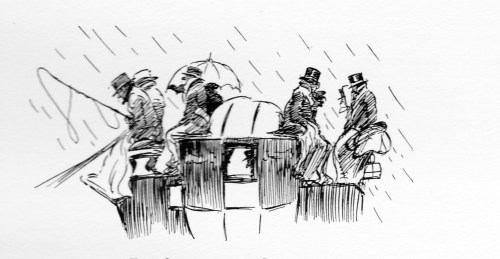
Of course you had to be considerate in how you used your umbrella. In 1822 Stanley Harris recalls sitting in front of a woman with an umbrella who would “shove it below your hat so adroitly as to send a little stream of water down the back of your neck.” This delightful drawing by Cecil Aldin shows the misery of being on top of the stage in the rain, even with a brolly. But even in this downpour, it is only a female passenger who is using one.
Finally here is a print showing a French invention – an umbrella complete with lightening conductor. Somehow I cannot see any English gentleman consenting to be seen with such an inelegant contraption!
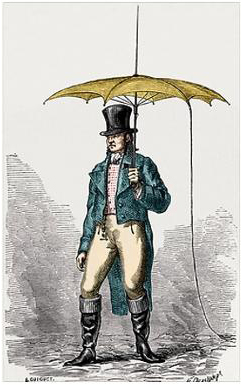
(This is an out of copyright image from Louis Figuier: Les merveilles de la science ou description populaire des inventions modernes (S. 596 ff.) (1867), Furne, Juvet)
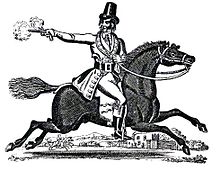 But the highwayman was a popular figure (at least, if you weren’t one of his victims). The crowd loved a villain, especially one who robbed those better off than themselves, carried out daring raids and escapes and, when almost inevitably brought to justice, “died game” on the gallows. Reality was less romantic – even the famous Dick Turpin, shown here on Black Bess, was a violent thug who tortured victims and inn keepers. The dashing Frenchman, Claude du Vall was hanged at Tyburn January 1670 despite (according to legend) gallantly sparing the possessions of any pretty lady who was prepared to dance with him. Presumably the plain ones just got robbed. The Victorians loved him and he was immortalized in a painting by Frith.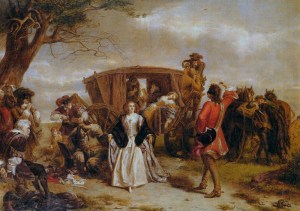

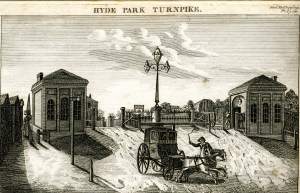 dent at the gates for giving her sister-in-law Eliza a chest cold. ‘The Horses actually gibbed on this side of Hyde Park Gate – a load of fresh gravel made it a formidable Hill to them, & they refused the collar; I believe there was a sore shoulder to irritate. Eliza was frightened, & we got out & were detained in the Eveng. air several minutes.’ You can follow Jane’s London travels in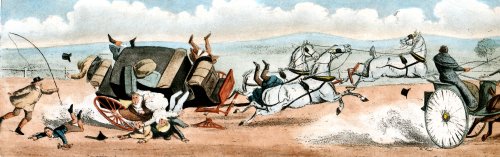
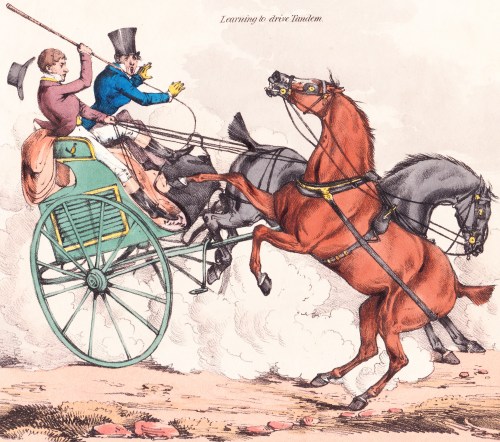 Alken shows a young gentleman who has got one of his pair turned around and one wheel off the road. The vehicle is a cocking cart used to transport fighting cocks and below the seat is a compartment ventilated by slats and a small image of a fighting cock on the armrest. In The Remains of a Stanhope (1827) the crash has already occurred, showing just how fragile these vehicles could be. A carpenter has been summoned and the owner is drawling somewhat optimistically, “I say my clever feller, have you an idea you can make this thing capable of progression?”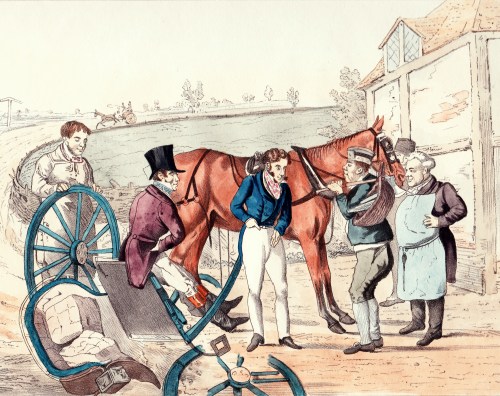
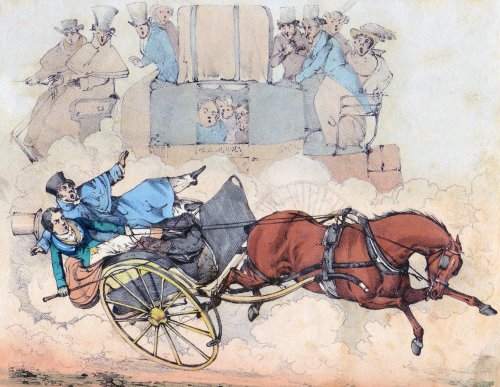
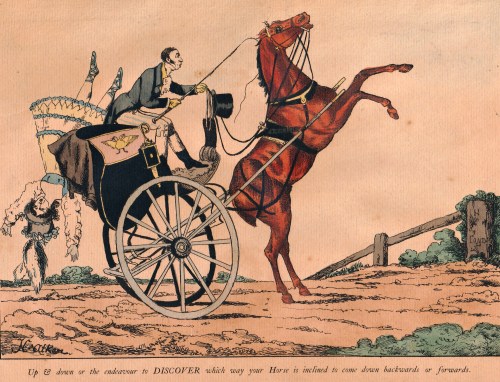
 Young men crashing their vehicles was obviously commonplace, and then as now, showing off to the ladies was also part of the joy of owning a sporting vehicle. Alken was not above titillating his audience with a glimpse of petticoat or a shapely leg, even when the owner of the leg was about to get seriously hurt. In “Up and down or the endeavour to discover which way your Horse is inclined to come down backwards or forwards” (1817) the driver takes no notice at all of his fair passenger vanishing over the back of his fancy carriage. There are some nice details in this print – the two-headed goose on the side panel is presumably a reference to the driver not knowing which way he is going and the luxurious sheepskin foot rug is clearly visible.
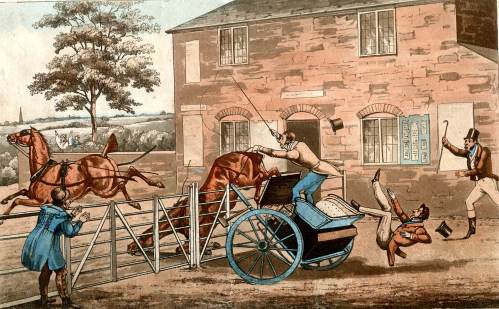
  In the same series is an awful warning about the dangers of not choosing your horses with care. Captioned “Trying a new match you discover that they are not only alike in colour weight & action but in disposition.” One young man is heading out over the back of the carriage while his companion is poised to leap for safety amidst flying greatcoats, hats and seat cushions.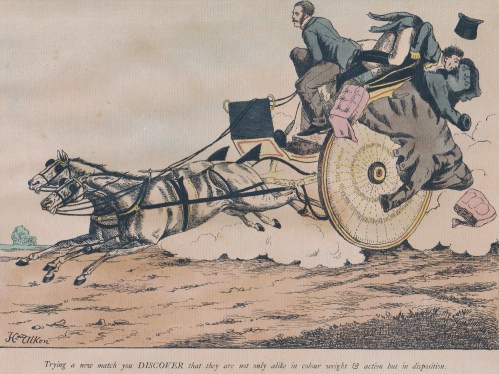
 Jane Austen's London