High Society in Summer 1803

On 22 June 1803  The Morning Post set out to inform its readers what was going on in High Society in its Fashionable World column.
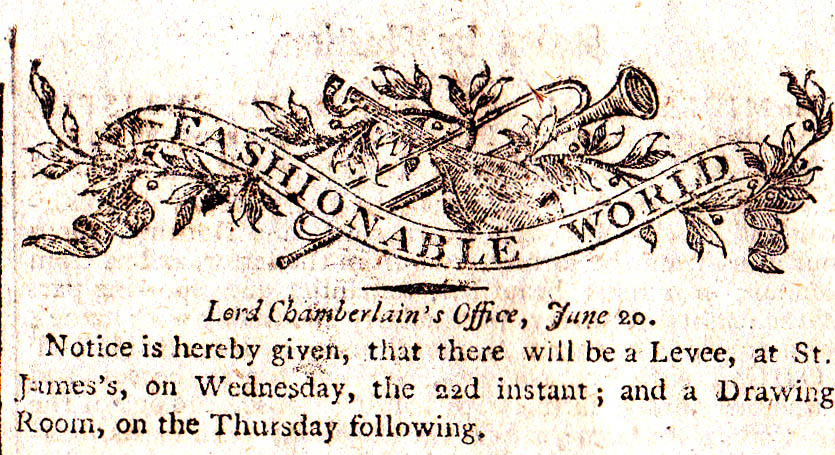
Image “Yesterday the QUEEN’S two dressers came to Town, to get the jewel cases ready; today Her MAJESTY will pack them up – to be deposited in Mr BRIDGES’S house, of Ludgate-hill, for the summer.”

Rundell & Bridge, jewellers, of 32, Ludgate Hill in the City of London, close to St Paul’s Cathedral, were the foremost late Georgian jewellers and goldsmiths and a great favourite of the royal family, especially the Prince of Wales. From 1805 they were known as Rundell, Bridge & Rundell.

 “Yesterday morning HIS MAJESTY, and the Princesses SOPHIA and AMELIA, attended by Ladies PITT and E. THYNNE, Generals GARTH and FITZROY, took an airing on horseback in the Great Park. HER MAJESTY, and the Princesses AUGUSTA and ELIZABETH, went to Frogmore, and walked in the gardens a long time.”

The royal family is obviously in residence at Windsor Castle which is still surrounded by its Great Park. Frogmore (http://www.royalcollection.org.uk/visit/frogmorehouse) was built in the late 17th century and was bought by King George III as a country retreat for Queen Charlotte. It became a favourite of Queen Victoria and is the location of the mausoleum where her mother, the Duchess of Kent, is buried and the mausoleum where Vitoria herself lies next to the tomb of Prince Albert.
 Image

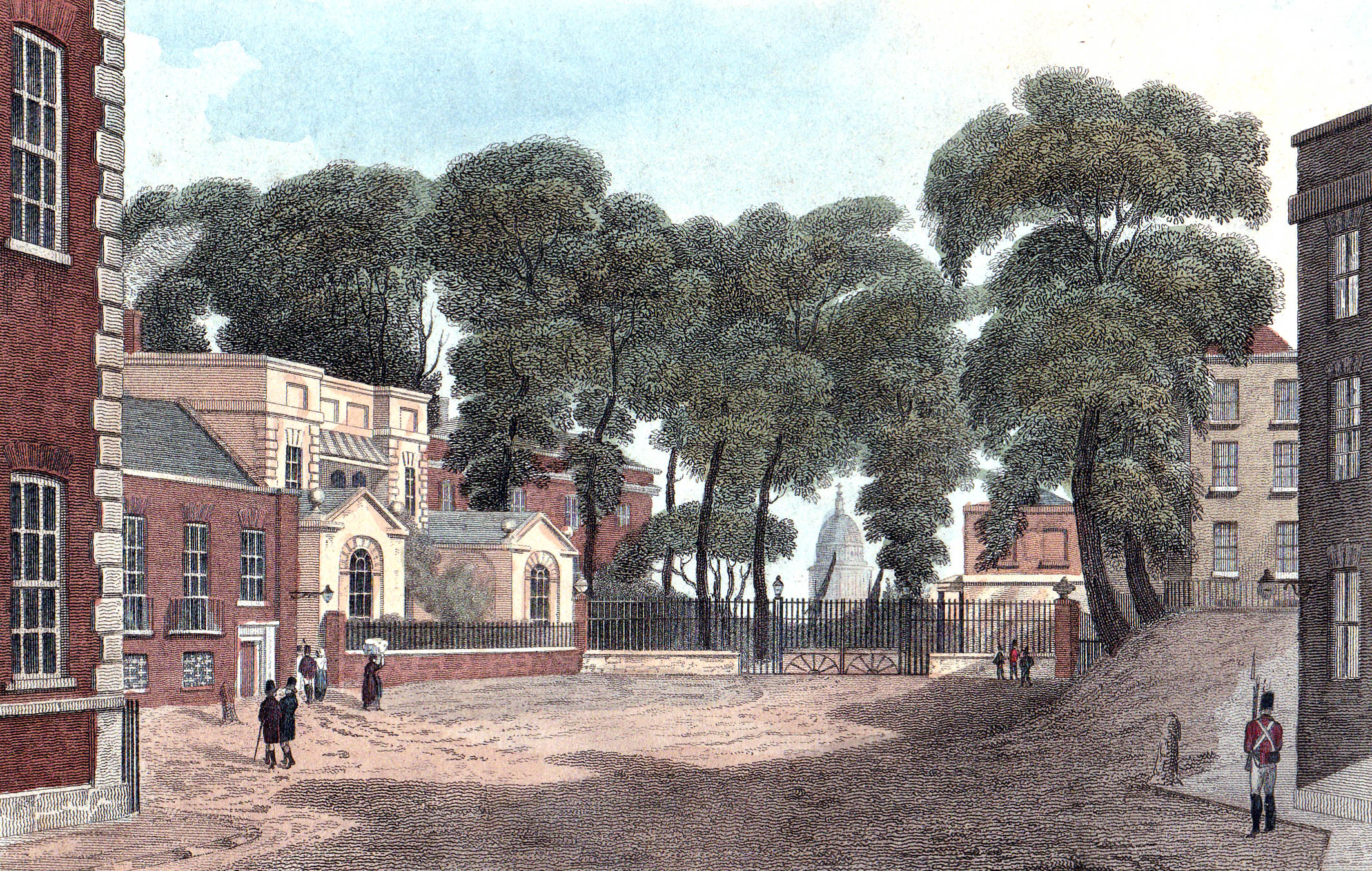
 “The marriage takes place at Fife House at five o’clock on Friday evening, and the Duke and Duchess sleep at Woburn.”

This rather sparse announcement refers to the marriage of John Russell, 6th Duke of Bedford to his second wife, Lady Georgiana Gordon, daughter of the Duke of Gordon. Fife House was one of the houses in Whitehall Yard, part of the palace of Whitehall, and was owned at this time by the Earl of Fife. It was demolished in 1867. Woburn is the seat of the Dukes of Bedford.  In this print (above) from Ackermann’s Repository, which shows the view through to the distant dome of St Paul’s Cathedral, Fife House is the redbrick house seen through the trees.

 With the arrival of summer many people were leaving London.

“The people of Brighton are looking forward with anxious eyes for the PRINCE, and hope to see him about the 4th of next month.”

At this date the Prince of Wales’s pleasure palace at Brighton had not reached its final magnificence. He first used it in 1786 and Henry Holland enlarged it in 1787. In 1801-2 it was further enlarged and in the year this piece appeared the prince had purchased a considerable area of land around the Pavilion and plans were in hand to build the magnificent riding school and stables. It was not until 1815 that Nash began the work that created the building we see today. The presence of the prince and the fashionable crowd he attracted was of enormous economic importance to the local community.

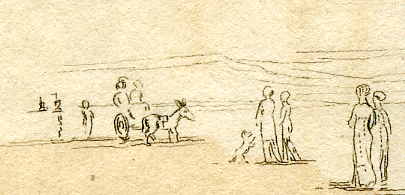
This charming litle sketch of people enjoying a stroll on the beach is from the background of one of Ackermann’s fashion prints for 1815.
Image

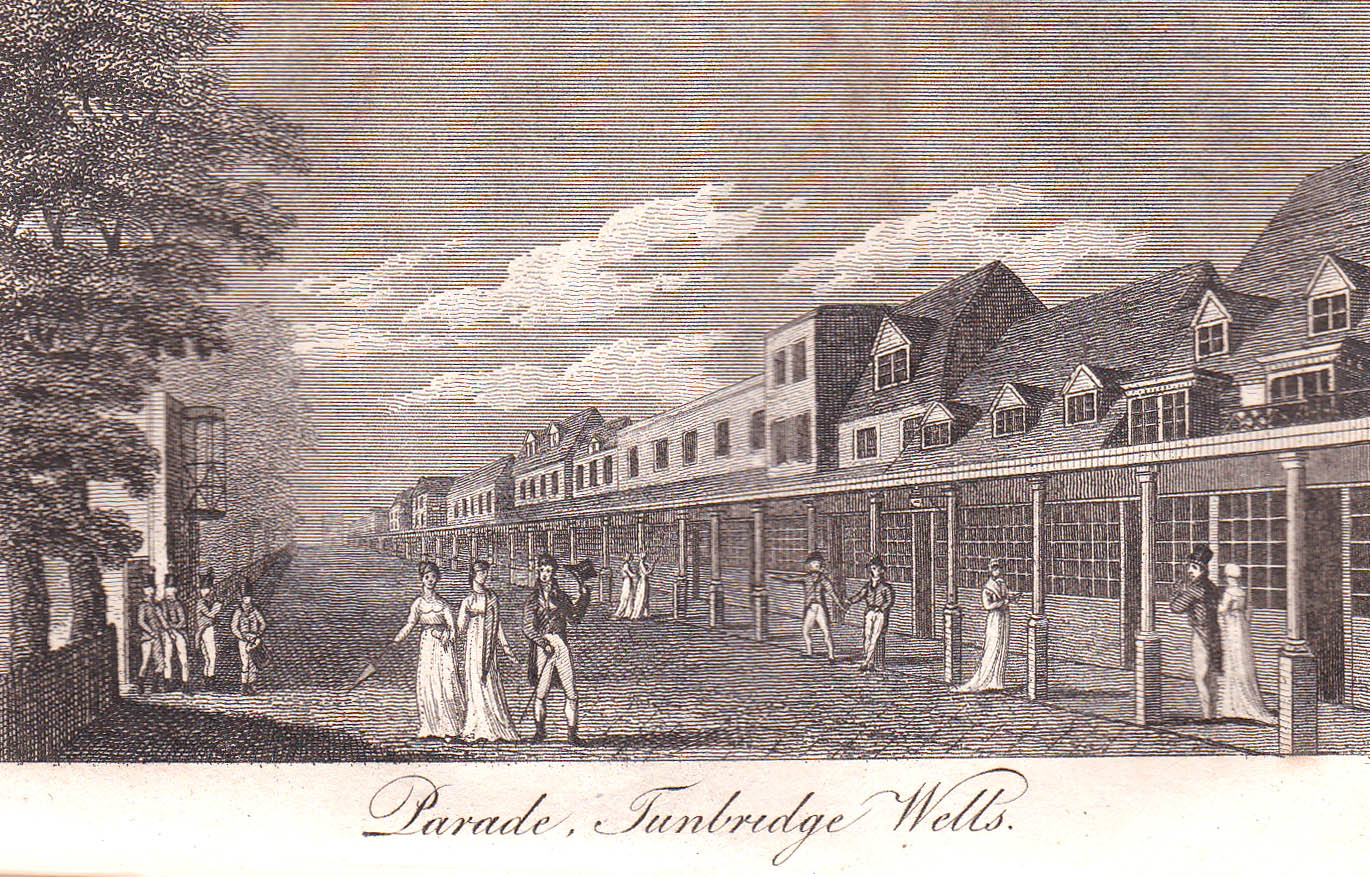
 Meanwhile “Among the fashionables at Tunbridge are, the Duke and Duchess of RUTLAND, Ladies DELAWAR, DYNEVOR, BOWYER, Sir J. and Lady BURGESS, Sir W. and Lady JERNINGHAM etc.”

Tunbridge Wells in Kent is only forty miles south of London, so was a convenient spa for those wishing to take the waters from the chalybeate springs and stroll along the Walks, now known as the Pantiles. (Shown in this print from The Guide to the Watering and Sea-Bathing Places. 1818) The town was made famous during Beau Nash’s reign as Master of Ceremonies, but by 1803 was beginning to suffer a little from the rise in popularity of sea bathing and seaside resorts. Even so, the stage coaches made nine return journeys to London daily. Image
Others were also going into the country. “The Bishop of DURHAM left town yesterday for his seat in Oxfordshire. The Countess of GERABTZOFF and suit [sic] have left WARNE’S Hotel, Conduit-street, for Russia.  William ORD, Esq. M.P. and C. J. BRANDLING Esq. are gone to Newcastle races, the former with his beautiful bride.”

 But despite the warmer weather other fashionables remained. “Lady DUNGANNON never looked handsomer than at the ball at Devonshire House; her dress was white and silver, made in style to show her fine neck to perfection. Her Ladyship did not dance until after supper.”

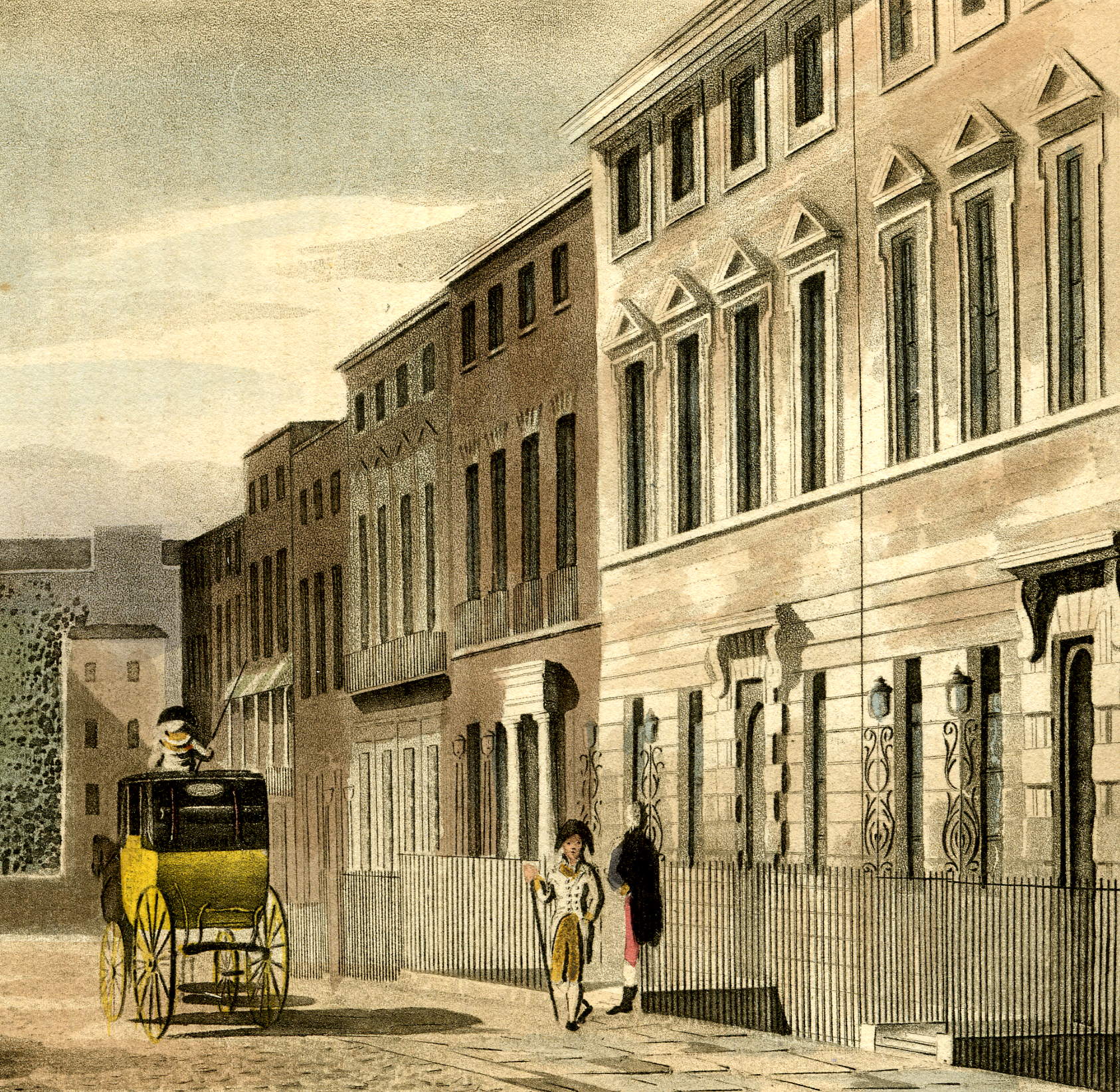
Lady Dungannon was the wife of the Irish peer Arthur Hill-Trevor, 2nd Viscount Dungannon. At this period “neck” was the term used to describe not only the neck itself, but also a lady’s shoulders and the upper slope of her bosom, considered a very important feature for a good figure. Devonshire House was the London home of the Cavendish family, Dukes of Devonshire, and occupied the land between the south side of Berkeley Square and Piccadilly. It was demolished in 1920 and the gates moved across Piccadilly to form one of the entrances into Green Park. In this print of Berkeley Square in 1813  (Ackerman’s Repository) the northern boundary of the gardens can be glimpsed. Image
And lastly there was news of some of the capital’s more eccentric residents. “TOMMY ONSLOW glories that he is superior to BONAPARTE as a whip and daily astonishes the citizens by turning the sharp corners with his phaeton and four.”

Tommy Onslow, or T.O., was Thomas, 2nd Earl of Onslow, a passionate enthusiast for carriage driving. He is remembered in the epigram:

What can little T. O. do?
Drive a phaeton and two.
Can little T. O. do no more?
Yes, — drive a phaeton and four.

The illustration is from the series The Road to a Fight and shows sporting gentlemen hurrying to a prizefight. Image

Without further comment the newspaper’s last Society final snippet reported, ‘General DUNDAS has imported a most beautiful Zebra from the Cape of Good Hope.’
1 Comment

Filed under High Society, Medicine & health, Royalty

Would Darcy Have Ridden a Bicycle?

Image

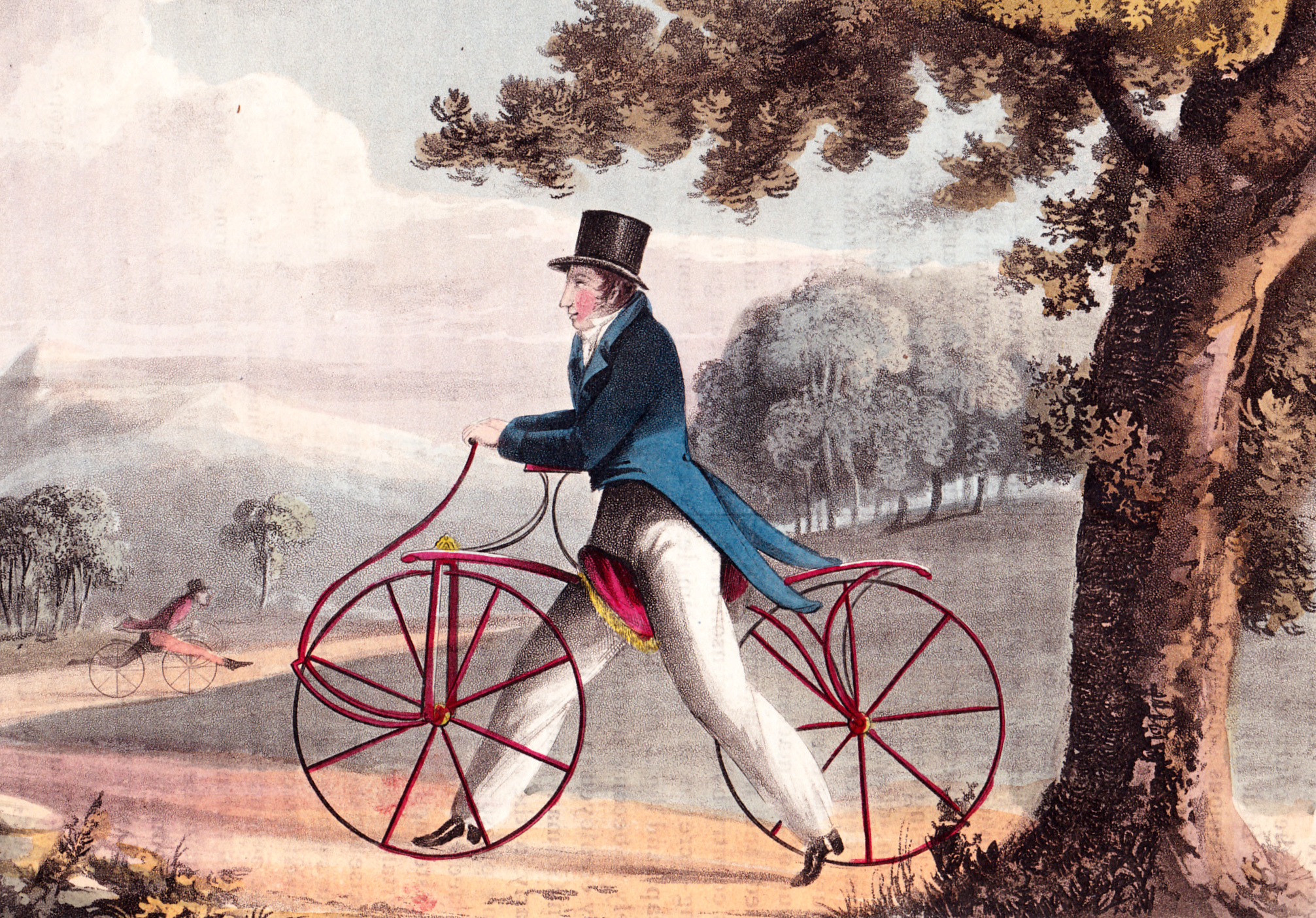
The combination of this fantastic print and the discussion in the UK press recently about encouraging cycling and making it safer prompted this post. Unfortunately the “Pedestrian Hobby Horse” arrived in England soon after Jane Austen’s death – I’ve love to know if she’d have ever given one of her characters a ride. I can imagine Lydia Bennett, skirts flying, shrieking with laughter!

The print, from Ackermann’s Repository (1819) is entitled Pedestrian Hobbyhorse and the text says it was invented by Baron von Drais, “a gentleman at the court of the Grand Duke of Baden.” The baron apparently invented a horseless carriage powered by two servants but it proved heavy and expensive so was abandoned, much to the relief of the unfortunate servants, I imagine!

 The baron went on to invent the hobbyhorse which he used for getting around large parks and gardens and it was introduced to London by Denis Johnson, a coach maker of 75, Long Acre. The Repository considered it simple, cheap and useful, especially in the country and in gentlemen’s pleasure grounds and parks. Medical men in France were already recommending it as a form of exercise.

 “The swiftness with which a person, well practised, can travel, is almost beyond belief: eight, nine, and even ten miles may be passed over within the hour, on good and level ground…the principle of this invention is taken from the art of skating.”

 Image

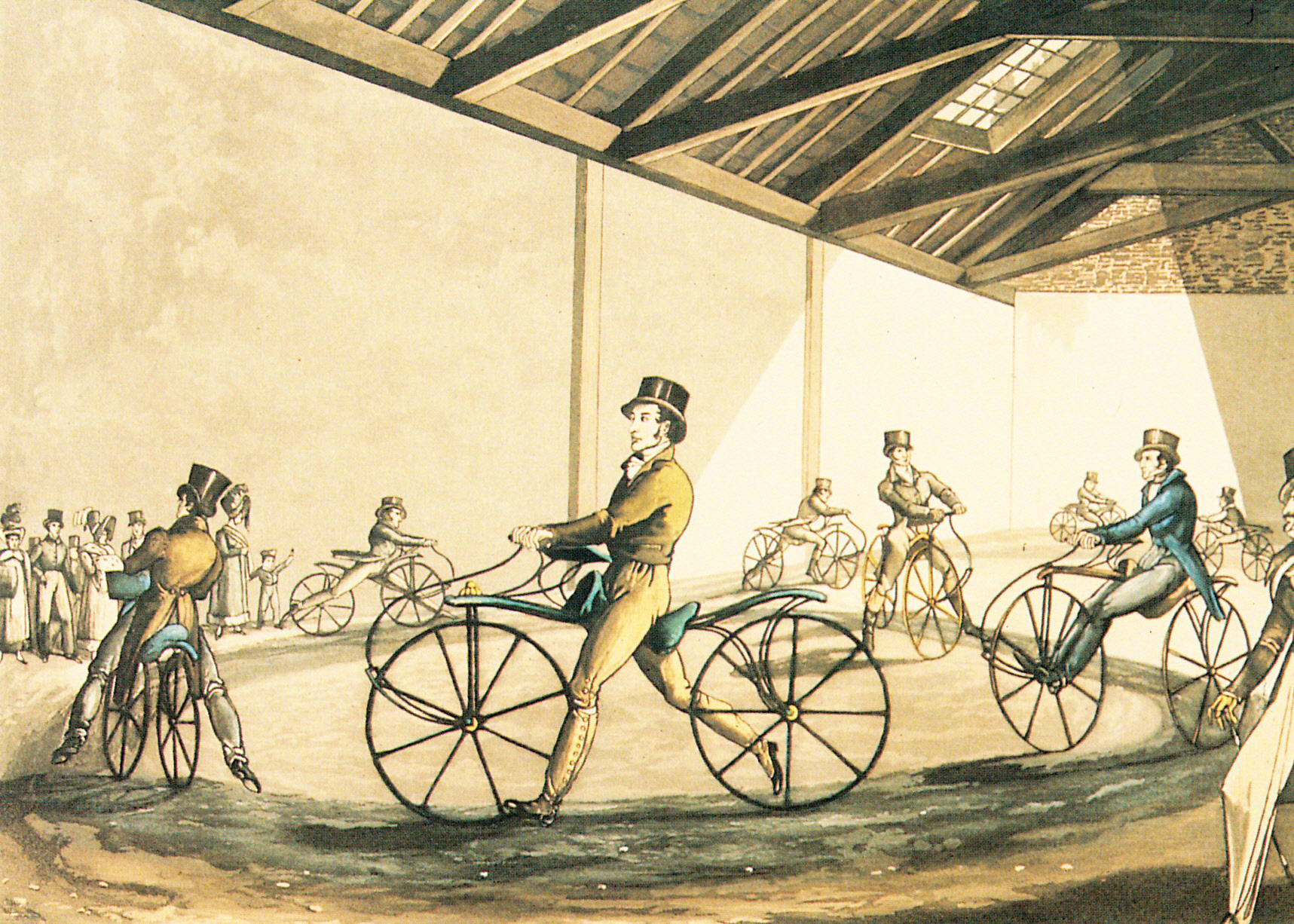
The rider sat astride a padded seat and rested his forearms on a padded board while steering with a small handle right at the front. Although it appears incredibly simple to us, used to bicycles and motorbikes, it was apparently necessary to take lessons and the  print above shows one of Mr Johnson’s Hobbyhorse Riding Schools. He opened one at 377, Strand and another at 40, Brewer Street, Golden Square in 1819. As you can see from the dress of the riders, this was a sport for well-to-do gentlemen. A hobbyhorse cost between £8-£10.

In Georgette Heyer’s novel Frederica the engaging youth Jessamy Merriville who cannot afford to hire a horse tries out the cheaper option of  a hobbyhorse, which Heyer calls a Pedestrian Curricle.

After a few lessons he hires one and,“Boy enough to want to startle his family with his unsuspected prowess, Jessamy had said nothing to them about his new hobby. Once he had perfected his balance, and could feel himself to be master of the Pedestrian Curricle, he meant to ride up to the door, and call his sisters out to watch his skill…he could not resist the temptation to coast down the long slope of Piccadilly, both feet daringly lifted from the flagway. This feat attracted a great deal of attention, some of it admiring some of it scandalised….”

Poor Jessamy finds himself in the midst of a dog fight and “…trying to control his balance, charged into a man mending chairs, lost control of his machine, and was flung on to the cobbled highway almost under the hooves of a high-stepping pair harnessed to a landaulet.”

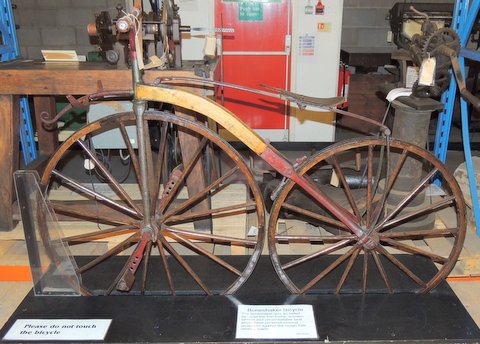
The hobbyhorse proved impractical for any surface other than very well-maintained paths and so dropped out of fashion by the early 1820s. Two-wheeled progression lapsed until the invention of a device in 1865 called a velocipde which had pedals which worked directly on the front wheel. It became known as the Boneshaker and was almost entirely made of wood, with metal tyres and no springs – hence the name.

 Image

This photograph shows one in the Birmingham Museum’s Store.

Which of Jane Austen’s characters would you like to see on a Pedestrian Hobbyhorse? Would it be below Mr Darcy’s dignity? Perhaps Mr Collins would think it an improving way to take exercise…

10 Comments

August 15, 2013 · 1:41 pm

Jane Austen, Stays and Elegant Fig Leaves

At this time of year, when we are all thinking about shedding as much clothing as possible in the heat, I think with even more sympathy about the layers of clothing that women were encumbered with in earlier years – and corsets, or stays as they were more usually known in the early 19th century in particular.

Stays could be made of leather, which was then not washed (a fairly dreadful thought!) or a substantial fabric, which at least could be laundered. Stays normally laced at the back but, before the invention of mass-produced metal eyelets, they could not be pulled as tight as Victorian stays were because the fabric would rip. Their shape and their constricting powers therefore depended on their stiffening of whalebone or thin cane. They pushed the breasts up rather than cupping them and were normally fitted with shoulder straps.

ImageThe print by Gillray is plate 1 from a series called The Progress of the Toilet, dated 1810 and shows a lady being laced into long stays. She is wearing fashionable clocked stockings and, rather daringly, drawers, caught in tight at the knee. Because they resembled masculine costume, drawers were considered very fast.

Jane Austen’s letters contain virtually nothing on the subject of underwear, but she did have very definite views on the subject of stays. In September 1813 she was able to pass on the latest intelligence from London on the subject  to her sister Cassandra. ‘I learnt from Mrs Tickar’s young Lady, to my high amusement, that the stays now are not made to force the Bosom up at all; that was a very unbecoming, unnatural fashion.’

Stays could be made to measure, but were also available off the peg and Mrs Clark, whose shop was at no.56, St James’s Street, advertised in 1807,  ‘…a large assortment of corsets of every size, and superior make, so that ladies may immediately suit themselves without the inconvenience of being measured.’

Ladies living out of town could order stays by mail order as this advertisement from the Morning Chronicle of November 1 1810 shows.

HER MAJESTY’S STAY-MAKER. – MRS. HARMAN No.18 New Bond-street, London, has the honour most respectfully to announce to those Ladies who attend to the elegance of the female figure, that she has now ready for their inspection a very large and fashionable assortment of her much-admired LONG and SHORT STAYS. The great number of Ladies of Rank and Fashion, who honour Mrs. Harman with wearing her Stays, is a most convincing proof of their pleasantness, utility, and superiority to every other Stay. Mrs. Harman’s Stays are finished with that novelty and taste which has procured for her the countenance of Royalty, and the patronage of the first Nobility. Ladies living in the country, by sending a letter (post paid), will have proper directions sent them to send their own measure, so as to insure their fitting.

Newspapers were not constrained by notions of modesty when commenting on ladies’ fashions and undergarments, or their appearance in them as this piece from The Times in 1799 on the flimsiness of fashionable gowns and the fashion for false bosoms shows:

“If the present fashion of nudity continues its career, the Milliners must give way to the carvers, and the most elegant fig-leaves will be all the mode. The fashion of false bosoms has at least this utility, that it compels our fashionable fair to wear something.”

And The Statesman on 2 September 1808 broke into verse to criticise modern fashions compared to those of the days of Queen Anne, managing to incorporate a furniture pun about chests and drawers in the process!

 When panoplied in whalebone stays,

Such as were worn in Anna’s days,

Our fair kept Virtue in their breasts,

And lock’d her safely – in their chests.

 But, since their chests are open’d, how,

And where, do they keep Virtue now?

Is she protected by their lawyers?

Or do they keep her – in their drawers?

Historical re-enactors have told me that they find their stays are supportive, and help prevent backache when they are working in kitchens, so perhaps there was something to be said for stays. What do you think?


6 Comments

Filed under Fashions, Royalty, Shopping

A Royal Birth, A Duchess “in the straw” and Some Dynastic Speculation

Felix Farley 2 crop

As I write this post the newspapers are full of discussion about the Duchess of Cambridge’s pregnancy, the birth and any other royal or baby detail they can try and make remotely relevant. I had always assumed that the Georgian papers were slightly more restrained and respectful about royal births, even when the royals themselves were often cruelly lampooned. Imagine my surprise when reading a copy of Felix Farley’s Bristol Journal of December 28th 1816 to find this snippet on the front page:

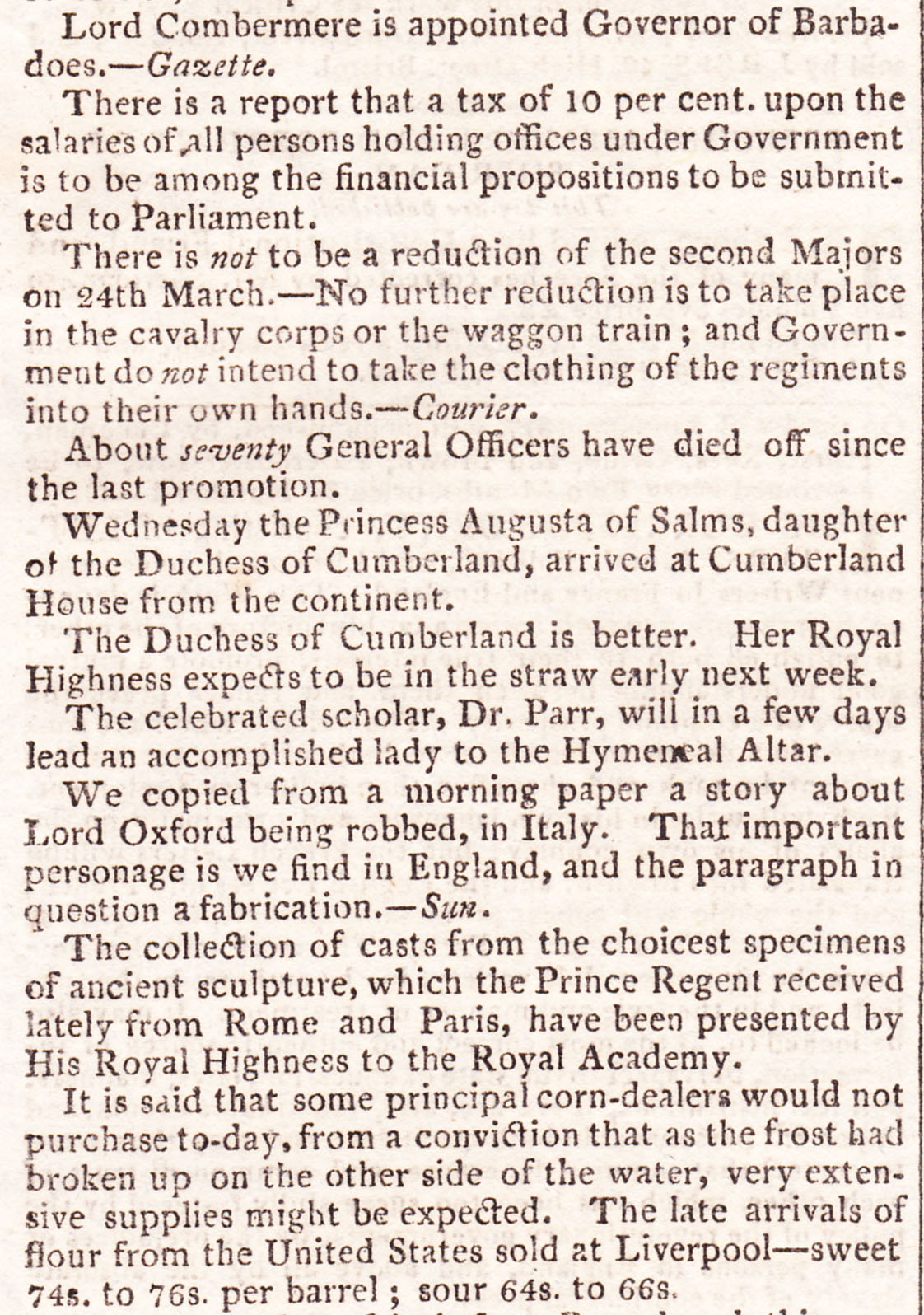
 Wednesday the Princes Augusta of Salms, daughter of the Duchess of Cumberland, arrived at Cumberland House from the continent.

In the straw crop

The information about the Duchess of Cumberland was in amongst a very mixed bag of news!

The Duchess of Cumberland is better. Her Royal Highness expects to be in the straw early next week. 

 “To be in the straw”, Grose’s Index to the Vulgar Tongue (1785) informs me is, “to be in childbed.” Is anyone else as amazed as I was to see a respectable newspaper using slang about such a subject? I would have thought they would say, the duchess “expects to be confined early next week.” Or has anyone come across the use of this phrase in a “respectable” context?

 I was intrigued enough to find out more about the Duchess of Cumberland and what happened. Even more intriguing was the discovery that she might well not have become the Duchess of Cumberland, for she had very nearly married another prince – the Duke of Cambridge!

 Princess Frederica of Mecklenberg-Strelitz was born in 1778, the niece of Queen Charlotte, wife of George III. She was therefore the first cousin of the numerous British royal offspring, including Prince George, later Prince Regent and King George IV.

Frederica’s married life was, to put it mildly, eventful. First, when she was only fifteen, she married Prince Louis, younger son of King Frederick William II of Prussia, but it was an unhappy match and he died in 1796 leaving her, at the age of eighteen, the mother of two children, Prince Frederick and Princess Frederica.

A year later she met and became unofficially engaged to Prince Adolphus, Duke of Cambridge, King George III’s seventh son. But to marry they needed the king’s permission and the queen, Frederica’s aunt, was adamantly opposed to the match and persuaded the king to refuse his consent.

The next year, Frederica became pregnant during an affair with Prince Frederick William of Solms-Braunfels who married her rapidly to prevent the scandal becoming any worse. It was another unhappy marriage, despite the birth of seven children, for Prince Frederick was dissipated and a heavy drinker. Three of the children lived to marriageable age and it was one of those, the Princess Augusta, who was mentioned (her title misspelt) in the Journal report.

Things were so bad between the couple that Frederica was advised to divorce, a remedy supported by the King of Prussia. It was at that point, in 1813, that she met Prince Ernest Augustus, Duke of Cumberland, and fifth son of King George III, who was visiting one of his German relatives. The couple fell in love and, very conveniently, Frederica’s husband died, creating rumours that she had poisoned him.

Frederica and Ernest married in Germany two years later and again at a second ceremony at Carlton House, the Prince Regent’s London home, on 29th August 1815. The king and Parliament gave their consent, but Queen Charlotte was still strongly opposed to the match, refused to attend the wedding and advised the couple to live on the continent as much as possible.

 The pregnancy that the Journal comments on was the first of this marriage, but tragically the baby, a girl, was stillborn. After a further stillbirth a son, Prince George, was born to the couple in 1819.

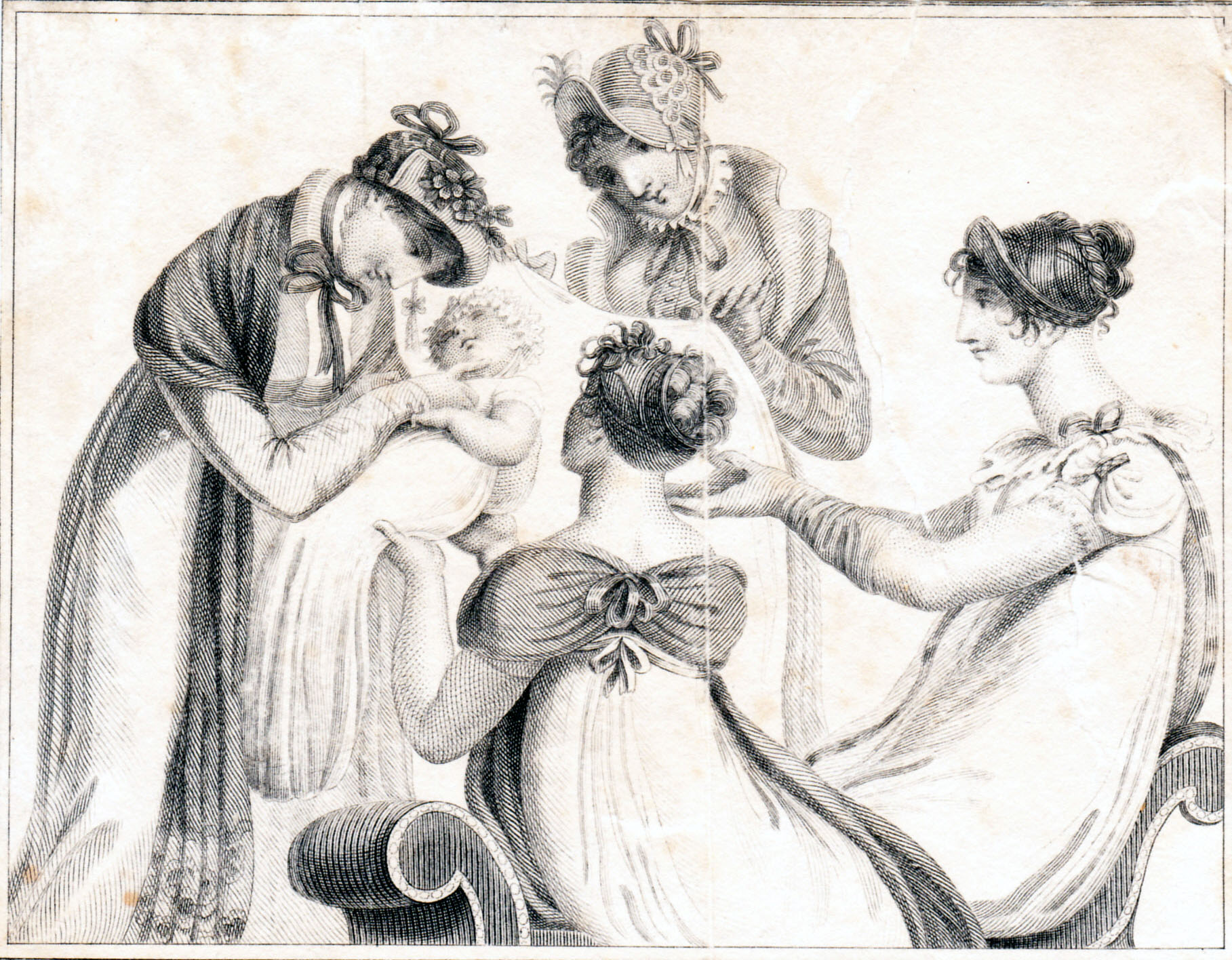
Ladies gather to admire the new arrival. A charming image from a ladies' memorandum book of 1806

Ladies gather to admire the new arrival. A charming image from a ladies’ memorandum book of 1806

 At the time of the newspaper report the expected birth of a child to the king’s fifth son was not of any great significance in the eyes of the public. The heir, the Prince Regent, had a very popular and healthy daughter, Princess Charlotte, and the Duke of Cumberland had three other brothers between himself and the throne. But as it turned out the unfortunate Charlotte died in childbirth in 1817 and there was a rush for the royal dukes to marry and produce heirs. Prince Frederick, the second son, died childless. The third succeeded George IV as William IV, but he had no legitimate children and it was the daughter of the fourth son, Edward, Duke of Kent, who became Queen Victoria.

But the British kings were also Kings of Hanover and Hanover operated under Salic Law which meant that no woman could succeed to the throne. So on William IV’s death Ernest became King of Hanover and Frederica his queen and eventually their son George became George V of Hanover. If Victoria had not been born then the throne of Great Britain would have gone to  Ernest  and then to his son. We would have had King Ernest I and then George V, who lived to 1878 – a continuation of the Georgians and no Victorians!

4 Comments

Filed under Royalty

Win a Copy of Walking Jane Austen’s London!

To celebrate the publication of Walking Jane Austen’s London  I am over at the lovely Word Wenches’ blog in conversation with historical romance author Jo Beverley about the story behind the book. Why not drop in and leave a comment there – there is the prize of a copy of the book to one lucky commentator.

http://wordwenches.typepad.com/word_wenches/2013/07/austenslondon.htmlJA Walks cover


15 Comments

Filed under Books

Jane Austen Travels by Stagecoach

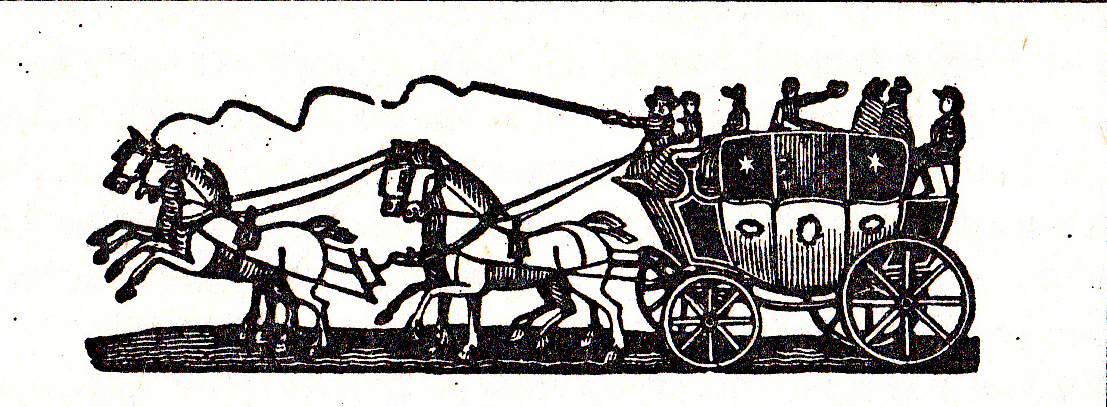
Advert header for the Regent coach 1822
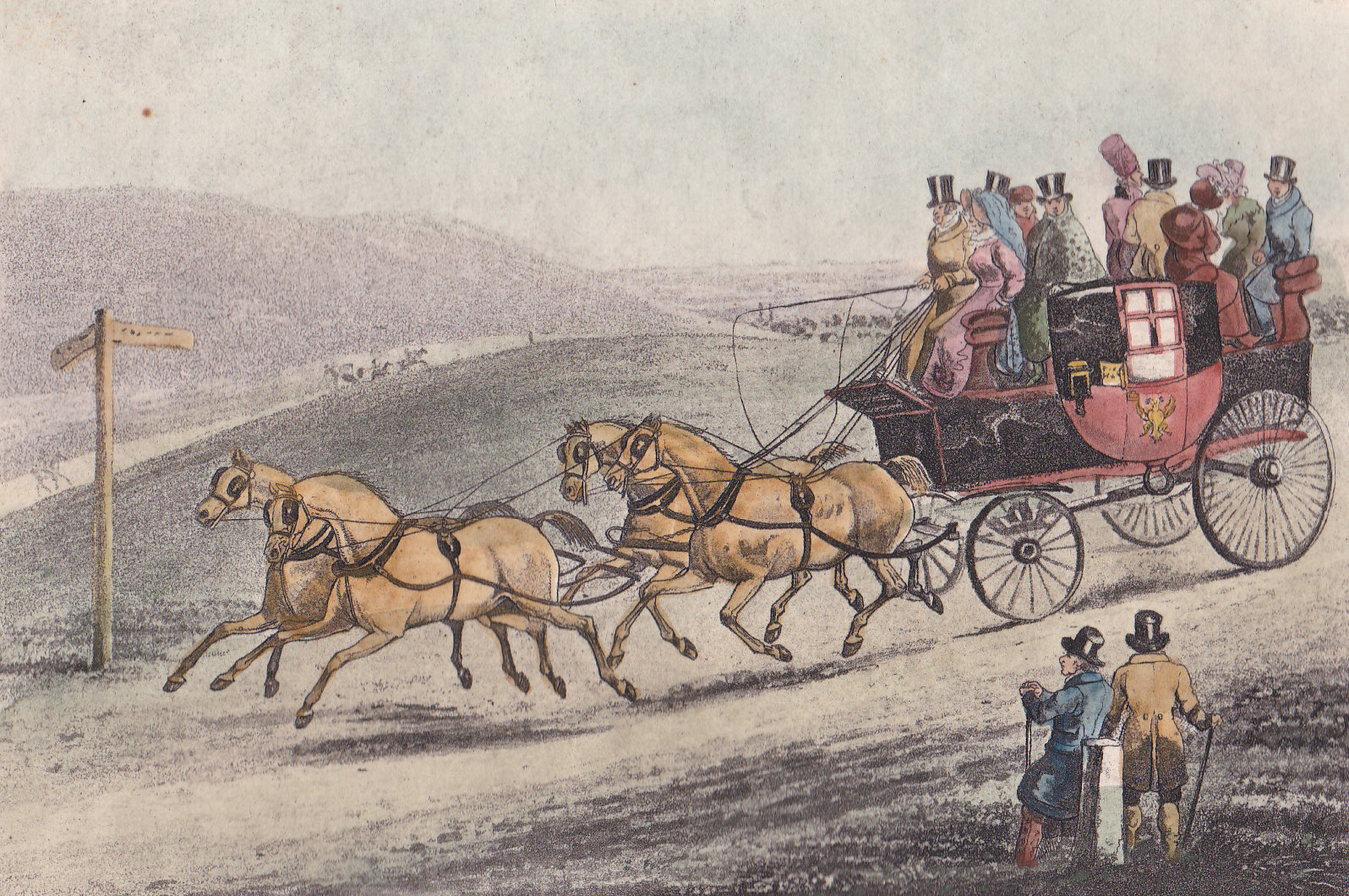
In 1796 20 year old Jane Austen wrote to her sister Cassandra, “As to our mode of travelling to Town, I want to go in a Stage Coach, but Frank [their brother] will not let me.” In her book Journey by Stages Stella Margetson states that Jane did not get her wish until August 1814 and I have been unable to find anything to the contrary in her letters.
As I am researching for a book on stagecoach travel at the moment I was glad of another excuse to dig into the Letters and remind myself what Jane wrote to her sister after arriving by stagecoach to stay with brother Henry in Hans Place on the 22nd August 1814.
“I had a very good Journey, not crouded [sic], two of the three taken up at Bentley [a village 7.5 miles form Chawton] being Children, the others of a reasonable size; & they were all very quiet & civil.”
This was a very important point for a lady travelling alone in the tight confines of the inside of the coach. With three passengers each side on a seat that was only 41 inches wide, knee to knee with those opposite, large or offensive fellow travellers would be exceedingly unpleasant.
“We were late in London, from being a great Load & changing Coaches at Farnham, it was nearly 4 I believe when we reached Sloane St, Henry himself met me, & soon as my Trunk & Basket would be routed out from all the other Trunks & Baskets in the World, we were on our way to Hans Place in the Luxury of a nice cool dirty Hackney Coach.”
From this it sounds as though Jane was dropped off at the top of Sloane Street where it meets Knightsbridge, before the stage continued on its way past the Hyde Park Corner turnpike and into London. The Hackney coach journey down to Hans Place would not have been a long one and she managed to retrieve all her luggage: an important consideration, especially when the journey involves a change of coach, as travellers’ guide books of the period warn.
stage crop
The next part of her description of the journey is not easy to interpret: “There were 4 in the Kitchen part of Yalden – & I was told 15 at top, among them Percy Benn…We took up a young Gibson at Holybourn; & in short everybody either did come up by Yalden yesterday, or wanted to come up.”
According to Deirdre le Faye, editor of the Letters, Mr Yalden was the owner of a private stage coach which he drove from Alton in Hampshire on one day and then back to Hampshire the next, although this does not quite accord with them having to change stages at Farnham. But what does Jane mean by the “Kitchen”? I wonder if she is making an “upstairs downstairs” joke with the inside passengers “downstairs” being in the “kitchen”. Or did the inside passengers gather in the kitchen of whichever establishment Yalden’s coach started from?
Fifteen passengers on top was a very large number and must have contributed to the chaos sorting out the luggage. Normally three of the outside passengers sat facing forward, three facing backwards and one next to the driver – seven in total. To have squeezed on another eight, they must have been jammed together in the luggage space between the front and rear facing passengers. This was potentially dangerous, for it could unbalance the coach, but Mr Yalden’s appears to have been quite a slow one, so perhaps there was not much risk.
The route after Bentley and Farnham is not given, but I would suspect the coach would have continued to Kingston upon Thames, crossed the Thames at Kew and then turned east for Knightsbridge. These days it is a journey of about fifty five miles. A fast coach would average ten miles an hour, Mr Yaldon’s probably six or seven, so Jane would have had to set out by at least seven in the morning. No wonder she was pleased to see Henry and his nice cool Hackney carriage, however dirty!
If anyone has an alternative explanation for what Jane meant by “the Kitchen part” I’d be fascinated to hear it.

11 Comments

Filed under Transport and travel

Soho House – and some very early central heating

A quick word to say that if you were interested in the last post about lighting you might like to see more of the house where I photographed two of the lamps – Soho House in Birmingham. It was the home of pioneer industrialist Matthew Boulton, a meeting place of the famous Lunar Men and the location of what may well be the first hot air central heating system since the Romans! More about it, plus some pictures at http://historicalromanceuk.blogspot.co.uk/

1 Comment

Filed under Buildings, Science & technology

Jane Austen by Candlelight – or was it a lamp?

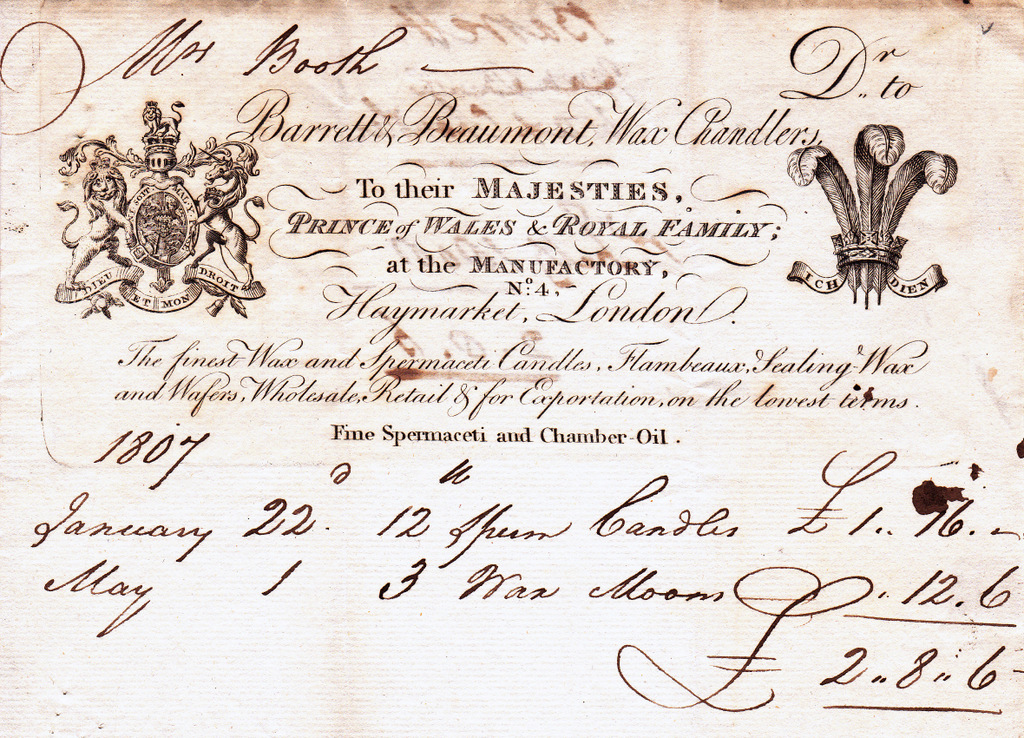
In September 1813 Jane Austen was staying with her brother Henry at his Henrietta Street address in Covent Garden, along with their brother Edward, his daughter Fanny and two of Fanny’s younger sisters. On the 16th Jane wrote to her sister Cassandra, ‘We are now all four of us young Ladies sitting around the Circular Table in the inner room writing our Letters, while the two Brothers are having a comfortable coze in the room adjoining.’1-Barretts bill minor crop

It is a charming picture, but how were the four ladies illuminating their work? Probably not with smelly tallow dip candles, unless they were in an economical mood. Those were made from mutton fat, usually contained bits of meat, smelled strongly and, in homes with any pretence to gentility, were Candle advert cropconfined to the service areas.

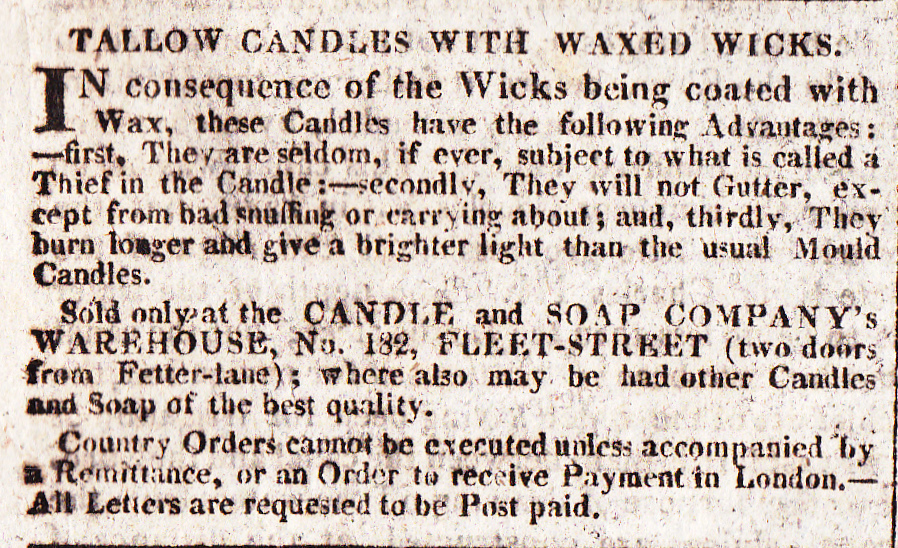
There was an “economy” candle available – tallow with a wick that had been dipped in wax which must have reduced the smell a little and, according to The Candle & Soap Company’s advert of August 1802 shown left, (The Statesman newspaper), would not “Gutter except from bad handling or carrying about.”

However, we know that the Austens bought pure wax candles from Penlington’s, a tallow chandlers at the sign of the Crown and Beehive, Charles   Street (now Wellington Street), a short walk from the Covent Garden piazza and Henrietta Street. It evidently produced superior candles, for the family would order from them by mail: on 1 November 1800 Jane tells Cassandra, who has just passed through London on her way to Kent, that their mother was ‘rather vexed’ because Cassandra did not call at Penlington’s but that she had sent a written order, ‘which does just as well.’

I don’t have a bill from Penlington’s, but the one shown at the top is from the very smart shop, Barrett & Beaumont, Wax Chandlers to Their Majesties – you can see the royal coat of arms to the left and the Prince of Wales’s feathers on the right, denoting the royal warrents.  The bill, for two pounds eight shillings and six pence is for twelve candles – I think it says “sperm” for spermaceti (ie whale oil) and three “Wax Moons”, which are a mystery to me.Candle magnifier

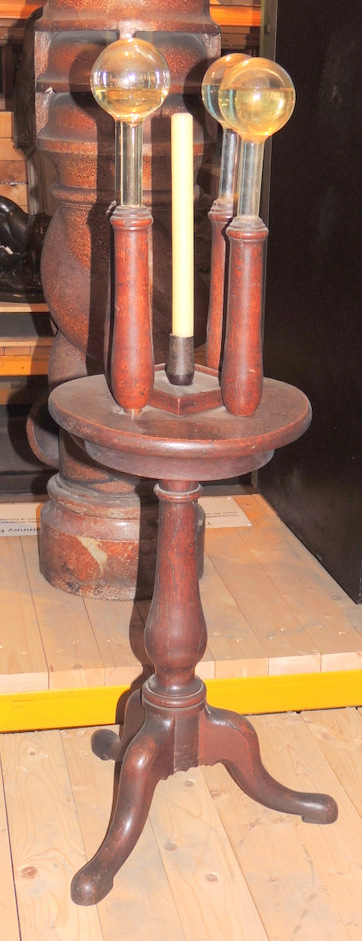
A single candle, or even a branch of candles, does not produce a very bright light, so for detailed work there were methods of focusing and concentrating the light. One method was to place a glass globe filled with water in front of the flame and this photograph (right) shows a device for giving a group of sewers stronger light from just one candle. (Birmingham Museums Reserve Collection).

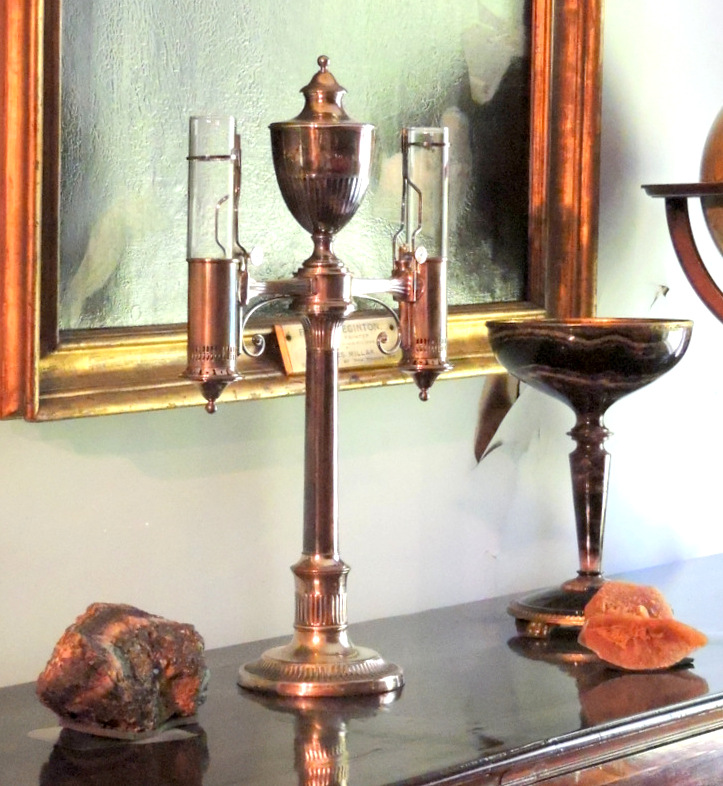
Argaud lampThe first lamp designed on scientific principles was the Argand lamp, patented in 1780. It used a wick drawing on a reservoir of whale (spermaceti) or vegetable oil and they were made in very handsome designs in silver or in Sheffield plate. The photograph (left) is of one at Soho House, Birmingham, the home of Matthew Boulton, the manufacturer. This particular pattern is silver plate, of about 1800.

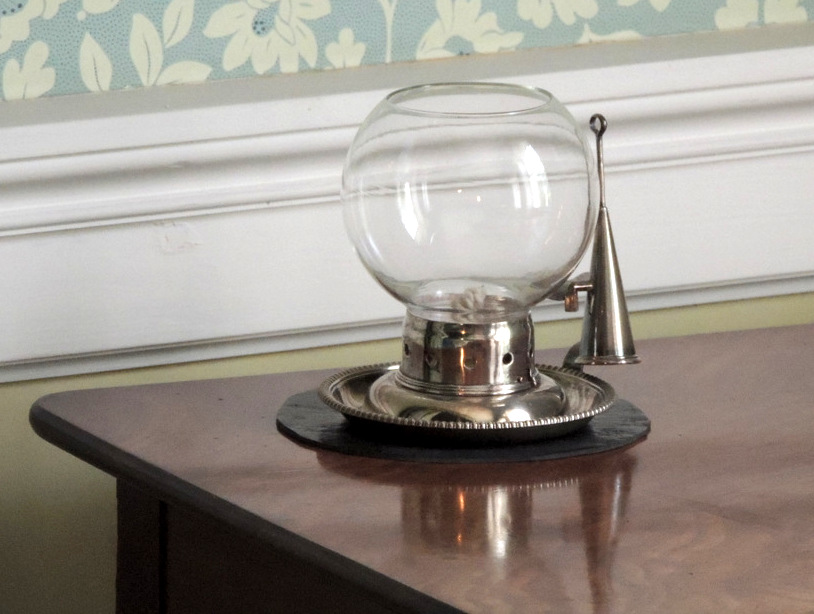
Soho House also contains another lamp by Matthew Boulton & Plate Company, this time of c.1820 (shown below). It is a neat little bedside lamp made to burn colza (rape seed) oil. With our frequent power cuts out here in the country I rather covet this little lamp.colza lampIf anyone knows what a “wax moon” might be, I’d love to hear from you!

23 Comments

Filed under Shopping, Uncategorized

Miss Austen Buys Fabric

The most frequent item mentioned by Jane Austen when she writes home to Cassandra about her London shopping expeditions is fabric for her own use and for Cassandra and their mother. Ready made gowns were unusual and ladies in modest circumstances, such as the Austens, would buy dress lengths of fabric and either make them up at home or use a local dressmaker.

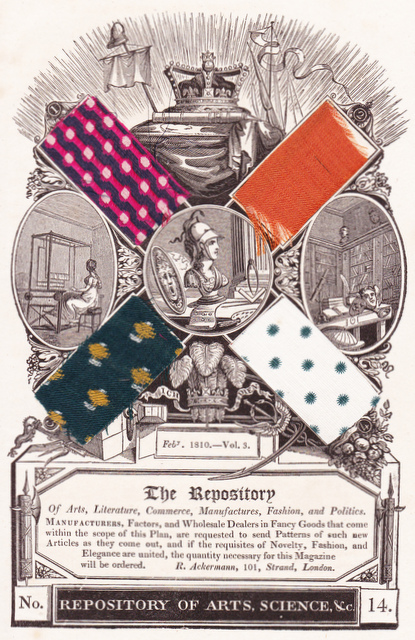
Mostly ladies would browse at the drapers’ shops and make their choices there, but Ackerman’s Repository of Arts, Science etc, was innovative enough to give samples of real fabrics in the magazine and a page for February 1810 is shown here.
1-Ackermann fabrics
Top left: A royal embossed satin: a splendid and elegant article for robes or pelisses. Sold by Harris, Moody & Co., silk-weavers, Pall-Mall.

Top right: A superfine imperial orange bombazeen, particularly calculated for Ladies’ dresses. It is sold, of every colour, by Messrs. Waithman and Everington, No,104, Fleet-street.

Bottom left: An imitative Angola shawl dress of blended green and amber. Sold by Messrs. Brisco & Powley, No.103, New Bond-street, from 38s to 50s per dress.

Bottom right: An India rib permanent green print. A patent has lately been obtained by Hewson, Higgins & Hett, for printing green on cotton goods. Sundry cotton goods for waistcoats are printed exclusively for Kestevens, York-street, Covent-garden.

On 24th May 1813 Jane wrote, “I went the day before (Friday) to Layton’s as I proposed, & got my Mother’s gown, 7 yds at 6/6.” [ie six shillings and six pence a yard]. Layton’s drapery shop, Bedford House, was at 9, Henrietta Street in Covent Garden, right next door to Henry Austen’s bank at number 10. Henry was on the point of moving to live in he apartments over the bank and Jane reports going next door to inspect the work, “which is all dirt & confusion, but in a very promising way…”

She does not say what kind of fabric she had purchased, presumably the ladies had agreed about that in advance, but in mid-September she was staying with Henry at number 10 and reports, “We did go to Layton & Shear’s before Breakfast. Very pretty English poplins at 4 [shillings and] 3 [pence]. Irish ditto at 6 [shillings] – more pretty certainly – beautiful.” Later in the same letter she writes to Cassandra, “…I am going to treat myself with spending [my superfluous wealth myself. I hope at least I shall find some poplin at Layton & Shears that will tempt me to buy it. If I do, it shall be sent to Chawton, as half will be for you … I shall send 20 yards.”

The invaluable English Women’s Clothing in the Nineteenth Century by C.Willet Cunnington describes poplin as being “made of a silk warp and wool or worsted weft, having a fine cord on the surface, and produced in several varieties, brocaded, watered and plain.”

Jane also patronised Christian & Sons at 11, Wigmore Street where she bought dimity (“A stout cotton fabric, plain or twilled, with a raised pattern on one side.”) and Newton’s, just of Leicester Square, for Irish linen.

One of the most up-market fabric shops were Wilding & Kent at Grafton house on the corner of New Bond Street and Grafton Street. On 17 April 1811 Jane and Manon, Eliza Austen’s maidservant, ‘…took our walk to Grafton House, & I have a good deal to say on that subject. I am sorry to tell you that I am getting very extravagant & spending all my Money; & what is worse for you, I have been spending yours too…’ she told Cassandra. It was a very busy shop and in November 1815 Jane complains of ‘the miseries’ of shopping there and most of her references to it mention an early start and long waits to be served – not that this stopped her going there frequently.

One fashionable drapers, Harding, Howell and Co., is not mentioned by Jane, although she must have known it, for it was located in Pall Mall in the seventeenth century red brick Schomberg House which still stands out in this street of stone and stucco.

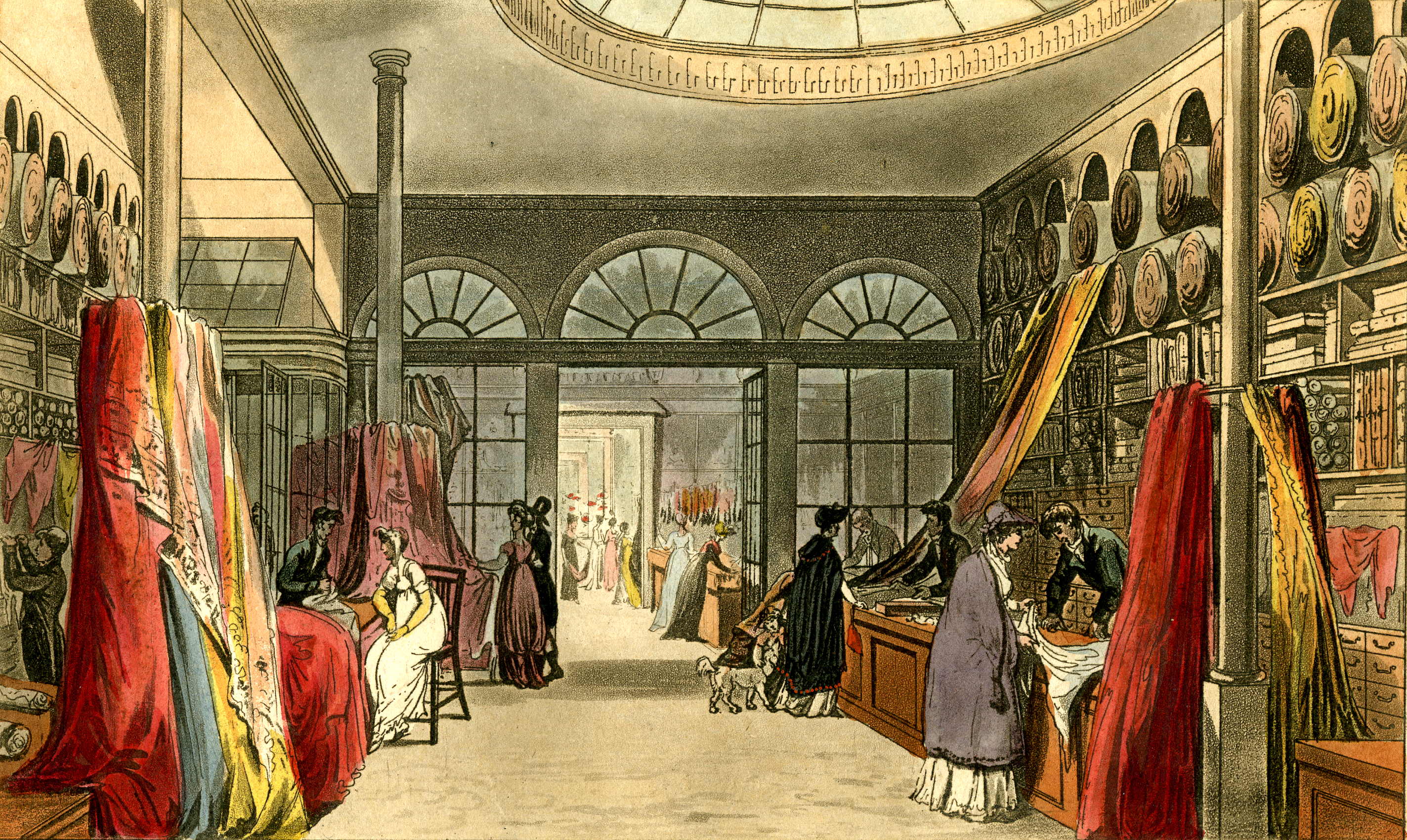
According to Ackermann’s Repository, which is where the illustration below appeared, ‘It is fitted up with great taste, and divided by glazed partitions into four departments.’ These were: furs and fans; ‘haberdashery of every description, siHarding, Howel0001lks, muslins, lace, gloves etc.’; jewellery and ornamental items including perfumery and finally, ‘millinery and dresses; so that there is no article of female attire or decoration, but what may here procured in the first style of elegance and fashion.’

12 Comments

Filed under Fashions, Shopping

Henry at Whites! Oh, what a Henry!

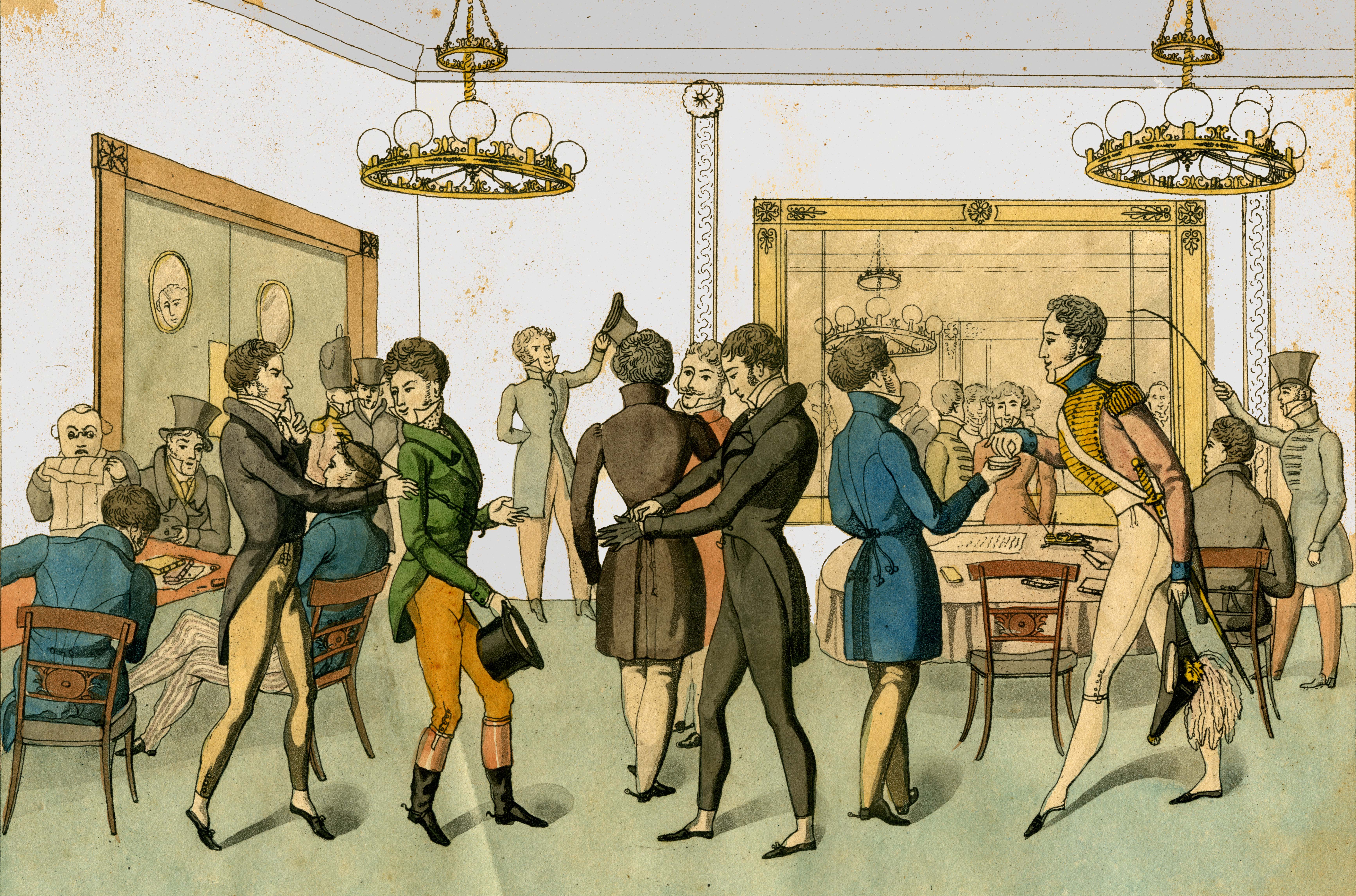
Club interior for JASt James’s Street was the heart of fashionable masculine London during the late Georgian and Regency period. Here gentlemen had their lodgings, kept their mistresses, bought their clothes and gambled in hells and clubs. It was not an exclusively male preserve, for modistes had their shops there and ladies could even buy ready-made corsets from Mrs Clark, whose shop was at no.56, and who advertised in 1807 ‘…a large assortment of corsets of every size, and superior make, so that ladies may immediately suit themselves without the inconvenience of being measured.’

SONY DSC However, it for the clubs that St James’s Street is famous and you can still view the exterior of many of them – getting inside is another matter! Membership has always been exclusive: who you knew mattered, breeding mattered – but money mattered less. Politics might influence which clubs a gentleman felt most at home in, although White’s, the most exclusive of them all, was non-political.

Boodles attracted the country set and hunting squires, the Four in Hand, sporting gentlemen. The Travellers’ Club was favoured by diplomats, Watier’s, in Piccadilly, by lovers of fine food and the Roxburghe was the haunt of bibliophiles. If you wanted high-stakes gaming, then Brookes’s and, after 1827, Crockford’s were the clubs for you.

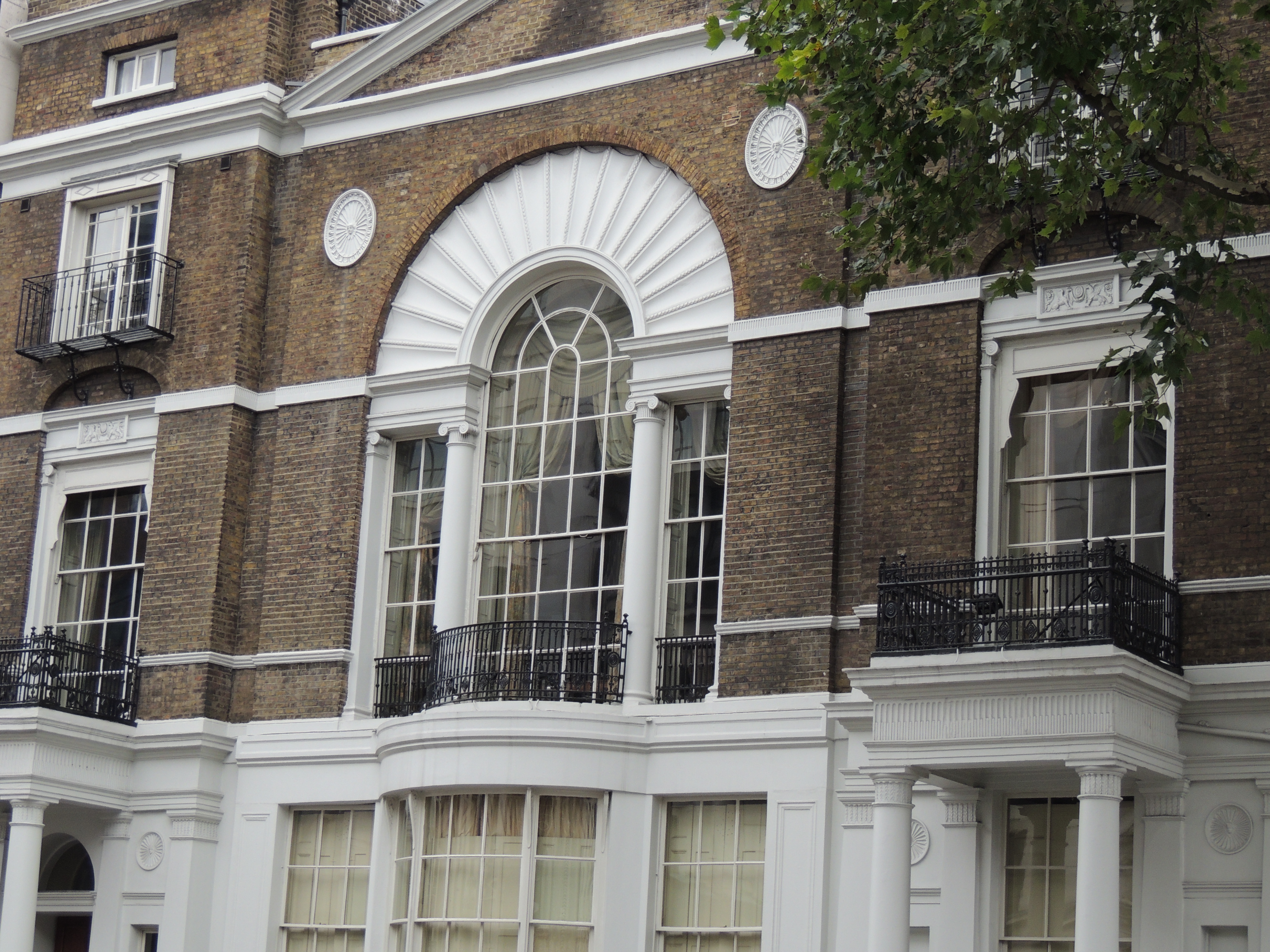
Today, if you walk down St James’s Street from the top of the hill at Piccadilly you almost immediately come to Crockfords on your right and White’s on your left. White’s possessed the famous Beau (or Bow) Window where the elite would sit to view, and pass judgment on, the passing scene. It still has a bow, but, given that there have been some changes to the exterior during the 19th century, it may not be the famous one.
Henry Austen, Jane’s banker brother,  had some very respectable connections, but he was not a club man. However, he must have had connection with those who were. In 1814, after the first defeat of Napoleon, threw a great ball that cost £10,000. Guests included King George III, the Prince Regent, the Emperor of Russia – and Henry Austen. ‘Henry at Whites! Oh! What a Henry.’ Jane could hardly contain herself at the news.

A little further down on the same side of the road is Boodles club. It moved here to no.28 in 1783 to premises originally occupied by the Savoir Vivre, a notorious hell.

 DSCN0058

To reach Brooks’s, you need to cross the road. Do take advantage of one of the traffic islands in this busy, very wide, street – they were originally introduced in the early nineteenth century to make life safer for the slightly inebriated clubmen making their way from one establishment to another. Brook’s is on the corner of Park Place and was one of Byron’s clubs. A stronghold of the Whigs, it moved here in 1778. this is the one London club I have been inside and the Great Subscription Room, illustrated here, looks just as it did then (although there were no Regency bucks engaged in gambling, much to my disappointment!).

In one corner of the Great Subscription Room a tense game is underway with a large pot of winnings in the centreJust a little further down was Arthur’s (not a great success) and the Cocoa Tree coffee house. The Cocoa Tree was not a formal club, but provided another sanctuary for like-minded gentlemen, such as Byron, who frequently visited.

Finally, to see the location of one of the gaming ‘hells’ where almost anyone who had the money to bet was admitted, cross the road again and walk down to the narrow entrance just before Berry Bros. & Rudd. This leads to Pickering Place, now a charming little courtyard, but once the home of some notorious hells, the reputed location of the last duel in London and, later in the 19th century, the home of the Texas legation.

Top: a club interior. The young man in breeches and carrying a riding whip and hat is being reproved for being improperly dressed.

Second: the bow window outside White’s Club (looking up towards Piccadilly)

Third: The handsome frontage of Boodles’s Club

Bottom: one corner of the Great Subscription Room at Brooks’s Club (1808). A high-stakes game is underway with a large pot of money to be won in the hollowed-out table centre.

4 Comments

Filed under Buildings, Gentlemen