Category Archives: Royalty

Jane Austen, Stays and Elegant Fig Leaves

At this time of year, when we are all thinking about shedding as much clothing as possible in the heat, I think with even more sympathy about the layers of clothing that women were encumbered with in earlier years – and corsets, or stays as they were more usually known in the early 19th century in particular.

Stays could be made of leather, which was then not washed (a fairly dreadful thought!) or a substantial fabric, which at least could be laundered. Stays normally laced at the back but, before the invention of mass-produced metal eyelets, they could not be pulled as tight as Victorian stays were because the fabric would rip. Their shape and their constricting powers therefore depended on their stiffening of whalebone or thin cane. They pushed the breasts up rather than cupping them and were normally fitted with shoulder straps.

ImageThe print by Gillray is plate 1 from a series called The Progress of the Toilet, dated 1810 and shows a lady being laced into long stays. She is wearing fashionable clocked stockings and, rather daringly, drawers, caught in tight at the knee. Because they resembled masculine costume, drawers were considered very fast.

Jane Austen’s letters contain virtually nothing on the subject of underwear, but she did have very definite views on the subject of stays. In September 1813 she was able to pass on the latest intelligence from London on the subject  to her sister Cassandra. ‘I learnt from Mrs Tickar’s young Lady, to my high amusement, that the stays now are not made to force the Bosom up at all; that was a very unbecoming, unnatural fashion.’

Stays could be made to measure, but were also available off the peg and Mrs Clark, whose shop was at no.56, St James’s Street, advertised in 1807,  ‘…a large assortment of corsets of every size, and superior make, so that ladies may immediately suit themselves without the inconvenience of being measured.’

Ladies living out of town could order stays by mail order as this advertisement from the Morning Chronicle of November 1 1810 shows.

HER MAJESTY’S STAY-MAKER. – MRS. HARMAN No.18 New Bond-street, London, has the honour most respectfully to announce to those Ladies who attend to the elegance of the female figure, that she has now ready for their inspection a very large and fashionable assortment of her much-admired LONG and SHORT STAYS. The great number of Ladies of Rank and Fashion, who honour Mrs. Harman with wearing her Stays, is a most convincing proof of their pleasantness, utility, and superiority to every other Stay. Mrs. Harman’s Stays are finished with that novelty and taste which has procured for her the countenance of Royalty, and the patronage of the first Nobility. Ladies living in the country, by sending a letter (post paid), will have proper directions sent them to send their own measure, so as to insure their fitting.

Newspapers were not constrained by notions of modesty when commenting on ladies’ fashions and undergarments, or their appearance in them as this piece from The Times in 1799 on the flimsiness of fashionable gowns and the fashion for false bosoms shows:

“If the present fashion of nudity continues its career, the Milliners must give way to the carvers, and the most elegant fig-leaves will be all the mode. The fashion of false bosoms has at least this utility, that it compels our fashionable fair to wear something.”

And The Statesman on 2 September 1808 broke into verse to criticise modern fashions compared to those of the days of Queen Anne, managing to incorporate a furniture pun about chests and drawers in the process!

 When panoplied in whalebone stays,

Such as were worn in Anna’s days,

Our fair kept Virtue in their breasts,

And lock’d her safely – in their chests.

 But, since their chests are open’d, how,

And where, do they keep Virtue now?

Is she protected by their lawyers?

Or do they keep her – in their drawers?

Historical re-enactors have told me that they find their stays are supportive, and help prevent backache when they are working in kitchens, so perhaps there was something to be said for stays. What do you think?



6 Comments

Filed under Fashions, Royalty, Shopping

A Royal Birth, A Duchess “in the straw” and Some Dynastic Speculation

Felix Farley 2 crop

As I write this post the newspapers are full of discussion about the Duchess of Cambridge’s pregnancy, the birth and any other royal or baby detail they can try and make remotely relevant. I had always assumed that the Georgian papers were slightly more restrained and respectful about royal births, even when the royals themselves were often cruelly lampooned. Imagine my surprise when reading a copy of Felix Farley’s Bristol Journal of December 28th 1816 to find this snippet on the front page:

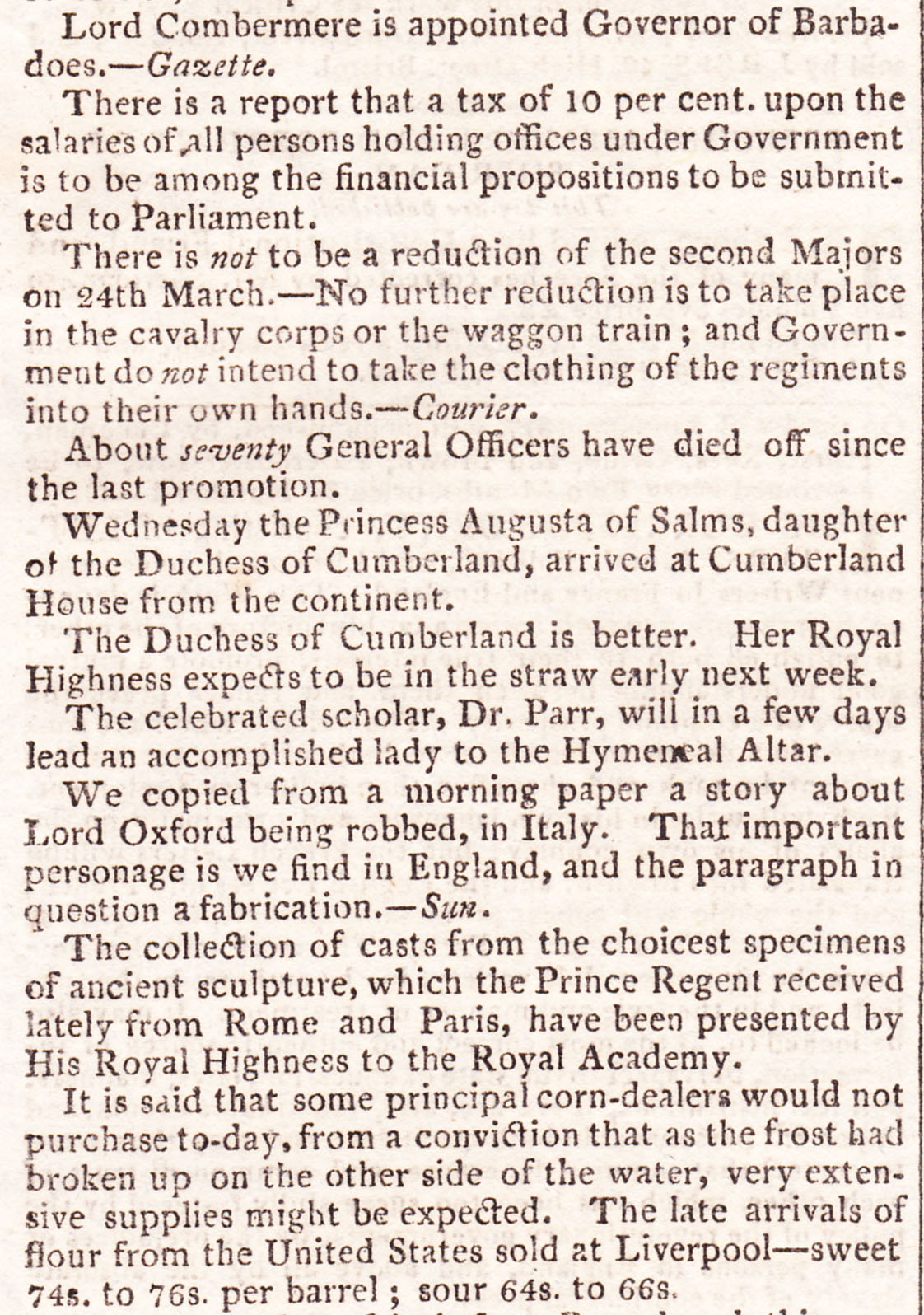
 Wednesday the Princes Augusta of Salms, daughter of the Duchess of Cumberland, arrived at Cumberland House from the continent.

In the straw crop

The information about the Duchess of Cumberland was in amongst a very mixed bag of news!

The Duchess of Cumberland is better. Her Royal Highness expects to be in the straw early next week. 

 “To be in the straw”, Grose’s Index to the Vulgar Tongue (1785) informs me is, “to be in childbed.” Is anyone else as amazed as I was to see a respectable newspaper using slang about such a subject? I would have thought they would say, the duchess “expects to be confined early next week.” Or has anyone come across the use of this phrase in a “respectable” context?

 I was intrigued enough to find out more about the Duchess of Cumberland and what happened. Even more intriguing was the discovery that she might well not have become the Duchess of Cumberland, for she had very nearly married another prince – the Duke of Cambridge!

 Princess Frederica of Mecklenberg-Strelitz was born in 1778, the niece of Queen Charlotte, wife of George III. She was therefore the first cousin of the numerous British royal offspring, including Prince George, later Prince Regent and King George IV.

Frederica’s married life was, to put it mildly, eventful. First, when she was only fifteen, she married Prince Louis, younger son of King Frederick William II of Prussia, but it was an unhappy match and he died in 1796 leaving her, at the age of eighteen, the mother of two children, Prince Frederick and Princess Frederica.

A year later she met and became unofficially engaged to Prince Adolphus, Duke of Cambridge, King George III’s seventh son. But to marry they needed the king’s permission and the queen, Frederica’s aunt, was adamantly opposed to the match and persuaded the king to refuse his consent.

The next year, Frederica became pregnant during an affair with Prince Frederick William of Solms-Braunfels who married her rapidly to prevent the scandal becoming any worse. It was another unhappy marriage, despite the birth of seven children, for Prince Frederick was dissipated and a heavy drinker. Three of the children lived to marriageable age and it was one of those, the Princess Augusta, who was mentioned (her title misspelt) in the Journal report.

Things were so bad between the couple that Frederica was advised to divorce, a remedy supported by the King of Prussia. It was at that point, in 1813, that she met Prince Ernest Augustus, Duke of Cumberland, and fifth son of King George III, who was visiting one of his German relatives. The couple fell in love and, very conveniently, Frederica’s husband died, creating rumours that she had poisoned him.

Frederica and Ernest married in Germany two years later and again at a second ceremony at Carlton House, the Prince Regent’s London home, on 29th August 1815. The king and Parliament gave their consent, but Queen Charlotte was still strongly opposed to the match, refused to attend the wedding and advised the couple to live on the continent as much as possible.

 The pregnancy that the Journal comments on was the first of this marriage, but tragically the baby, a girl, was stillborn. After a further stillbirth a son, Prince George, was born to the couple in 1819.

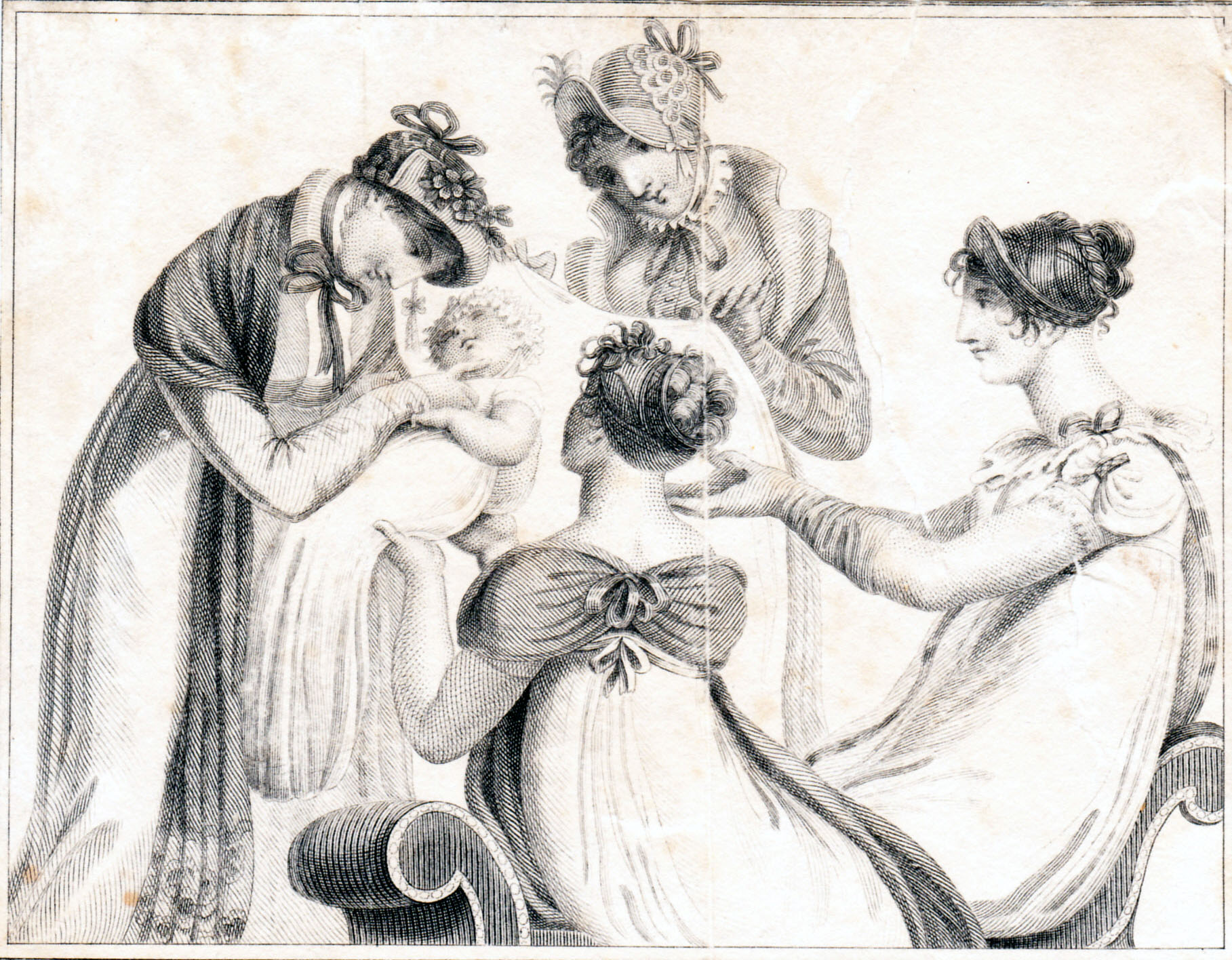
Ladies gather to admire the new arrival. A charming image from a ladies' memorandum book of 1806

Ladies gather to admire the new arrival. A charming image from a ladies’ memorandum book of 1806

 At the time of the newspaper report the expected birth of a child to the king’s fifth son was not of any great significance in the eyes of the public. The heir, the Prince Regent, had a very popular and healthy daughter, Princess Charlotte, and the Duke of Cumberland had three other brothers between himself and the throne. But as it turned out the unfortunate Charlotte died in childbirth in 1817 and there was a rush for the royal dukes to marry and produce heirs. Prince Frederick, the second son, died childless. The third succeeded George IV as William IV, but he had no legitimate children and it was the daughter of the fourth son, Edward, Duke of Kent, who became Queen Victoria.

But the British kings were also Kings of Hanover and Hanover operated under Salic Law which meant that no woman could succeed to the throne. So on William IV’s death Ernest became King of Hanover and Frederica his queen and eventually their son George became George V of Hanover. If Victoria had not been born then the throne of Great Britain would have gone to  Ernest  and then to his son. We would have had King Ernest I and then George V, who lived to 1878 – a continuation of the Georgians and no Victorians!

4 Comments

Filed under Royalty

St James’s Palace Part 2 – George III and the Regency

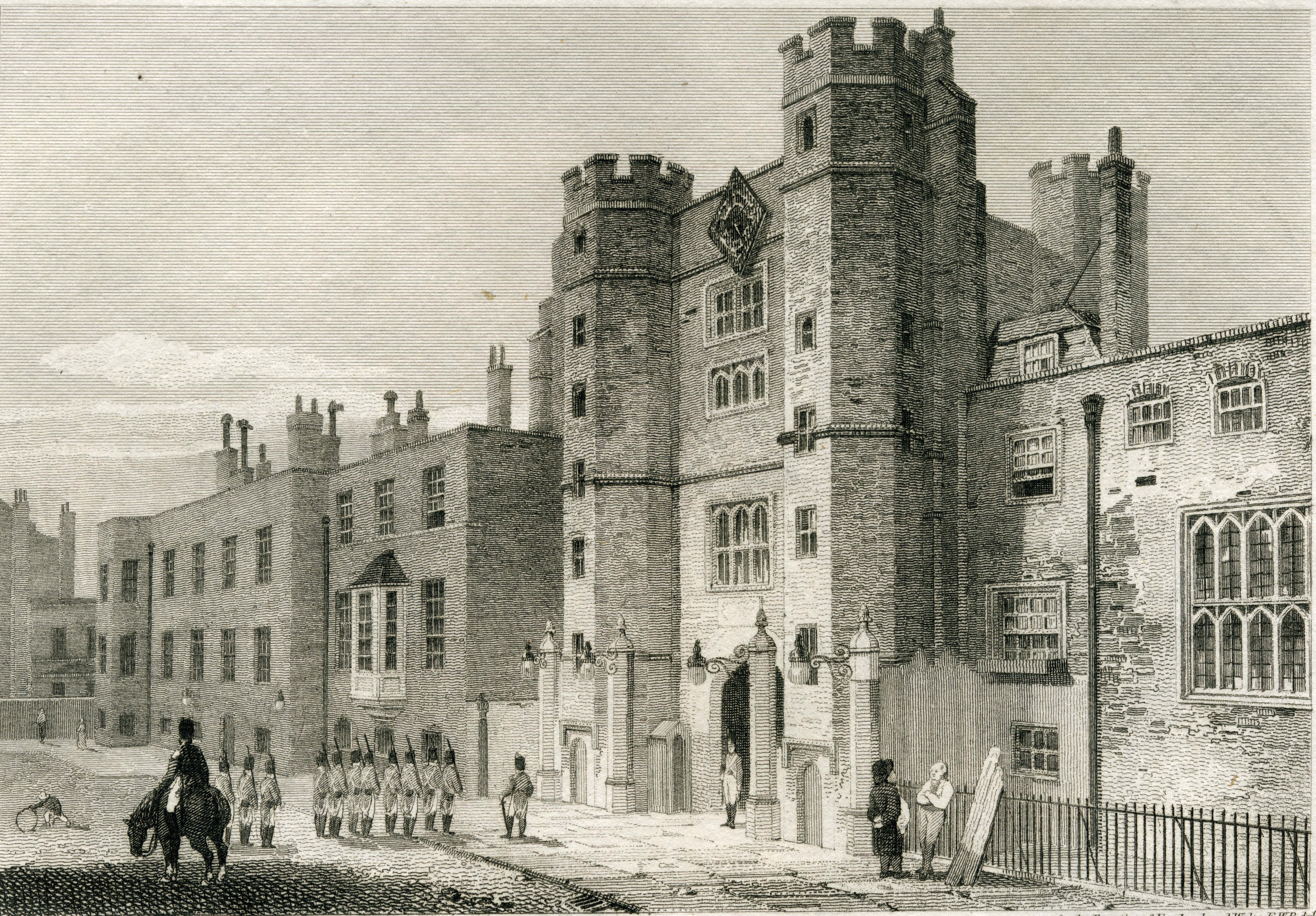
The Palace in 1809

The Palace in 1809

George III moved to St James’s Palace on his accession in 1760 and was married there the next year.  The ramshackle old palace did not suit the couple and in 1762, the year that Prince George (later to be Prince Regent and George IV) was born, George bought Buckingham House on the other side of St James’s Park.  The newly-weds moved there, renamed it the Queen’s House, and used St James’s Palace for state occasions, which included the births of the royal children.

The King held Levées in the afternoon on Wednesdays and Fridays, and on Mondays when Parliament was sitting. These were men-only occasions and formal Court dress or, for officers, dress uniform was worn. Male members of the royal family, ministers and ambassadors were expected to attend and MPs who supported the government of the day often came too. They would line the walls of the Privy Chamber (for those of the highest office) and the Presence Chamber and the King would circulate around the room before retiring to the King’s Closet and holding a Privy Council.

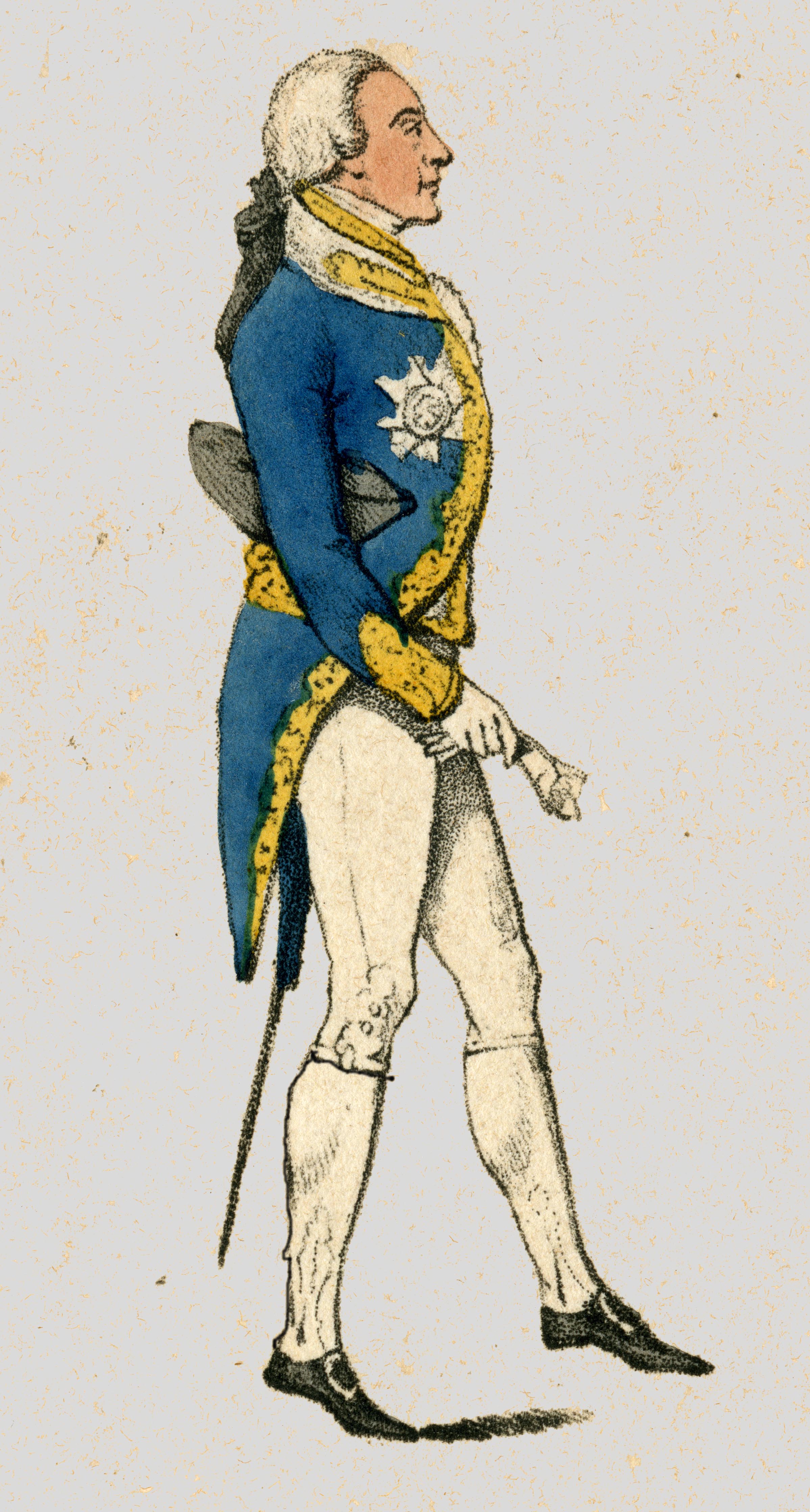
Court dress for men

Court dress for men

Drawing Rooms were held on Thursday afternoons and on Sundays after the morning service at the Chapel Royal. (Today this is the only part of the palace open to the public. Services are at 8.30 am and 11.30am, October to Good Friday.) Men and women were admitted: this was the opportunity for newcomers to Society to be presented and courtiers intending to marry would present their spouses. Drawing Rooms were also the occasion when new ambassadors were received, newly appointed senior officers and ministers would come to ‘kiss hands’ and decorations would be bestowed.Full court dress was worn, which for women meant vast hooped skirts, even when the fashion was for a high waistline, creating a ludicrous silhouette. When George VI came to the throne he allowed hoops to be dispensed with, but ostrich plumes continued to be compulsory. Jane Austen’s cousin, Eliza de Feuillide, attended a Drawing Room in her youth, before she was widowed and remarried Jane’s brother Henry. She complained bitterly about the great weight of the gown.

After the formal business was over the royals would work around the room speaking to the guests and later Queen Victoria recalled learning the art of ‘cercléing’.

After 1788, with the onset of the King’s illness, Levées and Drawing Rooms were held only intermittently at St James. In 1810 John Wallis noted, ‘…since [George III’s] last illness, this palace is almost deserted; a levee only is holden here now and then when the king comes from Windsor, for that purpose. Windsor is now the favourite residence.’ From then on one of the royal princes would preside or, for Drawing Rooms, the Queen.

On the King’s 72nd birthday in 1810 there were great celebrations on June 4th, featured in detail in all the papers. The Morning Chronicle reports that the royal family visited The Queen’s Palace in the morning but the King remained there in the afternoon while the Queen and her family processed to St James’s Palace. They were not only without the King, but also the Duke of Cumberland who was recovering from a murderous sword attack by his valet which left him badly cut around the head (or, as gossip persisted in stating, he had murdered the valet and had been wounded during the fight!) and Princess Amelia who had been in poor health for some time. The paper hints that many ladies had held off from ordering court dress in case they needed to change it for mourning. Princess Elizabeth was in tears throughout, although whether from worry about her siblings, or distress that her father could not attend, is not clear.

The Morning Chronicle devoted two full pages to describing the Drawing Room, the balls and illuminations in the evening and five and a half columns to details of the gowns worn by the ladies.

Although their parents were living at the Queen’s House (or perhaps because of that!) the royal dukes moved into apartments at St James’s Palace with, of course, the exception of the Prince Regent who had Carlton House built for himself. When he succeeded to the throne he redeveloped The Queen’s House to become Buckingham Palace, with State Apartments that removed the necessity to use St James’s. The old palace became the home of other royals, retired courtiers and  palace officials, a role it continues to fulfil as London home to the late Queen Mother, and the Duke and Duchess of Cambridge.

Here is part of the detailed description of the gown worn by every lady attending the Drawing Room for the King’s Birthday in 1810. (Morning Chronicle June 5th)

3 Comments

Filed under Buildings, Royalty

St James’s Palace – Part One

One building we can be certain would be completely recognisable to Jane Austen in today’s London is St James’s Palace which lies at the bottom of St James’s Street with Green Park to the north-west and St James’s Park to the south.

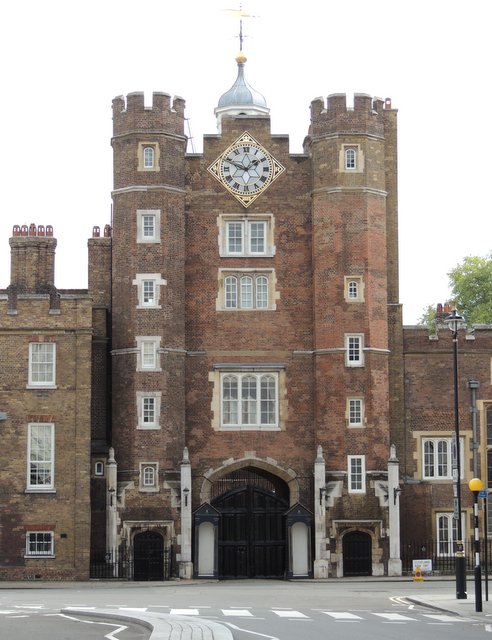
DSCN0073

It had an unglamorous beginning for a royal palace – as a leper hospital. In the 11th century the parish of St Margaret’s, Westminster (whose church sits in the grounds of Westminster Abbey) was given land for the establishment of a hospital for fourteen leprous women. The hospital was dedicated to St James the Less and was remote from habitation in a swampy area, regularly flooded by a branch of Tyburn Brook. What is now Piccadilly was a track on a ridge leading from the City of London to the west, but it was completely without habitation.

Successive kings and queens granted the hospital money until 1348 when the Black Death seems to have killed off the inhabitants and the buildings were leased out to various occupiers until 1439 when Henry VI granted the hospital and its lands to Eton College. In 1531 Henry VIII took it from the College in a swap with some royal lands elsewhere.

In the City of London and the City of Westminster Henry already possessed the Tower of London, Bridewell Palace, Baynards Castle, Whitehall Palace and Westminster Palace. He had another palace just downstream at Greenwich, plus Hampton Court upstream which he seized from Cardinal Wolsey. Despite all this he decided to build another palace at St James’s and had the old building demolished to make way for it. By acquiring the St James’s property he vastly extended his Westminster/Whitehall lands with a hunting park over a wide area, including what is now St James’s Park.The new palace was begun in 1536 and the great gatehouse that stands at the foot of St James’s Street dates from this phase of building. (Photograph at the top of the page). Edward VI, Mary and Elizabeth all lived at St James’s Palace from time to time and, with the accession of the Stuart dynasty, more work was done to make it a fit residence for the heir. Prince Henry, however, died in 1612, after which it was taken over by his brother, later Charles I. The palace was still remote, with parkland to the south and fields to the north. The only significant development was the Queen’s Chapel, built by Inigo Jones  in anticipation of Charles’s marriage to Henrietta Maria, a Roman Catholic who lived at the palace whilst Charles had his base at Whitehall.

During the Commonwealth the palace became a barracks and a prison, but after the Restoration the Duke of York (later James II) used it and considerable building work was carried out. James moved to Whitehall on his accession leaving St James’s to his queen. It was during this period that the palace’s first water closet, ‘The Stool Room’, was built complete with Dutch wall tiles and brass and ivory fittings to operate the flushing cistern.In the years after Charles II’s return to the throne the entire St James’s area was developed and became a major centre for courtiers, hangers-on at the court and the tradesmen who serviced them. After the Glorious Revolution William and Mary did not live at St James’s but Mary’s sister, Queen Anne, did, and had an extensive building programme carried out with a new suite of royal apartments designed by Sir Christopher Wren. The queen held ‘Drawing Rooms’ during the winter months when anyone of respectable appearance would be admitted, along with the courtiers and ministers there to do business, but they were dull occasions and the queen disliked the palace, preferring Windsor Castle or William and Mary’s Kensington Palace.When the Hanoverian monarchs took over the throne in 1714 George I moved into St James’s Palace and used it more intensively than his predecessors. George II disagreed, apparently concurring with the Prussian Baron Bielfeld who called it ‘crazy, smoky and dirty’ and Daniel Defoe who considered it ‘mean’ and beneath the dignity of the court.But it was the official London royal palace – Westminster and Whitehall had become Parliamentary and governmental complexes and the Tower was impossibly medieval. Winter was the time for the court to be in residence there with monarchs preferring Kew, Windsor and Kensington during the summer months.

Prince George, who was to become the Regent, then George IV, was born at St James’s Palace in 1762 and the baby was displayed less than two weeks after his birth to all those attending the Drawing Room. The king and queen considered the palace,  described by Sir John Fielding as ‘the jest of foreigners’, to be a ‘dust trap’, so they lived at the Queen’s House (later to become BuckinghamPalace). However that had no state rooms, so the Court was still officially at St James’s – where it remains to this day. All ambassadors are still accredited to The Court of St James’s.

I will visit the Court of St James under George III and George IV, as Regent and king, in my next post.

4 Comments

Filed under Buildings, Royalty