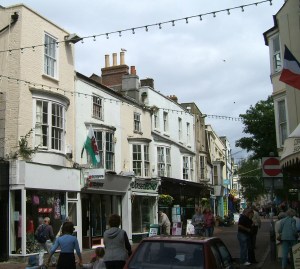
Visiting The Old Doss, The Navy Office and The Stone Pitcher

Few tourists walking up Ludgate Hill towards St Paul’s Cathedral today realise that they are close to three of the major London prisons, but the Bridewell, the Fleet and Newgate are within a stone’s throw.

Coming up New Bridge Street from Blackfriars’s Bridge you are walking over the Fleet River (or Ditch as it had become by the time of Roque’s map in 1747) and passing, on your left, the site of the Bridewell, or as it was known in cant terms, the Mill Doll or the Old Doss. It was built on the site of Henry VIII’s Bridewell Palace (the place where Holbein’s famous painting of The Ambassadors was created). In 1553 Edward VI gave the palace to the City as a refuge for homeless children, but in 1556 it became a House of Correction and workhouse. It dealt with vagrants, beggars, paupers and petty offenders until it burned down in the Great Fire of London, 1666.
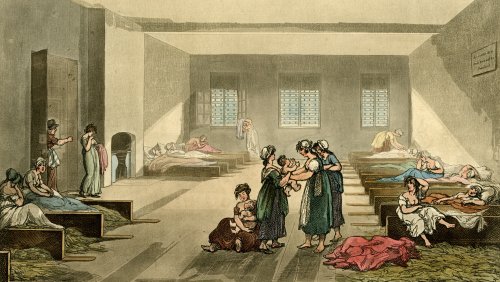
Bridewell

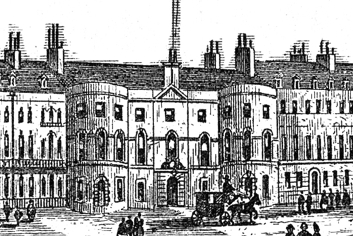
It was rebuilt and, because it was dealing with petty crime, handled a very large number of prisoners – 1,989 committals in 1800, for example. Its medical facilities were considered excellent by the standards of the day and it did give some training to youths and care to the babies born there to unmarried mothers. The image of 1808 shows the ‘Pass-room’ for unwed mothers, each with her bed of straw. The sign on the wall reads ‘Those who Dirts Their Bed shall be Punished.’ The Bridewell closed in 1855 and most of it was demolished, although you can still see part of the handsome façade just south of Costa Coffee.

When you reach the crossroads, with Ludgate Hill to your right and Fleet Street to your left, you are at the site of the Fleet Bridge. In front of you now is Farringdon Street, but this used to be Fleet Market, with the Fleet Ditch paved over and a long line of market stall running north. William Morgan’s map of 1682 shows the Fleet running open here in a canal.

In the angle between the Fleet and the northern side of Ludgate Hill was the Fleet Prison. As a pun on its name its Warden became known as Commander of the Fleet and the prison itself as ‘the Navy Office.’ The site of the Fleet Prison resembled a strange letter P and, as with so many ancient sites in London (it was built in 1197, destroyed during the Peasants’ Revolt in 1381, then in the Great Fire and also severely damaged during the Gordon Riots of 1780), the shape remains – walk up Ludgate Hill and look to the left down the relatively new Limeburner Lane and you can see the curve in the modern buildings on the site.

The Fleet was a debtors’ prison , with about 300 held there, often with their families, until they had discharged their debts. Given that they had to pay their gaolers for absolutely everything from food to having their chains removed, it is hard to see how they could do so without outside help. Many were reduced to begging from the windows of the cells, but those with a trade were permitted to exercise it and, if they had a little money, could take lodgings in the area immediately around the prison – the ‘Liberty of the Fleet.’ Before the Marriage Act of 1753 the Liberty was a prime location for secret or hasty marriages – as many as three hundred in a week.

The prison was frequently condemned for its appalling conditions but it did not close until 1842 and it was demolished four years later.
123For criminals, prisons were not places of punishment until later in the 19th century when the reduction in hangings and floggings meant that new, less physical, punishments such as a term in prison, were devised. In Georgian times they were holding places for prisoners awaiting trial or punishment – hanging, flogging, transportation, time in the stocks or pillory. They were chaotic, filthy and rife with disease and a prisoner’s degree of comfort, if such a thing was to be had, depended on the ‘garnish’ or bribes they could give to the gaolers, just as happened in the Fleet.

Climb Ludgate Hill a little further and you come on the left to The Old Bailey. In the early 18th century this led to a Sessions House – a place where trials took place and now vanished under the southern end of the Central Criminal Courts (1907). Following Old Bailey north you come to Newgate Street where, just to the right was, literally, the New Gate, a massive gatehouse spanning the road. From its southern part Newgate prison extended under what is now the majority of the Central Criminal Courts site. The first records of a prison here are 1188. It was rebuilt after the Great Fire and again in 1770-8, burned down during the Gordon Riots and rebuilt 1780-3.

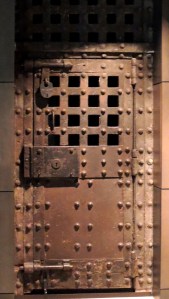
Newgate was so notorious that Grose’s and other slang dictionaries give over fifteen names for it – No.9 Fleet Market, Ackerman’s Hotel, the Stone Pitcher and Newman’s Tea Garden amongst them. An original door from Newgate and now in the Museum of London is shown above.

Roque’s map shows the Old Bailey forking just opposite the Sessions House with Little Old Bailey running up to Newgate Street on the left and leaving a triangular block of buildings in the centre. Old Bailey
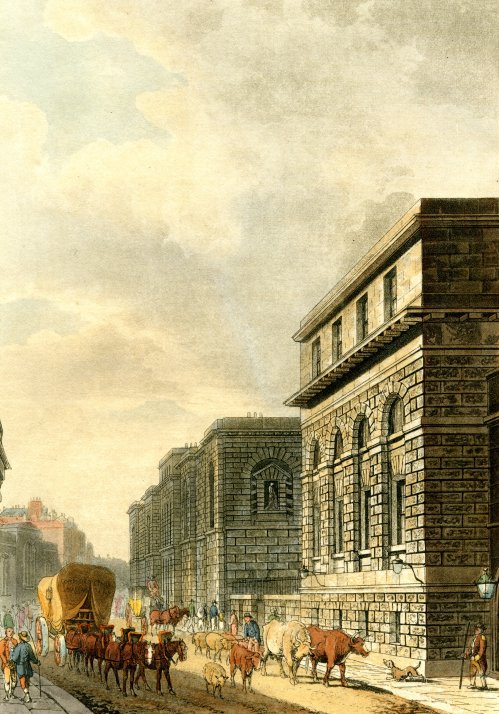
When public hangings at Tyburn were abolished – the long drive across London through jeering and cheering crowds became to be seen as uncivilised, and it certainly disturbed the peace of the smart new developments north of Oxford Street – they were transferred to Newgate in 1783. This was supposed to create a more orderly atmosphere where the watching executions could be experienced with due solemnity. To this end the buildings between the Little Old Bailey and the main street were demolished at the same time as the prison was rebuilt following the Gordon Riots, creating a triangular space which is still open today.In the print above (1814) the Sessions House is on the right with Newgate Prison itself beyond it. The open space faces it, out of sight to the left of the print.

Naturally public executions at the new location were as much of a bear garden as before, with the crowd crammed into the enclosed space and every property with a view making a killing out of renting out window space to view the condemned being led out through the Debtors’ Door.

The print below shows the execution of the Cato Street conspirators, 23 February, 1820. Because they were convicted of treason the initial sentence was hanging, drawing and quartering, a brutal survivor or the middle ages. As a nod to modern times it was commuted to hanging, but the bodies were beheaded symbolically afterwards.catostreet executions
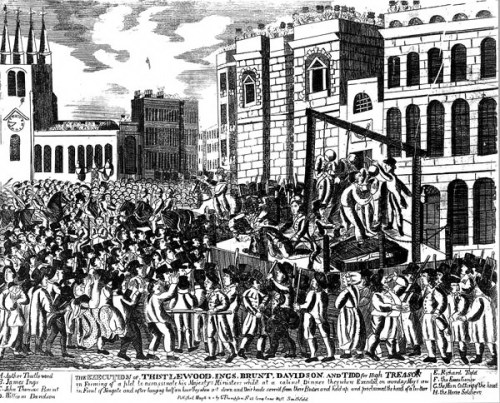
Newgate Prison is seen on the right and the church of St Sepulchre-without-Newgate, where a bell was tolled before a hanging, in the background.

Partly obscured by the cross-beam of the gallows you can just make out a rectangular panel. This was hung with chains and shackles and, when the prison in King’s Lynn was built, that door was reproduced in all its details.
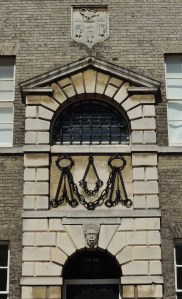
Lynn prison

Public hangings were ended in 1868 and now it takes an effort to stand in the attractive space, with its flower tubs and benches,facing the dignified mass of the Edwardian Central Criminal Courts and with the church still standing to your left and imagine what the place must have been like during an execution.

You can find these prisons on Walk 8 of Walking Jane Austen’s London and if you are intrigued by the slang and cant terms for the prisons you can find more for crime and punishment and the whole colourful world of Georgian and Regency underworld and sporting life in  Regency Slang Revealed.
Save

Save

Save

Save

3 Comments

Filed under Architecture, Crime, Riots

The Earl of Wittering Goes to the Seaside Part 9: Adventures in the Bath House

bath house 4

The Earl of Wittering marshals his family after breakfast to decide on the morning’s activities. ‘Porrett has made a recce,’ he announces. (He commanded the local militia for four months and, in his imagination, is forever a soldier…) ‘The bath house is up to standard and there is the choice of taking a machine and having a dunking or using the facilities – plunge pools, shower baths, steam rooms and so forth.’

‘I would like to go in the sea,’ young Arthur announces. ‘I will search for marine life.’

‘In that case Porrett will accompany you.’

Porrett attempts to look delighted at the challenge and not like a man who has already been in the sea once that morning.

‘I will bathe too,’ says Emily casting Porrett a languishing look. ‘I am already quite over-warm.’ Quite how she proposes to get close to Porrett once in the water she has no idea, but pretending to drown might be a good start…

‘Over-warm’ is putting it mildly so far as her grandfather’s besotted secretary is concerned. The sea, he fears, will probably boil around him if she is in it too.

‘I intend sampling the warm bath,’ Lady Wittering announces. ‘You will no doubt wish to join me, Emilia,’ she adds to her daughter in law in clear command.

‘I’ll investigate the billiards room. May try a shower later,’ Viscount Ditherstone remarks. If nothing else, Porrett thinks, the wretched man will be investigating just how separate the male and female facilities are.

‘And I will go for a dunking, I suppose,’ the Earl grumbles. ‘No need for you after all, Porrett, so long as I’m with Arthur.’ Fortunately he does not see the expression on his granddaughter’s face. ‘We’ll go in fifteen minutes.’

The family is completely delighted with the facilities of the bath house (except for Emily, who is still sulking). The two older ladies take themselves off to the warm baths where Lady Ditherstone, at least, imagines herself as a beauteous Roman lady about to bathe in asses’ milk –

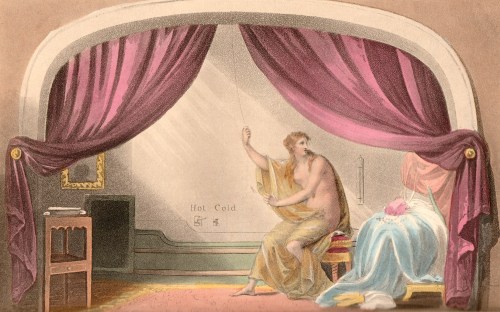
hot baths

The bathers, Emily chaperoned by her very reluctant maid, troop downstairs to their respective bathing machines and Porrett trails after the Viscount into the billiards room. He is not going to succumb to the temptation to take one of the telescopes out onto the balcony, he tells himself as he fidgets around, glancing at the well-stocked selection of newspapers and journals while keeping half an ear cocked for the click of billiard balls.

Silence, except for the snores of some elderly gentleman over by the bookshelves. Ditherstone has vanished. Porrett hastens out. Goodness knows what trouble the amorous lord is about to get himself into. No-one is visible in the vestibule but the faint click of boot heels comes from the steps under an arch labelled Ladies’ Rooms. With true valour Porrett rushes down in pursuit, just as a piercing shriek echoes up. In front of him is a door labelled Shower Bath. It is open and just visible are the tips of Lord Ditherstone’s brown tail coat. Porrett seizes them in both hands, drags backwards and yanks the door closed, finding himself embracing an armful of very irritated Viscount.

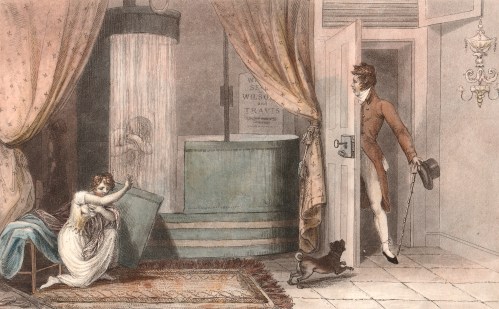
shower bath

‘Thank Heavens, my lord! You had wandered into the ladies’ section in error,’ he gasps, somewhat impeded by an aristocratic elbow in the stomach as the Viscount storms back upstairs. ‘Really,’ he adds severely to the gawping attendants as they reach the vestibule, ‘You should ensure the notices are more legible. His lordship has just been severely discommoded, as might any gentleman, especially a scholar such as his lordship with weak eyesight.’ The Viscount has occasionally been known to glance at the sporting press but that is as far as his scholarship extends.

‘Coffee and brandy,’ Ditherstone demands. ‘In the billiards room, immediately.’ Porrett follows him, fearing instant dismissal, and finds his hand taken and wrung in a painful clasp. ‘Good man, quick thinking. Two cups and glasses,’ he snaps as the waiter comes in. ‘Mr Porrett will be joining me.’ All Porrett can feel is intense relief that he will not be forced to leave the household, forced to say goodbye to Emily for ever…

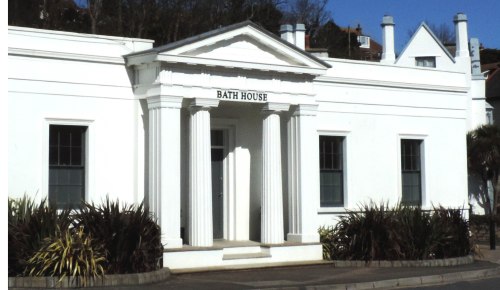
The photograph at the top of the post is of the Greek Revival-style bath house at Ilfracombe. This was a popular style intended to create a link with the Classical world and impart intellectual respectability to the pleasures of the bath. The two other images are from Poetical Sketches of Scarborough (1813).

Discover more about the Georgian bath houses – the gyms and fitness clubs of their day in The Georgian Seaside

Next time the family take some exercise on the beach.

Save

Save

Save

Save

Save

Save

Save

10 Comments

Filed under Buildings, Entertainment, Gentlemen, Medicine & health, Seaside resorts

The Earl of Wittering Goes to the Seaside Part 8: Porrett Takes to the Waves

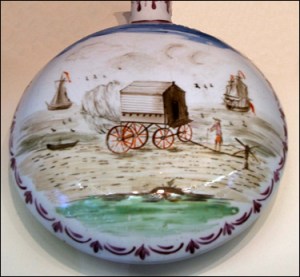
bathing machine flaskThe Earl of Wittering’s extended family have all decided that they will try being ‘dunked’ in the sea in the interests of their health, although their enthusiasm for the exercise varies considerably. Young Arthur is eager to observe jelly fish (although he has the tact not to mention them in front of his female relatives), his father, Viscount Ditherstone, is keen to catch a glimpse of any ladies bathing, while the Viscount’s father, the Earl, is grimly determined to suffer for the sake of his digestion, even if that means drinking sea water too.

The ladies are nervous (except Miss Emily) so Porrett, the Earl’s secretary, decides to take an early morning dip to test out the bath house and its facilities himself. He sneaks out early, unaware that Emily has heard him discuss this with the butler. She has armed herself with a telescope and is in position at her bed chamber balcony… (Emily may like to think she looks like the dashing female in the La Belle Assemblée print of October 1809 but unfortunately she is in a very modest gown). telescope shopped

The bath houses control the bathing machines and, although there are over thirty at Weymouth, it is still necessary to register at the bath house and wait to be summoned when one is free. The bath house also provides hot and cold baths, plunge baths, showers and elegant waiting rooms furnished with newspapers, journals and telescopes.

Bathing is normally carried out before noon, but even so, Porrett is so early that he secures a bathing machine immediately, pays one shilling and sixpence (the sixpence covers his ‘guide’ or ‘dipper’) and follows the man down the steps and across the sand to a bathing machine.

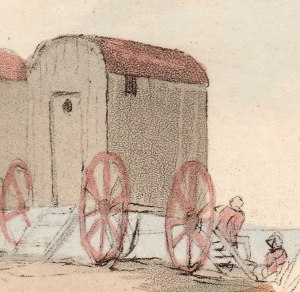
Porrett is a confident swimmer who has swum many times in the sea, so he doesn’t really need a guide, but he feels it his duty to examine the quality of the personnel. Nor does he need dipping – being thrust beneath the surface three or four times to ensure total contact with the health-giving ‘briny fluid’. He climbs the three steps at the back of the machine – really only a hut on large wheels, just over six foot long and not much taller – and lets himself in. Inside it is gloomy, lit only by slats set high in the walls, so he undresses more or less by touch, lurching to sit down with a thump on the bench when the horse between the shafts begins to pull the machine down the beach.

There are plenty of hooks for his clothes, he is glad to see. Porrett has nothing to change into, for it is considered positively effeminate for a man to swim wearing any kind of garment, and he winces as his bare feet come into contact with the sodden strip of carpet on the wooden floor and reminds himself to suggest that the ladies wear light sandals. There is more lurching as the machine enters the water, sounds of the horse being unhitched and led away, then a rattle and a splash as the hood is lowered to give him privacy. This hooped canvas device was invented by Mr Beale, a Margate Quaker, to ensure the modesty of bathers entering the water.

‘All ready, sir!’ the guide calls and Porrett lets himself out of the seaward door onto the top step.

bathing machines detailHe waves away the guide with some confidence. ‘I can swim, thank you,’ and plunges in, shuddering at the first shock of cold water. He surfaces within the cover but the space it encloses – about 10 by five feet – is too restricting and he ducks underneath and strikes out strongly.

Up on her balcony Miss Emily felt a most unmaidenly pang of disappointment when she saw the hood being let down on the only machine in operation. She almost turns away, then a dark head appears, seal-like, and she focuses the telescope. It is Porrett! Frederick, as she thinks of him. How strongly he swims. Her heart is positively fluttering and then he stops and… stands up. Frederick, she realises, has admirable shoulders and very trim waist and… Oh, the lens has steamed up.

Porrett spots two ladies walking their dog along the beach, so he hastily dips below the surface and swims back to the machine. Everything seems to be in order so he will reserve machines and dippers for the entire party before he goes back to breakfast, he decides. He dries himself on the scratchy towel provided (Note to self, remind the ladies to bring their own) and dresses with more difficulty than he stripped off as the machine lumbers back up the beach.

Emily hastens to return the telescope to her grandfather’s study, fanning herself with her free hand as she does so. Her slight tendre for Porrett is developing into something altogether more serious. He is so manly…

What will happen when the whole family goes to the beach? Can Emily arrange things so that Porrett comes too? Will the Viscount get his face slapped for leering at bathing beauties? How will the Earl’s indigestion respond to a dunking?

Discover more about the world of the Georgian Seaside  in The Georgian Seaside The Georgian Seaside Cover_MEDIUM WEB

Save

Save

Save

Save

Save

Save

Save

Save

7 Comments

Filed under Fashions, Seaside resorts

The Real Castle of Otranto

In 1764 Horace Walpole published The Castle of Otranto, A Story. Translated by William Marshal, Gent. From the Original Italian of Onuphrio Muralto, Canon of the Church of St. Nicholas at Otranto. [Image: British Library]

oTRANTO FRONT

Walpole (1717-97) was the son of Robert Walpole, recognised as Britain’s first Prime Minister, and was variously a Whig politician, a dilettante, an antiquarian and the creator of the wonderful Gothic masterpiece, Strawberry Hill, his house in Twickenham.

Walpole’s book – often considered to be the first Gothic novel – has the lot: a giant supernatural helmet that crushes a bridegroom to death, thwarted love, tragic stabbings, lustful noblemen, vengeful fathers, sword fights, ghostly happenings and much, much more. Frankly, attempting to summarise the plot is impossible but a short extract gives the flavour:

Manfred, whose spirits were inflamed, and whom Isabelle had driven from her on his urging his passion with too little reserve, did not doubt but that the inquietude she had expressed had been occasioned by her impatience to meet Theodore. Provoked by these conjectures, and enraged at her father, he hastened secretly to the great church.  Gliding softly between the aisles, and guided by an imperfect gleam of moonlight that shone faintly through the illuminated windows, he stole towards the tomb of Alfonso…

After the success of the first edition, purporting to be a translation of an ancient manuscript, Walpole came clean for the second edition and admitted to writing it. It was hugely popular, spawned an entire genre of fiction and inspired numerous stage melodramas.

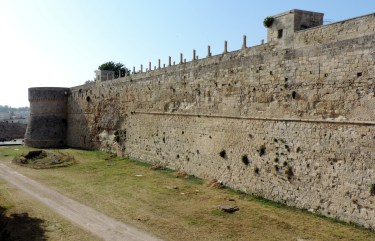
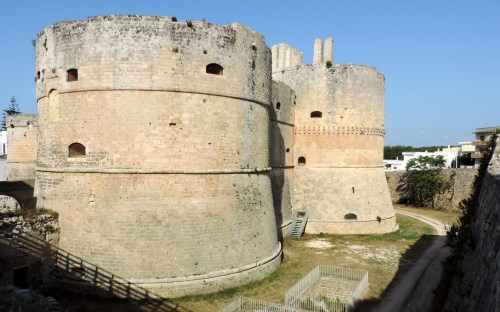
I was recently on a small ship cruise in the Mediterranean in the footsteps of Edward Lear and found myself in the Italian port of Otranto. Obviously the priority was to seek out the castle. I had visions of gothic towers, creepy turrets, gloomy dungeons, gargoyles… Actually, it is nothing like that at all, which was rather a disappointment.Otranto

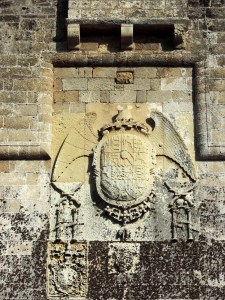
It is known as The Castello Aragonese, was rebuilt by Alphonso II of Naples in 1485–98 and is an aggressively militaristic edifice with not a gargoyle in sight. Over the entrance is the coat of arms of the Holy Roman Emperor Charles V (1500-58) who owned southern Italy when it was part of the Kingdom of Aragon.

Otranto arms

An impressive castle – but not, I fear, the house of horrors of Walpole’s imagination, unless one pictures the huge coat of arms taking off on those strange wings behind it and crashing down on some unfortunate bridegroom…

Napoleon stationed naval ships  in Otranto harbour from 1804 and in 1808 created the hereditary title Duc d’Otrante for his Minister of Police Joseph Fouché when the town became duché grand-fief in the satellite Kingdom of Naples. The dukes now live in Sweden and the title is still extant, apparently without any gothic nightmares to haunt the family.Otranto moat

Save

Save

Save

Save

Save

2 Comments

Filed under Architecture, Books, Buildings, Literature, Napoleon

The Earl of Wittering Goes to the Seaside: Part Seven. The Ladies Go Shopping (& so does Mr Porrett)

As a confidential secretary Porrett has a well-developed instinct for what will make the ladies of his employer’s household happy – and therefore what will keep the Earl of Wittering himself content. Nothing irritates his lordship more than his wife, daughter-in-law and granddaughter fidgeting about, bored and demanding his attention. Nothing, that is, but Porrett himself attempting to persuade the Earl to cast an eye over his accounts.

seaside shop

Therefore, now that the family is established in elegant lodgings in Weymouth, have signed the Master of Ceremony’s book, subscribed to the library and taken the air the next priority is to introduce the ladies to the retail opportunities that the town holds.

‘It will be intolerably provincial, I suppose,’ Lady Ditherstone observes with a sniff.

‘I venture to hope that your ladyship may not find it so,’ Porrett hastens to interject, seeing Miss Emily’s lower lip beginning to quiver in disappointment. Only one thing mars his optimistic daydreams of a life of bliss with Emily and that is the sneaking suspicion that his income would not satisfy her whims for all things novel, pretty and expensive. Then his romantic nature overcomes these moments of realism. “My darling,” she would cry, throwing herself on his manly (if rather skinny) chest. “I would live in a cottage and learn to cook if only I can be with you.”

‘Mr Porrett? You are gaping like a stricken haddock,’ Lady Wittering observes sharply.

‘Your ladyship’s pardon, I was mentally assembling the list of desirable emporia.’ He blushes in mortification at being so shamed, but Miss Emily sends him a speaking look of commiseration – it seems that perhaps she finds the haddock an attractive fish, or, more likely, she has been on the receiving end of her grandmother’s reproofs before now.

Porrett’s blush is now glowing like the sunset over the English Channel, but he clears his throat and delivers his report. ‘Many of the shops are temporary for the season, my lady. The most select establishments in Dorchester and Salisbury have a branch here during the summer, and, given the royal patronage, so do many London shops of distinction.’ He produces a town plan and begins to point out the highlights. ‘A jeweller with a royal warrant, here… three milliners in this street. A modiste here and here. A bazaar selling elegant trifles that may amuse is located on this corner and…’

‘And we must go and investigate immediately,’ Emily cries. ‘You are so clever Mr Porrett! I must have a new bonnet for I declare none of mine are fit to be seen.’

‘We must also acquire some of Mrs Bell’s Patent Bathing Preservers. Nothing would persuade me to be dipped in some hired bathing dress.’ Emily’s mother produces a shudder that would have made Sarah Siddons proud.

‘As you had the foresight to mention that before we left London I have made enquiries, my lady, and Arthbuthnott’s Haberdashery, Notions and Fancy Goods carries a stock of them.’

And right next door is Madame Ernestine’s hat shop. Porrett was up and about at dawn this morning checking out the shops and there is the most exquisite bonnet in the window that would look enchanting on Miss Emily’s dark curls.

‘We will go immediately. We will not require you, Porrett, as you have so efficiently marked the map. We will take one of the footmen to carry parcels.’

‘But – ’ Porrett’s lower lip begins to quiver with as much pathos as Miss Emily’s ever did.

‘But I have turned my ankle a little, Mama. I need the support of a gentleman’s arm if I am not to strain it and be unable to dance tonight. Mr Porrett would be perfect.’ Periwinkle blue eyes smile into his yearning grey ones.

‘I would be only too happy, Miss Emily.’ Although I may need a cold bath before and after the experience.

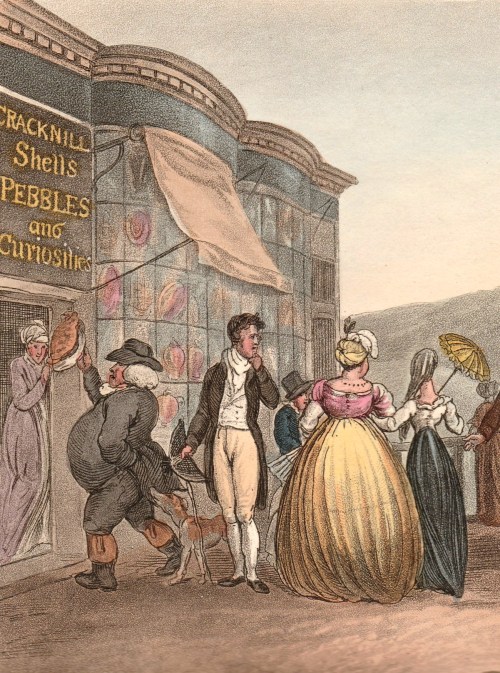
Dizzy with delight Porrett shepherds his little party through the streets of Weymouth, Claude the footman bringing up the rear and young Master Arthur tagging along too, for Porrett has promised him a shop selling shells, fossils and geological curiosities. Miss Emily holds tight to Porrett’s arm, limping just enough to give credibility to her tale of a painful ankle, and causing his bosom to swell with protective fervour.

Outside Arbuthnott’s store she hangs back, her gaze on the pretty bow window of the milliner’s shop. ‘I will just look in here, Mama. Mr Porrett will look after me.’ Arthur makes his escape – he has spotted the shell shop. (The one shown above is on the Terrace in Scarborough)

bonnet‘There is a bonnet here I thought might suit you, Miss Gatwick,’ he confesses, remembering to address her properly and not by her given name as he always thinks of her. ‘You see? That one on the stand.’
‘Oh! Oh, Frederick,’ she gasps as his head spins. ‘You are wonderful. It is perfection.’

Will Emily get her bonnet? Will the ladies obtain their bathing preservers? Will Porrett’s blood pressure ever return to normal? In the next installment the Gatwicks (and Porrett) will go sea bathing.

Discover more about the world of the Georgian Seaside – and its shopping opportunities –  in The Georgian Seaside

The Georgian Seaside Cover_MEDIUM WEB

Save

Save

3 Comments

Filed under Fashions, High Society, Seaside resorts, Shopping

Catching a Cawchery in a Slap-Ang Shop – Eating In the Regency Underworld

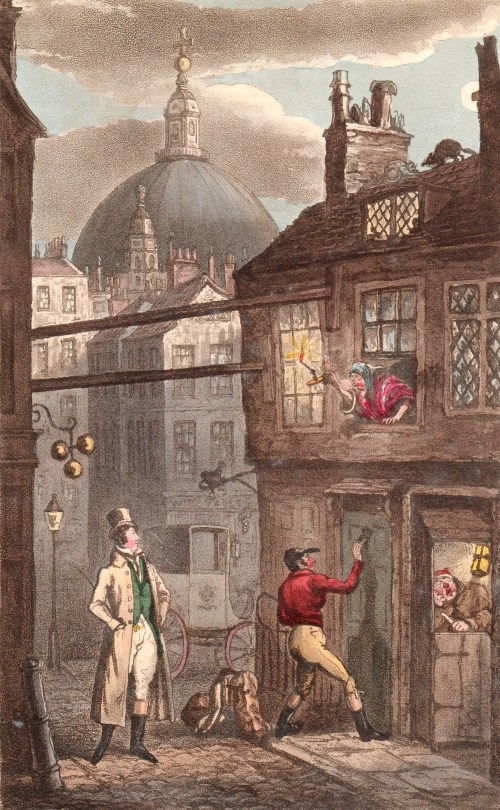
lodgingsYou are slumming it in Regency London – perhaps you’re in cheap lodgings avoiding your creditors, or dodging a furious father armed with a shotgun or your gambling habit has got the better of you and you are seriously out of pocket. You have found your cheap lodgings – a miserable, unheated room that you share with bedbugs, fleas, mice and the other inhabitants of your straw pallet – now you need to find something to eat. [The print above is of Logic’s lodgings in one of the Tom & Jerry tales by Pierce Egan. Note the dome of St Paul’s behind and the pawnbroker’s shop with its three gold balls on the left.]
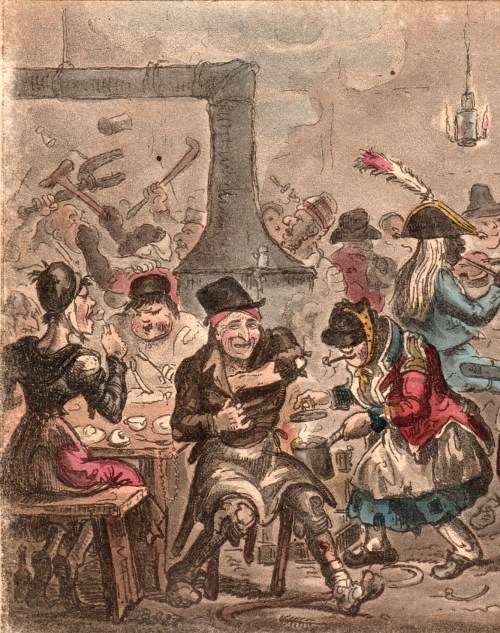
A respectable eating house with a decent daily ordinary might be within your means, otherwise you’ll be looking for a grubbery and, in this kind of area, it is probably a hand-in-pocket shop where ready money is expected and no credit is given or even a slam-bang or slap-ang shop, the lowest form of cook shop. Even if you are clammed, sharp-set or positively gutfoundered, you’ll still be hoping that it isn’t run by a cook ruffian, a really bad cook who’ll beat all to a todge, or unrecognisable mess.

If all you can afford is buster and beeswax or bread and cheese, it will taste better if it has been toasted to make a Welsh rabbit or, failing the cheese, you may have to make do with a scratch platter or tailor’s ragout of bread and sliced cucumbers slopped in vinegar.

If there’s a smell of cooking meat the chances are it will be a sheep’s head  – baked to make a Bloody Jemmy or Field Lane Duck or boiled with onions which makes a German Duck. But that might be too expensive so you settle for a galimaufry, a hodge-podge of leftovers or a cawchery, a stew (best not to investigate the ingredients). If you are lucky it might be padded out with some naked boys – rather lumpy dumplings. Below is a detail from “Tom and Jerry Masquerading Among the Cadgers in the Back Slum in the Holy Land” with the diners tucking into their food next to the stove while a riot breaks out in the background.

slum eating

Just when it all seems hopeless and you are contemplating a diet of flummery – oatmeal and water boiled to a jelly – one of your friends turns up with a loan and you can foul a plate and polish a bone with them and treat yourselves to an alderman – a fine roast turkey with a garland of sausages in place of the alderman’s chain of office.

As for what you’ll drink with your alderman, that’s another story – but the chances are you’ll be washing it down with a tankard or two of heavy wet.

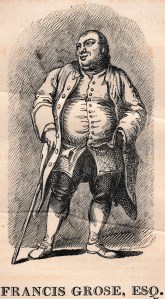
GroseFrancis Grose toured the back-slums and the rookeries of London in the 1780s collecting cant and slang terms for his Dictionary of the Vulgar Tongue,  assisted (or possibly supported) by his servant Batch. Judging by his portrait Grose had sampled plenty of naked boys, aldermen and Bloody Jemmys himself. He inspired a number of imitators (and downright plagiarists) but all these late Georgian slang dictionaries are arranged in alphabetical order of the terms defined.  Regency Slang Revealed  takes four of them and organises them thematically, with an index – the perfect guide for the explorer of the Regency underworld. Regency Slang Revealed Cover MEDIUM WEB

Save

Save

Save

Save

Save

Save

Save

1 Comment

Filed under Books, Entertainment, Food & drink, Street life

The Earl of Wittering Goes to the Seaside: Part Six The Ladies (and Porrett) Visit the Library

It is raining today, the second of the Gatwick family’s stay in Weymouth, so Lady Ditherstone abandons her father in law and husband to their news sheets, deals firmly with her daughter Emily’s pleas that taking to the ocean in the rain can hardly make you any wetter than you will be already, and carries off her mother in law the Countess of Wittering, Emily and young Arthur to visit the subscription library.

library

‘You have researched the available libraries I trust, Mr Porrett?’ She is inclined to rather like the Earl’s secretary, such a thoroughly nice, intelligent young man and really, once he takes off those wire-rimmed spectacles, quite good-looking. Intelligent, good-looking men are in short supply in the Gatwick household, although young Arthur certainly has a keen interest in natural philosophy.

‘Certainly, Lady Ditherstone. There are several, but most are not of a standard that would suit you, I fear. However there is one excellent one. As The Guide to All the Watering and Sea-Bathing Places remarks, those who frequent a good circulating library rather than a ballroom “frequently enjoy the most rational and the most permanent pleasure.” ‘ He regrets the quote as soon as he makes it, for Miss Emily fixes him with a look that is anything but kindly. So far as she is concerned nothing, but nothing, can exceed the pleasures of the ballroom.

‘Mr Porrett can come with us and carry our books as he is so fond of libraries,’ she says pertly. ‘And the umbrellas.’

Porrett, no fool, even if he is blinded by hopeless love, enlists the umbrella-wielding support of two footmen leaving himself to shelter Miss Emily. He employs the walk to the library with regaining her good graces. ‘They have all the latest fashion journals,’ he assures her. ‘And the latest novels.’ From ahead he can hear young Arthur stating that he needs a book on rocks and something on seaweed as he intends to collect both. Porrett is not certain, but he thinks the Viscountess gives the slightest, most well-bred, shudder. ‘And there is a section selling toys (he means novelties and small frivolities for adults, of course) – all the finest fans and reticules and so forth and souvenirs.’

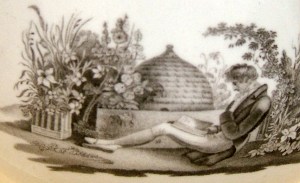
Pic105Emily gives him a beaming smile, much restored by thoughts of shopping, as they reach the circulating library. Porrett, having established that the monthly subscription is eight shillings, deals with the business side, taking out a subscription for both senior ladies. He also subscribes for himself, for he has a secret penchant for poetry and intends to take a slim volume off to the garden where he can brood on his heartache in peace. (Above, the artist of a Regency ‘bat print’ bowl has caught Porrett immersed in his poetry next to a beehive.)
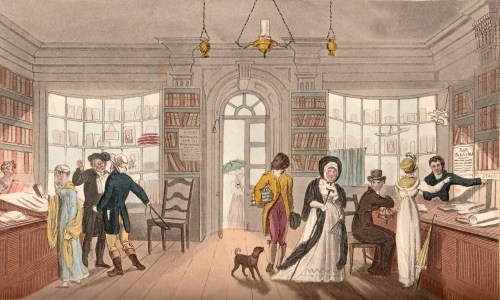
The library they find themselves in very like the one shown at the top of the post (Illustration of 1813 by Rowlandson). Note the shelf of New Arrivals on the right and the two gentlemen in energetic dispute over a political pamphlet on the left. A horn sprouting writing quills hangs in the right-hand window and a poster advertises a new book on Westminster and Its Monuments. The younger ladies shown are all in the height of fashion whereas the older lady with her little dog, long stick and black footman in attendance wisely chooses rather wider skirts and a lower waistline. Note the parasol propped up against the counter – it has the handle at what, today, is the wrong end. This persisted until about 1815 when the point where a parasol or umbrella was held when not in use shifted ends.

This evening the family attends the Assembly Rooms for an evening of dancing and cards. Porrett is thrilled to have been invited to accompany them, but somehow this afternoon, he is going to have to purchase a new pair of black silk stockings. Dare he risk ones with a stripe? What are the shops likely to be like? Find out more in   The Georgian Seaside: the English resorts before the railways came.


4 Comments

Filed under Books, Buildings, Entertainment, Fashions, High Society, Seaside resorts, Shopping

Cutting and Rumping – How to Snub in True Regency Style

We have all been there and experienced the moment when the last person we want to acknowledge is that old friend or acquaintance coming towards us down Bond Street. We used to be bosom bows but now they have committed some unforgivable sin – and what that might be will vary depending on our sex and our sensitivity – perhaps they  flirted with our beloved, wore the same gown as we did to a Drawing Room, made snide remarks about our virility at the club, were overheard sneering about our new French chef’s offerings at our last, vastly expensive, dinner party. Or they might have proved themselves unworthy of our acquaintance by some error of taste or action and can no longer be counted as one of us, one of the ton.

Clarendon hotel

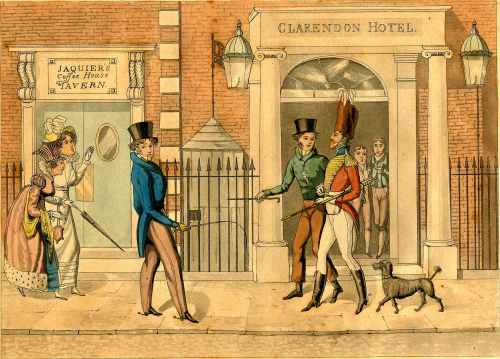
So – do you swallow your dislike or distaste and greet them as warmly as always, or do you deploy one of the armoury of “cuts” that the Regency lady or gentleman had at their disposal? Above is a scene in Bond Street with some cutting in action. It is from the “Bores” series (published by Thomas Edgerton 1824) and the story is that the military dandy is being approached by a country gentleman whose acquaintance he is now ‘bored’ with, so he is using the Cut Direct. The young man looking towards us appears to be using the Cut Modest to avoid eye contact with either of them.

The simplest cut (and the one most suited to the ladies as it involves no actual action at all) is The Cut Modest, or, Indirect. This is easiest if you are some distance from them, on the other side of the road perhaps, or in your carriage at the fashionable time to drive in Hyde Park. Just avert your gaze and pretend you have not seen them, even if they wave, call out to you or brandish their umbrella.

If they are right in front of you then you must be more assertive and exercise The Cut Direct. You act as though they are not there and so you look right through them, even if they are under your nose outside Wilding & Kent’s shop where you have just purchased some delicious lace or they are emerging from Dolland’s the opticians with the new telescope they are about to show off at the club. Look them in the face, meet their eye and show not a flicker of recognition.

They may, of course, assume you are simply miles away, thinking of that delicious young man they (most unfortunately) saw you with last night, or nursing a monumental hangover (caused by their cheap and nasty brandy ). In that case they may well greet you anyway, an embarrassing moment that calls for The Cut Courteous. Smile faintly, enquire courteously, “Sir (or Madam)? Do I have the pleasure of your acquaintance?” Then sail on past, they will get the point.

The person you wish to cut may be simply a chance-met acquaintance, one who you acquired on your travels perhaps, and who now hails you in the street, ready to presume on the fleeting camaraderie of that rather lurid night out in Rome on the Grand Tour, or the endless tedium of the voyage back from India where almost anyone other than the ship’s cat became a welcome companion. This calls for The Cut Obtuse. You have never been to Rome, you protest, certainly not to that dubious-sounding bordello near the Forum. India? Never set foot in it and as for the good ship Nausea, no it could not have been you, you never travel anywhere by sea except on your own yacht. And finally, no, you are most certainly not the Earl of Wittering.

They may be particularly persistent, or you may not have much confidence in keeping a straight-enough face. This requires The Cut Circumbendibus involving direct action – dodge into that alleyway, dive into that shop (and straight out again if you are female and you have found yourself in Weston the tailor’s elegant male sanctuary) or cross the street.

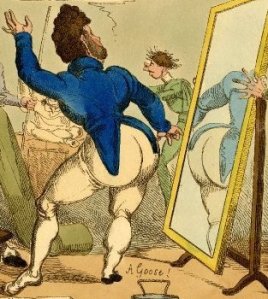
There are two embellishments to the basic cut that may be employed by the skilled cutter. The Cut Sublime involves casting up your eyes to the Heavens. You may pretend to be receiving inspiration from on high, studying cloud formation or wondering if that is a flock of ptarmigan flapping across St James’s Park. A degree of skill in not falling over your own feet or down a coal hole is required and you will need to estimate accurately when they have passed you by, or they may be waiting patiently for you to look down so they can enquire about the weather, the prospects for shooting game or the likelihood of divine intervention in your card playing. Finally there is The Cut Infernal, the opposite of the Sublime. Simply bend down and attend to your shoelaces or your spurs until the person has passed. This is obviously unsuited to ladies or to any gentleman whose posterior is best not displayed in such a manner. (See Rumping below.)

royal rumpFinally, and most regally, there is The Cut Visible, the cut so blunt and obvious that no-one could mistake it. The Prince Regent’s version of this is known as Rumping. If he wishes to indicate that some former acquaintance is now persona non grata then Prinny simply turns his back on them at the last moment as they approach him. The unfortunate cuttee is then presented with a fine view of the expansive royal backside. (A fine view of the Royal Rump can be seen in this detail from a Cruickshank cartoon of 1819)
I am indebted for these social hints to Pierce Egan’s version of Grose’s Classical Dictionary of the Vulgar Tongue (1823) and to John Bee’s Slang: a dictionary of the same year.

If you wish to stroll down Bond Street practicing your cutting technique the Walk 2 in Walking Jane Austen’s London will guide you to all the best places.


5 Comments

Filed under Gentlemen, High Society, Royalty

The Earl of Wittering Goes to the Seaside: Part Five The First Day

The Gatwick family are up early this first morning in their rented house on the Esplanade in Weymouth, even the Earl who has been parted from Gaston his chef and his breakfasts for three days, so is eager to get back to his devilled kidneys.

Lady Wittering relies on Porrett, the Earl’s secretary to have researched what the procedure is this first day. ‘But I want to go in the sea,’ complains Emily, making Porrett feel slightly faint – then seriously overheated – for a moment.

‘It would be advisable for the family to inscribe your names in the Master of Ceremonies’ book at the Assembly Rooms,’ Porrett explains when he has recovered from the mental image of Emily in the sea, breasting the waves… Oh goodness, now he needs a cold dip. ‘He will then call and inform the ladies of all the events planned for the next few weeks, ensure he knows your preferences, offer to perform any introductions you might wish and recommend suitable shops. I would suggest that after the Rooms that the ladies might like to inspect the libraries and see which they wish to subscribe to and call at the bath houses to decide which will have their patronage and view the various facilities available.’ Weymouth had gone through a number of Assembly Rooms and the new ones were at the Royal Hotel, only a few steps away from their lodgings. [The first Assembly Rooms were at the Ship Inn, below and the ones that the Gatwicks would patronise are below that to the right. ]

Pic165

Weymouth ass rooms

‘Facilities?’ Emily turns her large brown eyes on Porrett. ‘I thought it was just bathing machines for hire?’

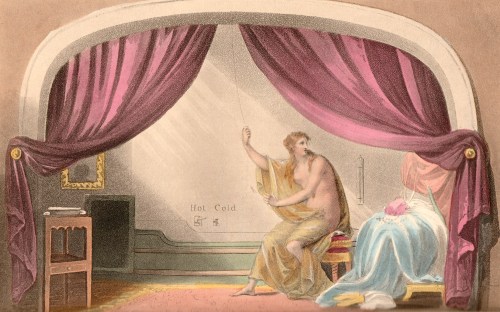
‘Oh no, Miss Gatwick. Shower baths, hot and cold seawater baths, steam rooms…’ Porrett’s brain begins to steam up giving him a vivid picture of Emily in the Warm Bath. He can’t cope with the thought of the Hot Bath… [Image from Political Sketches of Scarborough]


hot baths

‘Will you be accompanying us, Wittering? Ditherstone?’ The Countess studies her husband and son, both of whom have the air of men who would much rather take themselves off into town to locate the best library for the sporting papers, make enquiries about the prospects for some shooting, billiards and cards and generally avoid having to be grovelled to by the Master of Ceremonies.

‘I think not, my dear. I must go to the bank for one thing,’ Witttering emerges from his newspaper, obviously delighted to have found such an unexceptional excuse.

‘So must I,’ his son adds hastily. ‘Why not take Porrett to squire you about?’

Pic172‘I would be honoured, my lady. And, as it is such a pleasant day, perhaps you would care for a stroll along the main shopping streets?’ asks Porrett, in a seventh heaven. ‘I believe that Master Arthur has forgotten his hammer for extracting rock samples, so that could be purchased.’
‘Very well. Almira, Emily, Arthur, we will meet in the drawing room in one hour.’

Porrett makes a mental note to bring a footman along as well. he can hardly offer his arm to the countess (or, blissful thought) Miss Emily, if he is encumbered with a pile of shopping.

[Porrett will doubtless be taking his party along one of Weymouth’s bustling shopping streets – still full of Georgian buildings today]

The Georgian Seaside Cover_MEDIUM WEB

The Georgian Seaside: the English resorts before the railways came.


7 Comments

Filed under Buildings, Entertainment, Seaside resorts

The Earl of Wittering Goes to the Seaside: Part 4 The Journey

London to Weymouth

The day has dawned for the Gatwick family to set forth from their Mayfair Town house to their lodgings in Weymouth. Porrett, the Earl of Wittering’s much-tried secretary has driven the route recently, inspecting the available accommodation, but he went by stagecoach. Now he is in charge of the cavalcade of private conveyances his lordship’s party requires.

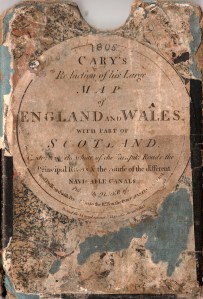
Cary mapThe first footman, two more footmen, two maids (more of those can be hired locally along with assorted kitchen skivvies) and Gaston the chef, left three days before to set up the house on the Esplanade and hire extra staff and furnishings required. That involved two lumbering old coaches plus a baggage coach.
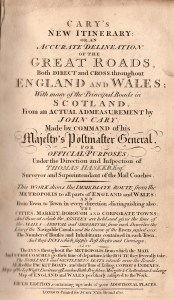
Now Porrett is mustering a coach for the Earl and Countess; a coach for the heir, Viscount Ditherstone, his wife and children and a coach for himself, the two ladies’ maids, two valets and the dressing and jewellery cases. That is a tight squash, but Porrett is too soft-hearted to make one of the valets travel on the box, even though he easily outranks them in the household hierarchy. Behind them comes another baggage coach, a lighter one this time, which should be able to keep up. That contains the overnight essentials for the family and their wardrobes.Cary front

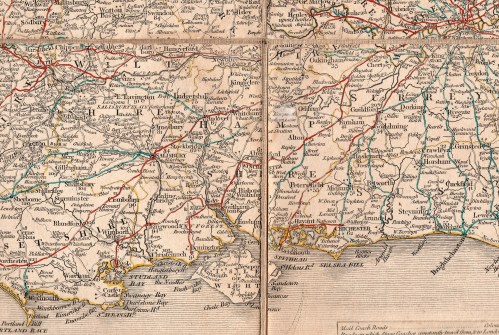
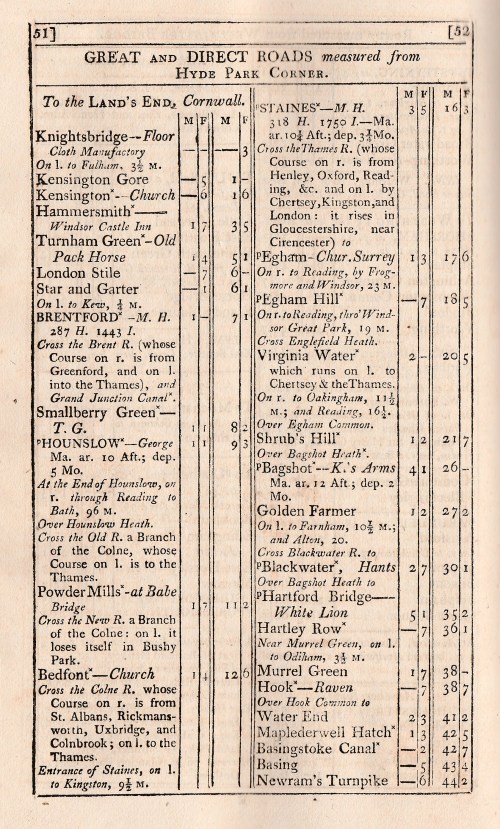
Porrett has studied the map in Cary’s Map of England and Wales [detail of the route above & slip case of the map  with the frontispiece of the Itinerary] along with Cary’s New Itinerary or an Accurate Delineation of the Great Roads… and knows it is 127 miles and 6 furlongs to Weymouth. [Page one of the route is shown right at the bottom of this post.]

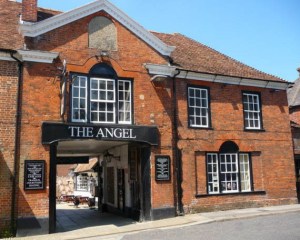
Porrett would like to think they could travel at 10 miles an hour, but experience of the family tells him this is most unlikely, so he is estimating seven mph and has reserved rooms at the Angel Inn in Andover [below], a mere 63 miles and 4 furlongs along the route to allow for an inevitably delayed start. Porrett is braced for the journey – and armed to the teeth, as are the coachmen and grooms – because 9 miles into the journey is Hounslow Heath and, although the heyday of the highwayman is past, it still has a fearsome reputation.

Angel inn

Porrett tightens his fingers around the pistol in his pocket, daydreaming about rescuing Miss Emily from the loathsome clutches of a masked swine on horseback. Oh, Mr Porrett, Frederick… you are so brave, she whispers as he sweeps her up into his arms…

This happy fantasy lasts as far as Staines where Mullett, the viscount’s valet, jabs him in the ribs and inquires acidly if he is in pain, pointing out that they are crossing the Thames. And so onwards, stopping only to change horses at Hook where they refresh themselves at the Raven before passing through Basingstoke to Andover. The next morning Porrett succeeds in getting his travelling circus on the road by ten, which he considers a triumph.

In Salisbury the countess wants to stop to sketch the cathedral, but her husband over-rules this fancy. He has been separated from Gaston the chef and his dinners far too long. From Salisbury to Blandford for refreshments and then on to Dorchester where the Land’s End road that they have been following continues westwards and they turn south to Weymouth.

Finally they draw up in front of their home for almost two months, with the bay and seascape laid out before them. Emily,  young Arthur and the senior Ditherstones are delighted with the scene. The Countess is obviously itching to find her sketch pad. The Earl stomps inside calling for brandy. Porrett braces himself – will his employer like the house?

The next episode of Porrett’s love affair (if only… he sighs) and the family’s activities in Weymouth  will follow here soon. Meanwhile read more about the world of the Georgian seaside in  The Georgian Seaside: the English resorts before the railways came.

And to follow one of the iconic coaching routes (by car, or on Google Streetview from the comfort of your armchair) try Following the Great North Road

route to Weymouth 1

3 Comments

Filed under Seaside resorts, Transport and travel