Category Archives: Wellington

George Hoby, Boot and Shoe Maker

I have posted before about shoemakers, cobblers and cordwainers (November 2014), but after a recent Twitter exchange about a George Hoby invoice I thought I would talk about it here, rather than in 140-character snippets! [I tweet as @LouiseRegency].

George Hoby (1759-1832) is probably the best-known London bootmaker, if only because he was the man Wellington went to to get his iconic Wellington boots made up. There is plenty of information about Hoby on-line, so I won’t repeat it here – but it took me ages to work out which corner of St James’s Street and Piccadilly his shop was on. The answer is the western corner which now has a shop selling caviar. Hoby, who died leaving £120,000, would probably have approved!

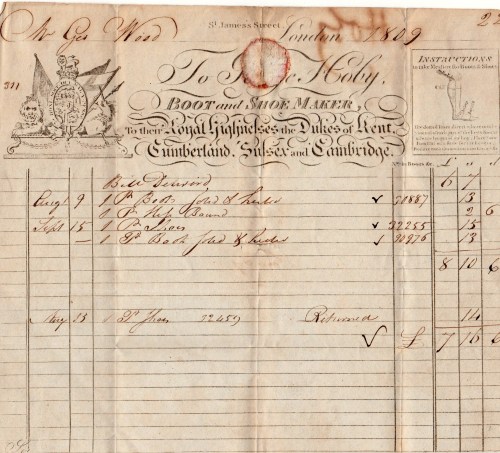
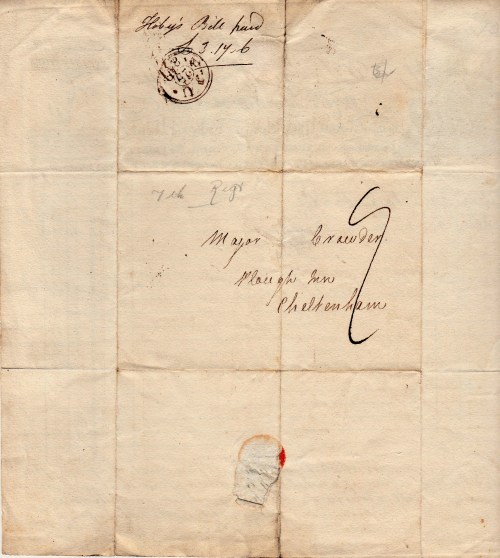
I own two of Hoby’s original invoices, from 1809 and 1818. Below is the 1808 one, both sides. It would have been folded so that the address was on the outside and sealed with red wax which is still visible on the front.
hoby-wood-front


hoby-wood-back Mr George Wood lived in Blandford Court which was on the south side of Pall Mall behind Marlborough House which is within a five minute walk of Hoby’s shop which is probably why the invoice appears to have been hand-delivered. I suspect that Mr Wood was a relative of Lieutenant-General Sir George Wood, ” the Royal Bengal Tiger” and his brother Sir Mark Wood, bt. Sir Mark certainly lived in Pall Mall.

The invoice is on very thick paper and shows that Hoby was ‘By Appointment” to four Royal Dukes – Kent, Cumberland, Sussex and Cambridge. The fact that he did a great deal of mail-order work is indicated by the box of “Instructions” for measuring yourself for boots. There is the hand-written number 311 on the left and 221 at the top right. These might be customer numbers, invoice numbers, ledger references – frankly, I have no idea, but the invoice for 1818 has 644 and 291.

Mr Wood’s bill was for:

Bill delivered £6 7s (ie he appears to be behind with his bills!)

Aug 9 1Pr (pair) Boots Soled & heeled 13s

1 Pr of [?] Bound 2s 6d

Sept 15 1 Pr Shoes 15s

1 Pr Boots soled & heeled 13s

The invoice is smaller than the later one and seems to have been cut off at the bottom because “Sir” can still be seen. It appears to have been sent like this because of the folds in the paper, so possibly the obliging note, shown below, did not apply to gentlemen owing £6 7s!

The 1818 invoice is on good paper, but nowhere near as thick. Hoby has retained the patronage of the four Royal Dukes and added their niece, the heir to the throne, Princess Charlotte and her husband, Leopold of Saxe-Cobourg.

hoby-crowder-front

hoby-crowder-back

This bill is to Major Crowder at the Plough Inn, Cheltenham. Major John Crowder was late of the 7th Regiment of Foot and had served with gallantry (according to his obituary in the Gentleman’s Magazine) at Copenhagen and in the Peninsula being wounded twice, once severely. He retired on half pay in 1815 and was promoted Colonel and knighted in 1838, a few months before his death.

The Major’s bill is for:

May 29 1 Pair Boots £2 18s

1 Do (ditto) Dress (presumably dress or evening shoes) 17s 6d

June 2 1 Do Boots £2.18

1 Do Dress 17s 6d

Box (presumably for packing) 2s

On June 2nd a pair of shoes and a pair of boots were returned. These must be the shoes sent out on May 29th, which says something for the postal service!

The message on the bottom of the page has been cut off on Mr Wood’s bill.

Unfortunately we cannot compare the price of boots over the nine years, but shoes seem to have increased by 2s 6d – although, of course, the Major’s may have been of a more expensive type.


Save

Save

Save

Save

4 Comments

Filed under Fashions, Gentlemen, Shopping, Wellington

“On Waterloo’s Ensanguined Plain” – Walter Scott Goes Souvenir hunting

scott-1

Walter Scott was one of the first tourists to visit the battlefield of Waterloo, arriving there in August, just weeks after the battle. He had the laudable idea of publishing an epic poem on the theme with the proceeds to go to a fund for the widows and orphans of British casualties. Scott was fortunate in being shown around the battlefield by senior officers who had fought there and later, in Paris, met Wellington himself.

This short extract gives a taste of the poem –

Ay, look again–that line, so black and trampled, marks the bivouac,

Yon deep-graved ruts the artillery’s track, so often lost and won;

And close beside, the hardened mud still shows where, fetlock-deep in blood,

The fierce dragoon, through battle’s flood, dashed the hot war-horse on.

These spots of excavation tell the ravage of the bursting shell –

And feel’st thou not the tainted steam, that reeks against the sultry beam,

From yonder trenched mound? The pestilential fumes declare

That Carnage has replenished there her garner-house profound…

scott2

Unfortunately it was badly received and critics panned it. One wit wrote:

On Waterloo’s ensanguined plain
Full many a gallant man was slain,
But none, by sabre or by shot,
Fell half so flat as Walter Scott.

scott-4 scott-5

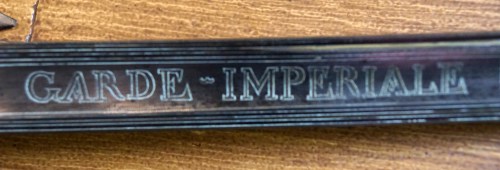
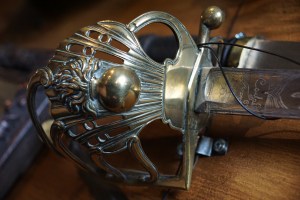
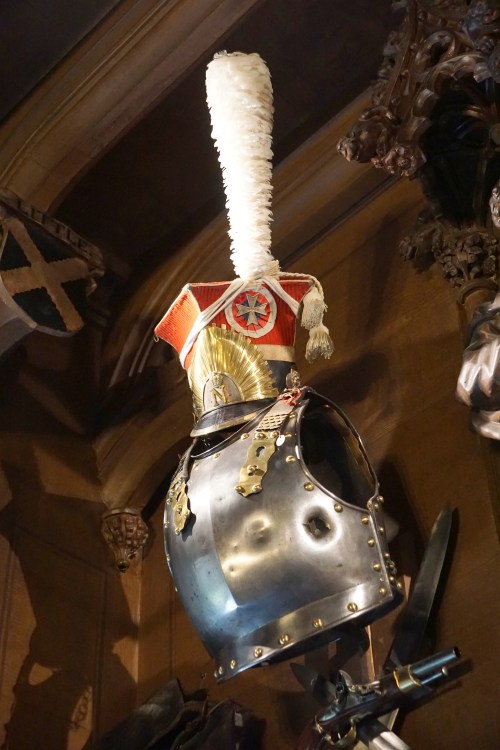
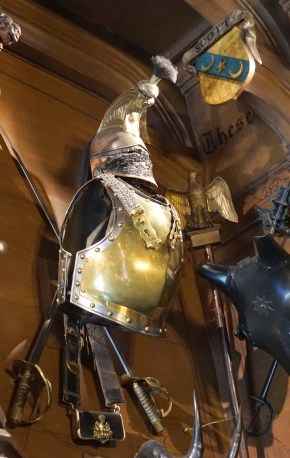
When I recently visited Abbotsford, Scott’s home in the Borders, I discovered that he had taken more than impressions and notes away with him. In my book  To The Field of Waterloo: the First Battlefield Tourists I had written of the insatiable souvenir-hunting of the visitors and I suppose I should not have been surprised to discover that Scott had collected a very superior set of trophies for the vast and eclectic collection that decorates the walls of the house. Photographs of some of them illustrate this post, handsome examples of the arms and armour of Napoleon’s vast army.

Save

Save

4 Comments

Filed under Battle of Waterloo, Literature, Waterloo, Wellington

1814 – the Summer of Celebrations

The summer of 1814 – and London is en fete to celebrate not only the victory over Napoleon but also the anniversary of Hanoverian rule. For three months Londoners had the opportunity to view, and enjoy, some of the most lavish celebrations the capital has ever seen.

Ack transp

On April 20 there was a triumphal procession for Louis XVII from Hyde Park to Grillon’s Hotel in Albemarle Street where he was staying with his entourage. On June 7 the Russian Czar Alexander I, King William III of Prussia, Marshal Blucher, Prince Metternich, the Prince of Liechtenstein, and Prince Leopold arrived in London and on June 11 the Prince Regent entertained all the Allied Leaders at the opera at Covent Garden. On June 16 they were the guests at a dinner held by the merchants and bankers of London in the City and on June 18 the Prince Regent, Marquess of Wellesley, Lord Liverpool, Marshal Blucher, Prince Metternich, Czar Alexander I, and Catherine Grand Duchess of Oldenburg were guests of honour at a dinner given by the Corporation of London.

On June 20, hopefully having had the opportunity for a rest and some digestion, the Prince Regent, the Duke of York, the King of Prussia, the Czar and  Generals Blucher, Lord Beresford and Hill reviewed 12,000 troops in Hyde Park. At 8pm that evening a re-enactment of the battle of Trafalgar was held in the park on the Serpentine with model ships three feet long (one metre) were deployed to recreate the main events of the battle. At the climax the French ships were sunk as the National Anthem was played.

The evening was staged as a popular entertainment and the park was transformed with stalls, arcades, and follies and pavilions. There were refreshments, taverns and fruit stalls and the crowd could listen to military bands as they watched acrobats or enjoyed the swings and roundabouts.

On June 22 the Allied Sovereigns watched a naval review at Portsmouth before leaving for the continent, but in London the celebrations were by no means over.

On June 28 Wellington was formally welcomed at Buckingham House by the Queen, and on July 1 a great ball was held in the Duke’s honour at Burlington House by White’s Club. It cost £10,000 and amongst the 1,700 guests was Jane Austen’s brother Henry. She was thrilled. On July 7 there was a Service of General Thanksgiving for the victory at St Paul’s Cathedral with Wellington carrying the Sword of State alongside the Regent and as a further sign of his pleasure the Regent held a fete in the gardens of Carlton House to honour the Duke on July 21.

Pagoda

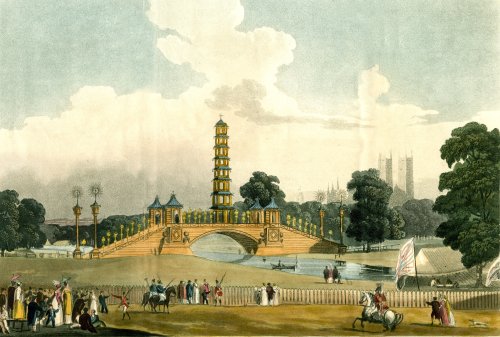
August 1,1814 was the hundredth anniversary of the accession of George I of Hanover to the British throne. The Battle of the Nile was represented by rowing boats on the canal in St James’s Park which was crossed by a new ‘Chinese’ bridge with, in the centre, a seven-storey pagoda. According to Ackermann’s Repository “It appeared a blazing edifice of golden fire, every part being covered in lamps, and glass reflectors at proper intervals relieving the splendour with their silver lustre.” At the height of the fireworks the pagoda caught fire and two men and a number of swans perished, but the crowd thought it was part of the celebrations and cheered wildly.

Meanwhile in Green Park a castle-like structure was built. After firework display that lasted, according to Ackermann’s, “for more than two hours, a discharge of cannon enveloped the whole building in smoke so dense, that no part of it was visible to the innumerable spectators assembled…but when this obstruction cleared away, it burst upon them, metamorphosed into the Temple of Concord, most brilliantly illuminated… and revolving upon its centre.”

Concord

Many shops and businesses also rose to the patriotic occasion and decorated their premises. Ackermann’s Repository at 101, Strand, was decorated by a ‘transparency’ almost 30 feet (10 metres) high and “brilliantly illuminated” from the back “with carbonic gas.”. The lower section shows the seven Christian and Cardinal Virtues with the Royal arms above and the standards of the Allied nations. The upper part is the Temple of Peace with the word REGENT above and all crowned with the Prince of Wales’s feathers. It is shown at the head of this post.

You can  enjoy these two historic parks by taking Walks 4 and 6 in Walking Jane Austen’s London.


Save

4 Comments

Filed under Architecture, Entertainment, London Parks, Prince Regent, Royalty, St James's Park, Wellington