Category Archives: Shopping

Jane Austen by Candlelight – or was it a lamp?

In September 1813 Jane Austen was staying with her brother Henry at his Henrietta Street address in Covent Garden, along with their brother Edward, his daughter Fanny and two of Fanny’s younger sisters. On the 16th Jane wrote to her sister Cassandra, ‘We are now all four of us young Ladies sitting around the Circular Table in the inner room writing our Letters, while the two Brothers are having a comfortable coze in the room adjoining.’1-Barretts bill minor crop
It is a charming picture, but how were the four ladies illuminating their work? Probably not with smelly tallow dip candles, unless they were in an economical mood. Those were made from mutton fat, usually contained bits of meat, smelled strongly and, in homes with any pretence to gentility, were Candle advert cropconfined to the service areas.
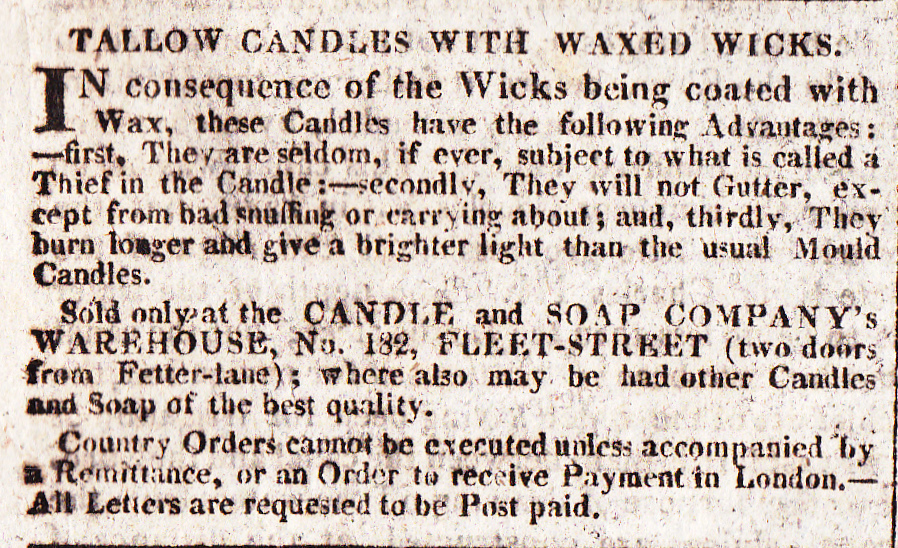
There was an “economy” candle available – tallow with a wick that had been dipped in wax which must have reduced the smell a little and, according to The Candle & Soap Company’s advert of August 1802 shown left, (The Statesman newspaper), would not “Gutter except from bad handling or carrying about.”

However, we know that the Austens bought pure wax candles from Penlington’s, a tallow chandlers at the sign of the Crown and Beehive, Charles   Street (now Wellington Street), a short walk from the Covent Garden piazza and Henrietta Street. It evidently produced superior candles, for the family would order from them by mail: on 1 November 1800 Jane tells Cassandra, who has just passed through London on her way to Kent, that their mother was ‘rather vexed’ because Cassandra did not call at Penlington’s but that she had sent a written order, ‘which does just as well.’

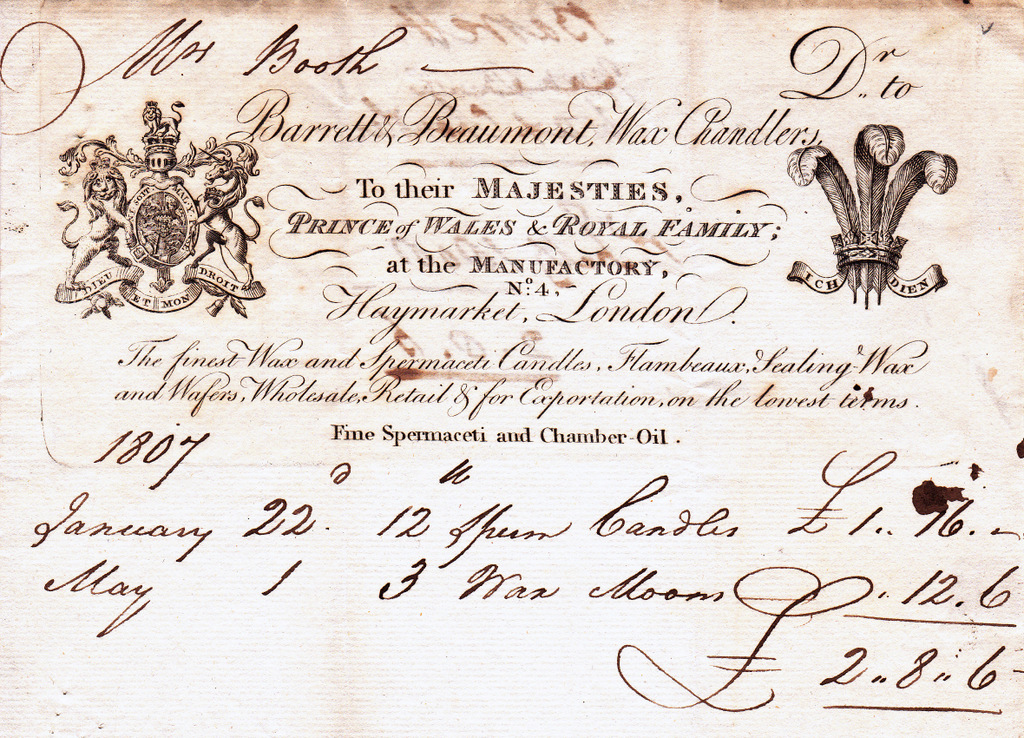
I don’t have a bill from Penlington’s, but the one shown at the top is from the very smart shop, Barrett & Beaumont, Wax Chandlers to Their Majesties – you can see the royal coat of arms to the left and the Prince of Wales’s feathers on the right, denoting the royal warrents.  The bill, for two pounds eight shillings and six pence is for twelve candles – I think it says “sperm” for spermaceti (ie whale oil) and three “Wax Moons”, which are a mystery to me.Candle magnifier
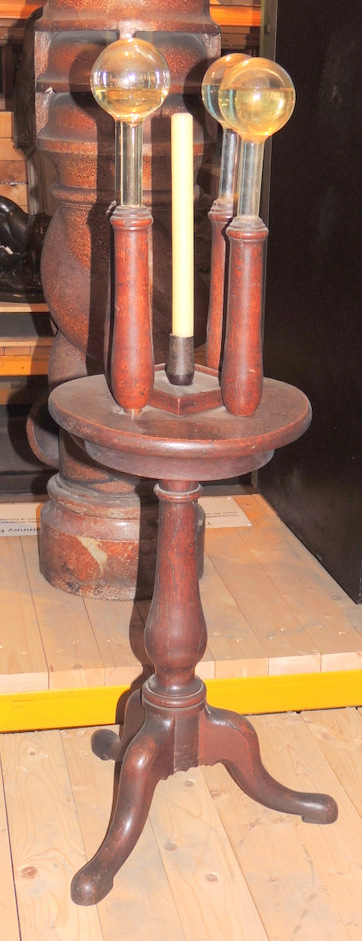
A single candle, or even a branch of candles, does not produce a very bright light, so for detailed work there were methods of focusing and concentrating the light. One method was to place a glass globe filled with water in front of the flame and this photograph (right) shows a device for giving a group of sewers stronger light from just one candle. (Birmingham Museums Reserve Collection).
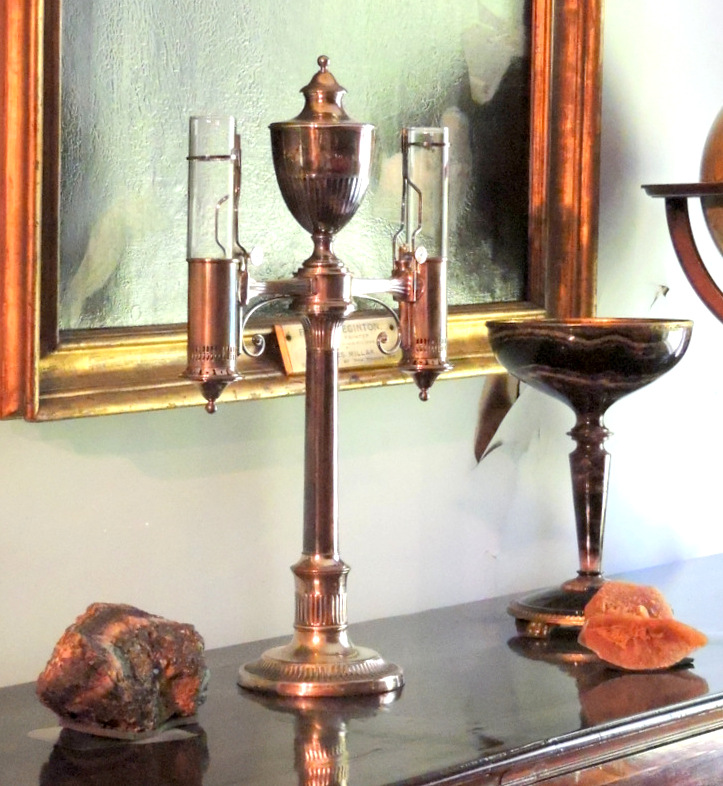
Argaud lampThe first lamp designed on scientific principles was the Argand lamp, patented in 1780. It used a wick drawing on a reservoir of whale (spermaceti) or vegetable oil and they were made in very handsome designs in silver or in Sheffield plate. The photograph (left) is of one at Soho House, Birmingham, the home of Matthew Boulton, the manufacturer. This particular pattern is silver plate, of about 1800.

Soho House also contains another lamp by Matthew Boulton & Plate Company, this time of c.1820 (shown below). It is a neat little bedside lamp made to burn colza (rape seed) oil. With our frequent power cuts out here in the country I rather covet this little lamp.colza lampIf anyone knows what a “wax moon” might be, I’d love to hear from you!
23 Comments

Filed under Shopping, Uncategorized

Miss Austen Buys Fabric

The most frequent item mentioned by Jane Austen when she writes home to Cassandra about her London shopping expeditions is fabric for her own use and for Cassandra and their mother. Ready made gowns were unusual and ladies in modest circumstances, such as the Austens, would buy dress lengths of fabric and either make them up at home or use a local dressmaker.

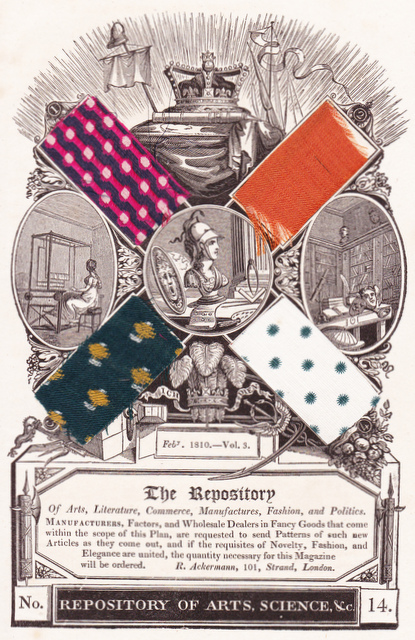
Mostly ladies would browse at the drapers’ shops and make their choices there, but Ackerman’s Repository of Arts, Science etc, was innovative enough to give samples of real fabrics in the magazine and a page for February 1810 is shown here.
1-Ackermann fabrics
Top left: A royal embossed satin: a splendid and elegant article for robes or pelisses. Sold by Harris, Moody & Co., silk-weavers, Pall-Mall.

Top right: A superfine imperial orange bombazeen, particularly calculated for Ladies’ dresses. It is sold, of every colour, by Messrs. Waithman and Everington, No,104, Fleet-street.

Bottom left: An imitative Angola shawl dress of blended green and amber. Sold by Messrs. Brisco & Powley, No.103, New Bond-street, from 38s to 50s per dress.

Bottom right: An India rib permanent green print. A patent has lately been obtained by Hewson, Higgins & Hett, for printing green on cotton goods. Sundry cotton goods for waistcoats are printed exclusively for Kestevens, York-street, Covent-garden.

On 24th May 1813 Jane wrote, “I went the day before (Friday) to Layton’s as I proposed, & got my Mother’s gown, 7 yds at 6/6.” [ie six shillings and six pence a yard]. Layton’s drapery shop, Bedford House, was at 9, Henrietta Street in Covent Garden, right next door to Henry Austen’s bank at number 10. Henry was on the point of moving to live in he apartments over the bank and Jane reports going next door to inspect the work, “which is all dirt & confusion, but in a very promising way…”

She does not say what kind of fabric she had purchased, presumably the ladies had agreed about that in advance, but in mid-September she was staying with Henry at number 10 and reports, “We did go to Layton & Shear’s before Breakfast. Very pretty English poplins at 4 [shillings and] 3 [pence]. Irish ditto at 6 [shillings] – more pretty certainly – beautiful.” Later in the same letter she writes to Cassandra, “…I am going to treat myself with spending [my superfluous wealth myself. I hope at least I shall find some poplin at Layton & Shears that will tempt me to buy it. If I do, it shall be sent to Chawton, as half will be for you … I shall send 20 yards.”

The invaluable English Women’s Clothing in the Nineteenth Century by C.Willet Cunnington describes poplin as being “made of a silk warp and wool or worsted weft, having a fine cord on the surface, and produced in several varieties, brocaded, watered and plain.”

Jane also patronised Christian & Sons at 11, Wigmore Street where she bought dimity (“A stout cotton fabric, plain or twilled, with a raised pattern on one side.”) and Newton’s, just of Leicester Square, for Irish linen.

One of the most up-market fabric shops were Wilding & Kent at Grafton house on the corner of New Bond Street and Grafton Street. On 17 April 1811 Jane and Manon, Eliza Austen’s maidservant, ‘…took our walk to Grafton House, & I have a good deal to say on that subject. I am sorry to tell you that I am getting very extravagant & spending all my Money; & what is worse for you, I have been spending yours too…’ she told Cassandra. It was a very busy shop and in November 1815 Jane complains of ‘the miseries’ of shopping there and most of her references to it mention an early start and long waits to be served – not that this stopped her going there frequently.

One fashionable drapers, Harding, Howell and Co., is not mentioned by Jane, although she must have known it, for it was located in Pall Mall in the seventeenth century red brick Schomberg House which still stands out in this street of stone and stucco.

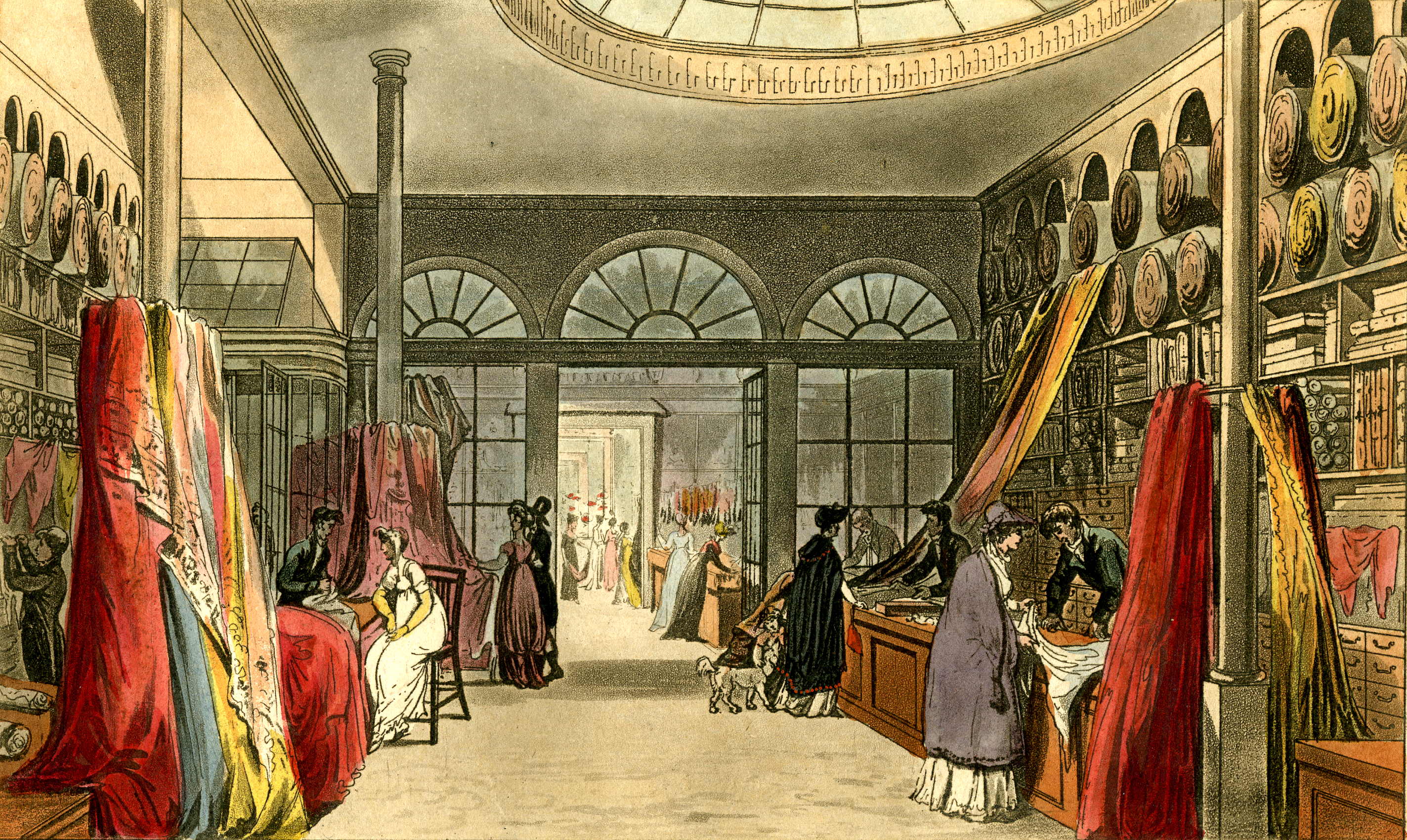
According to Ackermann’s Repository, which is where the illustration below appeared, ‘It is fitted up with great taste, and divided by glazed partitions into four departments.’ These were: furs and fans; ‘haberdashery of every description, siHarding, Howel0001lks, muslins, lace, gloves etc.’; jewellery and ornamental items including perfumery and finally, ‘millinery and dresses; so that there is no article of female attire or decoration, but what may here procured in the first style of elegance and fashion.’

12 Comments

Filed under Fashions, Shopping

Jane Austen Buys a Cap

Image

On March 7th 1814 Jane Austen was staying with her banker brother Henry in Henrietta Street, Covent Garden, and writing to her sister Cassandra. The weather was wintry – “Here’s a day! The Ground covered with snow! What is to become of us? We were to have walked out early to near Shops, & had the Carriage for the more distant.”

In the end she, and her niece Fanny, did go out on foot to Coventry Street to Newton’s the linen drapers and, it seems, wandered a litle futher along into Cranbourn Street to do some window shoping in Cranbourn Alley.  “A great many pretty Caps in the windows of Cranbourn Alley!  I hope when you come, we shall both be tempted. I have been ruining myself in black satin ribbon with a proper perl edge; & now I am trying to draw it up into kind of Roses, instead of putting it in plain double plaits.”

You can just make out Cranbourn Alley in the street view above – the second opening from the left. The Alley is still there today, just a minute’s walk west from Leicester Square tube station, but there is no longer any hope of finding charming headgear – it is just a narrow passage between a money exchange and a fast food shop and the crowds making for Leicester Square pass it without a glance.

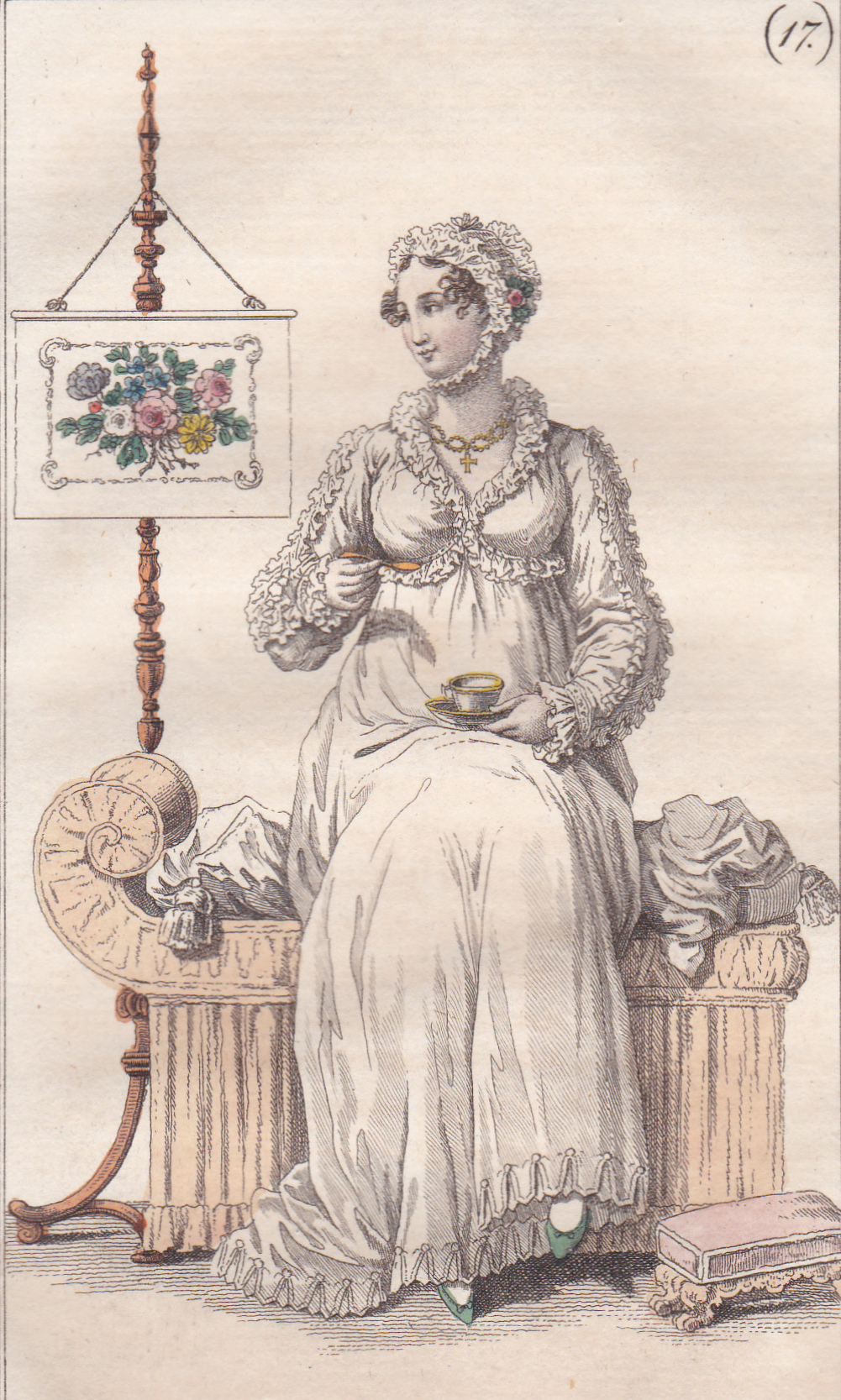
Image The pretty cap in the print is worn with Morning Undress and is from the French Journal des Dames et des Modes for 1814, headed Costume de Londres. Jane describes a new cap in detail in a letter to Cassandra on 16th September 1813. “My Cap is come home & I like it very much, Fanny has one also; hers is white Sarsenet & Lace, of a different shape from mine, more fit for morning, Carriage wear – which is what it is intended for – & is in shape excedingly like our own Sattin & Lace of last winter – shaped round the face exactly like it, with pipes & more fullness, & a round crown inserted behind. My Cap has a peak in front. Large, full Bows of very narrow ribbon (old twopenny) are the thing. One over the right temple perhaps, & another at the left ear.”


8 Comments

Filed under Fashions, Shopping