
 I love ice cream – which is fortunate as my husband, who is the cook in our house, has bought an expensive Italian ice cream maker which means we’ve got to eat lots to make it earn its keep!
But ice cream was a real luxury in the early 19thc. There was no way of making ice artificially – it had to be harvested and stored which was easy enough if you had a large estate with lakes and ponds which would freeze in winter and staff to do the work. Slabs of ice were cut and packed in ice houses where they could be insulated with thick walls and straw to keep the ice right through the year. But how did they manage in towns and cities? Presumably loads of ice were brought in by wagon, melting all the time, and would be stored in insulated rooms.
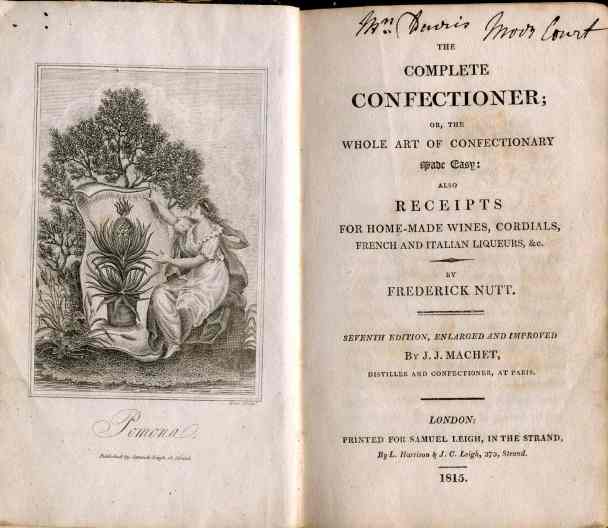
Once you had your ice, making frozen or chilled desserts was still hard work. I own a copy of The Complete Confectioner or, the Whole Art of Confectionary Made Easy by Frederick Nutt (1815). The book has a frontispiece (above) of a lady with a magnificent pineapple – a real status symbol at the time and so expensive that you could hire one as a centrepiece for your smart dinner party and then return it, untouched, the next day.
Mr Nutt has pages of receipts for ice creams and water ices. Here is the one for barberry ice cream, which gives the basic method used for all the others.
“Take a large wooden spoonful of barberry jam, and put it in a bason with one pint of cream; squeeze one lemon in, mix it well; put it into the freezing pot and cover it; put the freezing pot into a pail and some ice all round the pot; throw a great deal of salt on the pot in the pail, turning your pot around for ten minutes; then open your pot and scrape it from the sides, cover it up again and keep turning it for some time, till your cream is like butter, and as thick; put it in your moulds, put them into a pail, and cover it with ice and salt for three quarters of an hour, till you find the water is come to the top of the pail; do not be sparing of salt, for if you do not use enough it will not freeze: dip your mould into water, and turn it out on your plate to send to table.”
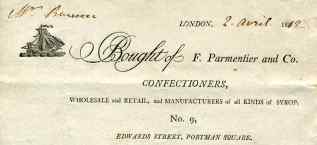
He uses jams and cordials extensively as flavourings for his ices and it was possible to buy syrups ready made. Here is the billhead for F Parmentier & Co. Confectioners of 9, Edwards Street, Portman Square for 1812. The purchaser had bought a bottle of orange syrup for 7 shillings, another of lemon at the same price and rout cake at 4 shillings.
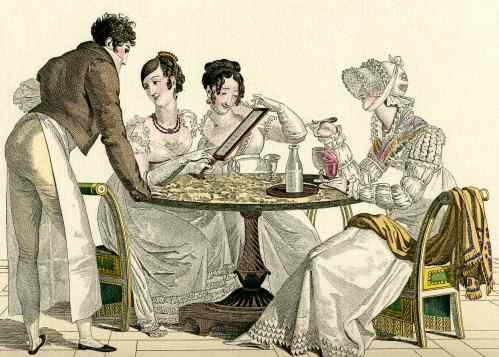
Gunther’s in Berkeley Square was the most famous of the London tea rooms and there you could have ices brought out for the ladies to eat in their carriages under the spreading lime trees that shaded the square.
The illustration of the three young women is French, from Le Bon Genre series of the early 1820s. It is called L’Embarras du Choix, although the lady on the left seems more interested in staring at the handsome waiter than choosing her ice cream from the menu!
 The image above is from La Belle Assemblée for October 1809 and shows ‘Sea Coast Promenade Fashion.’
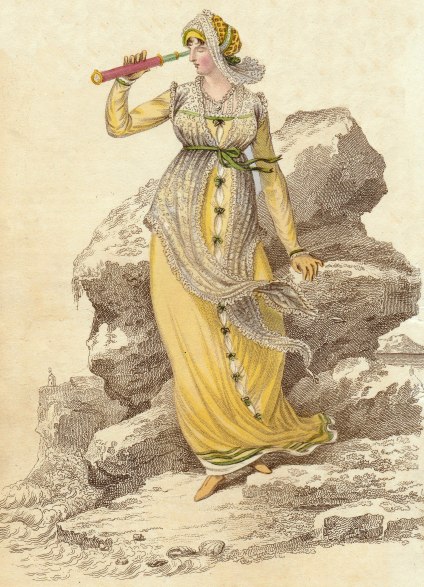
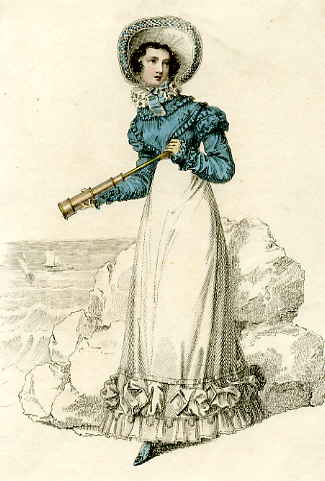 Somewhat later – I do not have a date for this, but it is c1820 – is this ‘Walking Dress’ from Ackermann’s Repository. I can’t help feeling that this lady is looking positively shifty as she readies her telescope.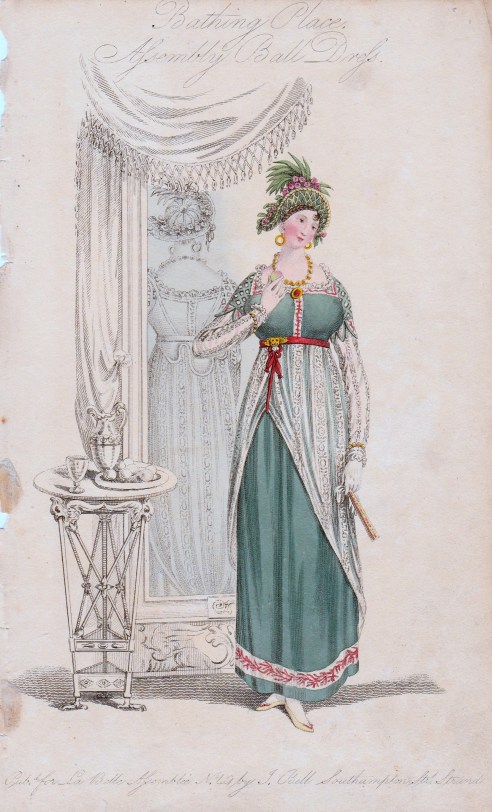

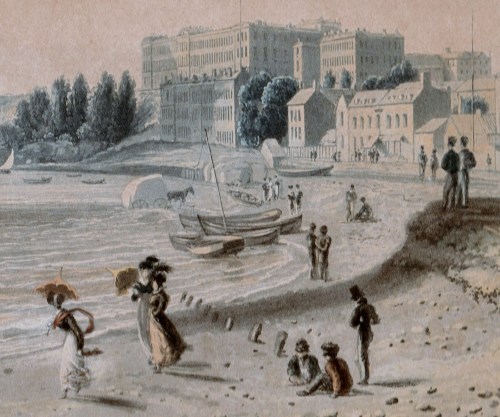
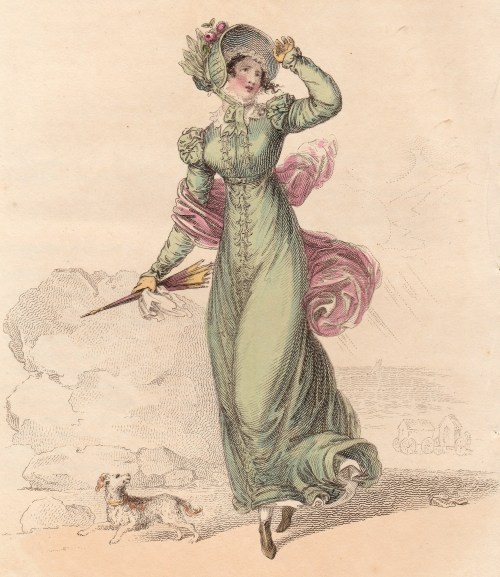
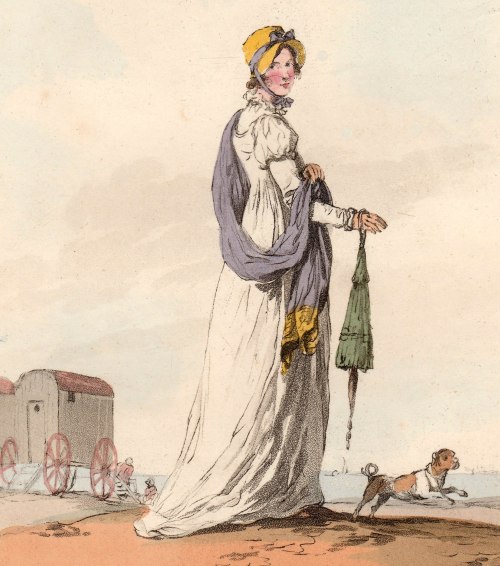
 What did one wear to get to and from those bathing machines? The ever-inventive Mrs Bell produced a magnificent ‘Sea Side Bathing Dress’ for the August 1815 edition of La Belle Assemblée. This is not the costume for entering the sea but for wearing to get there, and it is lavishly trimmed in drooping green, presumably to imitate seaweed. Note the bag she is carrying. This contains Mrs Bell’s ‘Bathing Preserver’ which she produced in 1814. You can see it in its bag again below (La Belle Assemblée September 1814). Here the lady is wearing ‘Sea Side Morning Dress’ with ‘Bathing Preserver. Invented & to be had exclusively of Mrs Bell, No.26 Charlotte Street, Bedford Square.’ The Preserver is in the bag lying beside her chair.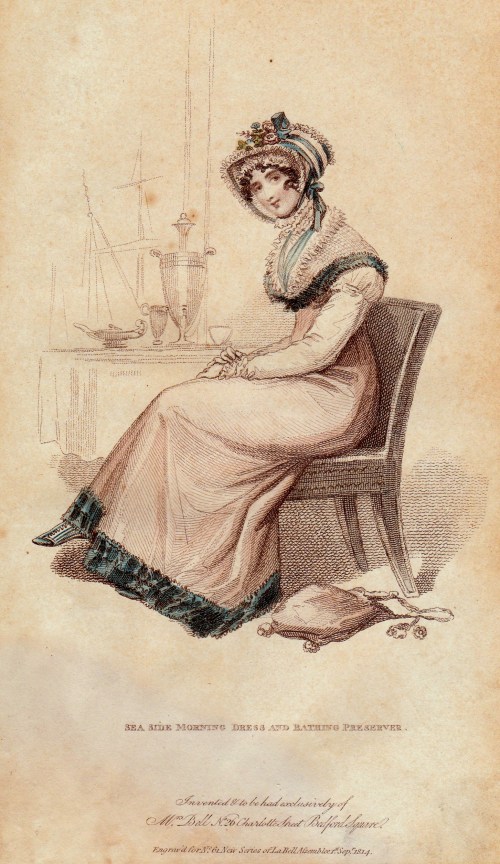
 Jane Austen's London