Category Archives: Gentlemen

Would Darcy Have Ridden a Bicycle?

Image

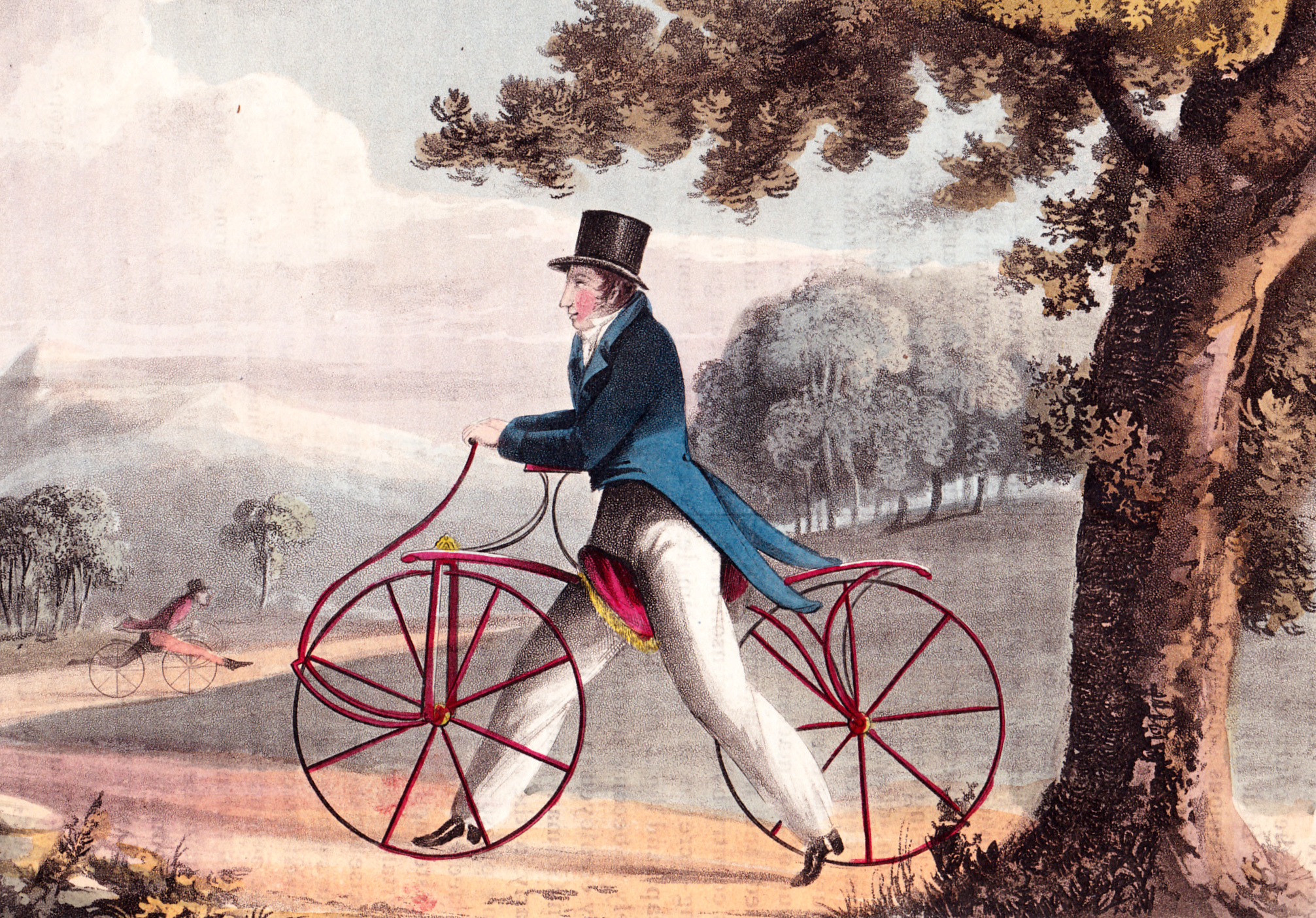
The combination of this fantastic print and the discussion in the UK press recently about encouraging cycling and making it safer prompted this post. Unfortunately the “Pedestrian Hobby Horse” arrived in England soon after Jane Austen’s death – I’ve love to know if she’d have ever given one of her characters a ride. I can imagine Lydia Bennett, skirts flying, shrieking with laughter!

The print, from Ackermann’s Repository (1819) is entitled Pedestrian Hobbyhorse and the text says it was invented by Baron von Drais, “a gentleman at the court of the Grand Duke of Baden.” The baron apparently invented a horseless carriage powered by two servants but it proved heavy and expensive so was abandoned, much to the relief of the unfortunate servants, I imagine!

 The baron went on to invent the hobbyhorse which he used for getting around large parks and gardens and it was introduced to London by Denis Johnson, a coach maker of 75, Long Acre. The Repository considered it simple, cheap and useful, especially in the country and in gentlemen’s pleasure grounds and parks. Medical men in France were already recommending it as a form of exercise.

 “The swiftness with which a person, well practised, can travel, is almost beyond belief: eight, nine, and even ten miles may be passed over within the hour, on good and level ground…the principle of this invention is taken from the art of skating.”
 Image

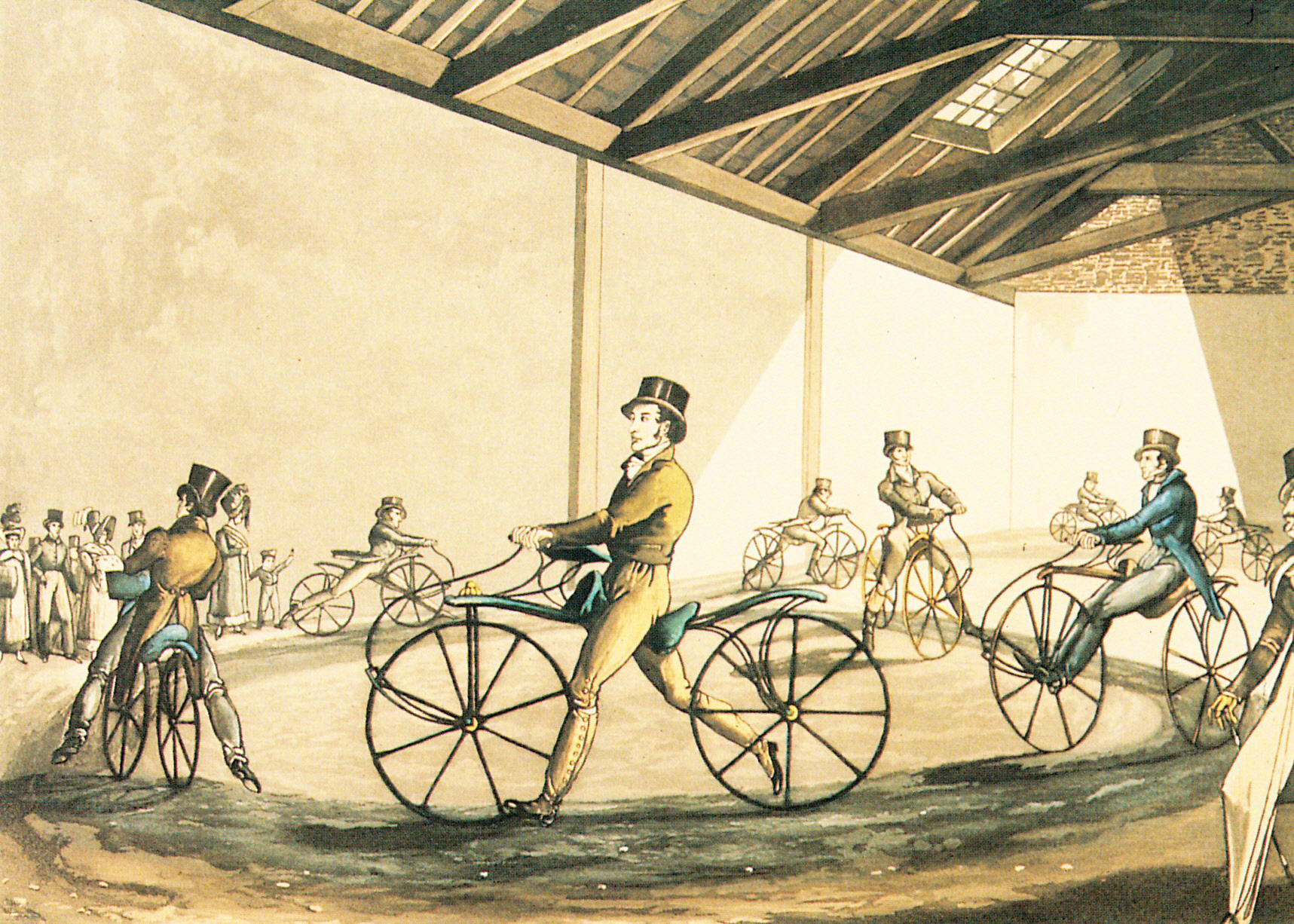
The rider sat astride a padded seat and rested his forearms on a padded board while steering with a small handle right at the front. Although it appears incredibly simple to us, used to bicycles and motorbikes, it was apparently necessary to take lessons and the  print above shows one of Mr Johnson’s Hobbyhorse Riding Schools. He opened one at 377, Strand and another at 40, Brewer Street, Golden Square in 1819. As you can see from the dress of the riders, this was a sport for well-to-do gentlemen. A hobbyhorse cost between £8-£10.

In Georgette Heyer’s novel Frederica the engaging youth Jessamy Merriville who cannot afford to hire a horse tries out the cheaper option of  a hobbyhorse, which Heyer calls a Pedestrian Curricle.

After a few lessons he hires one and,“Boy enough to want to startle his family with his unsuspected prowess, Jessamy had said nothing to them about his new hobby. Once he had perfected his balance, and could feel himself to be master of the Pedestrian Curricle, he meant to ride up to the door, and call his sisters out to watch his skill…he could not resist the temptation to coast down the long slope of Piccadilly, both feet daringly lifted from the flagway. This feat attracted a great deal of attention, some of it admiring some of it scandalised….”

Poor Jessamy finds himself in the midst of a dog fight and “…trying to control his balance, charged into a man mending chairs, lost control of his machine, and was flung on to the cobbled highway almost under the hooves of a high-stepping pair harnessed to a landaulet.”

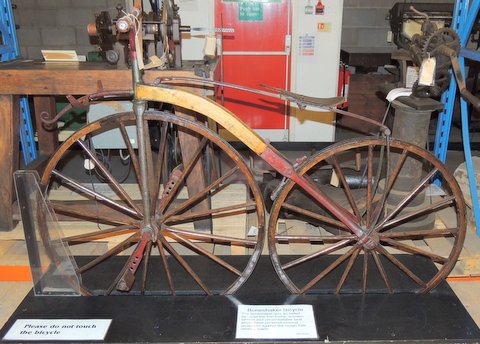
The hobbyhorse proved impractical for any surface other than very well-maintained paths and so dropped out of fashion by the early 1820s. Two-wheeled progression lapsed until the invention of a device in 1865 called a velocipde which had pedals which worked directly on the front wheel. It became known as the Boneshaker and was almost entirely made of wood, with metal tyres and no springs – hence the name.
 Image

This photograph shows one in the Birmingham Museum’s Store.

Which of Jane Austen’s characters would you like to see on a Pedestrian Hobbyhorse? Would it be below Mr Darcy’s dignity? Perhaps Mr Collins would think it an improving way to take exercise…
10 Comments

August 15, 2013 · 1:41 pm

Henry at Whites! Oh, what a Henry!

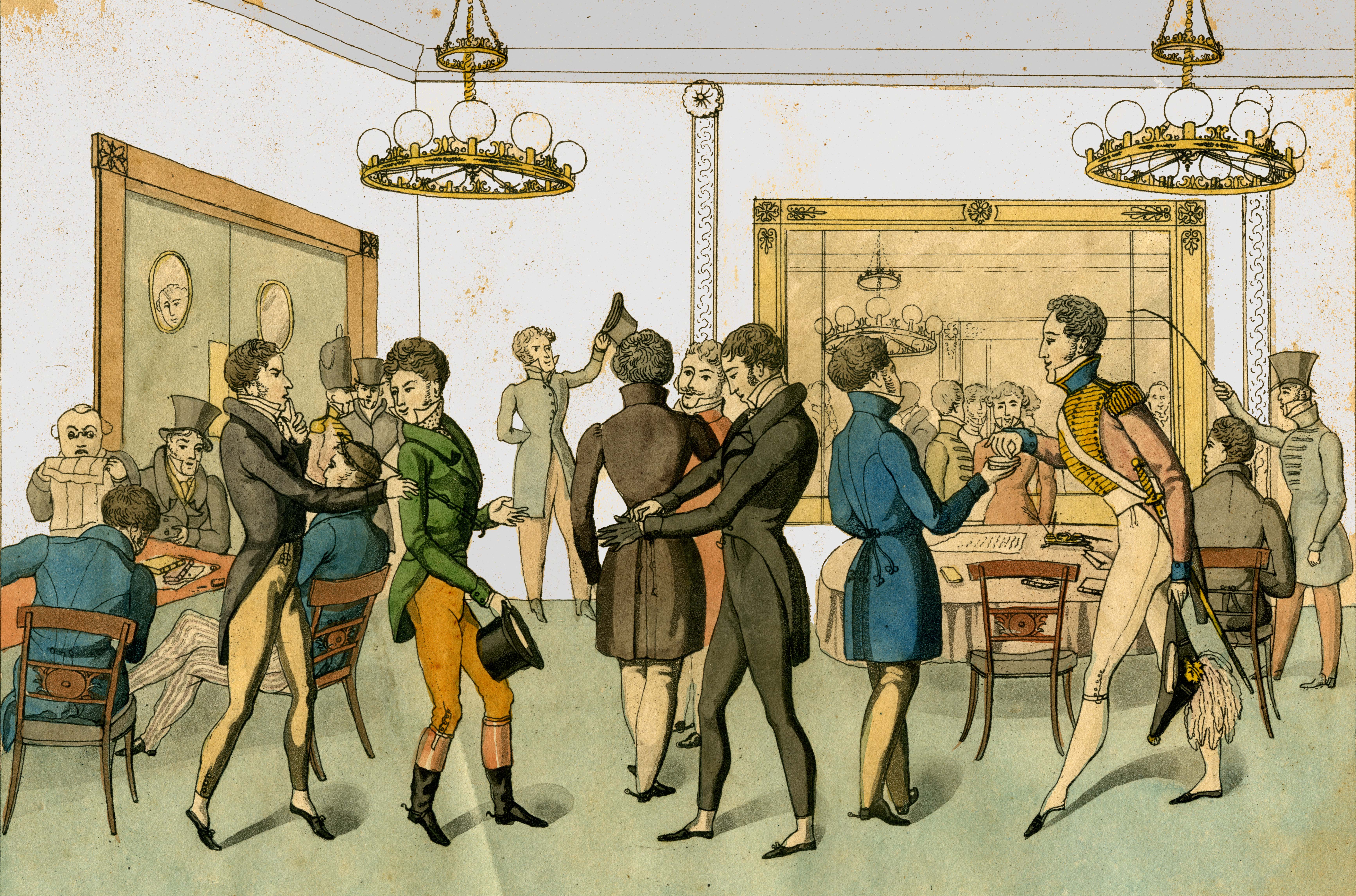
Club interior for JASt James’s Street was the heart of fashionable masculine London during the late Georgian and Regency period. Here gentlemen had their lodgings, kept their mistresses, bought their clothes and gambled in hells and clubs. It was not an exclusively male preserve, for modistes had their shops there and ladies could even buy ready-made corsets from Mrs Clark, whose shop was at no.56, and who advertised in 1807 ‘…a large assortment of corsets of every size, and superior make, so that ladies may immediately suit themselves without the inconvenience of being measured.’

SONY DSC However, it for the clubs that St James’s Street is famous and you can still view the exterior of many of them – getting inside is another matter! Membership has always been exclusive: who you knew mattered, breeding mattered – but money mattered less. Politics might influence which clubs a gentleman felt most at home in, although White’s, the most exclusive of them all, was non-political.

Boodles attracted the country set and hunting squires, the Four in Hand, sporting gentlemen. The Travellers’ Club was favoured by diplomats, Watier’s, in Piccadilly, by lovers of fine food and the Roxburghe was the haunt of bibliophiles. If you wanted high-stakes gaming, then Brookes’s and, after 1827, Crockford’s were the clubs for you.

Today, if you walk down St James’s Street from the top of the hill at Piccadilly you almost immediately come to Crockfords on your right and White’s on your left. White’s possessed the famous Beau (or Bow) Window where the elite would sit to view, and pass judgment on, the passing scene. It still has a bow, but, given that there have been some changes to the exterior during the 19th century, it may not be the famous one.
Henry Austen, Jane’s banker brother,  had some very respectable connections, but he was not a club man. However, he must have had connection with those who were. In 1814, after the first defeat of Napoleon, threw a great ball that cost £10,000. Guests included King George III, the Prince Regent, the Emperor of Russia – and Henry Austen. ‘Henry at Whites! Oh! What a Henry.’ Jane could hardly contain herself at the news.

A little further down on the same side of the road is Boodles club. It moved here to no.28 in 1783 to premises originally occupied by the Savoir Vivre, a notorious hell.

 DSCN0058

To reach Brooks’s, you need to cross the road. Do take advantage of one of the traffic islands in this busy, very wide, street – they were originally introduced in the early nineteenth century to make life safer for the slightly inebriated clubmen making their way from one establishment to another. Brook’s is on the corner of Park Place and was one of Byron’s clubs. A stronghold of the Whigs, it moved here in 1778. this is the one London club I have been inside and the Great Subscription Room, illustrated here, looks just as it did then (although there were no Regency bucks engaged in gambling, much to my disappointment!).

In one corner of the Great Subscription Room a tense game is underway with a large pot of winnings in the centreJust a little further down was Arthur’s (not a great success) and the Cocoa Tree coffee house. The Cocoa Tree was not a formal club, but provided another sanctuary for like-minded gentlemen, such as Byron, who frequently visited.

Finally, to see the location of one of the gaming ‘hells’ where almost anyone who had the money to bet was admitted, cross the road again and walk down to the narrow entrance just before Berry Bros. & Rudd. This leads to Pickering Place, now a charming little courtyard, but once the home of some notorious hells, the reputed location of the last duel in London and, later in the 19th century, the home of the Texas legation.

Top: a club interior. The young man in breeches and carrying a riding whip and hat is being reproved for being improperly dressed.

Second: the bow window outside White’s Club (looking up towards Piccadilly)

Third: The handsome frontage of Boodles’s Club

Bottom: one corner of the Great Subscription Room at Brooks’s Club (1808). A high-stakes game is underway with a large pot of money to be won in the hollowed-out table centre.

4 Comments

Filed under Buildings, Gentlemen