
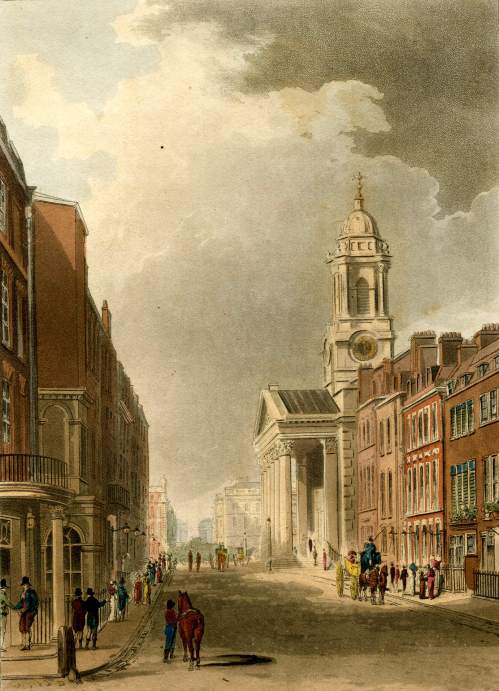
A marriage between the aristocratic hero and his true love in St George’s Hanover Square forms the climax of many a romantic historical novel, and I’ve used that scene myself. The church, completed in 1724, was built to serve the new and expanding residential area between Piccadilly and Tyburn or Oxford Road (now Oxford Street). These handsome streets and squares were a magnet for the upper classes in Society and handsome St George’s was the perfect place to be married or to have your children baptised. The 5th Earl of Jersey, husband of Lady Jersey one of the famous Patronesses of Almack’s, was a churchwarden here, although their marriage was a private one by special licence in their Berkeley Square house.
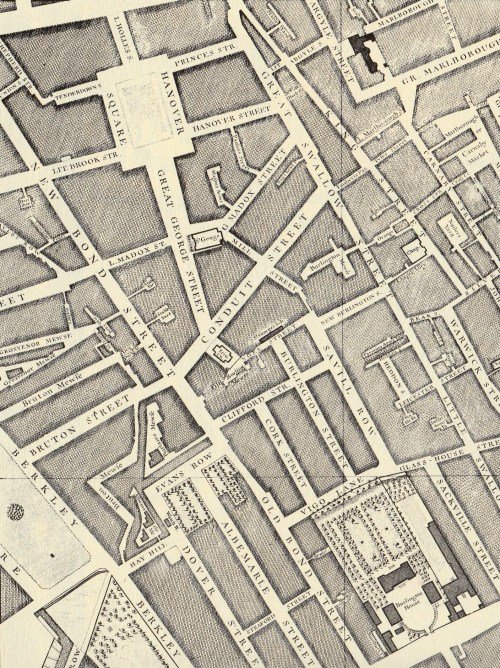
In a detail from John Roque’s map of 1747 (below) the new church sits with Burlington House to the South and Berkley (as it was then spelled) Square to the South West.
True, it is not in Hanover Square at all, but on the East side of George Street and its position gives the West front a cramped outlook, almost but not quite, looking down Maddox Street. The view at the top of the post (1812, from Ackermann’s Repository) is probably the best angle, then and now.
It is sometimes easy to forget that the occupants of these fashionable squares, great mansions and elegant terraces were serviced by a multitude of tradesmen, servants and labourers, all of whom ‘lived in’ with their employers or set up shop close by or who lodged within easy walking distance of their employment. St George’s was their church too and in between the glamorous christenings and marriages the humbler parishioners were in and out, tying the knot, naming their babies and being buried.
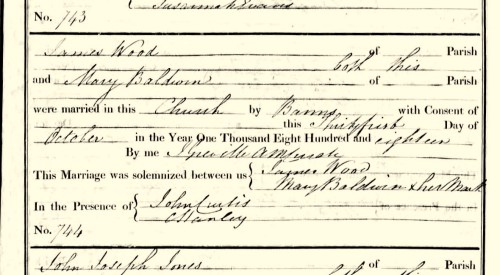
This was brought home to me by discovering my great-great-great grandfather James Wood marrying Mary Baldwin at St George’s. This was a surprise – James was a humble labourer turned chair mender and caner from Berkhamstead in Hertfordshire. What was he doing in London, let alone getting married in Mayfair? Then I discovered that he was a ‘servant’ (no idea what kind) of the Earl of Bridgewater whose country house was at Ashridge, close to Berkhamstead. The Earl had a London home in Albemarle Street (bottom, centre on the map), so presumably James Wood was there serving his employer in some capacity.
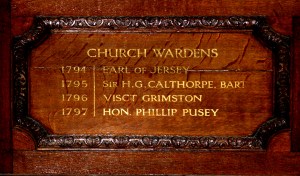
After that discovery ancestors marrying or having children baptised at St George’s in the 18th and early 19th century started appearing in large numbers – all from the concentration of piano makers in Marylebone, just North of Oxford Street. Possibly St George’s was seen as an aspirational place to be married because the Marylebone piano key makers, piano string makers, piano striker coverers and occasional dolls’ eyes makers did have other options in the various chapels of ease that had been built to help ease the pressure on the churches in these new and crowded districts.
One of those chapels can be seen on the map on Conduit Street facing up George Street. This was Trinity Chapel and had one of the strangest histories of any London place of worship. A Chapel of Ease was a chapel either built before a parish church was in existence or added later to take the strain in a very large or crowded parish. This one started life as a moveable Roman Catholic chapel on wheels used by King James II. After he fled the country in 1688 to be replaced by William and Mary, the chapel was abandoned on Hounslow Heath where James had abdicated. Probably he took mass there in one of his last acts as king. It was transported to Conduit Street and turned into an Anglican Chapel of Ease on the initiative of Archbishop Tenison. Later it was acquired by bookseller and High Bailiff of Westminster James Robson, who had it demolished and rebuilt in brick, but because it was on leasehold land it was not eligible to be a parish church, hence the need for St George’s to be built. Unfortunately no images of the remarkable ‘traveling tabernacle’ seem to have survived and Trinity Chapel was demolished in 1875, the owner of the ground having decided that secular buildings would be more profitable.

 Jane Austen's London
I’m sure I have a completely wrong idea of what a mobile chapel might look like, but, very irreverently, in my mind it’s not unlike a gypsy caravan.
I know – the mind boggles. And yet it must have been substantial enough to make it worthwhile transporting it and reconsecrating it when you’d think it would be easier and cheaper to knock up a simple wooden structure from scratch
It doesn’t sound terribly regal, either.
I’ve got a picture of a large jewel casket on wheels – lots of bling and gilding and paint and hangings
That would work.
A mobile chapel… the modern equivalent would probably all be packed into one of those canvas covered camping trailers you see being pulled behind cars, then with one press of a button it all whooshes into life.
I am doing our family tree, my great, Great grandparents are both on census 1891 as being resident at St George’s, Hanover square. Thomas Barnes Coachman and Mary Ann Barnes Domestic.
From this point I can’t find anymore information, or how I find out more.
Hoping someone can help
Michelle
I suspect he is might be the Tom Barnes who was baptised in Syston 19 May 1867, son of Eliza Barnes, but no father given. unfortunately it doesn’t give date of birth. From the registration of William Morris Barnes, born 1889, Mary Ann’s maiden name was Jones, so they are the couple married at St James, Clapham 8 June 1889. He names his father as George Barnes, labourer He gives his age as 25. She is the daughter of Morris Jones, labourer and was 24. I can find them in the 1901 census with 3 more children in Barkstone, Lincs, although he gives his birthplace as Ponton, which is a few miles S of Syston.
Hope that helps (sources Ancestry & Find my Past)
Yes thank u
I have these details, it was more about their time at St George’s, who did they work for?
They were resident at 13 Halkin mews for part of their time there too.
Thank you for taking your time to look
Michelle
My Ancesters were married there says from the Parish living in Thomas Street bu I can’t find any street in this area. Can anyone help. I’m tracing James Jackson Richards. Trying to find his father also named James who was in Iron Merchant from Old Swinford. Thanks for any help
What date was the marriage, Karen?
It wwas 1847 Louise. James Jackson Richards and Margaret Pile.
I’ve had a look at both Regency and Victorian London street maps and can find a lot of Thomas Streets but none in the St George’s parish. Sorry!
Thank you Louise for looking x