
It is raining today, the second of the Gatwick family’s stay in Weymouth, so Lady Ditherstone abandons her father in law and husband to their news sheets, deals firmly with her daughter Emily’s pleas that taking to the ocean in the rain can hardly make you any wetter than you will be already, and carries off her mother in law the Countess of Wittering, Emily and young Arthur to visit the subscription library.
‘You have researched the available libraries I trust, Mr Porrett?’ She is inclined to rather like the Earl’s secretary, such a thoroughly nice, intelligent young man and really, once he takes off those wire-rimmed spectacles, quite good-looking. Intelligent, good-looking men are in short supply in the Gatwick household, although young Arthur certainly has a keen interest in natural philosophy.
‘Certainly, Lady Ditherstone. There are several, but most are not of a standard that would suit you, I fear. However there is one excellent one. As The Guide to All the Watering and Sea-Bathing Places remarks, those who frequent a good circulating library rather than a ballroom “frequently enjoy the most rational and the most permanent pleasure.” ‘ He regrets the quote as soon as he makes it, for Miss Emily fixes him with a look that is anything but kindly. So far as she is concerned nothing, but nothing, can exceed the pleasures of the ballroom.
‘Mr Porrett can come with us and carry our books as he is so fond of libraries,’ she says pertly. ‘And the umbrellas.’
Porrett, no fool, even if he is blinded by hopeless love, enlists the umbrella-wielding support of two footmen leaving himself to shelter Miss Emily. He employs the walk to the library with regaining her good graces. ‘They have all the latest fashion journals,’ he assures her. ‘And the latest novels.’ From ahead he can hear young Arthur stating that he needs a book on rocks and something on seaweed as he intends to collect both. Porrett is not certain, but he thinks the Viscountess gives the slightest, most well-bred, shudder. ‘And there is a section selling toys (he means novelties and small frivolities for adults, of course) – all the finest fans and reticules and so forth and souvenirs.’
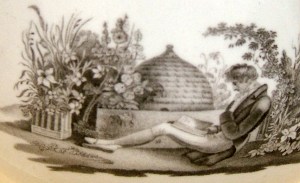 Emily gives him a beaming smile, much restored by thoughts of shopping, as they reach the circulating library. Porrett, having established that the monthly subscription is eight shillings, deals with the business side, taking out a subscription for both senior ladies. He also subscribes for himself, for he has a secret penchant for poetry and intends to take a slim volume off to the garden where he can brood on his heartache in peace. (Above, the artist of a Regency ‘bat print’ bowl has caught Porrett immersed in his poetry next to a beehive.)
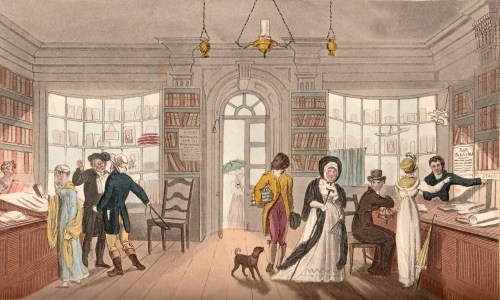
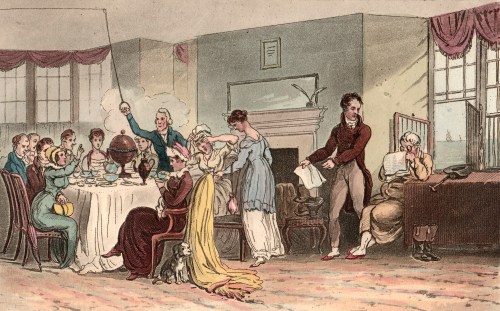
The library they find themselves in very like the one shown at the top of the post (Illustration of 1813 by Rowlandson). Note the shelf of New Arrivals on the right and the two gentlemen in energetic dispute over a political pamphlet on the left. A horn sprouting writing quills hangs in the right-hand window and a poster advertises a new book on Westminster and Its Monuments. The younger ladies shown are all in the height of fashion whereas the older lady with her little dog, long stick and black footman in attendance wisely chooses rather wider skirts and a lower waistline. Note the parasol propped up against the counter – it has the handle at what, today, is the wrong end. This persisted until about 1815 when the point where a parasol or umbrella was held when not in use shifted ends.
This evening the family attends the Assembly Rooms for an evening of dancing and cards. Porrett is thrilled to have been invited to accompany them, but somehow this afternoon, he is going to have to purchase a new pair of black silk stockings. Dare he risk ones with a stripe? What are the shops likely to be like? Find out more in The Georgian Seaside: the English resorts before the railways came.
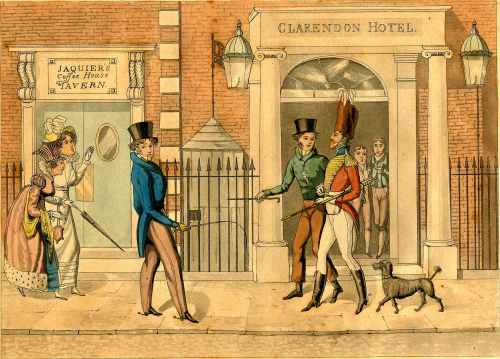
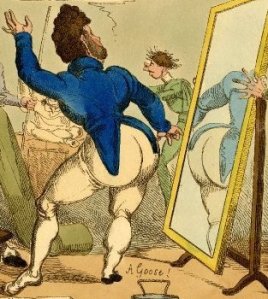 Finally, and most regally, there is The Cut Visible, the cut so blunt and obvious that no-one could mistake it. The Prince Regent’s version of this is known as Rumping. If he wishes to indicate that some former acquaintance is now persona non grata then Prinny simply turns his back on them at the last moment as they approach him. The unfortunate cuttee is then presented with a fine view of the expansive royal backside. (A fine view of the Royal Rump can be seen in this detail from a Cruickshank cartoon of 1819)
 ‘I would be honoured, my lady. And, as it is such a pleasant day, perhaps you would care for a stroll along the main shopping streets?’ asks Porrett, in a seventh heaven. ‘I believe that Master Arthur has forgotten his hammer for extracting rock samples, so that could be purchased.’
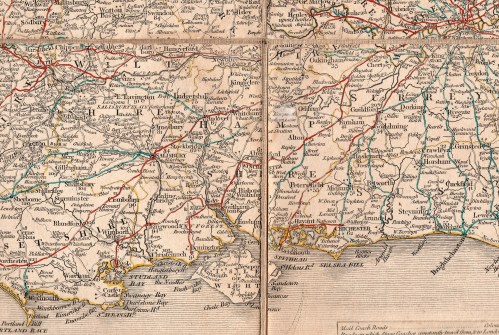
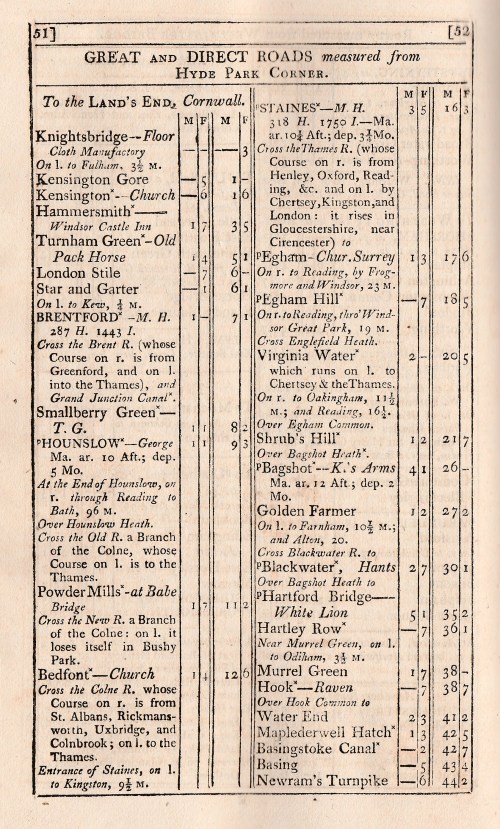
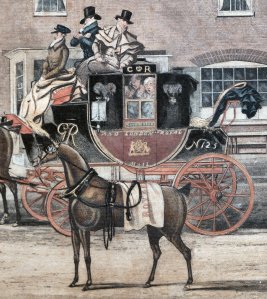
 The first footman, two more footmen, two maids (more of those can be hired locally along with assorted kitchen skivvies) and Gaston the chef, left three days before to set up the house on the Esplanade and hire extra staff and furnishings required. That involved two lumbering old coaches plus a baggage coach.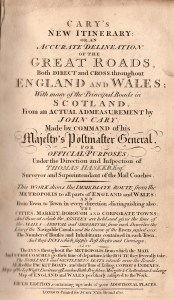


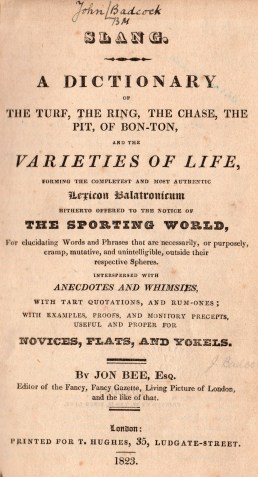
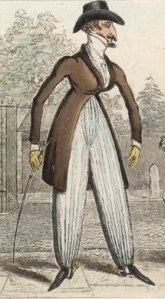 An invention of 1816, and applied to persons whose extravagant dress called forth the sneers of the vulgar; they were mostly young men who had this designation, and they were charged with wearing stays – a mistake easily fallen into, their wide web-belts having that appearance. Men of fashion became dandy soon after; having imported a good deal of French manner in their gait, lispings, wrinkled foreheads, killing king’s English, wearing immense pleated pantaloons, the coat cut away, small waistcoat, with cravat and chitterlings* immense: Hat small; hair frizzled and protruding. If one fell down he could not rise without assistance. Yet they assumed to be a little au militaire, and some wore mustachios. Lord Petersham was at the head of this sect of mannerists.
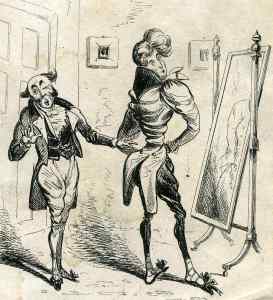 Kid, Kiddy and Kidling implies youth; but an old evergreen chap may be dressed kiddily, i.e. knowingly, with his hat on one side, shirt-collar up on high, coat cut away in the skirts, or outside breast-pockets, a yellow, bird’s-eye-blue , or Belcher fogle*, circling his squeeze**, and a chitterling shirt*** of great magnitude protruding on the sight, and wagging as its wearer walks. These compounded compose the kiddy; and if father and son come it in the same style, the latter is a kidling.
 Jane Austen's London